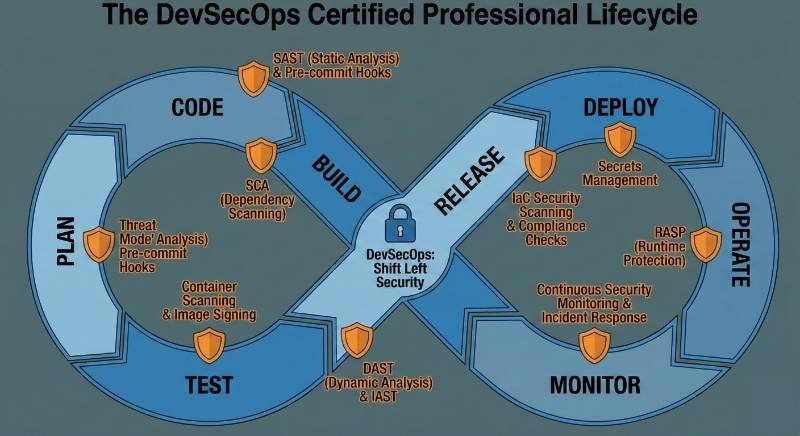
In the current landscape of software engineering, speed is nothing without security, and the DevSecOps Certified Professional Online Training is the key to mastering this balance. Gone are the days when security was a final hurdle; today, it must be baked into every step of the Software Development Life Cycle (SDLC) through a “shift left” methodology. As a mentor watching this industry evolve for two decades, I see a distinct gap where many engineers know CI/CD but lack the skills to secure that chain properly. This guide focuses on the DevSecOps Certified Professional Online Training program, designed to take working engineers and managers and turn them into practitioners who can architect, implement, and manage secure DevOps pipelines, moving you beyond just “doing DevOps” to leading secure infrastructure initiatives.
Why DevSecOps is the New Standard
Before diving into the certification, you need to understand the “why.” Traditional security practices were designed for waterfall development. They are too slow for modern agile and DevOps velocity. When security is a gatekeeper at the end of the process, it becomes the enemy of speed. DevSecOps changes the culture. It makes security everyone’s responsibility. It automates security checks within the CI/CD pipeline. This means you find vulnerabilities hours after code is written, not months later. Companies globally are desperately looking for professionals who understand this cultural and technical shift. They need engineers who don’t just use tools, but understand how to weave security into the fabric of development.
Deep Dive: DevSecOps Certified Professional Online Training
This section covers everything you need to know about the core certification we are discussing.
What it is
The DevSecOps Certified Professional Online Training is a comprehensive program designed to validate your ability to integrate security practices seamlessly into DevOps workflows. It moves beyond theory into the practical application of security tools in CI/CD, containerization, and cloud environments.
Who should take it
This is not usually an entry-level course. It is best suited for:
- Working DevOps Engineers looking to specialize in security.
- Software Engineers who want to own the full lifecycle of their code.
- Security professionals wanting to understand modern development pipelines.
- Technical leads and managers responsible for secure delivery.
Skills you’ll gain
- Implementing “Shift Left” security methodologies.
- Static Application Security Testing (SAST) integration.
- Dynamic Application Security Testing (DAST) automation.
- Container Security (Docker and Kubernetes vulnerability scanning).
- Infrastructure as Code (IaC) scanning and security.
- Managing secrets in CI/CD pipelines safely.
- Cloud security posture management within DevOps protocols.
Real-world projects you should be able to do after it
Upon completion, you should be comfortable executing projects like:
- Building a fully automated CI/CD pipeline using Jenkins or GitLab CI that includes automated SAST and DAST stages, blocking builds if high-severity vulnerabilities are found.
- Implementing automated image scanning for a Kubernetes cluster to prevent vulnerable Docker images from being deployed to production.
- Auditing and securing Terraform or Ansible scripts using automated IaC security tools before provisioning cloud infrastructure.
Preparation Plan
Depending on your current experience level, here are three ways to tackle this DevSecOps Certified Professional Online Training:
The 7–14 Day “Intensive” Plan (For experienced DevOps folks)
- Focus: Gap analysis. Skim areas you know (like basic CI/CD) and deep dive into the security tooling integrations.
- Daily: dedicated 3–4 hours to hands-on labs.
The 30-Day “Working Professional” Plan (Recommended)
- Focus: Steady progression. Week 1: Concepts and Culture. Week 2: SAST/DAST integration. Week 3: Container & Cloud Security. Week 4: Final projects and review.
- Daily: 1–2 hours of study after work or early morning.
The 60-Day “Thorough” Plan (For those newer to DevOps)
- Focus: Mastering the basics first. Ensure you fully grasp standard DevOps tools before trying to secure them. Spend extra time on the foundational labs.
- Schedule: 3–4 sessions per week, 2 hours each.
Common mistakes students make
- Ignoring the culture: Focusing 100% on tools and 0% on the cultural shift required to make DevSecOps work in a real company.
- Skipping labs: Watching videos without getting your hands dirty on the command line. You cannot learn DevSecOps just by reading.
- Over-tooling: Trying to learn every single security tool available instead of mastering the concepts using a few core tools.
Best next certification after this
After solidifying your DevSecOps foundations, the best logical step is often a deep dive into Kubernetes security, such as the Certified Kubernetes Security Specialist (CKS), or a cloud-specific security specialization (AWS/Azure Security).
Master Certification Roadmap
To guide your career, it helps to see the bigger picture. Below is a structured view of how different certifications fit together across various modern IT domains.
| Track | Certification Level | Certification Name / Focus | Who it’s for | Skills Covered | Recommended Order |
| DevSecOps | Professional | DevSecOps Certified Professional Online Training (DSOCP) | DevOps Engineers, Security Admins, Developers | SAST, DAST, Container Security, Compliance as Code, Secure CI/CD | Mid-Career |
| DevOps | Foundation | DevOps Certified Practitioner | Beginners, Freshers, Ops Junior staff | Linux basics, Git, Basic Jenkins, Docker fundamentals | First Step |
| DevOps | Professional | DevOps Certified Professional | Working Engineers, Developers | Advanced CI/CD, Kubernetes orchestration, Ansible configuration | Second Step |
| SRE | Professional | Site Reliability Engineering (SRE) Professional | Ops Engineers, Sysadmins, Senior Devs | SLI/SLO/SLA, Observability, Incident Response, Chaos Engineering | Mid-Career |
| Cloud | Professional | Certified Cloud & DevOps Architect (AWS/Azure/GCP) | Senior Engineers, Architects | Cloud Design Patterns, HA/DR strategies, Cost optimization | Senior Level |
| DataOps | Professional | DataOps Certified Professional | Data Engineers, DBAs | Data pipelines, Data quality automation, Data governance | Mid-Career |
| AI/MLOps | Professional | MLOps Certified Professional | Data Scientists, ML Engineers | Model training pipelines, Model serving, Model monitoring | Specialized |
Choose Your Path: 6 Learning Tracks
The industry is broad. While DevSecOps Certified Professional Online Training is critical, it often overlaps with other domains. Here is a high-level view of the six main tracks you might find yourself in.
1. The DevOps Track
Focus: Speed and automation of software delivery. Bridging the gap between code and production operations using CI/CD, containers, and config management.
2. The DevSecOps Track
Focus: Security at speed. Integrating security controls, compliance, and vulnerability management directly into the DevOps track mentioned above.
3. The SRE (Site Reliability Engineering) Track
Focus: Reliability and scalability using software engineering approaches to operations problems. Heavy focus on monitoring, SLOs, and incident management.
4. The AIOps / MLOps Track
Focus: Managing the lifecycle of Artificial Intelligence and Machine Learning models in production. It’s DevOps applied to data science.
5. The DataOps Track
Focus: Improving the quality and cycle time of data analytics. Applying Agile and DevOps principles to data pipelines and warehousing.
6. The FinOps Track
Focus: Cloud financial management. Bringing financial accountability to the variable spend model of cloud, enabling distributed teams to make business trade-offs between speed, cost, and quality.
Role Mapping: Which Certification Fits Your Job?
If you are currently in a role and wondering what to study next, here is my recommended mapping.
- DevOps Engineer: Start with DevOps Professional foundations. Once comfortable, immediately move to DevSecOps Certified Professional Online Training to increase your value.
- SRE (Site Reliability Engineer): Focus on SRE specific training first (Observability, SLOs). Then, take DevSecOps training to understand how insecure code affects reliability.
- Platform Engineer: You need a broad base. DevOps Professional and Kubernetes certifications are key. DevSecOps is crucial to ensure the platform you build is secure by default for developers.
- Cloud Engineer: Focus on provider-specific (AWS/Azure) certifications first. Then use DevSecOps training to learn how to automate security within those clouds.
- Security Engineer: You likely know security theory. You need DevOps training to understand where to apply your knowledge in modern pipelines. The DSOCP is ideal for bridging this gap.
- Data Engineer: Look toward DataOps certifications to manage your pipelines better.
- FinOps Practitioner: Focus specifically on cloud cost management and FinOps foundation courses.
- Engineering Manager: You don’t need deep hands-on labs, but you need the overview concepts from the DevOps and DevSecOps professional tracks to lead your teams effectively.
Beyond DSOCP: What’s Next?
Once you have achieved the DevSecOps Certified Professional status, where do you go? Here are three distinct options depending on your career goals.
Option 1: Same Track Deep Dive (Specialization)
- If you want to be a hardcore security practitioner, dive deeper into specific technologies.
- Suggestion: CKS (Certified Kubernetes Security Specialist) or advanced cloud security certifications (e.g., AWS Certified Security – Specialty).
Option 2: Cross-Track Broadening (Versatility)
- If you want to be a well-rounded platform architect, you need to understand reliability as well as security.
- Suggestion: SRE (Site Reliability Engineering) Professional training to balance your security knowledge with availability concepts.
Option 3: Leadership Track (Management)
- If your goal is to lead teams or become a CTO/VP of Engineering.
- Suggestion: Focus on architectural certifications (like TOGAF or Cloud Architect professional levels) and soft-skills training for organizational transformation.
Top Institutions for DevSecOps Training Help
When pursuing certifications like the DSOCP, having the right training partner is vital. Based on market presence, here are institutions providing help in training cum certifications for DevSecOps Certified Professional Online Training.
As the primary provider of the DSOCP discussed here, DevOpsSchool focuses heavily on practical, job-oriented training. They are known for comprehensive curriculums that blend theory with significant hands-on lab requirements designed to get engineers “project-ready.”
Cotocus
Cotocus is recognized for corporate training and consulting services in the DevOps and Agile space. They often provide tailored training programs suited for organizations looking to upskill entire teams in modern delivery practices.
Scmgalaxy
Scmgalaxy has long been a community hub for SCM and DevOps professionals. Their training offerings often leverage deep community expertise and focus on foundational tools and methodologies used in software configuration management and DevOps.
BestDevOps
This platform typically focuses on curating top-tier DevOps resources and training modules. They aim to provide streamlined paths for learning complex DevOps toolchains and methodologies.
devsecopsschool
A specialized entity focusing purely on the intersection of development, security, and operations. Their programs are targeted specifically at bridging the gap between traditional security teams and modern development workflows.
sreschool
Dedicated to Site Reliability Engineering, this institution focuses on teaching the principles pioneered by Google regarding system scalability, reliability, and monitoring.
aiopsschool
This institution centers on the emerging field of AIOps, teaching IT professionals how to leverage artificial intelligence and machine learning to automate and improve IT operations and incident response.
dataopsschool
Focusing on the data analytics lifecycle, DataOpsSchool provides training on applying agile and DevOps principles to data management, ensuring data quality and faster time-to-insight.
finopsschool
This entity addresses the growing need for cloud financial management. Their training helps organizations understand cloud spend, implement cost optimization strategies, and align technology costs with business outcomes.
General Certification FAQs
Here are common questions I hear from engineers regarding DevSecOps Certified Professional Online Training and the career path.
Q1: Is DevSecOps a separate role from DevOps?
A: It can be, but ideally, it’s a methodology. In smaller teams, the DevOps engineer adopts DevSecOps practices. In larger enterprises, you might see dedicated “DevSecOps Engineers” who build the security tooling that developers consume.
Q2: Are there prerequisites for the DSOCP online training?
A: While there are no hard official prerequisites, you will struggle if you don’t have basic knowledge of Linux, basic scripting competence, and a fundamental understanding of what CI/CD is. It is not for absolute IT beginners.
Q3: How difficult is the DevSecOps Certified Professional Online Training?
A: It is considered a professional-level course. The difficulty lies not just in understanding individual tools, but in understanding how to integrate them into a working pipeline without breaking the development flow.
Q4: Will this certification guarantee me a job?
A: No certification guarantees a job. However, the DSOCP validates that you have the hands-on skills companies are desperately hiring for right now. It significantly helps your resume stand out and prepares you for technical interviews.
Q5: How much time does the training take to complete?
A: This varies by provider and your own pace. typically, a comprehensive professional online training course requires 30–50 hours of dedicated study and lab time to absorb fully.
Q6: I am a traditional security analyst. Is this for me?
A: Absolutely. If you don’t learn how development pipelines work today, your traditional security skills will become less relevant. This training bridges your security knowledge with modern delivery methods.
Q7: Do I need to be an expert coder to take this?
A: You do not need to be a full-stack application developer. However, you must be comfortable reading code (to understand SAST results) and writing scripts (Bash, Python, or YAML for pipeline configurations).
Q8: What is the difference between SAST and DAST covered in the course?
A: SAST (Static Application Security Testing) analyzes source code at rest without running it to find flaws. DAST (Dynamic Application Security Testing) attacks a running version of the application from the outside to find vulnerabilities. The DSOCP covers both.
Q9: Does this training cover cloud security (AWS/Azure)?
A: Yes, modern DevSecOps is almost always tied to the cloud. The training covers principles of securing infrastructure and applications deployed in cloud environments, including Infrastructure as Code (IaC) security.
Q10: How does this differ from CKS (Certified Kubernetes Security Specialist)?
A: CKS is hyper-focused only on Kubernetes security. The DevSecOps Certified Professional Online Training is broader, covering the entire CI/CD lifecycle, including source code analysis, artifact management, pipeline security, and runtime platforms like Docker/Kubernetes.
Q11: Is the training hands-on or mostly theory?
A: Effective DSOCP training must be heavily hands-on. Theory is useless if you cannot configure a Jenkins pipeline to reject a build due to a failed security scan. Expect significant lab work.
Q12: Why is “culture” mentioned so often in DevSecOps training?
A: Because you can have the best tools in the world, but if developers see security as a roadblock and try to bypass it, you have failed. A major part of a DevSecOps professional’s job is making security easy for developers to adopt.
FAQs on DevSecOps Certified Professional Online Training
Q1: Is this training difficult for beginners?
A: Yes, if you are new to IT. However, for those with some development or operations background, the step-by-step structure makes it manageable.
Q2: How long does it take to complete?
A: typically 30–45 hours. If you study one hour a day, you can comfortably finish the DevSecOps Certified Professional Online Training in about a month.
Q3: Will this help me get a salary hike?
A: High-demand skills often lead to better pay. This certification proves you have specialized security skills that employers are actively seeking.
Q4: Do I need to be an expert coder?
A: No, but you should be comfortable reading code to spot vulnerabilities and writing basic scripts (like Bash or YAML) for automation.
Q5: How is this different from a Cyber Security course?
A: Traditional courses focus on finding bugs after software is built. This training focuses on preventing them by integrating security tools into the build process.
Q6: Does it cover Cloud (AWS/Azure)?
A: Yes. Modern DevSecOps is tied to the cloud. You will learn to secure infrastructure and scan “Infrastructure as Code” templates.
Q7: Can managers take this course?
A: Absolutely. It helps managers understand the workflow, estimate timelines better, and build a “security-first” culture.
Q8: What if I get stuck during the labs?
A: Troubleshooting is part of the learning process. Most providers, including DevOpsSchool, offer mentor support to help you through the practical exercises.
Conclusion
The transition from traditional ops or development to DevSecOps is one of the most valuable career moves you can make today. The industry is screaming for professionals who can balance the need for velocity with the absolute necessity of security.
The DevSecOps Certified Professional Online Training is more than just a badge; it’s a structured pathway to acquiring these high-demand skills. Don’t just watch the industry evolve from the sidelines. Get the training, do the labs, and become the expert your organization needs.

Best Cardiac Hospitals Near You
Discover top heart hospitals, cardiology centers & cardiac care services by city.
Advanced Heart Care • Trusted Hospitals • Expert Teams
View Best Hospitals