Introduction
Digital Experience Platforms are integrated software platforms that help organizations manage, deliver, and optimize digital experiences across websites, mobile apps, portals, and customer touchpoints. These platforms combine content management, personalization, analytics, automation, and integration capabilities into a unified system, allowing organizations to deliver consistent and personalized digital journeys.
Modern organizations must engage users across multiple digital channels while maintaining consistency, performance, and security. Digital Experience Platforms enable content delivery, customer interaction, workflow automation, and personalization at scale. Businesses rely on these platforms for customer portals, marketing ecosystems, e-commerce experiences, digital transformation, and unified digital engagement.
Common use cases include personalized web experiences, customer portals, omnichannel marketing, digital transformation platforms, and enterprise content ecosystems. Buyers should evaluate scalability, personalization capability, integration ecosystem, performance, governance, automation, deployment flexibility, analytics, and long-term value.
Digital Experience Platforms work best for enterprises, large organizations, and digital-first businesses delivering consistent experiences across multiple channels. They may not suit small projects requiring only basic website management.
Key Trends in Digital Experience Platforms
- Composable and modular platform architecture
- AI-driven personalization and automation
- Omnichannel digital experience delivery
- Integration-first ecosystem approach
- Cloud-native scalability and performance optimization
- Real-time customer journey orchestration
- Strong governance and content lifecycle management
- Data-driven personalization and analytics
- API-driven integration and extensibility
- Increasing adoption in enterprise digital transformation
Selection Methodology
The platforms included were selected using practical and balanced evaluation criteria.
- Strong global adoption and enterprise presence
- Feature completeness and platform maturity
- Personalization and automation capability
- Performance and scalability
- Integration ecosystem strength
- Governance and security capabilities
- Suitability across large-scale digital environments
- Long-term sustainability and innovation
- Reliability and operational stability
Tools Included
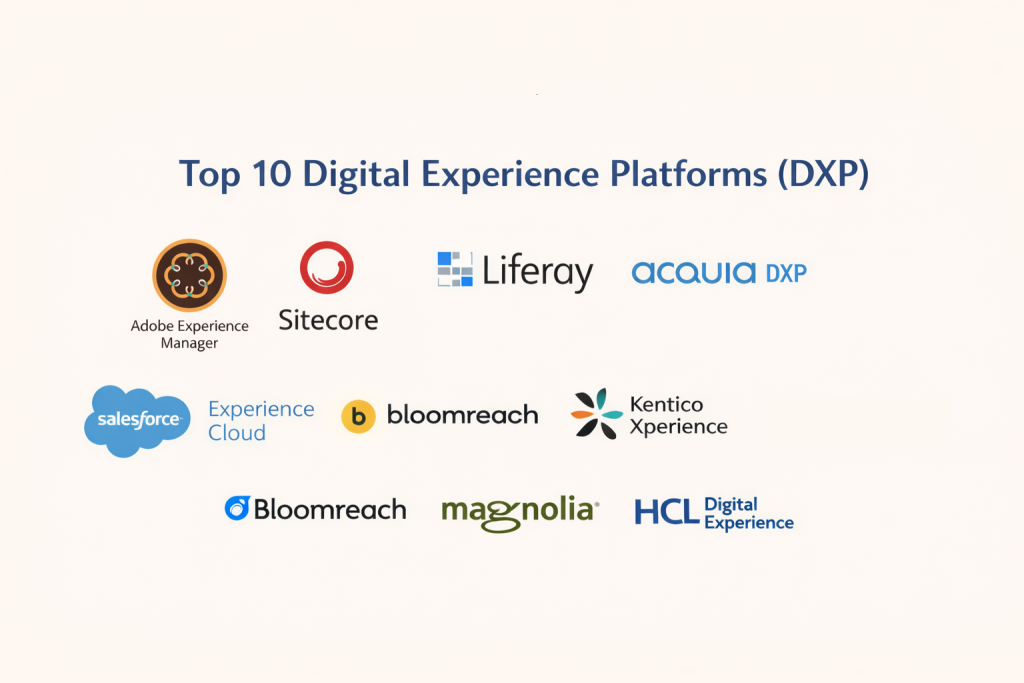
Adobe Experience Manager, Sitecore, Liferay, Acquia DXP, Optimizely, Salesforce Experience Cloud, Bloomreach, Kentico Xperience, Magnolia, HCL Digital Experience
Tools
1.Adobe Experience Manager
Adobe Experience Manager is an enterprise digital experience platform designed for large-scale content management, personalization, and omnichannel delivery.
Key Features
- Content and digital asset management
- Personalization and automation
- Omnichannel content delivery
- Workflow automation
- Enterprise scalability
Pros
- Strong enterprise capabilities
- Advanced personalization
- Scalable architecture
Cons
- Complex implementation
- Higher operational investment
- Requires expertise
Platforms / Deployment
Cloud / Hybrid
Security & Compliance
Encryption, RBAC, audit logging — Varies
Integrations & Ecosystem
Integrates with analytics, marketing automation, CRM systems, and enterprise platforms to enable full digital experience delivery.
Support & Community
Enterprise support and structured documentation.
2.Sitecore
Sitecore is a digital experience platform focused on personalization, customer journey orchestration, and enterprise digital engagement.
Key Features
- Personalization engine
- Marketing automation
- Content management
- Multi-channel delivery
- Workflow automation
Pros
- Strong personalization capabilities
- Enterprise scalability
- Robust analytics
Cons
- Complex setup
- Higher operational cost
- Requires expert management
Platforms / Deployment
Cloud / Hybrid
Security & Compliance
Encryption, RBAC, audit logging — Varies
Integrations & Ecosystem
Supports integrations with CRM systems, marketing platforms, analytics, and digital commerce ecosystems.
Support & Community
Enterprise-grade documentation and support.
3.Liferay
Liferay is an enterprise digital experience platform used for portals, customer engagement, and digital transformation.
Key Features
- Portal management
- Content management
- Personalization
- Workflow automation
- Integration framework
Pros
- Strong portal capabilities
- Flexible architecture
- Enterprise-ready
Cons
- Requires implementation planning
- Technical setup needed
- Learning curve present
Platforms / Deployment
Cloud / Self-hosted
Security & Compliance
RBAC, encryption — Varies
Integrations & Ecosystem
Supports integrations with enterprise systems, analytics platforms, and digital services.
Support & Community
Strong enterprise ecosystem.
4.Acquia DXP
Acquia DXP is a digital experience platform built on open architecture for scalable content and customer experience delivery.
Key Features
- Content management
- Personalization
- Marketing automation
- Workflow management
- Scalable infrastructure
Pros
- Flexible architecture
- Enterprise scalability
- Strong integration ecosystem
Cons
- Requires planning
- Higher operational complexity
- Cost varies
Platforms / Deployment
Cloud
Security & Compliance
Encryption, RBAC — Varies
Integrations & Ecosystem
Integrates with marketing automation, analytics platforms, and enterprise systems.
Support & Community
Enterprise support and structured resources.
5.Optimizely
Optimizely is a digital experience platform focused on experimentation, personalization, and digital optimization.
Key Features
- Experimentation tools
- Personalization engine
- Content management
- Analytics and optimization
- Workflow automation
Pros
- Strong optimization tools
- Data-driven personalization
- Enterprise-ready
Cons
- Requires implementation effort
- Learning curve
- Pricing varies
Platforms / Deployment
Cloud
Security & Compliance
Encryption, RBAC — Varies
Integrations & Ecosystem
Integrates with analytics, marketing automation, and digital platforms.
Support & Community
Enterprise documentation and support.
6.Salesforce Experience Cloud
Salesforce Experience Cloud is a digital experience platform designed for customer portals, partner ecosystems, and digital engagement.
Key Features
- Customer and partner portals
- Workflow automation
- Content management
- Integration with CRM
- Personalization
Pros
- Strong CRM integration
- Enterprise scalability
- Robust ecosystem
Cons
- Requires configuration
- Higher cost
- Complex setup
Platforms / Deployment
Cloud
Security & Compliance
Encryption, RBAC — Varies
Integrations & Ecosystem
Deep integration with CRM, analytics, automation, and enterprise systems.
Support & Community
Enterprise-grade ecosystem and support.
7.Bloomreach
Bloomreach is a digital experience platform focused on personalization, commerce experience, and content-driven engagement.
Key Features
- Personalization engine
- Content management
- Commerce integration
- Customer journey orchestration
- Analytics
Pros
- Strong personalization
- Commerce-focused capabilities
- Scalable
Cons
- Requires implementation
- Learning curve
- Pricing varies
Platforms / Deployment
Cloud
Security & Compliance
Encryption, RBAC — Varies
Integrations & Ecosystem
Integrates with commerce platforms, analytics tools, and marketing automation.
Support & Community
Enterprise support and documentation.
8.Kentico Xperience
Kentico Xperience is a digital experience platform combining content management, marketing automation, and personalization.
Key Features
- Content management
- Marketing automation
- Personalization
- Workflow automation
- Analytics
Pros
- Balanced feature set
- Scalable architecture
- Flexible deployment
Cons
- Requires setup
- Learning curve
- Implementation effort
Platforms / Deployment
Cloud / Hybrid
Security & Compliance
Encryption, RBAC — Varies
Integrations & Ecosystem
Supports integration with analytics, marketing, and enterprise systems.
Support & Community
Structured support and ecosystem.
9.Magnolia
Magnolia is a flexible digital experience platform focused on hybrid architecture and enterprise content governance.
Key Features
- Hybrid architecture
- Workflow automation
- Content modeling
- Multi-channel delivery
- Governance
Pros
- Flexible architecture
- Enterprise-ready
- Strong governance
Cons
- Complex implementation
- Requires expertise
- Higher cost
Platforms / Deployment
Cloud / Hybrid
Security & Compliance
Encryption, RBAC — Varies
Integrations & Ecosystem
Integrates with enterprise platforms, analytics systems, and digital ecosystems.
Support & Community
Enterprise support structure.
10.HCL Digital Experience
HCL Digital Experience is an enterprise digital platform designed for portals, customer engagement, and digital transformation.
Key Features
- Portal platform
- Personalization
- Content management
- Workflow automation
- Scalable infrastructure
Pros
- Strong enterprise capability
- Scalable architecture
- Flexible deployment
Cons
- Complex setup
- Requires expertise
- Implementation effort
Platforms / Deployment
Cloud / Self-hosted
Security & Compliance
Encryption, RBAC — Varies
Integrations & Ecosystem
Supports integration with enterprise systems, analytics, and digital platforms.
Support & Community
Enterprise documentation and support.
Comparison Table
| Tool | Best For | Platform | Deployment | Standout Feature | Public Rating |
|---|---|---|---|---|---|
| Adobe Experience Manager | Enterprise DXP | Web | Cloud/Hybrid | Personalization | N/A |
| Sitecore | Personalization | Web | Cloud/Hybrid | Customer journey | N/A |
| Liferay | Portal platform | Web | Cloud/Self | Portal management | N/A |
| Acquia DXP | Open architecture | Web | Cloud | Flexible platform | N/A |
| Optimizely | Experimentation | Web | Cloud | Optimization tools | N/A |
| Salesforce Experience Cloud | Customer portals | Web | Cloud | CRM integration | N/A |
| Bloomreach | Commerce experience | Web | Cloud | Personalization | N/A |
| Kentico Xperience | Balanced DXP | Web | Cloud/Hybrid | Automation | N/A |
| Magnolia | Hybrid architecture | Web | Cloud/Hybrid | Governance | N/A |
| HCL Digital Experience | Enterprise portal | Web | Cloud/Self | Portal platform | N/A |
Evaluation & Scoring
| Tool | Core | Ease | Integrations | Security | Performance | Support | Value | Weighted Total |
|---|---|---|---|---|---|---|---|---|
| Adobe Experience Manager | 10 | 6 | 9 | 9 | 9 | 9 | 6 | 8.5 |
| Sitecore | 9 | 6 | 9 | 9 | 9 | 9 | 6 | 8.3 |
| Liferay | 8 | 7 | 8 | 8 | 8 | 8 | 7 | 7.9 |
| Acquia DXP | 9 | 6 | 9 | 8 | 8 | 8 | 7 | 8.0 |
| Optimizely | 8 | 7 | 8 | 8 | 8 | 8 | 7 | 7.9 |
| Salesforce Experience Cloud | 9 | 6 | 10 | 9 | 9 | 9 | 6 | 8.4 |
| Bloomreach | 8 | 7 | 8 | 8 | 8 | 8 | 7 | 7.9 |
| Kentico Xperience | 8 | 7 | 8 | 8 | 8 | 8 | 7 | 7.9 |
| Magnolia | 8 | 6 | 8 | 8 | 8 | 8 | 7 | 7.8 |
| HCL Digital Experience | 9 | 6 | 9 | 9 | 9 | 9 | 6 | 8.3 |
Which Digital Experience Platforms (DXP) Is Right for You?
Choosing the right Digital Experience Platform depends on your organization’s size, digital maturity, content complexity, integration needs, and customer experience goals. There is no single universal platform that fits every scenario. The right choice comes from aligning platform strengths with business priorities, technical capability, and long-term scalability.
Solo / Freelancer
Individuals and small teams usually need simplicity, speed, and minimal technical overhead. Complex enterprise-grade platforms may add unnecessary cost and complexity.
Best fit:
- Lightweight or modular experience platforms
- Simple content personalization tools
- Platforms with easy setup and minimal maintenance
Focus on:
- Ease of use
- Fast deployment
- Cost efficiency
- Basic analytics and personalization
Avoid heavy enterprise platforms unless long-term scaling is required.
Small and Growing Businesses
Small organizations need a balance between usability and scalability. They often require marketing automation, personalization, and content management without heavy infrastructure.
Best fit:
- Integrated experience platforms with marketing and content tools
- Platforms offering automation and analytics
- Solutions that grow with business expansion
Focus on:
- Ease of adoption
- Integration with CRM and marketing tools
- Performance and scalability
- Cost vs feature balance
Choose platforms that can scale without major migration later.
Mid-Market Organizations
Mid-sized organizations require structured content management, integration flexibility, and stronger personalization. Digital experiences often span multiple channels and customer journeys.
Best fit:
- Composable digital experience platforms
- Platforms with strong integration and API capabilities
- Solutions supporting workflow automation and content governance
Focus on:
- Omnichannel delivery
- Integration ecosystem
- Performance and reliability
- Governance and collaboration tools
Ensure the platform supports future scaling and advanced experience delivery.
Enterprise Organizations
Enterprises require highly scalable, secure, and customizable platforms capable of handling large content ecosystems, complex workflows, and multi-channel digital experiences.
Best fit:
- Enterprise-grade digital experience platforms
- Platforms with strong governance and compliance
- Solutions supporting personalization at scale
Focus on:
- Scalability and reliability
- Security and governance
- Integration with enterprise systems
- Automation and workflow control
Enterprises should prioritize long-term digital strategy and operational efficiency over short-term simplicity.
Budget vs Premium Platforms
Budget-friendly platforms work well for small teams and simple digital experiences, while premium platforms provide advanced personalization, automation, and enterprise-grade governance.
Budget focus:
- Ease of use
- Basic personalization
- Essential integrations
Premium focus:
- Advanced automation
- Scalable architecture
- Governance and compliance
- Multi-channel orchestration
Choose based on growth expectations and operational complexity.
Feature Depth vs Ease of Use
Some platforms provide deep customization and advanced features but require technical expertise, while others prioritize simplicity and speed.
Feature-heavy platforms suit:
- Complex digital ecosystems
- Custom workflows
- Large-scale content operations
Ease-focused platforms suit:
- Small teams
- Rapid deployment
- Limited technical resources
Balance technical capability with operational needs before selecting.
Integrations and Scalability
Digital Experience Platforms must integrate seamlessly with analytics, CRM, marketing automation, commerce, and cloud systems. Scalability ensures consistent performance as traffic and content grow.
Prioritize:
- API-first architecture
- Integration ecosystem
- Future scalability
- Performance under load
Avoid platforms that limit long-term expansion.
Security and Governance Needs
Security and governance are critical, especially for organizations handling sensitive data, compliance requirements, or large-scale content operations.
Evaluate:
- Access control and permissions
- Data protection and encryption
- Compliance readiness
- Audit and monitoring capabilities
Organizations in regulated industries should prioritize governance and compliance over ease of use.
FAQs
1.What is a Digital Experience Platform
A Digital Experience Platform manages content, personalization, and digital interactions across multiple channels from a unified system.
2.Is DXP only for enterprises
Primarily used by enterprises, but some platforms support mid-sized organizations.
3.What is the main advantage of DXP
Unified digital experience delivery and personalization.
4.Can DXP integrate with other systems
Yes, integration with CRM, analytics, and automation platforms is a core capability.
5.Are DXP platforms secure
Most platforms provide encryption and governance when configured properly.
6.How long does implementation take
Simple deployments may take weeks, complex enterprise deployments may take longer.
7.Do DXPs require developers
Most platforms require technical expertise for setup and customization.
8.What is the difference between CMS and DXP
DXP includes CMS plus personalization, automation, and customer experience management.
9.Can DXP scale for large organizations
Yes, DXP platforms are built for enterprise scalability.
10.What are alternatives to DXP
CMS platforms and digital experience tools used separately.
Conclusion
Digital Experience Platforms play a critical role in modern digital transformation by enabling organizations to manage, personalize, and deliver consistent digital experiences across multiple channels. These platforms combine content management, personalization, analytics, automation, and integration into a unified system, allowing organizations to create seamless and engaging user journeys. Organizations adopting Digital Experience Platforms often achieve improved customer engagement, better content governance, enhanced personalization, and more efficient digital operations. Developer teams benefit from flexible architecture and integration capability, while business teams gain the ability to deliver personalized and consistent digital experiences at scale. Large organizations particularly value the scalability, automation, and governance features that support complex digital ecosystems and long-term digital growth.

Best Cardiac Hospitals Near You
Discover top heart hospitals, cardiology centers & cardiac care services by city.
Advanced Heart Care • Trusted Hospitals • Expert Teams
View Best Hospitals