Introduction
A/B testing tools are the scientific engines of digital growth. They allow organizations to move past “gut feelings” and design decisions by split-testing different versions of a webpage, app feature, or marketing message to see which performs better. By randomly showing Version A and Version B to different segments of visitors, companies can mathematically prove which changes drive more revenue, sign-ups, or engagement.
The industry has shifted away from simple button-color tests. Modern experimentation platforms now leverage AI-driven orchestration and server-side testing to deliver highly personalized experiences at scale. Whether you are a solo marketer looking for a visual editor or a developer-heavy product team needing feature flags, there is a specialized tool designed for your specific “experimentation velocity.”
Real-World Use Cases:
- Pricing Experiments: Testing different subscription tiers to find the optimal revenue point.
- Landing Page Optimization: Comparing headlines and hero images to lower bounce rates.
- Feature Rollouts: Gradually releasing a new app feature to 5% of users to monitor performance.
- Dynamic Personalization: Serving different content based on a user’s past purchase history.
What Buyers Should Evaluate:
- Statistical Model: Does it use Bayesian (faster for small samples) or Frequentist (traditional) statistics?
- Flicker Protection: Does the tool prevent the “flash” of original content before the variant loads?
- Ease of Implementation: Can marketers launch tests, or is a developer required for every change?
- Integration Ecosystem: How well does it sync with your existing analytics (GA4, Mixpanel) and CDP?
Best for: Growth hackers, conversion rate optimization (CRO) specialists, and product managers.
Not ideal for: Websites with extremely low traffic where reaching statistical significance is impossible.
Key Trends in A/B Testing Tools
- Prompt-Based Experimentation: Using natural language to describe a test (e.g., “Change all CTA buttons to green and make the text bold”) and having AI generate the code.
- Warehouse-Native Testing: Tools that run experiments directly on top of your data warehouse (Snowflake, BigQuery) to ensure data consistency.
- Anti-Flicker Technology: Advanced asynchronous scripts that eliminate the “flicker effect” without compromising Largest Contentful Paint (LCP) scores.
- Multi-Armed Bandit (MAB): AI that automatically shifts traffic toward the winning variation in real-time to minimize lost revenue during the test.
- Hybrid Experimentation: The ability to combine client-side visual edits with complex server-side logic in a single campaign.
- Privacy-First Experimentation: Cookieless tracking methods that remain compliant with strict 2026 global privacy regulations.
How We Selected These Tools (Methodology)
Our selection process for the top A/B testing platforms was based on:
- Statistical Reliability: We prioritized tools with robust engines that prevent “peaking” errors and provide clear confidence levels.
- User Experience: Evaluating the balance between a powerful feature set and an intuitive interface for non-technical users.
- Implementation Flexibility: The ability to handle both simple web tweaks and complex full-stack product experiments.
- Performance Impact: Measuring how much the testing script slows down page load times.
- Market Presence: Identifying tools with a proven track record in enterprise, SMB, and e-commerce sectors.
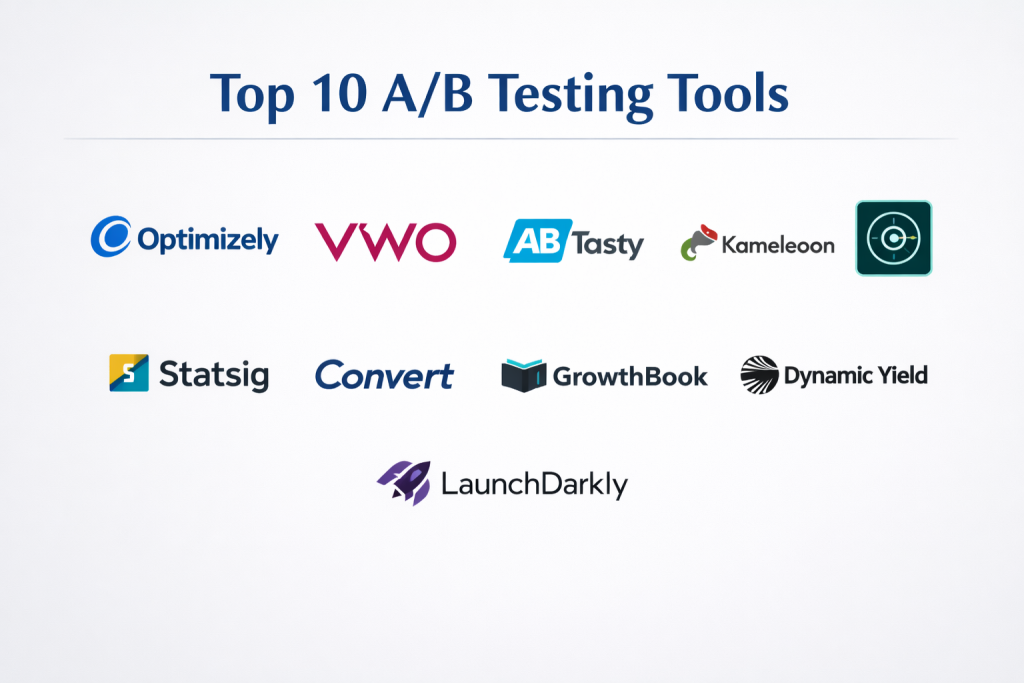
Top 10 A/B Testing Tools
1.Optimizely
Optimizely is the undisputed heavyweight of the experimentation world, designed for large enterprises that require a “culture of experimentation” across web, mobile, and server-side applications.
Key Features
- Visual Editor: A powerful drag-and-drop interface for marketers to make frontend changes.
- Stats Engine: A proprietary sequential testing model that allows for real-time result checking without statistical bias.
- Feature Experimentation: Built-in feature flagging to test new product functionality behind the scenes.
- Personalization: Advanced targeting based on user attributes and real-time behavior.
- Program Management: Tools for teams to collaborate, ideate, and prioritize a roadmap of experiments.
Pros
- Unrivaled for high-volume, complex enterprise environments.
- Seamlessly connects with most major marketing stacks and data warehouses.
Cons
- One of the most expensive options on the market.
- Requires a significant learning curve to master all enterprise-grade features.
Platforms / Deployment
- Web, Mobile, Server-side (Cloud)
Security & Compliance
- SOC 2 Type II, GDPR, HIPAA, ISO 27001.
2.VWO (Visual Website Optimizer)
VWO is a comprehensive optimization suite that bundles A/B testing with behavioral insights like heatmaps and session recordings, making it a favorite for CRO-focused teams.
Key Features
- SmartCode: An asynchronous script designed to prevent flickering and improve site speed.
- Bayesian Stats Engine: Delivers faster results, especially useful for websites with moderate traffic.
- VWO Insights: Integrated heatmaps and recordings to see “why” a variant lost.
- Plan & Deploy: A built-in project management tool to track your testing hypothesis and results.
- AI Copilot: Generative AI that suggests headlines and content variations for your tests.
Pros
- Excellent “all-in-one” value for teams that need both qualitative and quantitative data.
- Generous free tier for small businesses and startups.
Cons
- The interface can occasionally feel cluttered due to the sheer number of integrated tools.
- Advanced segmentation can become pricey on higher-tier plans.
Platforms / Deployment
- Web, Mobile, Server-side (Cloud)
Security & Compliance
- GDPR, CCPA, ISO 27001, BS 10012.
3.AB Tasty
AB Tasty focuses on “Experience Optimization,” blending testing, personalization, and e-merchandising into a platform that is highly popular among e-commerce brands.
Key Features
- Nudge Engagement: Pre-built widgets like social proof (e.g., “5 people are looking at this”) and countdown timers.
- Emotion AI: Segments users based on their psychological “emotional state” using behavioral signals.
- Server-Side Experimentation: Strong capabilities for testing complex backend logic like search algorithms.
- Buy-It-Now Analysis: Specialized metrics for e-commerce conversion and average order value (AOV).
- Performance Center: A dashboard dedicated to monitoring how the AB Tasty script affects your Core Web Vitals.
Pros
- Highly tailored for retailers looking to drive immediate ROI through personalization.
- Very user-friendly for marketing teams with limited technical support.
Cons
- Statistical reporting is slightly less granular than developer-focused tools.
- AI-driven emotional segments may require high traffic to be accurate.
Platforms / Deployment
- Web, Mobile, Server-side (Cloud)
Security & Compliance
- SOC 2, GDPR, HIPAA.
4.Kameleoon
Kameleoon is an AI-powered experimentation platform known for its speed and its “Prompt-Based Experimentation” (PBX), which allows users to create tests using natural language.
Key Features
- Prompt-Based Experimentation (PBX): Describe a change in plain English, and the AI handles the implementation.
- TypeScript Engine: Uses a lightweight script that claims to be the fastest in the market with zero flicker.
- Widget Studio: A dedicated environment for building complex quizzes, banners, and forms for testing.
- Hybrid Experimentation: Allows developers and marketers to work on the same experiment across client and server sides.
- Predictive Targeting: Uses machine learning to identify the users most likely to convert with a specific variation.
Pros
- Industry-leading innovation in AI-assisted test creation.
- Exceptionally strong support for healthcare and finance due to strict security protocols.
Cons
- Smaller global support presence compared to giants like Optimizely.
- Some users find the “Widget Studio” menu navigation a bit fragmented.
Platforms / Deployment
- Web, Full Stack, Mobile (Cloud)
Security & Compliance
- HIPAA, GDPR, ISO 27001.
5.Adobe Target
Adobe Target is the experimentation engine for the Adobe Experience Cloud. It is designed for companies already invested in the Adobe ecosystem that want to leverage massive data sets for personalization.
Key Features
- Auto-Allocate: Automatically pushes traffic to the winning variant to maximize conversions during the test.
- Auto-Target: Uses AI to serve the best variant to each individual user based on their specific profile.
- Deep Analytics Integration: Native bi-directional sync with Adobe Analytics for unmatched reporting depth.
- Experience Fragments: Reuse content created in Adobe Experience Manager (AEM) directly in your tests.
- Recommendation Engine: Built-in tools for testing product or content recommendations.
Pros
- Powerful AI orchestration that automates large-scale personalization.
- Best-in-class for organizations already using the full Adobe stack.
Cons
- Extremely high complexity; often requires a dedicated specialist or consultant.
- High cost and “vendor lock-in” within the Adobe suite.
Platforms / Deployment
- Web, Mobile App, IoT, Email (Cloud)
Security & Compliance
- SOC 2, GDPR, HIPAA, FedRAMP.
6.Statsig
Statsig is a modern, developer-first platform that focuses on “Product Observability.” It is built to bridge the gap between feature flags and A/B testing, making it a favorite for modern product teams.
Key Features
- Pulse Results: Automatically calculates the impact of every feature rollout on every metric in your system.
- Warehouse-Native: Queries your data directly from Snowflake or BigQuery to ensure a “single source of truth.”
- Autotune: A multi-armed bandit feature that optimizes traffic allocation toward winning variations.
- Holdouts: Keeps a “global control group” to measure the cumulative impact of all your experiments over time.
- Custom Metrics: Easily define complex success events based on raw data logs.
Pros
- Very affordable for startups and offers a generous “free forever” tier.
- Designed for high-velocity engineering teams who want to test everything.
Cons
- Lacks a “no-code” visual editor for marketers; it is fundamentally a technical tool.
- The dashboard can be intimidating for those not familiar with product analytics.
Platforms / Deployment
- Server-side, Mobile SDKs, Web SDKs
Security & Compliance
- SOC 2 Type II, GDPR, HIPAA.
7.Convert
Convert (Experiences) is widely respected in the CRO community for its commitment to privacy, ethical data practices, and high-quality human support.
Key Features
- Privacy-First Tracking: Compliant with GDPR, CCPA, and PECR without needing complex legal workarounds.
- Advanced Targeting: 40+ built-in filters to target tests by location, device, weather, or custom JS.
- Integrations Gallery: 100+ native integrations with tools like GA4, Hotjar, and HubSpot.
- No-Flicker Technology: Optimized script loading to ensure a seamless visitor experience.
- Multi-Page Testing: Test changes that span across a whole checkout funnel or sequence of pages.
Pros
- Exceptional customer support that often helps with technical implementation.
- Strong focus on data privacy makes it a safe choice for European companies.
Cons
- Does not offer a native “full-stack” or server-side feature management suite (it is mostly focused on web).
- The visual editor can sometimes struggle with very complex Single Page Applications (SPAs).
Platforms / Deployment
- Web (Cloud)
Security & Compliance
- GDPR, CCPA, ISO 27001.
8.GrowthBook
GrowthBook is the leading open-source experimentation platform. It allows companies to build their own internal testing culture with total control over their data and infrastructure.
Key Features
- Open Source: The core engine is free and transparent, allowing for custom modifications.
- Visual Editor Extension: A Chrome extension that lets you build tests visually even on a self-hosted setup.
- SQL Generation: Shows you the exact SQL used to calculate results, ensuring no “black box” metrics.
- SDK Variety: Supports almost every modern programming language and framework.
- Metric Governance: Tools to standardize how success is measured across different product teams.
Pros
- Zero “per-user” or “per-test” costs if self-hosted, making it highly scalable.
- Perfect for teams that want to own their experimentation data completely.
Cons
- Requires engineering resources to set up and maintain the self-hosted version.
- Lacks some of the “polished” marketing features found in SaaS-only tools.
Platforms / Deployment
- Cloud / Self-Hosted
Security & Compliance
- GDPR (Self-hosted allows for total compliance control).
9.Dynamic Yield
Now part of Mastercard, Dynamic Yield is an enterprise-grade personalization platform that excels in using AI to orchestrate experiences across web, app, and even email.
Key Features
- Predictive Targeting: AI models that predict user intent and serve the most relevant variation.
- Multilevel Testing: Test everything from page layouts to specific product recommendation algorithms.
- Omnichannel Logic: Ensure a user sees the same variant on their mobile phone that they saw on their desktop.
- Audience Manager: Create highly specific segments using first-party and third-party data.
- Experience APIs: Allows for testing in non-web environments like kiosks or point-of-sale systems.
Pros
- Unmatched for large-scale e-commerce personalization and “merchandising.”
- Backed by Mastercard’s data infrastructure for advanced insights.
Cons
- Very complex and expensive, primarily for the “Global 2000” companies.
- Testing features can sometimes feel secondary to the personalization features.
Platforms / Deployment
- Web, Mobile, Server-side, Email (Cloud)
Security & Compliance
- SOC 2, GDPR, HIPAA, PCI DSS.
10.LaunchDarkly
LaunchDarkly is primarily a feature management platform that has evolved to offer robust A/B testing through “Experimentation Add-ons.” It is the gold standard for testing “in production.”
Key Features
- Feature Flags: The foundation of the tool, allowing you to turn features on/off for specific users instantly.
- Kill Switches: If a test variation breaks your site, you can disable it instantly without a code deploy.
- Targeting Rules: Use complex logic to decide exactly who enters an experiment (e.g., “Beta users in Canada”).
- Phased Rollouts: Start a test with 1% of users and ramp up as you gain confidence.
- Metric Sync: Connect with tools like Datadog or New Relic to see how tests impact system performance.
Pros
- The safest way to test—errors can be remediated in milliseconds.
- Deeply integrated into the modern DevOps and engineering workflow.
Cons
- Not designed for marketing-led visual changes (no drag-and-drop editor).
- Pricing is based on “seats” and “client-side connections,” which can become complex.
Platforms / Deployment
- Web, Mobile, Server-side, Edge (Cloud)
Security & Compliance
- SOC 2 Type II, HIPAA, GDPR, FedRAMP.
Comparison Table
| Tool Name | Best For | Statistical Model | Deployment | Standout Feature |
| Optimizely | Enterprise Scale | Sequential | Web/Mobile/SS | Program Management |
| VWO | All-in-One CRO | Bayesian | Web/Mobile/SS | Integrated Heatmaps |
| AB Tasty | E-commerce | Bayesian/Seq | Web/Mobile/SS | Emotion AI Segments |
| Kameleoon | AI Innovation | Frequentist/Seq | Web/Full Stack | Prompt-Based Testing |
| Adobe Target | Adobe Ecosystem | Frequentist/AI | Omnichannel | Auto-Target AI |
| Statsig | Product Engineers | Bayesian/Freq | Warehouse-Nat | Pulse Metrics |
| Convert | Privacy & SMBs | Frequentist | Web | Ethics-First Tracking |
| GrowthBook | Open Source | Bayesian/Freq | Cloud/Self-Host | SQL Transparency |
| Dynamic Yield | Personalization | Frequentist/AI | Omnichannel | Omnichannel Sync |
| LaunchDarkly | DevOps Testing | Bayesian | Full Stack | Instant Kill Switches |
Evaluation & Scoring of A/B Testing Tools
| Tool Name | Stats (25%) | Ease (15%) | Features (15%) | Perf (15%) | Support (10%) | Security (10%) | Value (10%) | Total |
| Optimizely | 10 | 6 | 10 | 8 | 9 | 10 | 6 | 8.55 |
| VWO | 8 | 9 | 9 | 7 | 8 | 9 | 9 | 8.40 |
| AB Tasty | 8 | 9 | 9 | 8 | 9 | 9 | 7 | 8.35 |
| Kameleoon | 9 | 8 | 9 | 10 | 8 | 10 | 8 | 8.90 |
| Adobe Target | 9 | 5 | 10 | 7 | 9 | 10 | 5 | 7.80 |
| Statsig | 10 | 7 | 8 | 9 | 8 | 9 | 10 | 8.65 |
| Convert | 8 | 8 | 7 | 9 | 10 | 10 | 8 | 8.45 |
| GrowthBook | 9 | 6 | 8 | 10 | 6 | 10 | 10 | 8.40 |
| Dynamic Yield | 8 | 6 | 10 | 7 | 8 | 9 | 6 | 7.75 |
| LaunchDarkly | 9 | 7 | 8 | 9 | 9 | 10 | 7 | 8.45 |
Which A/B Testing Tool Is Right for You?
Marketing / CRO Specialist
If your goal is to quickly test website copy, images, and layouts without waiting for a developer, VWO or Convert are your best options. They offer the best balance of visual editing and robust reporting.
Product / Software Engineer
For teams that want to test deep product logic, algorithms, or new features, Statsig or GrowthBook are the clear winners. They integrate with your code rather than just your “frontend.”
High-Growth Startup
If you need a tool that handles both marketing and product tests but is budget-friendly, PostHog (from our previous guide) or Statsig provide the most scalability for the price.
Global Enterprise
Large organizations with multiple teams and strict compliance needs should choose Optimizely or Adobe Target. These platforms provide the governance and security required to run thousands of tests simultaneously.
E-commerce & Retail
If you want to use AI to automatically show “Recommended for You” sections or “Social Proof” widgets, AB Tasty or Dynamic Yield are specifically optimized for increasing transaction value.
Frequently Asked Questions (FAQs)
1.What is the “Flicker Effect” in A/B testing?
Flicker (or FOOC—Flash of Original Content) happens when the original version of a page loads for a split second before the A/B testing script swaps it for the variant. Modern tools like Kameleoon and VWO use advanced scripts to hide this from the user.
2.How long should I run an A/B test?
Most experts recommend running a test for at least two full business cycles (usually 14 days) to account for variations in weekend vs. weekday behavior. You should also wait until you reach at least 95% statistical significance.
3.What is “Statistical Significance”?
It is a mathematical measure that tells you how likely it is that your result was caused by the change you made, rather than by random chance. A 95% significance level means there is only a 5% chance the result is a fluke.
4.Do A/B testing tools hurt SEO?
Generally, no. Google explicitly supports A/B testing as long as you aren’t “cloaking” (showing search engines something different than users). Using 302 redirects and canonical tags is the best practice.
5.Can I run tests on my mobile app?
Yes, but you need a tool that offers a Mobile SDK (like Optimizely, Statsig, or VWO). Unlike web testing, mobile app tests often require “server-side” implementation to avoid waiting for App Store updates.
6.What is Bayesian vs. Frequentist statistics?
Frequentist statistics (the traditional way) require a fixed sample size before you can look at results. Bayesian statistics (the modern way) are more “fluid” and allow you to see the “probability of a variant being better” as data comes in.
7.Is there a free alternative to Google Optimize?
Since Google Optimize was sunset, the best free/affordable alternatives are VWO (Starter Plan), GrowthBook (Self-hosted), and Statsig (Free Tier).
8.What is a “Multi-Armed Bandit” (MAB) test?
Unlike a standard A/B test where traffic is split 50/50 until the end, a MAB test uses AI to gradually send more traffic to the winning version while the test is still running, saving you money.
9.Can I test more than two versions at once?
Yes, this is called Multivariate Testing (MVT). It allows you to test multiple variables (e.g., three headlines and two button colors) simultaneously to see which combination performs best.
10.What is a “Feature Flag”?
A feature flag is a snippet of code that allows you to turn a feature on or off for specific users without deploying new code. This is the foundation for modern product experimentation.
Conclusion
A/B testing is no longer a luxury; it is the fundamental process of learning what your customers actually want. Whether you are using the AI-powered prompt testing of Kameleoon or the developer-centric observability of Statsig, the objective remains the same: to stop guessing and start knowing. The brands that win aren’t necessarily those with the biggest budgets, but those that can run experiments, learn from the data, and iterate faster than their competitors. the selection of an A/B testing platform, it is essential to recognize that the value of experimentation lies not in the software itself, but in the velocity of learning it enables for your team. The transition from a “highest paid person’s opinion” (HiPPO) culture to a data-driven one requires a tool that fits your organizational workflow. If your marketing team needs to pivot quickly without technical barriers, the visual agility of VWO or Convert is indispensable. Conversely, if your engineers are leading the charge by testing complex algorithms and backend logic, the precision of Statsig or the transparency of GrowthBook will be your greatest assets.

Best Cardiac Hospitals Near You
Discover top heart hospitals, cardiology centers & cardiac care services by city.
Advanced Heart Care • Trusted Hospitals • Expert Teams
View Best Hospitals