Introduction
Customer Data Platforms (CDPs) are systems that collect, unify, and activate customer data across channels. In simple terms, a CDP takes data from your website, mobile app, CRM, support system, ads, and product usage tools, then builds a cleaner and more consistent customer profile. After that, it sends the right segments and events to your marketing, analytics, and product tools so teams can personalize experiences and measure results.
This category matters because most teams struggle with the same problems: messy tracking, disconnected tools, duplicated customer records, and slow segmentation. A good CDP reduces chaos by making customer data trusted, reusable, and ready for action.
Common real-world use cases:
- Building a single customer profile from web, app, CRM, and offline data
- Creating reusable audiences for email, ads, SMS, and onsite personalization
- Improving attribution by sending cleaner events and identities to analytics
- Triggering lifecycle campaigns based on user behavior and product usage
- Enforcing governance with rules for consent, data quality, and routing
What buyers should evaluate (practical checklist):
- Identity resolution: how it merges anonymous and known users
- Data collection: SDKs, tracking plans, server-side options, offline imports
- Data modeling: events, traits, schemas, catalogs, and custom objects (Varies)
- Data quality: validation rules, deduping, debugging, and replay options (Varies)
- Activation: how well it syncs audiences to downstream tools
- Real-time capability: event streaming, low-latency segmentation (Varies)
- Governance: roles, approvals, audit trails, change control (Varies)
- Privacy controls: consent inputs, deletion workflows, retention support (Varies)
- Integrations: breadth and depth of connectors and API flexibility
- Operational ownership: who can run it daily, and how hard it is to maintain
Best for: growth, marketing ops, product analytics, data engineering, and CRM teams that need consistent customer data across tools and want to scale personalization and measurement.
Not ideal for: very small teams with minimal tracking needs, tiny customer databases, or businesses that only need basic email segmentation inside a single marketing tool and do not need cross-tool identity and routing.
Key Trends in Customer Data Platforms
- More focus on first-party data and server-side event collection to improve reliability
- Stronger identity resolution strategies that link web, app, and offline records
- Faster activation, with more real-time audience updates for key journeys
- Better governance and change control to prevent tracking and schema chaos
- Increased privacy expectations, including deletion workflows and consent-aware routing
- Composable stacks, where CDP acts as a routing and modeling layer instead of a “one tool does everything” approach
- Deeper warehouse alignment, where the CDP and data platform work together (Varies by tool)
- More automation for event quality checks, naming consistency, and debugging (Varies)
- Larger integration ecosystems, including ad platforms, CRM, support, and personalization tools
- More emphasis on proving incremental impact through disciplined measurement and audience holdouts (Varies)
How We Selected These Tools
- Selected widely recognized CDPs used in real production environments
- Balanced the list across enterprise platforms and developer-friendly options
- Prioritized tools known for strong identity, routing, and activation capabilities
- Considered integration breadth for marketing, analytics, and customer engagement stacks
- Considered operational maturity: governance features, scalability, and workflow stability
- Considered fit across different company sizes and data maturity levels
- Avoided guessing public ratings and certifications; used Not publicly stated and N/A where uncertain
- Focused on practical buyer needs: clean profiles, reliable pipelines, and measurable activation
Top 10 Customer Data Platforms (CDP) Tools
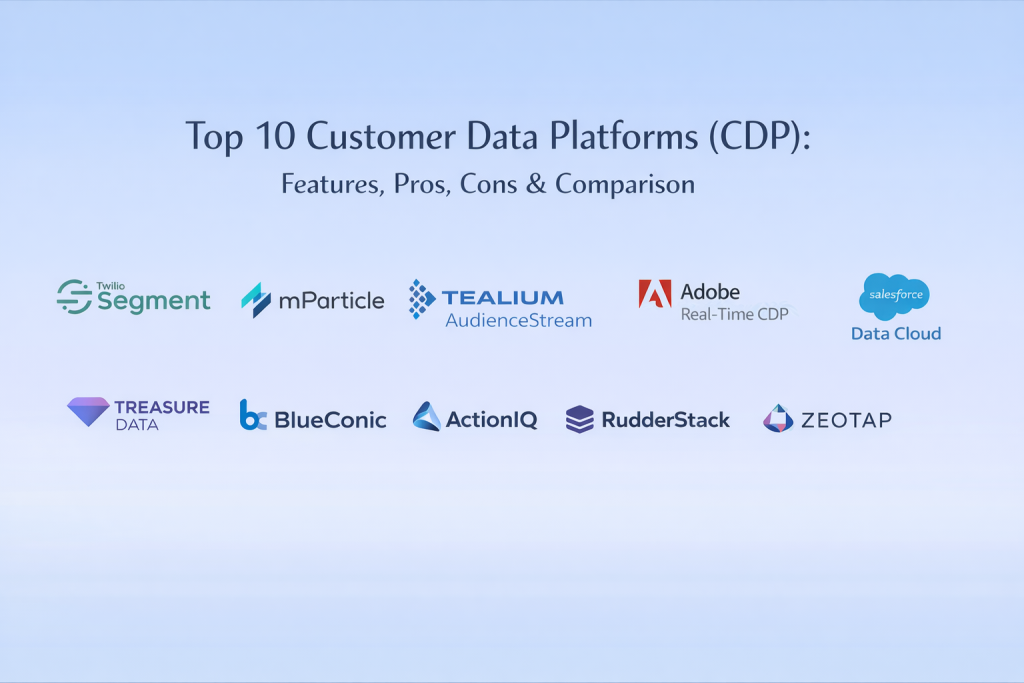
1. — Twilio Segment
A popular CDP used to collect and route customer events, unify profiles, and send consistent data to analytics, marketing, and product tools.
Key Features
- Event collection across web, mobile, and server sources (Varies)
- Central routing of events to many downstream destinations
- Identity stitching patterns for known and anonymous users (Varies)
- Tracking governance concepts such as schemas and validation (Varies)
- Audience building and activation workflows (Varies)
- Debugging and replay patterns depending on setup (Varies / Not publicly stated)
Pros
- Strong ecosystem fit for teams that rely on many tools
- Practical foundation for consistent tracking and routing
Cons
- Outcomes depend on disciplined tracking plans and data ownership
- Advanced governance and identity can require careful configuration
Platforms / Deployment
- Platform(s): Web / iOS / Android / Server-side (Varies)
- Deployment: Cloud
Security & Compliance
- Not publicly stated
Integrations & Ecosystem
Often used as a central hub that connects to analytics, CRMs, marketing tools, and warehouses.
- Analytics and product analytics destinations (Varies)
- Marketing automation and email platforms (Varies)
- Advertising audiences (Varies)
- APIs, webhooks, and custom destinations (Varies)
Support & Community
Strong documentation footprint and broad community awareness. Support tiers vary by plan. Varies / Not publicly stated.
2 — mParticle
A CDP focused on enterprise-grade event collection, identity resolution, and audience activation, often used by teams with high data quality and governance needs.
Key Features
- Real-time event collection and routing patterns (Varies)
- Identity resolution with configurable rules (Varies)
- Audience segmentation and activation for marketing tools (Varies)
- Data quality workflows and governance concepts (Varies)
- Profile management with event-based personalization signals (Varies)
- Strong operational tooling for managing customer data pipelines (Varies)
Pros
- Strong for enterprise data governance and identity complexity
- Designed for scale with a focus on quality and control
Cons
- Implementation can be heavier than simpler routing-only setups
- Best value appears when teams actively use advanced identity and governance
Platforms / Deployment
- Platform(s): Web / iOS / Android / Server-side (Varies)
- Deployment: Cloud
Security & Compliance
- Not publicly stated
Integrations & Ecosystem
Typically integrates broadly across analytics, marketing, and data stacks with flexible routing.
- Marketing activation destinations (Varies)
- Analytics and experimentation tools (Varies)
- Warehouses and data platforms (Varies)
- APIs and custom connectors (Varies)
Support & Community
Strong vendor support for larger customers; community smaller than the most broadly adopted developer tools. Varies / Not publicly stated.
3 — Tealium AudienceStream
A CDP often used for audience creation and activation, with strong alignment to tag management and event collection ecosystems depending on the organization’s setup.
Key Features
- Audience segmentation and real-time activation patterns (Varies)
- Profile enrichment and attribute management (Varies)
- Event and visitor data collection concepts (Varies)
- Consent-aware audience activation workflows (Varies / Not publicly stated)
- Connector ecosystem for sending audiences to many tools (Varies)
- Governance concepts for managing attributes and audiences (Varies)
Pros
- Strong for teams focused on audience activation and marketing ops
- Useful when audience governance and control is a priority
Cons
- Complexity depends on how data collection is implemented
- Teams need clear ownership of attributes and audience definitions
Platforms / Deployment
- Platform(s): Web (Varies); Mobile (Varies)
- Deployment: Cloud
Security & Compliance
- Not publicly stated
Integrations & Ecosystem
Often used to push audiences to marketing and engagement tools with configurable connectors.
- Ad platforms and audience destinations (Varies)
- Marketing automation and email tools (Varies)
- Analytics destinations (Varies)
- APIs and connectors (Varies / Not publicly stated)
Support & Community
Vendor-led onboarding and support are common in enterprise contexts. Community varies. Varies / Not publicly stated.
4 — Adobe Real-Time CDP
An enterprise CDP designed to unify profiles and activate audiences across Adobe and non-Adobe ecosystems, typically used by organizations running large digital experience programs.
Key Features
- Unified profiles and segmentation concepts at enterprise scale (Varies)
- Real-time audience activation patterns (Varies)
- Identity resolution and profile stitching concepts (Varies / Not publicly stated)
- Governance workflows suitable for large teams (Varies)
- Integrations with experience delivery and analytics ecosystems (Varies)
- Data modeling patterns for complex customer attributes (Varies)
Pros
- Strong fit for enterprise experience and marketing programs
- Works well when integrated into larger digital experience ecosystems
Cons
- Can be heavy for smaller teams or simple routing use cases
- Implementation complexity increases with large data models and governance requirements
Platforms / Deployment
- Platform(s): Web (Varies); Omnichannel activation (Varies)
- Deployment: Cloud
Security & Compliance
- Not publicly stated
Integrations & Ecosystem
Often connects deeply into enterprise marketing and experience stacks, plus external destinations depending on setup.
- Experience delivery and analytics tools (Varies)
- CRM and marketing systems (Varies)
- Data platform integrations (Varies)
- APIs and connectors (Varies / Not publicly stated)
Support & Community
Enterprise support model with partner ecosystem. Community strength varies by region and stack adoption. Varies / Not publicly stated.
5 — Salesforce Data Cloud
A CDP-style platform aligned to CRM-driven customer operations, built to unify profiles and activate audiences across engagement workflows when Salesforce is central.
Key Features
- Profile unification aligned with CRM-centric operating models (Varies)
- Audience segmentation and activation patterns (Varies)
- Identity and data model support across customer touchpoints (Varies)
- Integration patterns across engagement and sales workflows (Varies)
- Governance concepts suited for enterprise operations (Varies)
- Activation into marketing and customer engagement surfaces (Varies)
Pros
- Strong fit for Salesforce-centered organizations
- Useful when sales, service, and marketing teams want aligned customer profiles
Cons
- Best value depends on how deeply the organization uses Salesforce ecosystems
- Data modeling and identity can become complex without clear ownership
Platforms / Deployment
- Platform(s): Omnichannel (Varies)
- Deployment: Cloud
Security & Compliance
- Not publicly stated
Integrations & Ecosystem
Often leverages Salesforce ecosystem integration, plus external connections depending on configuration.
- CRM, marketing, and service workflows (Varies)
- External audience destinations (Varies)
- Data pipelines and ingestion sources (Varies)
- APIs and connectors (Varies / Not publicly stated)
Support & Community
Strong documentation footprint; implementation often benefits from admins and architects. Varies / Not publicly stated.
6 — Treasure Data
An enterprise CDP known for handling large-scale customer data collection and segmentation, often used by organizations with complex data sources and strong analytics needs.
Key Features
- Large-scale data ingestion and profile unification concepts (Varies)
- Segmentation and audience activation workflows (Varies)
- Data governance and operational controls (Varies)
- Batch and streaming ingestion patterns (Varies)
- Advanced data modeling flexibility for customer attributes (Varies)
- Activation and orchestration support patterns (Varies / Not publicly stated)
Pros
- Strong fit for data-heavy enterprises with complex sources
- Useful when segmentation and analytics depth matter
Cons
- Implementation can require stronger data engineering involvement
- Overkill for very small stacks with simple activation needs
Platforms / Deployment
- Platform(s): Web (Varies / N/A)
- Deployment: Cloud
Security & Compliance
- Not publicly stated
Integrations & Ecosystem
Often connects to data platforms, analytics, and marketing activation destinations.
- Warehouses and data platforms (Varies)
- Marketing and advertising destinations (Varies)
- Analytics and BI tools (Varies)
- APIs and connectors (Varies / Not publicly stated)
Support & Community
Enterprise support is typical; community is smaller than developer-first tools. Varies / Not publicly stated.
7 — BlueConic
A CDP often chosen for marketing and digital teams that want accessible profile building and audience activation with practical governance features.
Key Features
- Unified profiles with configurable data capture and enrichment (Varies)
- Segmentation and activation workflows for marketing destinations (Varies)
- Consent-aware personalization and audience routing patterns (Varies / Not publicly stated)
- Identity handling and profile merging concepts (Varies)
- UI-driven workflows for marketing ops teams (Varies)
- Integrations for activation across engagement tools (Varies)
Pros
- Practical for marketing operations teams that want speed and usability
- Useful for personalization and audience activation programs
Cons
- Advanced data modeling may require careful planning for scale
- Integration depth varies depending on destination needs
Platforms / Deployment
- Platform(s): Web (Varies); Omnichannel activation (Varies)
- Deployment: Cloud
Security & Compliance
- Not publicly stated
Integrations & Ecosystem
Often used to send audiences and profile updates to marketing, personalization, and analytics tools.
- Marketing automation and email tools (Varies)
- Ad platforms and audience exports (Varies)
- Analytics and experimentation tools (Varies)
- APIs and connectors (Varies / Not publicly stated)
Support & Community
Vendor documentation and onboarding are common. Community varies. Varies / Not publicly stated.
8 — ActionIQ
A CDP designed for enterprise audience building and activation, often used by teams that want strong segmentation and orchestration across multiple marketing destinations.
Key Features
- Audience segmentation and activation at enterprise scale (Varies)
- Identity and profile concepts for unified customer views (Varies)
- Activation routing to many marketing and ad destinations (Varies)
- Data ingestion patterns for multiple sources (Varies)
- Governance concepts for audience management (Varies)
- Operational tooling for marketing activation programs (Varies / Not publicly stated)
Pros
- Strong for enterprise activation workflows and audience operations
- Useful when multiple business units need consistent audience definitions
Cons
- Best value appears when teams run frequent, structured activation programs
- Requires clear data ownership and collaboration across teams
Platforms / Deployment
- Platform(s): Web (Varies / N/A)
- Deployment: Cloud
Security & Compliance
- Not publicly stated
Integrations & Ecosystem
Typically designed to integrate deeply with marketing activation ecosystems.
- Ad destinations and audience syncing (Varies)
- Marketing automation tools (Varies)
- Analytics and measurement tools (Varies)
- APIs and connectors (Varies / Not publicly stated)
Support & Community
Enterprise customer success and implementation support are common. Community varies. Varies / Not publicly stated.
9 — RudderStack
A developer-friendly customer data pipeline platform often used as a CDP-style routing layer, especially when teams want more control over data collection and destinations.
Key Features
- Event collection and routing for web, mobile, and server sources (Varies)
- Flexible destination routing patterns with engineering ownership
- Warehouse and analytics alignment concepts (Varies)
- Strong control over tracking pipelines and event flows (Varies)
- Supports custom transformations and routing rules (Varies / Not publicly stated)
- Useful for teams building a composable data stack (Varies)
Pros
- Strong fit for engineering-led teams that want control and flexibility
- Good for composable architectures and custom routing needs
Cons
- Requires technical ownership and disciplined tracking governance
- Some advanced audience features depend on how you build around it
Platforms / Deployment
- Platform(s): Web / iOS / Android / Server-side (Varies)
- Deployment: Cloud / Self-hosted (Varies)
Security & Compliance
- Not publicly stated
Integrations & Ecosystem
Often used to route events to analytics, warehouses, and marketing tools, with extensibility via APIs.
- Warehouses and analytics destinations (Varies)
- Marketing tools (Varies)
- Custom transformations and routing logic (Varies)
- APIs and connectors (Varies / Not publicly stated)
Support & Community
Developer community presence is solid; support tiers vary by plan. Varies / Not publicly stated.
10 — Zeotap
A customer data platform often associated with identity and audience activation needs, typically used by teams focused on marketing data unification and activation.
Key Features
- Identity and customer profile unification concepts (Varies)
- Segmentation and audience activation patterns (Varies)
- Data enrichment and audience building workflows (Varies / Not publicly stated)
- Activation into marketing and advertising ecosystems (Varies)
- Governance patterns depending on deployment and region (Varies)
- Data ingestion concepts for multiple sources (Varies)
Pros
- Useful for marketing teams focused on identity and activation
- Practical when audience activation is the primary goal
Cons
- Fit depends on region, data sources, and activation destinations
- Data modeling depth varies by use case and configuration
Platforms / Deployment
- Platform(s): Web (Varies / N/A)
- Deployment: Cloud
Security & Compliance
- Not publicly stated
Integrations & Ecosystem
Typically integrates with marketing and advertising destinations, plus data ingestion sources.
- Audience destinations and ad ecosystems (Varies)
- Marketing activation tools (Varies)
- Data ingestion sources (Varies)
- APIs and connectors (Varies / Not publicly stated)
Support & Community
Vendor support is common; community varies and may be more enterprise-focused. Varies / Not publicly stated.
Comparison Table
| Tool Name | Best For | Platform(s) Supported | Deployment | Standout Feature | Public Rating |
|---|---|---|---|---|---|
| Twilio Segment | General-purpose event routing and activation hub | Web / iOS / Android / Server-side (Varies) | Cloud | Broad destination ecosystem for routing | N/A |
| mParticle | Enterprise identity and data quality governance | Web / iOS / Android / Server-side (Varies) | Cloud | Strong identity resolution and control | N/A |
| Tealium AudienceStream | Audience building and real-time activation | Web (Varies); Mobile (Varies) | Cloud | Audience activation connectors | N/A |
| Adobe Real-Time CDP | Enterprise unified profiles for experience programs | Web (Varies); Omnichannel activation (Varies) | Cloud | Enterprise-scale profile and activation | N/A |
| Salesforce Data Cloud | CRM-aligned customer profiles and activation | Omnichannel (Varies) | Cloud | CRM-centered unification and activation | N/A |
| Treasure Data | Data-heavy enterprises with complex sources | Web (Varies / N/A) | Cloud | Scale-oriented ingestion and segmentation | N/A |
| BlueConic | Marketing ops-friendly profile and activation workflows | Web (Varies); Omnichannel activation (Varies) | Cloud | Usable profile building for marketing teams | N/A |
| ActionIQ | Enterprise segmentation and multi-destination activation | Web (Varies / N/A) | Cloud | Enterprise audience operations | N/A |
| RudderStack | Developer-led composable customer data pipelines | Web / iOS / Android / Server-side (Varies) | Cloud / Self-hosted (Varies) | High control over routing and pipelines | N/A |
| Zeotap | Identity-driven activation for marketing needs | Web (Varies / N/A) | Cloud | Identity and audience activation focus | N/A |
Evaluation and Scoring
Weights:
- Core features – 25%
- Ease of use – 15%
- Integrations and ecosystem – 15%
- Security and compliance – 10%
- Performance and reliability – 10%
- Support and community – 10%
- Price and value – 15%
| Tool Name | Core (25%) | Ease (15%) | Integrations (15%) | Security (10%) | Performance (10%) | Support (10%) | Value (15%) | Weighted Total (0–10) |
|---|---|---|---|---|---|---|---|---|
| Twilio Segment | 8 | 8 | 9 | 6 | 8 | 8 | 7 | 7.95 |
| mParticle | 9 | 6 | 8 | 7 | 8 | 7 | 6 | 7.45 |
| Tealium AudienceStream | 8 | 7 | 8 | 6 | 7 | 7 | 6 | 7.05 |
| Adobe Real-Time CDP | 9 | 6 | 8 | 7 | 8 | 8 | 6 | 7.55 |
| Salesforce Data Cloud | 9 | 6 | 9 | 7 | 8 | 8 | 6 | 7.70 |
| Treasure Data | 8 | 6 | 7 | 6 | 8 | 7 | 6 | 6.90 |
| BlueConic | 7 | 8 | 7 | 6 | 7 | 7 | 7 | 7.10 |
| ActionIQ | 8 | 6 | 8 | 6 | 7 | 7 | 6 | 6.95 |
| RudderStack | 7 | 6 | 8 | 6 | 7 | 7 | 8 | 7.05 |
| Zeotap | 7 | 7 | 7 | 6 | 7 | 6 | 6 | 6.60 |
How to interpret the scores:
- These scores are comparative to help shortlisting and trade-off decisions, not official ratings.
- A tool with lower ease can still be a great fit if you have strong data engineering and clear ownership.
- Security and compliance should always be verified directly with the vendor and your internal security team.
- Value depends on usage, scale, and internal effort, so treat it as directional.
- A short pilot with real data will reveal more than any scorecard.
Which Customer Data Platform Is Right for You?
Solo or Freelancer
Most solo operators do not need a full CDP unless they run multiple products, multiple channels, and a complex analytics stack.
- If you mainly need consistent tracking, focus on clean event naming and a simple pipeline approach.
- If you do choose a CDP-style tool, prioritize ease and quick setup, and keep the destination list small.
SMB
SMBs usually win by focusing on the core: reliable data collection, clean identities, and a few high-impact activations.
- Choose tools that make it easy to standardize events and route them to analytics and a marketing platform.
- Keep governance simple: a small tracking plan, a few key user traits, and clear owners for changes.
Mid-Market
Mid-market teams often have multiple products, multiple channels, and real segmentation needs.
- Prioritize identity resolution, reusable audiences, and strong integrations.
- Make sure the CDP can support both marketing activation and product analytics cleanly.
- Create a process for managing schema changes so you do not break dashboards and campaigns.
Enterprise
Enterprise CDP success depends on governance, scale, and cross-team agreement on definitions.
- Choose platforms that support complex identity resolution and large-scale segmentation.
- Build an operating model: who owns identity rules, who approves schema changes, and who monitors pipeline health.
- Ensure the platform supports enterprise activation needs across multiple brands, regions, and tools.
Budget vs Premium
- Budget-leaning teams should prioritize a stable event pipeline and fewer destinations, then expand only after proving ROI.
- Premium enterprise platforms can reduce fragmentation across large stacks, but require stronger implementation and governance discipline.
Feature Depth vs Ease of Use
- If you want speed, pick tools that are easier to configure and operate day-to-day.
- If you need deep identity and governance, accept more complexity and invest in process design.
Integrations and Scalability
- If you already use many tools, integration breadth matters as much as core CDP features.
- If your data volume is high, prioritize reliability, performance, and stable routing patterns.
- If you use a warehouse-centric stack, consider how the CDP supports alignment with your data platform workflows.
Security and Compliance Needs
- Validate access controls, auditability, data retention, and deletion workflows before rollout.
- In regulated environments, treat privacy and governance as part of the CDP design, not an add-on.
- When details are unclear, request formal documentation and internal security review.
Frequently Asked Questions
1.What does a CDP do in simple terms?
A CDP collects customer data from many sources, unifies profiles, and sends clean events and audiences to your marketing, analytics, and product tools.
2.Do we need a CDP if we already have a CRM?
A CRM is mainly for sales and service records. A CDP focuses on behavioral events and cross-tool activation, often combining CRM data with web and app activity.
3.How long does CDP implementation usually take?
It varies. Basic event routing can be fast, while full identity resolution, governance, and multi-channel activation takes longer and needs stronger planning.
4.What data should we start with first?
Start with your most important events and traits: signup, purchase, key product actions, and lifecycle milestones. Add more only after your pipeline is stable.
5.What is the biggest reason CDP projects fail?
Lack of ownership. Without a tracking plan, data governance, and clear responsibilities, the CDP becomes another messy system instead of a trusted source.
6.Can a CDP help with personalization?
Yes. It can build audiences and send cleaner signals to personalization and messaging tools. Personalization quality depends on your event quality and identity strategy.
7.How do CDPs handle consent and privacy?
Many support consent-aware routing concepts and deletion workflows, but capability depth varies by tool and setup. Always validate your legal and privacy requirements.
8.Should we choose a CDP that is easy or one that is powerful?
Choose based on team reality. Powerful tools help at scale, but only if you have the skills and process maturity to run them. Easy tools win when speed and adoption matter most.
9.What is the difference between a CDP and a data warehouse?
A warehouse stores data for analysis. A CDP focuses on operational customer profiles, audience building, and activation to downstream tools, though many stacks combine both.
10.What is a smart first step before buying a CDP?
Document your tracking plan, define your identity approach, list your required destinations, and run a pilot with real data to validate activation, reliability, and team workflow.
Conclusion
A Customer Data Platform can be one of the most valuable systems in your stack, but only when it solves the real problem: making customer data reliable, usable, and repeatable across teams. Many organizations buy a CDP hoping it will magically fix broken tracking, messy CRM data, inconsistent event names, and unclear ownership. In reality, the CDP amplifies whatever discipline you already have. If your tracking is chaotic, you will simply move chaos faster. If your tracking is clean and your ownership model is strong, you can move faster with confidence and build durable growth workflows.If your biggest pain is inconsistent tracking, you need strong event collection, debugging, and governance workflows.If your biggest pain is fragmented identity, you need clear identity resolution rules and a plan for how anonymous users become known customers.

Best Cardiac Hospitals Near You
Discover top heart hospitals, cardiology centers & cardiac care services by city.
Advanced Heart Care • Trusted Hospitals • Expert Teams
View Best Hospitals