Introduction
API management platforms help teams publish, secure, monitor, and scale APIs so they can be safely used by mobile apps, web apps, partners, and internal teams. They usually sit in front of your services and enforce rules like authentication, rate limits, routing, transformations, and traffic control. Many platforms also include a developer portal, API documentation publishing, versioning, and analytics.
This category matters because most businesses now depend on APIs for core workflows like onboarding, payments, logistics, customer identity, and integrations. As APIs grow, teams need consistent governance so one team’s API decisions do not break another team’s product. A strong API management platform reduces outages, improves security posture, and makes API delivery more predictable.
Real-world use cases:
- Publishing partner APIs with access control, quotas, and onboarding workflows
- Protecting internal microservices with authentication, rate limits, and traffic shaping
- Running a developer portal for multiple product APIs across teams
- Monitoring API latency, errors, and usage trends to improve reliability
- Migrating from legacy APIs to new versions without breaking clients
What buyers should evaluate before choosing:
- Gateway capabilities: routing, rate limiting, quotas, caching, transformations
- Security: OAuth flows, JWT validation, mTLS options, RBAC, audit visibility
- Developer portal quality: onboarding, API keys, docs, self-service access
- Policy management: reusable rules, global standards, version control
- Observability: analytics, logs, tracing hooks, alerting integration
- Deployment flexibility: cloud, self-hosted, hybrid, multi-region needs
- Integration ecosystem: identity providers, CI/CD, service meshes, catalogs
- Performance: throughput, latency overhead, scaling behavior
- Governance: multi-team support, environments, approvals, lifecycle controls
- Cost model: how pricing scales with traffic, environments, and features
Best for: platform engineering teams, API product teams, enterprises, fintech, SaaS, and integration-heavy businesses that need strong security controls, predictable scaling, and governed API publishing across multiple teams.
Not ideal for: very small projects with only one or two internal APIs, where lightweight gateways or direct ingress controls may be enough and full API management overhead is not justified.
Key Trends in API Management Platforms
- Shift from simple gateways to full API product governance with catalogs and lifecycle controls
- Stronger focus on identity-first API security, including consistent token validation and policy reuse
- Increased demand for hybrid deployment models to support regulated workloads and multi-cloud
- Better support for event-driven patterns alongside traditional REST-style APIs (varies by platform)
- More emphasis on observability integration: tracing hooks, structured logs, and error insights
- Developer portal experience becoming a competitive differentiator for partner and public APIs
- Policy-as-code style workflows becoming more common for repeatability and auditability
- Greater need for traffic shaping to handle bursty mobile and partner usage patterns
- Focus on cost efficiency as traffic grows, with smarter caching and rate strategies
- Alignment with internal platform engineering: standard templates, golden paths, and governance
How We Selected These Tools
- Strong credibility and usage for real API programs at scale
- Coverage across enterprise suites and modern gateway-first platforms
- Practical feature completeness: security, portal, analytics, governance
- Deployment options that fit common enterprise and SaaS needs
- Integration ecosystem fit for identity, CI/CD, logging, and monitoring
- Maintainability signals: reusable policies, multi-environment controls, team workflows
- Community, documentation, and support readiness for long-term operations
- A balanced list so teams can shortlist by size, complexity, and architecture
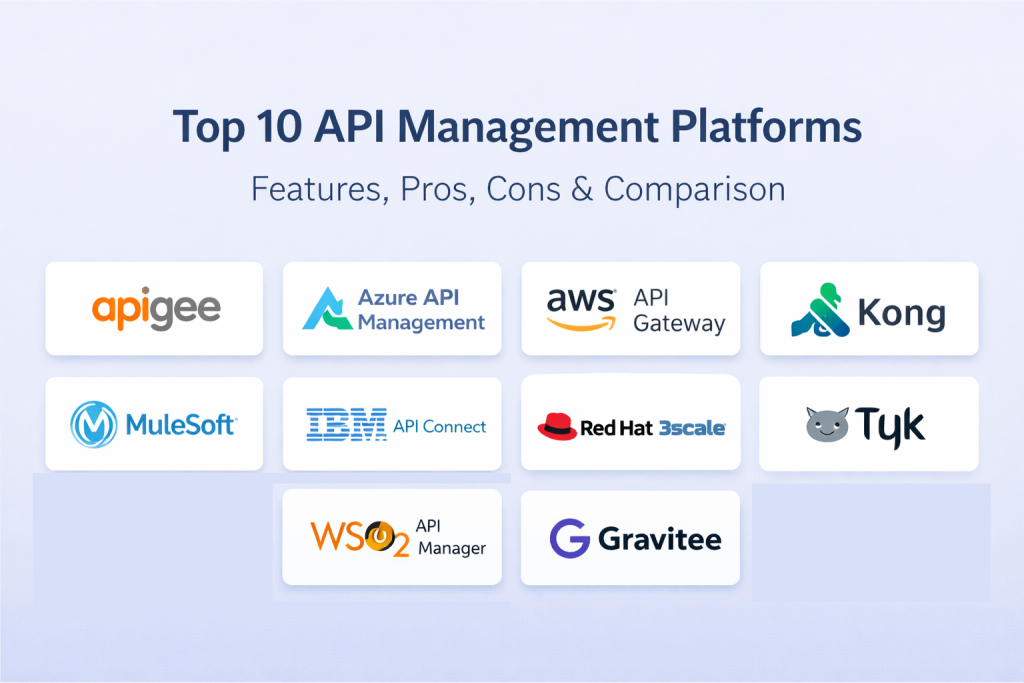
Top 10 API Management Platforms
1 — Apigee
A mature enterprise API management platform commonly used for large-scale API programs. It is often selected when teams need strong governance, analytics, and consistent policy enforcement across many APIs and teams.
Key Features
- API gateway policies for authentication, rate limits, and traffic control
- Developer portal and onboarding workflows (varies by setup)
- API analytics and usage visibility for product decisions
- Versioning and lifecycle controls for API programs (varies)
- Policy reuse patterns and centralized management
- Supports enterprise rollout across multiple environments (varies)
Pros
- Strong fit for large API portfolios and governance
- Good analytics for monitoring usage and performance trends
- Mature policy approach for consistent enforcement
Cons
- Complexity can be high for small teams
- Cost planning can be challenging as usage grows
- Platform setup and governance require discipline
Platforms / Deployment
Cloud, Hybrid (varies)
Security and Compliance
Common capabilities include OAuth-style flows, JWT validation, rate limits, and role-based administration patterns. Specific compliance claims vary by plan and contract, so use Not publicly stated where unsure.
Integrations and Ecosystem
Typically integrates with identity providers, logging systems, and CI/CD workflows depending on the organization’s architecture.
- Identity integration patterns (varies)
- Logging and monitoring integrations (varies)
- CI/CD and automation workflows (varies)
- API catalog and documentation workflows (varies)
Support and Community
Strong enterprise support ecosystem. Community and templates vary by customer segment.
2 — Azure API Management
A widely used API management service for teams running workloads on Microsoft-centric stacks. It is often chosen for centralized governance, developer portals, and strong integration with common enterprise identity patterns.
Key Features
- Central gateway policies for rate limits, quotas, and transformations
- Developer portal for API discovery and onboarding (varies)
- Versioning and revision patterns for controlled rollout (varies)
- Analytics dashboards and API usage insights (varies)
- Support for multiple environments and staged releases (varies)
- Access control patterns suited for enterprise operations (varies)
Pros
- Strong fit for organizations using Microsoft ecosystem services
- Good governance model for multi-team API programs
- Practical portal and onboarding capabilities
Cons
- Cost and performance tuning require careful planning
- Some advanced customization depends on architecture choices
- Hybrid patterns can add operational complexity
Platforms / Deployment
Cloud, Hybrid (varies)
Security and Compliance
Supports common security patterns such as token validation, rate limiting, and admin role controls. Specific compliance details: Not publicly stated.
Integrations and Ecosystem
Works well with enterprise systems, identity providers, and monitoring stacks depending on the environment.
- Identity and access integrations (varies)
- Logging and monitoring integrations (varies)
- CI/CD automation patterns (varies)
- Service and app integrations (varies)
Support and Community
Strong documentation and broad enterprise adoption. Support tiers vary.
3 — AWS API Gateway
A managed gateway service commonly used to publish and secure APIs for applications running on AWS. It is often chosen for fast setup, autoscaling behavior, and close integration with AWS-native building blocks.
Key Features
- Managed gateway for API routing and request handling
- Throttling and quotas for traffic control (varies)
- Authentication and authorization integration patterns (varies)
- Monitoring hooks through AWS observability services (varies)
- Deployment stages and versioning workflows (varies)
- Integration patterns with serverless and service endpoints (varies)
Pros
- Quick to adopt for teams already using AWS
- Scales for many common traffic patterns with managed operations
- Good fit for serverless and cloud-native architectures
Cons
- Costs can rise with high request volume and features
- Deep customization may require additional services or patterns
- Governance across many teams needs strong internal standards
Platforms / Deployment
Cloud
Security and Compliance
Common support for token-based auth patterns, request validation, throttling, and access control. Compliance details: Not publicly stated.
Integrations and Ecosystem
Strong integration options across AWS services, identity patterns, and monitoring tools depending on architecture.
- Identity integration patterns (varies)
- Logging and monitoring workflows (varies)
- CI/CD release automation (varies)
- Service-to-service integration patterns (varies)
Support and Community
Large community and many implementation examples. Support depends on service plan and organizational setup.
4 — Kong
A popular gateway-first platform used for API traffic control, security policies, and routing. It is often selected by teams that want strong flexibility, plugin-based extensibility, and deployment choices.
Key Features
- High-performance API gateway with plugin extensibility
- Rate limiting, authentication policies, and traffic shaping patterns
- Support for multiple deployment styles (varies by edition)
- Central management and policy distribution (varies)
- Developer portal options (varies)
- Observability and logging integration patterns (varies)
Pros
- Strong flexibility and extensibility via plugins
- Good fit for cloud-native and microservice architectures
- Useful for teams that need deployment choice and customization
Cons
- Governance and consistent standards require planning
- Some advanced capabilities depend on edition and architecture
- Operational complexity increases at large scale without discipline
Platforms / Deployment
Cloud, Self-hosted, Hybrid (varies)
Security and Compliance
Common support for auth plugins, mTLS options (varies), RBAC patterns (varies), and audit-style controls (varies). Compliance details: Not publicly stated.
Integrations and Ecosystem
A strong plugin ecosystem supports common integrations and custom extensions.
- Authentication and identity plugins (varies)
- Logging and monitoring integrations (varies)
- CI/CD and config automation patterns (varies)
- Service mesh and gateway patterns (varies)
Support and Community
Strong community presence. Enterprise support varies by plan.
5 — MuleSoft Anypoint Platform
An enterprise integration platform that includes API management capabilities. It is often chosen when a company needs both API governance and broader integration workflows across many systems.
Key Features
- API lifecycle management with governance workflows (varies)
- Policies for security, traffic, and access control (varies)
- Strong integration tooling for connecting enterprise systems (varies)
- API catalog and discovery patterns (varies)
- Developer portal and onboarding options (varies)
- Monitoring and operational visibility (varies)
Pros
- Strong fit when API management and integration are both required
- Good for enterprise governance and cross-system connectivity
- Useful for standardizing API programs across teams
Cons
- Can be heavy for small teams with simple API needs
- Licensing and platform complexity can be challenging
- Implementation success depends on good platform governance
Platforms / Deployment
Cloud, Hybrid (varies)
Security and Compliance
Common support for policy-driven security and access controls. Compliance specifics: Not publicly stated.
Integrations and Ecosystem
Known for broad enterprise integration patterns and connectors (varies by environment).
- Enterprise system connectivity patterns (varies)
- API catalog and discovery workflows (varies)
- Identity integration approaches (varies)
- Automation and lifecycle workflows (varies)
Support and Community
Strong enterprise support ecosystem. Community resources vary by industry.
6 — IBM API Connect
An enterprise-focused API management suite designed for governance, security policies, and lifecycle controls. It is commonly used where regulated workflows and structured API programs are important.
Key Features
- API gateway and policy enforcement capabilities
- Lifecycle management for API design, publish, versioning (varies)
- Developer portal experiences (varies)
- Analytics and monitoring visibility (varies)
- Multi-environment controls for enterprise rollout (varies)
- Governance workflows for teams (varies)
Pros
- Strong fit for enterprise governance and structured API programs
- Useful lifecycle controls for large teams
- Practical policy management approach
Cons
- Can be complex for small teams
- Operational setup may require experienced platform owners
- Feature depth depends on deployment and configuration
Platforms / Deployment
Cloud, Self-hosted, Hybrid (varies)
Security and Compliance
Common support for policy-based security patterns and access controls. Compliance details: Not publicly stated.
Integrations and Ecosystem
Typically integrates with enterprise identity systems and observability stacks depending on environment.
- Identity provider integrations (varies)
- Logging and monitoring integrations (varies)
- CI/CD and release workflows (varies)
- API documentation and portal workflows (varies)
Support and Community
Enterprise support is a major strength. Community varies by customer base.
7 — Red Hat 3scale
An API management platform often used in enterprise environments that value platform operations, governance, and integration with modern infrastructure stacks.
Key Features
- API gateway policies for access control and traffic limits (varies)
- Developer portal and API onboarding options (varies)
- Analytics and usage visibility (varies)
- Multi-environment management patterns (varies)
- Support for enterprise deployment styles (varies)
- Administration tools for managing multiple APIs (varies)
Pros
- Strong fit for enterprise governance needs
- Useful for organizations standardizing API publishing
- Works well in structured platform operations models
Cons
- Requires platform ownership and governance discipline
- Some teams may find setup heavy for small workloads
- Feature depth depends on deployment approach
Platforms / Deployment
Cloud, Self-hosted, Hybrid (varies)
Security and Compliance
Common support for access controls and policy enforcement. Compliance details: Not publicly stated.
Integrations and Ecosystem
Integrations typically align with enterprise identity and platform operations tooling.
- Identity integrations (varies)
- Logging and monitoring integrations (varies)
- Automation and deployment workflows (varies)
- Portal and documentation workflows (varies)
Support and Community
Enterprise support and documentation are key. Community depth varies by region and use case.
8 — Tyk
A flexible API management platform often chosen for teams that want control over deployment and straightforward gateway features. It is commonly used for modern API programs that need traffic policies and developer onboarding patterns.
Key Features
- API gateway with authentication and rate limiting patterns
- Policy and key management workflows (varies)
- Developer portal options (varies)
- Analytics and monitoring features (varies)
- Deployment flexibility depending on edition (varies)
- API lifecycle and versioning patterns (varies)
Pros
- Good flexibility for different deployment needs
- Practical for teams building modern API programs
- Strong core gateway capabilities for many use cases
Cons
- Some advanced governance features vary by edition
- Large-scale operations need strong internal standards
- Integration depth depends on architecture choices
Platforms / Deployment
Cloud, Self-hosted, Hybrid (varies)
Security and Compliance
Common support for auth, keys, token validation, and traffic controls. Compliance details: Not publicly stated.
Integrations and Ecosystem
Typically integrates via plugins, APIs, and standard observability patterns.
- Identity integrations (varies)
- Logging and monitoring integrations (varies)
- CI/CD config workflows (varies)
- Developer portal integrations (varies)
Support and Community
Good community footprint and documentation. Support tiers vary.
9 — WSO2 API Manager
A widely recognized API management platform often used in enterprise and integration-heavy environments. It is typically selected when teams want strong control, policy depth, and self-hosted or flexible deployment options.
Key Features
- API gateway policy enforcement for security and traffic control
- Developer portal and API subscription workflows (varies)
- Lifecycle management for versioning and publishing (varies)
- Analytics and monitoring visibility (varies)
- Support for enterprise rollout with multiple environments (varies)
- Extensibility patterns for custom needs (varies)
Pros
- Strong for enterprise control and extensibility
- Useful for organizations that prefer self-hosting options
- Practical governance patterns for multi-team API programs
Cons
- Setup and operations can be complex
- Requires disciplined platform management
- Performance and usability depend on configuration and architecture
Platforms / Deployment
Cloud, Self-hosted, Hybrid (varies)
Security and Compliance
Common support for token validation, role controls, and policy enforcement patterns. Compliance details: Not publicly stated.
Integrations and Ecosystem
Often integrates with identity providers, logging stacks, and automation workflows depending on environment.
- Identity and access integrations (varies)
- Logging and monitoring integrations (varies)
- CI/CD and config automation (varies)
- Portal and documentation workflows (varies)
Support and Community
Strong global community and documentation; enterprise support varies by contract.
10 — Gravitee
An API management platform often chosen for modern API programs that need gateway controls, developer onboarding, and flexible deployment. It is commonly used when teams want policy control plus a platform approach.
Key Features
- API gateway for traffic management and access controls
- Policy-driven request handling patterns (varies)
- Developer portal options (varies)
- Analytics and monitoring features (varies)
- Deployment flexibility depending on edition (varies)
- Extensibility options for integrations and custom policies (varies)
Pros
- Good balance of gateway features and platform capabilities
- Flexible deployment options for different environments
- Useful for teams building governed API programs
Cons
- Some advanced enterprise needs may require careful sizing and setup
- Feature depth varies by edition
- Operational success depends on strong platform standards
Platforms / Deployment
Cloud, Self-hosted, Hybrid (varies)
Security and Compliance
Common support for authentication policies, token validation, and traffic controls. Compliance details: Not publicly stated.
Integrations and Ecosystem
Typically integrates using standard connectors, APIs, and observability patterns.
- Identity integrations (varies)
- Monitoring and logging integrations (varies)
- CI/CD automation patterns (varies)
- Portal and documentation workflows (varies)
Support and Community
Growing community with practical docs; support tiers vary.
Comparison Table
| Tool Name | Best For | Platform(s) Supported | Deployment | Standout Feature | Public Rating |
|---|---|---|---|---|---|
| Apigee | Large-scale API governance and analytics | Web | Cloud, Hybrid (varies) | Enterprise policy and analytics depth | N/A |
| Azure API Management | Microsoft-centric API programs | Web | Cloud, Hybrid (varies) | Strong enterprise governance model | N/A |
| AWS API Gateway | AWS-native API publishing at speed | Web | Cloud | Managed scaling and service integration | N/A |
| Kong | Flexible gateway-first API programs | Web | Cloud, Self-hosted, Hybrid (varies) | Plugin-based extensibility | N/A |
| MuleSoft Anypoint Platform | API management plus enterprise integration | Web | Cloud, Hybrid (varies) | Strong integration and governance suite | N/A |
| IBM API Connect | Structured enterprise API lifecycle control | Web | Cloud, Self-hosted, Hybrid (varies) | Governance-focused suite approach | N/A |
| Red Hat 3scale | Enterprise platform operations for APIs | Web | Cloud, Self-hosted, Hybrid (varies) | Enterprise rollout patterns | N/A |
| Tyk | Deployment-flexible API management | Web | Cloud, Self-hosted, Hybrid (varies) | Practical gateway and portal options | N/A |
| WSO2 API Manager | Extensible API management with control | Web | Cloud, Self-hosted, Hybrid (varies) | Strong extensibility and self-hosting fit | N/A |
| Gravitee | Modern API programs with platform approach | Web | Cloud, Self-hosted, Hybrid (varies) | Policy-driven gateway plus portal | N/A |
Evaluation and Scoring of API Management Platforms
Scoring model:
- Each criterion is scored from 1 to 10.
- Weighted total is calculated using the weights below.
- Scores are comparative to help shortlisting, not an absolute truth.
- Use hard requirements (deployment constraints, identity needs, traffic scale) as filters before you rely on totals.
Weights:
- Core features – 25 percent
- Ease of use – 15 percent
- Integrations and ecosystem – 15 percent
- Security and compliance – 10 percent
- Performance and reliability – 10 percent
- Support and community – 10 percent
- Price and value – 15 percent
| Tool Name | Core (25%) | Ease (15%) | Integrations (15%) | Security (10%) | Performance (10%) | Support (10%) | Value (15%) | Weighted Total (0–10) |
|---|---|---|---|---|---|---|---|---|
| Apigee | 9 | 7 | 9 | 7 | 8 | 8 | 6 | 7.85 |
| Azure API Management | 8 | 8 | 8 | 7 | 8 | 8 | 7 | 7.75 |
| AWS API Gateway | 8 | 7 | 8 | 7 | 8 | 8 | 8 | 7.75 |
| Kong | 8 | 7 | 8 | 7 | 8 | 8 | 7 | 7.60 |
| MuleSoft Anypoint Platform | 9 | 6 | 9 | 7 | 8 | 8 | 5 | 7.55 |
| IBM API Connect | 8 | 6 | 8 | 7 | 7 | 7 | 6 | 7.10 |
| Red Hat 3scale | 7 | 6 | 7 | 6 | 7 | 7 | 7 | 6.75 |
| Tyk | 7 | 7 | 7 | 6 | 7 | 7 | 7 | 6.90 |
| WSO2 API Manager | 8 | 6 | 8 | 6 | 7 | 7 | 7 | 7.15 |
| Gravitee | 7 | 7 | 7 | 6 | 7 | 7 | 7 | 6.90 |
How to interpret the scores:
- If you need strict governance across many teams, prioritize Core, Security, and Integrations.
- If developer experience and onboarding matter most, prioritize Ease and Support.
- If you expect very high traffic, validate Performance through a pilot and load tests.
- If budgets are tight, Value matters, but do not ignore operational effort and complexity.
Which API Management Platform Is Right for You?
Solo / Freelancer
If you manage a small set of APIs, keep it simple and focus on what reduces your operational workload.
- Start with managed services if your APIs are already in a single cloud environment.
- If you need flexibility and plugins, consider gateway-first tools that are easier to control.
- Avoid heavy enterprise suites unless you truly need large-scale governance.
SMB
SMBs usually need reliable security basics, reasonable cost scaling, and fast onboarding.
- Choose a platform that supports quick policy setup, clear analytics, and simple developer onboarding.
- Favor tools with straightforward deployment and strong documentation.
- Make sure the portal and API key workflows work well for your partners and internal teams.
Mid-Market
Mid-market teams often have multiple products and growing platform needs.
- Prioritize reusable policies, multi-environment controls, and predictable release workflows.
- Choose a platform that fits your identity model and observability stack.
- Validate that your organization can operate the platform without creating a bottleneck team.
Enterprise
Enterprises need governance, consistency, and safe scaling across many teams.
- Prioritize lifecycle controls, policy reuse, approvals, and strong access boundaries.
- Confirm the platform can handle many APIs, many teams, and multiple environments cleanly.
- Treat platform ownership, standards, and onboarding as part of the product, not an afterthought.
Budget vs Premium
- Budget-friendly success usually comes from operational simplicity and good defaults, not only licensing.
- Premium platforms can pay off when governance, scale, and multi-team operations are the main pain points.
- Model cost over time using real traffic, environment count, and support needs.
Feature Depth vs Ease of Use
- Feature depth matters for complex policies, transformations, and large-scale governance.
- Ease of use matters for quick onboarding and reducing daily friction for developers.
- A good choice balances both, then standardizes your internal patterns through templates and guidelines.
Integrations and Scalability
- If you rely on many SaaS and enterprise systems, integrations can be the deciding factor.
- Validate how the platform connects to identity, logging, monitoring, and CI/CD workflows.
- Check how scaling is handled and what it looks like to run multi-region or high traffic scenarios.
Security and Compliance Needs
- Confirm your required authentication patterns and token validation flows.
- Validate rate limiting, quotas, and abuse protection for public or partner APIs.
- Ensure role-based administration fits your operating model.
- Treat compliance claims as contract-level details and use “Not publicly stated” if you cannot verify.
Frequently Asked Questions
- What is the difference between an API gateway and API management
An API gateway focuses on traffic control and routing. API management adds developer portals, lifecycle governance, onboarding, analytics, and multi-team controls. - Do I need API management if I only have internal APIs
Not always. If internal APIs are few and controlled, a lightweight gateway may be enough. API management becomes valuable when many teams, clients, or partners rely on consistent policies. - What security capabilities should I treat as non-negotiable
At minimum: authentication enforcement, rate limiting, request validation, and role-based administration. For partner or public APIs, add stronger abuse controls and clear access boundaries. - How do I choose between managed cloud services and self-hosted options
Managed services reduce operational work. Self-hosted can offer more control in constrained environments. Hybrid makes sense when you must combine both. - What are the most common mistakes when rolling out API management
Skipping governance, inconsistent policies, weak versioning discipline, and ignoring developer portal experience are common mistakes. Another big mistake is not defining ownership and lifecycle rules. - How do I evaluate performance and reliability
Run a pilot with real traffic patterns, test caching and rate limits, and measure latency overhead. Also test failure behavior when backends are slow or unavailable. - What should an API management pilot include
Include two APIs, one partner onboarding flow, one authentication method, rate limits, logging integration, and a simple portal experience. Add one version upgrade scenario to test lifecycle controls. - Can these platforms help with API monetization
Some platforms support usage plans and subscription-style controls (varies by platform). Even without monetization features, strong analytics and access plans can support pricing models. - How important is the developer portal
Very important for partner or public APIs. A portal that makes onboarding easy reduces support load, improves adoption, and prevents unsafe or inconsistent usage patterns. - How do I reduce vendor lock-in
Keep API definitions and policies documented, standardize on common auth patterns, and avoid proprietary transforms when possible. Design your architecture so APIs can be moved with minimal client disruption.
Conclusion
API management platforms help you secure, publish, govern, and scale APIs so teams and partners can use them safely. The best choice depends on your traffic scale, identity model, deployment constraints, and how many teams will publish APIs. Enterprise suites shine for governance-heavy environments, while gateway-first tools can be ideal for flexible modern architectures. Shortlist two or three platforms, run a pilot with real policies and real integrations, then measure latency, usability, and operational effort.
Choose the platform that makes API delivery consistent and reliable without turning platform operations into a bottleneck.

Best Cardiac Hospitals Near You
Discover top heart hospitals, cardiology centers & cardiac care services by city.
Advanced Heart Care • Trusted Hospitals • Expert Teams
View Best Hospitals