Introduction
Process mining tools help you see how work truly happens inside your organization by analyzing event data from your systems. In simple terms, they take system logs from tools like ERP, CRM, ticketing, and workflow platforms, then reconstruct the real process flow: what steps happen, in what order, how long each step takes, where work loops back, and where delays and exceptions occur. This gives you an evidence-based view of reality, not what a flowchart says should happen.
This matters now because most organizations are trying to improve speed, cost, quality, and compliance at the same time. However, improvement efforts often fail when teams rely on interviews and assumptions. Process mining shows bottlenecks, rework, handoff delays, and variation across teams, regions, or products. It also helps you measure improvements over time.
Real-world use cases:
- Order-to-cash: find delay reasons, rework loops, and slow approvals
- Procure-to-pay: detect maverick spend patterns and invoice exceptions
- IT service operations: see ticket routing loops and SLA risks
- Customer onboarding: measure drop-offs, idle time, and compliance gaps
- Claims and case handling: identify rework and unnecessary escalations
What buyers should evaluate before choosing:
- Data connectivity: how easily you can ingest event logs from your systems
- Model accuracy: ability to map real variants and handle noisy data
- Conformance checking: comparing reality vs expected process rules
- Root-cause analysis: filters, correlations, and drill-down analytics
- Performance: ability to handle large volumes and many variants
- Usability: how quickly business teams can get insights without heavy data work
- Automation alignment: exporting insights into workflow, RPA, or improvement actions
- Collaboration: sharing findings, governance, and process ownership workflows
- Security: access control, audit trails, and data isolation
- Operating model: how the tool supports continuous improvement, not one-off studies
Best for: process excellence teams, operations leaders, transformation programs, IT service owners, finance operations, supply chain teams, and compliance groups that need data-backed improvement.
Not ideal for: teams without reliable event data, or organizations expecting process mining to “fix processes automatically” without owners, governance, and change execution.
Key Trends in Process Mining Tools
- Faster time-to-first-insight through guided templates and prebuilt process models
- Stronger integration with automation programs so insights turn into actions
- More emphasis on data quality management and event standardization
- Increased focus on variant management: understanding “happy paths” vs exceptions
- Better collaboration features for process owners, not only analysts
- Greater demand for conformance checking and audit-ready evidence trails
- More scalable analytics for large enterprises with many systems and regions
- Wider adoption in IT operations and service management, not only finance and supply chain
- Higher expectations for operational monitoring: continuous process health, not one-time analysis
- Stronger governance needs: shared process definitions, ownership, and controlled changes
How We Selected These Tools
- Recognized adoption and visibility in process mining programs
- Practical capabilities for discovery, analysis, and conformance checking
- Ability to support both analysts and process owners with usable workflows
- Connectors or realistic integration paths to common enterprise systems
- Evidence of operational maturity: performance, reliability, and drill-down depth
- Fit across different organization sizes and maturity levels
- Balanced mix of enterprise suites and credible specialist platforms
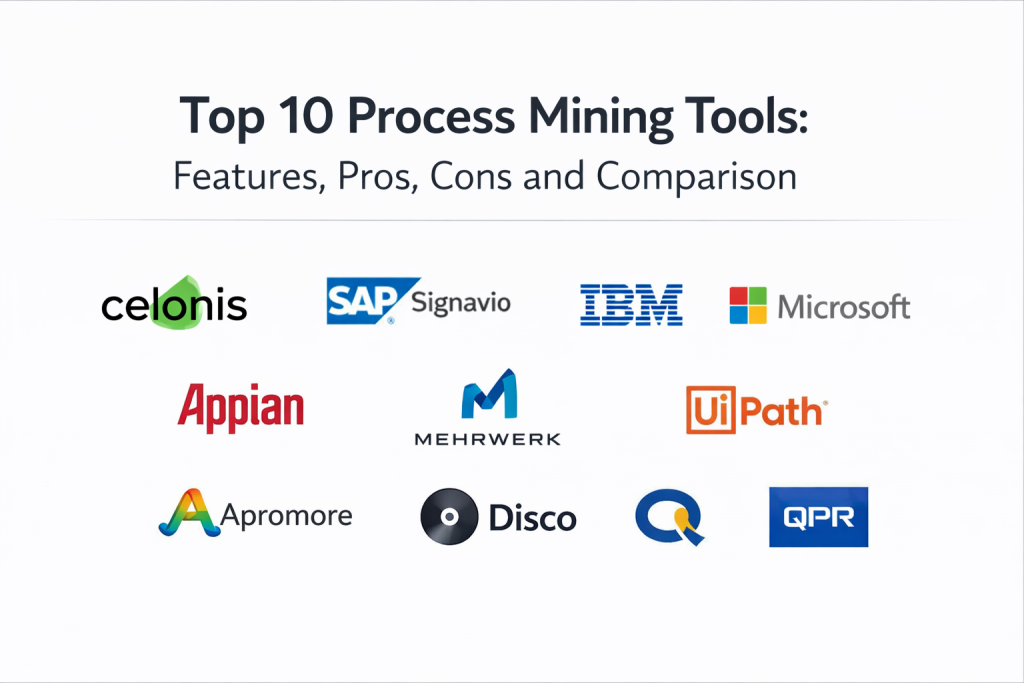
Top 10 Process Mining Tools
1 — Celonis
Overview
Celonis is widely associated with enterprise process mining programs focused on finance, supply chain, and operations. It is commonly used for discovering real process flows, analyzing variants, and driving improvement initiatives at scale.
Key Features
- Process discovery from event logs with variant analysis
- Performance analytics for cycle time, waiting time, and handoff delays
- Conformance checking to compare reality against expected rules
- Root-cause analysis with filtering and drill-down patterns
- Collaboration capabilities for sharing findings (Varies / N/A)
- Large-scale processing for complex enterprise datasets (Varies / N/A)
- Improvement tracking and monitoring patterns (Varies / N/A)
Pros
- Strong enterprise focus for complex, cross-system processes
- Helpful for continuous improvement programs that need depth
Cons
- Successful outcomes depend on event data quality and process ownership
- Can feel heavy for small, early-stage teams without a clear scope
Platforms / Deployment
- Platform: Web (Varies / N/A)
- Deployment: Cloud (Varies / N/A)
Security and Compliance
- Not publicly stated
Integrations and Ecosystem
Celonis is often used with ERP and operational systems to map end-to-end processes.
- ERP and business system connectivity patterns (Varies / N/A)
- Data ingestion through connectors and data pipelines (Varies / N/A)
- Integration into improvement workflows and operational dashboards
Support and Community
Enterprise support is typically available. Community strength varies, but many organizations rely on structured enablement and internal centers of excellence.
2 — SAP Signavio Process Intelligence
Overview
SAP Signavio Process Intelligence is often used by organizations that want process insight aligned with business transformation programs, especially in SAP-centered environments. It is commonly positioned for process discovery and analysis tied to process improvement.
Key Features
- Process discovery and visualization from event data (Varies / N/A)
- Variant analysis to identify deviations and rework patterns
- Performance analytics for throughput and bottleneck visibility
- Conformance checking and compliance-oriented analysis (Varies / N/A)
- Collaboration support for process owners and stakeholders (Varies / N/A)
- Alignment with broader process modeling practices (Varies / N/A)
- Useful for standardizing process understanding across teams
Pros
- Strong fit for transformation programs that need shared process visibility
- Useful when SAP process landscapes are central
Cons
- Best value often depends on how tightly you align it with transformation execution
- Data preparation effort can be significant without clean event logs
Platforms / Deployment
- Platform: Web
- Deployment: Cloud (Varies / N/A)
Security and Compliance
- Not publicly stated
Integrations and Ecosystem
Often used where process insight must connect to enterprise transformation efforts.
- SAP ecosystem alignment patterns (Varies / N/A)
- Data ingestion and mapping to process activities (Varies / N/A)
- Collaboration workflows for process standardization
Support and Community
Support depends on enterprise agreements and partners. Adoption works best with clear process ownership and governance.
3 — IBM Process Mining
Overview
IBM Process Mining is used in enterprise settings to discover real process flows, analyze bottlenecks, and support improvement initiatives. It can be relevant for teams that want process analytics aligned with enterprise automation programs.
Key Features
- Process discovery and visualization from event logs
- Bottleneck detection and cycle time analysis
- Variant analysis and deviation identification
- Conformance checking patterns (Varies / N/A)
- Dashboards and reporting for operational visibility (Varies / N/A)
- Supports improvement measurement over time (Varies / N/A)
- Useful for structured enterprise process programs
Pros
- Good fit for enterprise improvement programs with clear scope
- Can align well with broader automation and operations initiatives
Cons
- Data modeling effort can be non-trivial for complex system landscapes
- Tool success depends on consistent event data and definitions
Platforms / Deployment
- Platform: Varies / N/A
- Deployment: Cloud, Self-hosted, Hybrid (Varies / N/A)
Security and Compliance
- Not publicly stated
Integrations and Ecosystem
Often used with enterprise data sources and operational systems.
- Integration through data pipelines and connectors (Varies / N/A)
- Can support enterprise automation alignment patterns (Varies / N/A)
- Extensibility depends on deployment approach
Support and Community
Enterprise support options vary. Documentation and onboarding effectiveness often depend on implementation approach.
4 — Microsoft Process Mining
Overview
Microsoft Process Mining is often considered by organizations that already rely heavily on Microsoft platforms and want process insights connected to business workflows. It can be relevant for teams looking to connect process discovery to automation and approvals.
Key Features
- Process discovery from event data (Varies / N/A)
- Visualization of paths, variants, and bottlenecks (Varies / N/A)
- Filters and drill-down analytics for root-cause exploration
- Ability to connect insights to workflow improvement work (Varies / N/A)
- Collaboration patterns within productivity ecosystems (Varies / N/A)
- Useful for operational teams standardizing process insights
- Supports continuous monitoring concepts (Varies / N/A)
Pros
- Strong fit for organizations already centered on Microsoft tooling
- Practical when insights must connect quickly to workflow improvements
Cons
- Capability depth and packaging can vary by environment
- Data preparation and event mapping still require careful work
Platforms / Deployment
- Platform: Web (Varies / N/A)
- Deployment: Cloud (Varies / N/A)
Security and Compliance
- Not publicly stated
Integrations and Ecosystem
Often evaluated when teams want process insights close to existing operational tools.
- Works well when event data can be captured consistently (Varies / N/A)
- Integration patterns depend on system landscape and connectors
- Useful for business teams that want shared visibility
Support and Community
Support depends on licensing and agreements. Community resources are broad, but process mining success still needs process ownership and data discipline.
5 — UiPath Process Mining
Overview
UiPath Process Mining is commonly used in automation programs to identify automation candidates, measure impact, and monitor process performance. It is often evaluated when RPA and task automation are already in scope.
Key Features
- Process discovery and variant analysis from event logs
- Bottleneck and throughput analytics
- Automation opportunity identification patterns (Varies / N/A)
- Conformance checking concepts for process compliance (Varies / N/A)
- Monitoring and dashboards to track improvements (Varies / N/A)
- Alignment with automation execution and orchestration workflows (Varies / N/A)
- Useful for building an automation pipeline from insights
Pros
- Strong fit when process mining must feed automation decisions
- Helpful for measuring automation outcomes and process improvements
Cons
- Best value appears when event data and automation execution are connected
- Data ingestion and mapping still need careful implementation
Platforms / Deployment
- Platform: Web (Varies / N/A)
- Deployment: Cloud (Varies / N/A)
Security and Compliance
- Not publicly stated
Integrations and Ecosystem
Often used to connect discovery with automation planning and execution.
- Integrations with automation programs and operational systems (Varies / N/A)
- Can support automation prioritization and benefit tracking
- Extensibility depends on the broader automation stack
Support and Community
Large automation community footprint. Support tiers vary. Strong results typically come from a defined automation operating model.
6 — Appian Process Mining
Overview
Appian Process Mining is often evaluated by organizations building workflow-driven business applications and wanting evidence-based process insight to improve execution. It can be relevant when process mining should connect to workflow changes and case operations.
Key Features
- Process discovery and visualization patterns (Varies / N/A)
- Variant analysis and bottleneck detection
- Performance monitoring to track cycle time and delays
- Conformance checking concepts (Varies / N/A)
- Collaboration features for process stakeholders (Varies / N/A)
- Alignment with workflow and case improvements (Varies / N/A)
- Useful for improving operational execution within process apps
Pros
- Helpful when insights need to translate into workflow changes quickly
- Practical for process owners running operational programs
Cons
- Value depends on event data availability and mapping quality
- Larger enterprises may need strong governance to standardize definitions
Platforms / Deployment
- Platform: Web
- Deployment: Cloud, Self-hosted, Hybrid (Varies / N/A)
Security and Compliance
- Not publicly stated
Integrations and Ecosystem
Often used where process apps and operational workflows need continuous improvement.
- Integration patterns through connectors and services (Varies / N/A)
- Useful for combining process insight with execution changes
- Extensibility depends on platform usage and architecture
Support and Community
Enterprise support is common. Community and templates help, but process mining still requires disciplined data preparation and ownership.
7 — MEHRWERK Process Mining
Overview
MEHRWERK Process Mining is often used in process improvement programs that need discovery, analysis, and practical reporting. It can be relevant for organizations seeking structured process mining capabilities without forcing a single transformation methodology.
Key Features
- Process discovery and variant visualization
- Bottleneck analysis and performance dashboards
- Conformance checking concepts for compliance analysis (Varies / N/A)
- Filtering and drill-down for root-cause analysis
- Reporting and stakeholder-ready insights (Varies / N/A)
- Supports multiple process domains across business functions
- Useful for continuous improvement measurement over time
Pros
- Practical for process transparency and performance measurement
- Useful for teams wanting strong reporting and analysis workflows
Cons
- Data mapping and standardization remain a key effort area
- Ecosystem breadth depends on your integration landscape
Platforms / Deployment
- Platform: Varies / N/A
- Deployment: Cloud, Self-hosted, Hybrid (Varies / N/A)
Security and Compliance
- Not publicly stated
Integrations and Ecosystem
Often used where teams want a direct path from process data to improvement insights.
- Data integration depends on your systems and pipelines (Varies / N/A)
- Useful across finance, operations, and service processes
- Extensibility varies by deployment approach
Support and Community
Support varies by plan. Community is smaller than mass-market platforms, so onboarding and enablement should be evaluated early.
8 — Apromore
Overview
Apromore is often discussed as a process mining platform with strong analytical foundations and flexibility for different process mining approaches. It can be relevant for teams that want robust analysis methods and control over how mining is performed.
Key Features
- Process discovery and variant analysis
- Conformance checking and deviation analysis concepts (Varies / N/A)
- Filtering, clustering, and advanced analytics patterns (Varies / N/A)
- Supports process improvement investigations across domains
- Useful for analysts who need deeper control over mining workflows
- Export and reporting capabilities for stakeholder communication (Varies / N/A)
- Supports ongoing monitoring approaches (Varies / N/A)
Pros
- Strong for analytical depth and investigation-style process mining
- Useful for teams that want more control and flexibility
Cons
- Business teams may need enablement to use advanced features effectively
- Integration and data preparation still require disciplined work
Platforms / Deployment
- Platform: Web (Varies / N/A)
- Deployment: Cloud, Self-hosted, Hybrid (Varies / N/A)
Security and Compliance
- Not publicly stated
Integrations and Ecosystem
Often used in environments where teams want flexible mining approaches.
- Data ingestion depends on event log preparation and pipelines (Varies / N/A)
- Works well for multi-process analysis and investigative work
- Extensibility depends on deployment model and tooling choices
Support and Community
Community signals exist, especially among process mining practitioners. Support tiers vary; evaluate documentation and onboarding for your team’s skill level.
9 — Fluxicon Disco
Overview
Fluxicon Disco is widely known for fast, straightforward process mining analysis that many analysts use for exploration and investigation. It is often chosen for quick insight generation and lightweight mining workflows.
Key Features
- Fast process discovery and visualization from event logs
- Strong filtering and drill-down for variant exploration
- Performance analysis for time between steps and bottlenecks
- Useful for exploratory analysis and investigation workflows
- Simple exportable visuals and analysis views (Varies / N/A)
- Works well for analysts and process improvement specialists
- Designed for rapid, iterative process exploration
Pros
- Very strong for quick analysis and fast time-to-insight
- Good for analysts who want a focused, lightweight tool
Cons
- Enterprise-wide governance and collaboration features may be limited
- Integrations often rely on prepared event logs and analyst workflows
Platforms / Deployment
- Platform: Windows, macOS (Varies / N/A)
- Deployment: Desktop (Varies / N/A)
Security and Compliance
- Not publicly stated
Integrations and Ecosystem
Disco is commonly used with exported event logs from operational systems.
- Works well with CSV-style event data prepared by analysts
- Often paired with BI tools for reporting (Varies / N/A)
- Integration depth depends on how you build your data pipeline
Support and Community
Documentation is typically straightforward. Community is strong among practitioners, but enterprise support models vary.
10 — QPR ProcessAnalyzer
Overview
QPR ProcessAnalyzer is a process mining platform often used to analyze process performance, variants, and compliance across business functions. It is typically considered for structured mining programs that need repeatable reporting and analysis.
Key Features
- Process discovery and variant visualization
- Bottleneck detection and performance analytics
- Conformance checking concepts for compliance analysis (Varies / N/A)
- Reporting and dashboard patterns for process owners
- Root-cause analysis with filtering and segmentation
- Supports multi-process analysis across departments
- Useful for continuous process performance monitoring
Pros
- Practical for repeatable process analytics and reporting
- Useful for organizations building structured mining programs
Cons
- Data preparation effort remains a key success factor
- Ecosystem fit depends on your systems and integration approach
Platforms / Deployment
- Platform: Web (Varies / N/A)
- Deployment: Cloud, Self-hosted, Hybrid (Varies / N/A)
Security and Compliance
- Not publicly stated
Integrations and Ecosystem
Often used where teams want structured analysis across many process areas.
- Data connectivity depends on event log availability (Varies / N/A)
- Works well with standardized event definitions and process catalogs
- Extensibility depends on deployment and integration design
Support and Community
Support varies by plan. Evaluate onboarding, templates, and enablement options based on your team maturity.
Comparison Table
| Tool Name | Best For | Platform(s) Supported | Deployment (Cloud/Self-hosted/Hybrid) | Standout Feature | Public Rating |
|---|---|---|---|---|---|
| Celonis | Large enterprise, cross-system process improvement | Web (Varies / N/A) | Cloud (Varies / N/A) | Deep variant and performance analysis at scale | N/A |
| SAP Signavio Process Intelligence | Transformation programs needing shared process visibility | Web | Cloud (Varies / N/A) | Strong alignment with process standardization | N/A |
| IBM Process Mining | Enterprise process analytics aligned with automation programs | Varies / N/A | Cloud/Self-hosted/Hybrid (Varies / N/A) | Structured enterprise process discovery | N/A |
| Microsoft Process Mining | Microsoft-centered teams connecting insights to workflow improvements | Web (Varies / N/A) | Cloud (Varies / N/A) | Practical fit with productivity ecosystems | N/A |
| UiPath Process Mining | Automation programs prioritizing candidates and measuring impact | Web (Varies / N/A) | Cloud (Varies / N/A) | Strong link between insights and automation | N/A |
| Appian Process Mining | Workflow and case teams improving execution continuously | Web | Cloud/Self-hosted/Hybrid (Varies / N/A) | Insight-to-workflow improvement alignment | N/A |
| MEHRWERK Process Mining | Reporting-driven process transparency programs | Varies / N/A | Cloud/Self-hosted/Hybrid (Varies / N/A) | Practical dashboards and analysis workflows | N/A |
| Apromore | Analytical depth and flexible mining approaches | Web (Varies / N/A) | Cloud/Self-hosted/Hybrid (Varies / N/A) | Strong investigative analysis capabilities | N/A |
| Fluxicon Disco | Fast exploratory mining for analysts | Windows, macOS (Varies / N/A) | Varies / N/A | Very fast time-to-insight for event logs | N/A |
| QPR ProcessAnalyzer | Repeatable process analytics and monitoring programs | Web (Varies / N/A) | Cloud/Self-hosted/Hybrid (Varies / N/A) | Structured reporting and segmentation | N/A |
Evaluation and Scoring of Process Mining Tools
Scoring model:
- Each criterion is scored from 1 to 10 for comparative shortlisting.
- Weighted Total is a directional guide, not a promise of outcomes.
- If you have strict compliance needs, treat that as a requirement rather than a score.
- Always validate results with a real dataset and a real process before standardizing.
Weights:
- Core features – 25%
- Ease of use – 15%
- Integrations & ecosystem – 15%
- Security & compliance – 10%
- Performance & reliability – 10%
- Support & community – 10%
- Price / value – 15%
| Tool Name | Core (25%) | Ease (15%) | Integrations (15%) | Security (10%) | Performance (10%) | Support (10%) | Value (15%) | Weighted Total (0–10) |
|---|---|---|---|---|---|---|---|---|
| Celonis | 9 | 7 | 8 | 7 | 8 | 8 | 6 | 7.70 |
| SAP Signavio Process Intelligence | 8 | 7 | 7 | 7 | 7 | 7 | 6 | 7.05 |
| IBM Process Mining | 8 | 6 | 7 | 7 | 7 | 7 | 6 | 6.85 |
| Microsoft Process Mining | 7 | 8 | 7 | 7 | 7 | 7 | 7 | 7.15 |
| UiPath Process Mining | 8 | 7 | 7 | 6 | 7 | 8 | 6 | 6.95 |
| Appian Process Mining | 7 | 7 | 7 | 6 | 7 | 7 | 6 | 6.70 |
| MEHRWERK Process Mining | 7 | 6 | 6 | 6 | 7 | 6 | 6 | 6.35 |
| Apromore | 8 | 6 | 6 | 6 | 7 | 6 | 7 | 6.85 |
| Fluxicon Disco | 7 | 9 | 5 | 5 | 8 | 6 | 8 | 7.10 |
| QPR ProcessAnalyzer | 7 | 6 | 6 | 6 | 7 | 6 | 6 | 6.35 |
How to interpret these scores:
- Core rewards depth in discovery, variants, conformance, and analytics.
- Ease matters when process owners must self-serve insights, not only analysts.
- Integrations matter when you need many systems and end-to-end event coverage.
- Value is highly dependent on scope, data readiness, and how you operationalize improvements.
Which Process Mining Tool Is Right for You?
Solo / Freelancer
If you are solo, prioritize fast learning, fast analysis, and a clear workflow for building clean event logs. Tools that work well for exploratory mining can help you deliver quick insights and build credibility. Your biggest success factor is not the tool itself, but your ability to define the case ID, activity names, and timestamps consistently.
SMB
SMBs should focus on tools that deliver clear insights without heavy setup. Keep scope tight: one process, one system, one clear objective. SMB success often comes from improving a few high-friction steps rather than trying to mine everything at once. Also ensure you have someone who owns the process and can act on findings.
Mid-Market
Mid-market teams usually need repeatability: standardized event definitions, dashboards for process owners, and a lightweight governance model. Choose a tool that supports segmentation (by product, region, team) and enables repeatable reporting. Strong results come from making process mining a monthly habit, not a one-time project.
Enterprise
Enterprises need scale, governance, and cross-system coverage. Choose a tool that can handle large datasets, variant complexity, and conformance analysis, and that supports stakeholder collaboration. The operating model matters most: define process ownership, define a process catalog, standardize event data, and create a backlog of improvement actions with measurable outcomes.
Budget vs Premium
- Budget-leaning teams should prioritize clarity and speed over advanced enterprise governance features.
- Premium platforms can pay off when improvement value is high, process complexity is large, and many teams rely on consistent outcomes.
- The highest hidden cost is poor data readiness; invest in event data quality early to avoid expensive stalls.
Feature Depth vs Ease of Use
- If your users are analysts, deeper filtering, conformance tools, and advanced segmentation may matter most.
- If your users are process owners, prioritize usability, clear dashboards, and guided insights.
- A common approach is to use an analyst-friendly tool for discovery and a broader platform for ongoing monitoring.
Integrations and Scalability
Choose based on how you will feed event logs over time. If you can only export data manually, process mining becomes a one-off exercise. If you can build a repeatable event pipeline, process mining becomes continuous. Scalability also depends on how you standardize activity naming and case IDs across systems so end-to-end analysis becomes possible.
Security and Compliance Needs
Process mining often touches sensitive operational data. Prioritize role-based access, audit trails, and environment separation. Also define what data is allowed in the event log, how long it is stored, and how you handle sensitive attributes. Strong governance prevents accidental exposure while still enabling meaningful analysis.
Frequently Asked Questions
What is process mining in simple terms?
Process mining reconstructs how work actually flows by reading event logs from systems. It shows real paths, delays, rework loops, and variations so teams can improve based on evidence.
What data do we need to start?
You typically need a case ID, an activity name, and a timestamp for each event. Many teams also add attributes like team, region, or customer segment for deeper analysis.
Why do process mining projects fail?
The most common reasons are poor event data quality, unclear process ownership, and trying to mine too many processes at once. Start narrow and standardize data early.
Is process mining the same as task mining?
No. Process mining is mainly based on system event logs. Task mining often focuses on user-level interactions to understand detailed steps at the desktop level.
How long does it take to get value?
If your data is ready, you can find insights quickly. If data needs cleanup and mapping, time-to-value depends on how fast you can standardize event definitions.
Can process mining prove compliance issues?
It can highlight deviations from expected flows and identify where steps were skipped or delayed. However, the strength of evidence depends on the completeness and accuracy of logs.
How do we choose the first process to mine?
Pick a process with high volume, visible pain, and clear stakeholders. Order-to-cash, procure-to-pay, onboarding, and service workflows are common starting points.
What should we validate in a pilot?
Validate event data correctness, variant clarity, bottleneck signals, and whether insights lead to actionable changes. Also validate access control and reporting needs.
Does process mining replace BPM or workflow tools?
No. Process mining shows what is happening and where to improve. BPM and workflow tools help you implement and govern the improved process execution.
How do we keep process mining continuous?
Build repeatable event pipelines, define a process owner, and create a routine: review insights, prioritize improvements, implement changes, then measure impact in the same tool.
Conclusion
Process mining tools help you move from guesswork to evidence by revealing how processes truly run across systems, teams, and exceptions. The best tool depends on your goals: fast exploratory insight, enterprise-scale transformation, automation-driven improvement, or continuous operational monitoring. Your biggest success factor will almost always be data readiness and ownership, not the platform name. Start with one high-impact process and define your event log carefully so the insights are trustworthy. Then shortlist two or three tools, run a pilot using real data, validate variant and bottleneck findings with process owners, and confirm you can operationalize improvements through governance and repeatable data pipelines.

Best Cardiac Hospitals Near You
Discover top heart hospitals, cardiology centers & cardiac care services by city.
Advanced Heart Care • Trusted Hospitals • Expert Teams
View Best Hospitals