Introduction
Employee scheduling software helps managers plan shifts, assign coverage, publish schedules, handle changes, and track staffing needs across roles, locations, and teams. In simple terms, it solves three daily problems: who is working, when are they working, and do we have enough coverage to meet demand? The best scheduling tools reduce last-minute chaos, lower overtime risk, and improve employee satisfaction by making schedules clear, fair, and easy to manage.
This category matters because scheduling is where operations either run smoothly or fall apart. Missed coverage leads to poor service and burnout. Over-scheduling wastes labor budget. Unclear schedules cause no-shows and disputes. A strong scheduling platform introduces structure with templates, rules, approvals, and self-service, while still staying flexible for real life changes.
Real-world use cases:
- Shift scheduling for retail, healthcare, hospitality, warehouses, and field teams
- Publishing schedules to employees with notifications and confirmations
- Shift swaps, open shifts, and availability management
- Coverage planning to prevent under-staffing and overtime spikes
- Manager approvals and audit-friendly schedule change history concepts
What buyers should evaluate before choosing:
- Scheduling depth (templates, rotations, open shifts, swap workflows, approvals)
- Employee self-service (availability, swap requests, time-off requests, messaging)
- Coverage and demand planning (forecasting concepts, role-based coverage rules)
- Rules and compliance support (break rules concepts, overtime thresholds, fairness rules)
- Multi-location support (locations, departments, roles, permission boundaries)
- Communication tools (notifications, confirmations, shift notes, announcements)
- Time tracking integration (clock-ins, attendance exceptions, payroll exports)
- Reporting (coverage, attendance, overtime trends, staffing efficiency signals)
- Integrations (payroll, HR, POS, identity, APIs, exports)
- Adoption and usability (manager speed, employee mobile experience, low friction)
Best for: organizations with shift-based work, rotating coverage, multiple locations, or frequent schedule changes that need structure plus flexibility.
Not ideal for: small teams with fixed hours and minimal change, where a shared calendar may be enough.
Key Trends in Employee Scheduling Software
- More self-service shift swaps with rule checks to reduce manager workload
- Faster schedule publishing with confirmation and notification workflows
- Greater demand forecasting integration to match staffing to demand signals
- More real-time alerts for overtime risk and coverage gaps
- Better mobile-first experiences for frontline employees
- Stronger role-based permissions for multi-location operations
- More automation for recurring schedules and shift templates
- Increased focus on fairness and transparency in scheduling practices
- Tighter integration with time and attendance for payroll-ready data
- Improved reporting for staffing efficiency and coverage consistency
How We Selected These Tools
- Strong adoption in shift-based scheduling across multiple industries
- Practical scheduling workflows: create, publish, change, approve, audit concepts
- Employee self-service depth for availability, swaps, and communication
- Support for multi-location and multi-role scheduling needs
- Integration readiness with payroll, HR, and time capture workflows
- Balanced selection across lightweight scheduling tools and enterprise suites
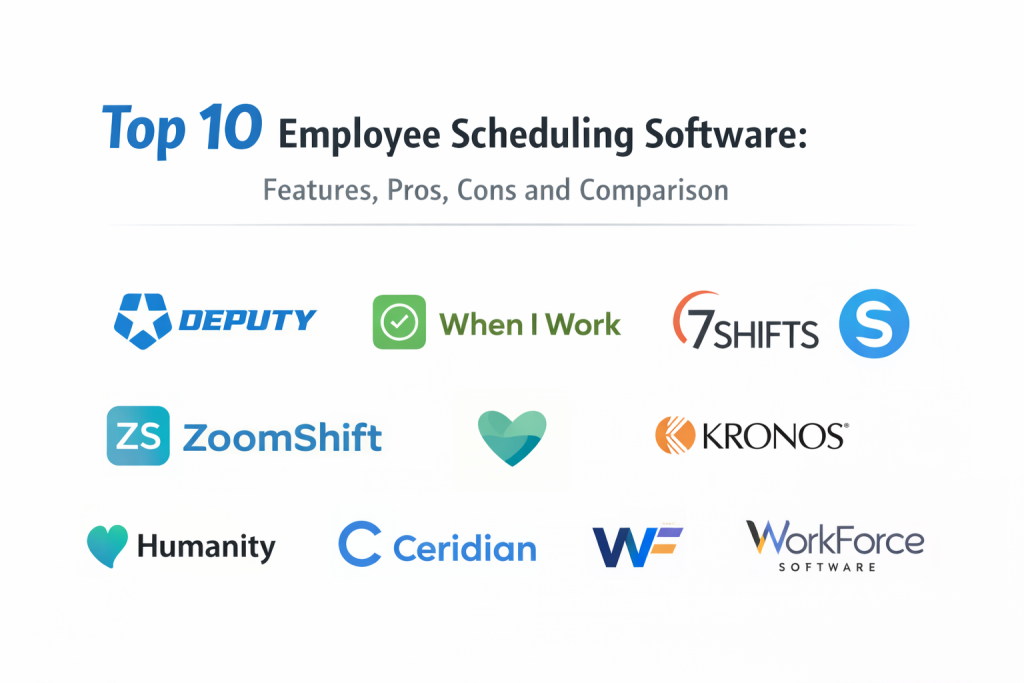
Top 10 Employee Scheduling Software
1 — Deputy
Deputy is widely used for shift scheduling with strong mobile self-service, fast schedule building, and clear communication. It fits retail, hospitality, services, and multi-location teams.
Key Features
- Shift scheduling with templates and open shifts (Varies / N/A)
- Availability management and employee self-service (Varies / N/A)
- Shift swap requests with manager approvals concepts (Varies / N/A)
- Notifications and schedule publishing workflows (Varies / N/A)
- Role and location-based scheduling concepts (Varies / N/A)
- Time and attendance connection concepts (Varies / N/A)
- Reporting for coverage and scheduling patterns (Varies / N/A)
Pros
- Fast adoption with strong mobile experience
- Self-service features reduce manager scheduling workload
Cons
- Advanced enterprise labor optimization can be limited
- Deep HR governance may require a broader suite
Platforms / Deployment
- Platform(s): Web, iOS, Android (Varies / N/A)
- Deployment: Cloud
Security and Compliance
Not publicly stated
Integrations and Ecosystem
Often paired with payroll and operational systems depending on industry setup.
- Payroll and HR integrations vary (Varies / N/A)
- POS and operational tool integrations depend on environment (Varies / N/A)
- APIs and export workflows vary by plan (Varies / N/A)
Support and Community
Typically easy onboarding. Support tiers vary by plan.
2 — When I Work
When I Work focuses on scheduling simplicity and communication for shift teams. It fits teams that need quick schedules, clear notifications, and smooth shift swap workflows.
Key Features
- Scheduling with templates and team visibility (Varies / N/A)
- Employee self-service for availability and swaps (Varies / N/A)
- Messaging for announcements and schedule updates (Varies / N/A)
- Manager approvals for swaps and changes concepts (Varies / N/A)
- Multi-location and role concepts depending on setup (Varies / N/A)
- Time clock and attendance connection concepts (Varies / N/A)
- Reporting for hours and coverage signals (Varies / N/A)
Pros
- Simple schedule building and strong team communication
- Easy to deploy for shift teams
Cons
- Advanced forecasting and complex labor rule support may be limited
- Deep enterprise permission models may require bigger suites
Platforms / Deployment
- Platform(s): Web, iOS, Android (Varies / N/A)
- Deployment: Cloud
Security and Compliance
Not publicly stated
Integrations and Ecosystem
Commonly used with payroll tools depending on business needs.
- Payroll integrations vary by environment (Varies / N/A)
- Export workflows depend on payroll stack (Varies / N/A)
- APIs and connectors vary by plan (Varies / N/A)
Support and Community
Support depends on plan. Adoption improves with standardized scheduling habits.
3 — Homebase
Homebase is often used by small businesses for scheduling, time clocks, and team communication. It fits retail, restaurants, and service teams that need straightforward scheduling with minimal overhead.
Key Features
- Scheduling templates and shift publishing workflows (Varies / N/A)
- Employee availability management concepts (Varies / N/A)
- Shift swaps and manager approvals concepts (Varies / N/A)
- Time clock integration concepts (Varies / N/A)
- Messaging for schedule updates (Varies / N/A)
- Basic labor cost and hours reporting signals (Varies / N/A)
- Useful for small teams wanting fast setup
Pros
- Easy for small businesses to adopt quickly
- Helpful combination of scheduling and basic workforce workflows
Cons
- Advanced multi-location enterprise features may be limited
- Deep forecasting and labor optimization may be limited
Platforms / Deployment
- Platform(s): Web, iOS, Android (Varies / N/A)
- Deployment: Cloud
Security and Compliance
Not publicly stated
Integrations and Ecosystem
Often used with payroll services and small business systems.
- Payroll integrations vary (Varies / N/A)
- Export workflows depend on environment (Varies / N/A)
- Integrations vary by plan and setup (Varies / N/A)
Support and Community
Support tiers vary. Onboarding is generally straightforward for small teams.
4 — 7shifts
7shifts is widely used for restaurant scheduling with features designed for shift-based hospitality operations. It fits teams needing scheduling, communication, and labor awareness in a restaurant-focused workflow.
Key Features
- Restaurant-friendly scheduling templates and rotations (Varies / N/A)
- Employee availability and shift swap workflows (Varies / N/A)
- Communication tools for shift notes and announcements (Varies / N/A)
- Labor awareness and reporting signals (Varies / N/A)
- Manager approvals and schedule change workflows (Varies / N/A)
- Role-based scheduling for positions and stations concepts (Varies / N/A)
- Useful for multi-location restaurant operations
Pros
- Strong industry fit for restaurants and shift-based hospitality
- Helpful communication features that reduce schedule confusion
Cons
- Best fit is hospitality; other industries may prefer more general platforms
- Deep enterprise HR governance may require broader suites
Platforms / Deployment
- Platform(s): Web, iOS, Android (Varies / N/A)
- Deployment: Cloud
Security and Compliance
Not publicly stated
Integrations and Ecosystem
Often paired with POS and payroll tools in restaurant operations.
- POS integrations vary by environment (Varies / N/A)
- Payroll and export workflows depend on setup (Varies / N/A)
- APIs and connectors vary by plan (Varies / N/A)
Support and Community
Strong onboarding for restaurants. Support tiers vary by plan.
5 — Sling
Sling supports scheduling, shift swaps, and communication for shift teams. It fits teams that want simple scheduling and easy coordination without heavy configuration.
Key Features
- Shift scheduling with templates and recurring schedules (Varies / N/A)
- Employee availability and swap requests (Varies / N/A)
- Team messaging and announcements (Varies / N/A)
- Basic labor cost and hours visibility signals (Varies / N/A)
- Multi-location support concepts (Varies / N/A)
- Approvals concepts for schedule changes (Varies / N/A)
- Useful for small and mid shift operations
Pros
- Simple and fast scheduling workflows
- Good communication features for shift coordination
Cons
- Advanced forecasting and labor optimization may be limited
- Deep compliance rule handling may require workforce suites
Platforms / Deployment
- Platform(s): Web, iOS, Android (Varies / N/A)
- Deployment: Cloud
Security and Compliance
Not publicly stated
Integrations and Ecosystem
Often used alongside payroll tools depending on team needs.
- Integrations vary by environment (Varies / N/A)
- Export workflows depend on payroll stack (Varies / N/A)
- APIs and automation vary by plan (Varies / N/A)
Support and Community
Support depends on plan. Adoption improves with clear scheduling rules and training.
6 — ZoomShift
ZoomShift provides scheduling and shift management for hourly teams, with a focus on clean mobile experiences and simple workflows. It fits small-to-mid teams needing clarity and ease.
Key Features
- Scheduling templates and shift publishing workflows (Varies / N/A)
- Employee availability, time-off requests, and swaps (Varies / N/A)
- Notifications and reminders for shift confirmations (Varies / N/A)
- Role-based scheduling concepts (Varies / N/A)
- Basic reporting for schedules and hours signals (Varies / N/A)
- Time tracking connection concepts (Varies / N/A)
- Useful for teams that want fast adoption
Pros
- Simple scheduling with strong employee usability
- Helpful self-service for availability and swaps
Cons
- Advanced enterprise reporting may be limited
- Deep labor forecasting and optimization may be limited
Platforms / Deployment
- Platform(s): Web, iOS, Android (Varies / N/A)
- Deployment: Cloud
Security and Compliance
Not publicly stated
Integrations and Ecosystem
Often used with payroll tools and operational systems depending on environment.
- Integrations vary by setup (Varies / N/A)
- Export workflows depend on payroll environment (Varies / N/A)
- APIs and connectors vary by plan (Varies / N/A)
Support and Community
Support tiers vary. Implementation is usually straightforward.
7 — Humanity
Humanity is a scheduling tool used for shift planning, employee availability, and coverage management. It fits teams that need structured scheduling and clear self-service workflows.
Key Features
- Shift scheduling with templates and rotations concepts (Varies / N/A)
- Availability management and time-off requests (Varies / N/A)
- Shift swaps and manager approvals concepts (Varies / N/A)
- Coverage planning and staffing visibility signals (Varies / N/A)
- Reporting for hours and scheduling trends (Varies / N/A)
- Time tracking and attendance connection concepts (Varies / N/A)
- Useful for teams needing structured scheduling workflows
Pros
- Good scheduling structure for recurring shift operations
- Helpful availability and time-off request workflows
Cons
- Advanced forecasting features may be limited
- Deep enterprise governance may require larger suites
Platforms / Deployment
- Platform(s): Web, iOS, Android (Varies / N/A)
- Deployment: Cloud
Security and Compliance
Not publicly stated
Integrations and Ecosystem
Often used with payroll and time tracking environments depending on needs.
- Integrations vary by environment (Varies / N/A)
- Export workflows depend on payroll setup (Varies / N/A)
- APIs and connectors vary by plan (Varies / N/A)
Support and Community
Support depends on plan. Adoption improves with consistent schedule templates.
8 — Kronos Workforce Ready
Kronos Workforce Ready is used for scheduling and workforce workflows in organizations that need stronger policy control and structured approvals. It fits teams that want scheduling connected to attendance and payroll readiness.
Key Features
- Scheduling workflows with policy-aware controls concepts (Varies / N/A)
- Attendance and time capture integration concepts (Varies / N/A)
- Manager approvals for schedule changes and exceptions (Varies / N/A)
- Employee self-service for schedules and requests (Varies / N/A)
- Reporting for coverage, overtime risk, and labor signals (Varies / N/A)
- Multi-location governance and role-based access concepts (Varies / N/A)
- Useful for organizations with structured workforce operations
Pros
- Strong fit when scheduling must align with attendance and policy controls
- Useful governance for multi-location operations
Cons
- Can be more complex than lightweight scheduling-only tools
- Configuration effort depends on policy complexity
Platforms / Deployment
- Platform(s): Web, iOS, Android (Varies / N/A)
- Deployment: Cloud (Varies / N/A)
Security and Compliance
Not publicly stated
Integrations and Ecosystem
Often used with payroll and HR workflows where data consistency is important.
- Payroll and HR integrations vary (Varies / N/A)
- Device and attendance workflows depend on setup (Varies / N/A)
- APIs and reporting pipelines vary by configuration (Varies / N/A)
Support and Community
Enterprise support orientation. Success improves with policy clarity and training.
9 — Ceridian Dayforce
Ceridian Dayforce supports scheduling and workforce operations with strong alignment to attendance and payroll readiness. It fits organizations that need manager controls, approvals, and policy-driven workforce workflows.
Key Features
- Scheduling and shift planning workflows (Varies / N/A)
- Time and attendance integration concepts (Varies / N/A)
- Policy rules for labor compliance concepts (Varies / N/A)
- Exception handling and manager approvals patterns (Varies / N/A)
- Reporting for overtime risk and attendance signals (Varies / N/A)
- Employee self-service for schedules and requests (Varies / N/A)
- Useful for workforce operations with policy-driven governance
Pros
- Strong policy-driven workforce workflows and approvals
- Helpful reporting for overtime and coverage risk visibility
Cons
- Configuration effort depends on labor rules and enterprise needs
- May be more than needed for scheduling-only use cases
Platforms / Deployment
- Platform(s): Web, iOS, Android (Varies / N/A)
- Deployment: Cloud (Varies / N/A)
Security and Compliance
Not publicly stated
Integrations and Ecosystem
Often used where scheduling must connect to attendance and payroll processing.
- Integrations depend on business environment (Varies / N/A)
- Exports and reporting pipelines vary by configuration (Varies / N/A)
- APIs support automation and analytics workflows (Varies / N/A)
Support and Community
Enterprise support model. Implementation and training are important for adoption.
10 — WorkForce Software
WorkForce Software supports scheduling for organizations with complex coverage needs, labor rules, and multi-location operations. It fits teams requiring stronger controls and structured scheduling governance.
Key Features
- Advanced scheduling and coverage planning concepts (Varies / N/A)
- Labor rule configuration for compliance concepts (Varies / N/A)
- Employee self-service for availability and requests (Varies / N/A)
- Manager approvals and schedule change workflows (Varies / N/A)
- Reporting for coverage, labor costs, and staffing signals (Varies / N/A)
- Multi-location governance and role-based access concepts (Varies / N/A)
- Useful for complex scheduling environments
Pros
- Strong fit for complex coverage planning and labor rule needs
- Helpful governance for large multi-location operations
Cons
- Implementation effort can be significant
- May be heavy for small teams with simple schedules
Platforms / Deployment
- Platform(s): Web, iOS, Android (Varies / N/A)
- Deployment: Cloud (Varies / N/A)
Security and Compliance
Not publicly stated
Integrations and Ecosystem
Often integrated with HR and payroll to keep schedule and attendance data consistent.
- HR and payroll integrations vary (Varies / N/A)
- Export workflows depend on configuration (Varies / N/A)
- APIs support automation and reporting pipelines (Varies / N/A)
Support and Community
Enterprise support orientation. Success improves with standardized scheduling policies.
Comparison Table
| Tool Name | Best For | Platform(s) Supported | Deployment (Cloud/Self-hosted/Hybrid) | Standout Feature | Public Rating |
|---|---|---|---|---|---|
| Deputy | Shift scheduling with strong self-service and fast adoption | Web, iOS, Android (Varies / N/A) | Cloud | Mobile-first scheduling and swaps | N/A |
| When I Work | Simple scheduling plus team communication | Web, iOS, Android (Varies / N/A) | Cloud | Messaging and schedule visibility | N/A |
| Homebase | Small business scheduling with time clock options | Web, iOS, Android (Varies / N/A) | Cloud | Easy setup for small teams | N/A |
| 7shifts | Restaurant scheduling with hospitality workflows | Web, iOS, Android (Varies / N/A) | Cloud | Restaurant-focused scheduling workflows | N/A |
| Sling | Scheduling plus communication for shift teams | Web, iOS, Android (Varies / N/A) | Cloud | Recurring schedules and messaging | N/A |
| ZoomShift | Simple scheduling for hourly teams | Web, iOS, Android (Varies / N/A) | Cloud | Clean employee self-service workflows | N/A |
| Humanity | Structured scheduling with availability management | Web, iOS, Android (Varies / N/A) | Cloud | Shift templates and availability workflows | N/A |
| Kronos Workforce Ready | Policy-aware scheduling linked to attendance | Web, iOS, Android (Varies / N/A) | Cloud (Varies / N/A) | Scheduling aligned to workforce policies | N/A |
| Ceridian Dayforce | Policy-driven scheduling with payroll readiness focus | Web, iOS, Android (Varies / N/A) | Cloud (Varies / N/A) | Strong approval and policy workflows | N/A |
| WorkForce Software | Complex scheduling and coverage planning at scale | Web, iOS, Android (Varies / N/A) | Cloud (Varies / N/A) | Advanced coverage and governance | N/A |
Evaluation and Scoring of Employee Scheduling Software
Scoring model:
- Each criterion uses a 1–10 score for comparative shortlisting.
- Weighted Total is a directional estimate across this list, not a verified public rating.
- Use scoring to shortlist, then validate with a pilot using real shift patterns, swap workflows, and policy constraints.
- Treat must-haves like multi-location support, self-service swaps, and overtime controls as filters before scoring.
Weights:
- Core features – 25%
- Ease of use – 15%
- Integrations and ecosystem – 15%
- Security and compliance – 10%
- Performance and reliability – 10%
- Support and community – 10%
- Price / value – 15%
| Tool Name | Core (25%) | Ease (15%) | Integrations (15%) | Security (10%) | Performance (10%) | Support (10%) | Value (15%) | Weighted Total (0–10) |
|---|---|---|---|---|---|---|---|---|
| Deputy | 8 | 8 | 7 | 6 | 7 | 7 | 7 | 7.45 |
| When I Work | 7 | 8 | 6 | 6 | 7 | 7 | 7 | 7.05 |
| Homebase | 7 | 8 | 6 | 6 | 7 | 7 | 7 | 7.05 |
| 7shifts | 7 | 8 | 6 | 6 | 7 | 7 | 7 | 7.05 |
| Sling | 7 | 8 | 6 | 6 | 7 | 7 | 7 | 7.05 |
| ZoomShift | 7 | 8 | 6 | 6 | 7 | 7 | 7 | 7.05 |
| Humanity | 7 | 7 | 6 | 6 | 7 | 7 | 6 | 6.75 |
| Kronos Workforce Ready | 8 | 6 | 7 | 7 | 7 | 7 | 5 | 6.80 |
| Ceridian Dayforce | 8 | 6 | 7 | 7 | 7 | 7 | 5 | 6.80 |
| WorkForce Software | 8 | 6 | 7 | 7 | 7 | 7 | 5 | 6.80 |
How to interpret these scores:
- Core rewards scheduling depth, templates, swaps, approvals, and coverage control.
- Ease matters because managers build schedules and employees interact daily.
- Integrations matter when schedules must connect to attendance, payroll, and operations.
- Value depends on workforce size, schedule volatility, and the cost of missed coverage and overtime.
Which Employee Scheduling Software Is Right for You?
Solo / Freelancer
Most solo workers do not need scheduling software. If you manage a few part-time staff, choose a simple tool that publishes schedules clearly and supports availability and swap requests without complexity.
SMB
SMBs often need quick schedule building, clear communication, and easy shift swaps. Deputy and When I Work are strong fits when adoption and simplicity matter. Homebase and Sling can work well for small operations wanting scheduling plus basic workforce workflows. Choose the tool that your managers can build schedules in quickly and your staff will actually use on mobile.
Mid-Market
Mid-market organizations typically face multi-location complexity, frequent changes, and overtime risk. Humanity can work when you want structured scheduling. Kronos Workforce Ready can fit when scheduling must align with attendance and policy controls. Ceridian Dayforce becomes relevant when approvals, policy rules, and payroll readiness need stronger governance.
Enterprise
Enterprises usually need policy-driven scheduling, complex coverage planning, and integration with HR and payroll systems. WorkForce Software can fit where coverage planning and multi-location governance are complex. Ceridian Dayforce and Kronos Workforce Ready can fit when scheduling must tie closely to attendance and compliance workflows. Enterprises should focus on standard templates, role-based permissions, and consistent scheduling policies across locations.
Budget vs Premium
- Budget-first teams should prioritize adoption and quick schedule publishing.
- Premium tools are justified when policy controls, integration, and coverage planning reduce overtime waste and missed coverage.
- The real cost is scheduling chaos; choose the tool that removes the most friction.
Feature Depth vs Ease of Use
- If your pain is “constant shift changes,” prioritize swaps, open shifts, and strong mobile self-service.
- If your pain is “overtime surprises,” prioritize rule alerts and coverage dashboards.
- If your pain is “manager workload,” prioritize templates, recurring schedules, and automation.
Integrations and Scalability
Scheduling becomes more powerful when it connects to time and attendance, payroll, and operational systems. Validate that roles, locations, and departments map cleanly, and test how schedules flow into attendance capture and pay codes. For scalability, test multi-location permissions, performance with large employee counts, and how easily templates can be standardized across sites.
Security and Compliance Needs
Security details vary by vendor. Focus on role-based access, change history concepts for schedule edits, and clear approval rules for swaps and exceptions. Also define internal policies for data access and schedule fairness to maintain trust and reduce disputes.
Frequently Asked Questions
What is employee scheduling software used for?
It is used to build and publish shift schedules, manage availability, handle swaps and open shifts, and keep coverage aligned to staffing needs.
How do shift swaps work?
Employees request swaps or open shifts, and managers approve based on coverage rules and policy constraints, depending on the tool setup.
Do scheduling tools prevent overtime?
They can help by showing coverage gaps and overtime risk early, alerting managers, and supporting smarter staffing decisions.
Should scheduling include roles and skills?
Yes, when coverage depends on skill sets. Role-based scheduling reduces mistakes and improves service quality.
What is the biggest scheduling mistake teams make?
Overcomplicating the schedule structure. Too many roles, rules, and exceptions can slow managers and confuse employees.
Do we need scheduling if we already have time tracking?
Time tracking records hours worked. Scheduling plans coverage and shifts. Many operations need both for smooth staffing and payroll accuracy.
How do we increase employee adoption?
Use a mobile-friendly tool, publish schedules consistently, enable self-service swaps, and keep policies transparent and fair.
What should we test in a scheduling pilot?
Schedule building speed, mobile employee experience, swap workflow quality, notification reliability, and reporting accuracy for hours and coverage.
How do we handle last-minute call-outs?
Use open shifts, broadcast notifications, swap requests, and manager approval flows. Strong communication features matter most here.
Can scheduling tools work across multiple locations?
Yes, many support multi-location operations with role-based permissions. Validate permission boundaries and reporting during a pilot.
Conclusion
Employee scheduling software reduces operational chaos by making shifts clear, coverage predictable, and schedule changes manageable. The best tool depends on how often your schedules change, how many locations you manage, and how strict your coverage and labor policies are. Some teams succeed with simple, mobile-first platforms that staff adopt quickly and managers can use without training overload. Others need stronger governance, policy rules, and integration with attendance and payroll workflows to prevent overtime and reduce rework. A practical next step is to shortlist two or three tools, run a pilot using real shift patterns and swap requests, and validate how fast managers can build schedules and how reliably employees receive updates. Confirm that permissions work across locations, and that reporting helps you spot coverage gaps early. When scheduling becomes consistent and transparent, teams experience fewer no-shows, lower overtime surprises, and smoother daily operations.

Best Cardiac Hospitals Near You
Discover top heart hospitals, cardiology centers & cardiac care services by city.
Advanced Heart Care • Trusted Hospitals • Expert Teams
View Best Hospitals