Introduction
Human Capital Management (HCM) suites are platforms that help organizations manage the full employee lifecycle in one place. In plain English, they keep your people data accurate, your HR processes consistent, and your workforce operations easier to run. A typical HCM suite covers core HR records, onboarding, time off, performance, compensation, reporting, and often payroll or strong payroll connections. Instead of spreading HR work across spreadsheets and disconnected tools, an HCM suite creates one system of record with structured workflows and approvals.
This category matters because people operations become complex as soon as headcount grows. You start dealing with policy consistency, promotions, transfers, compliance documents, approvals, and reporting demands from leadership. If data is scattered, HR teams spend time fixing mismatches rather than improving employee experience. A good HCM suite reduces rework, supports better decisions, and makes audits and reporting simpler.
Real-world use cases:
- Maintaining a single employee record across teams, locations, and departments
- Onboarding workflows with documents, tasks, and approvals
- Time off policies, approvals, and balances across different employee types
- Performance cycles, goal tracking, and manager reviews
- Compensation changes, job changes, and workforce reporting for leadership
What buyers should evaluate before choosing:
- Core HR depth (employee records, job history, org structure, workflows)
- Onboarding and offboarding (tasks, templates, documents, approvals)
- Time off management (policies, accrual concepts, approvals, visibility)
- Performance and talent workflows (goals, reviews, calibration concepts)
- Compensation management (cycles, approvals, audit history concepts)
- Payroll fit (native payroll or reliable payroll integrations)
- Reporting and analytics (dashboards, exports, workforce insights)
- Integrations (identity, payroll, finance, IT systems, APIs, connectors)
- Security controls (role-based access, audit logs, sensitive data handling)
- Scalability and governance (multi-entity, multi-location, permissions, admin load)
Best for: growing organizations that want consistent HR workflows, accurate employee data, better reporting, and strong governance across the employee lifecycle.
Not ideal for: very small teams with minimal HR processes and fixed policies, where a simple HR tracker and basic payroll setup are enough.
Key Trends in Human Capital Management Suites
- Stronger workflow automation for approvals, job changes, and policy enforcement
- More employee self-service to reduce HR ticket volume
- Better analytics for headcount, attrition signals, and workforce planning
- Increased focus on role-based access and sensitive data segmentation
- Tighter integration with IT operations for onboarding and offboarding tasks
- More configurable policy handling for different regions and worker types
- Greater emphasis on consistent data governance to reduce reporting conflicts
- Better mobile experiences for employees and managers
- More unified suites that connect HR, time, and payroll operations
- Higher expectations for fast implementation and clean integrations
How We Selected These Tools
- Strong market adoption and recognition as HCM suites
- Practical coverage of core HR plus adjacent processes like time off, performance, and compensation
- Evidence of scalability across different organization sizes and industries
- Integration readiness with payroll, identity, finance, and IT workflows
- Balance across enterprise suites and modern mid-market platforms
- Emphasis on usability, governance, and reporting depth
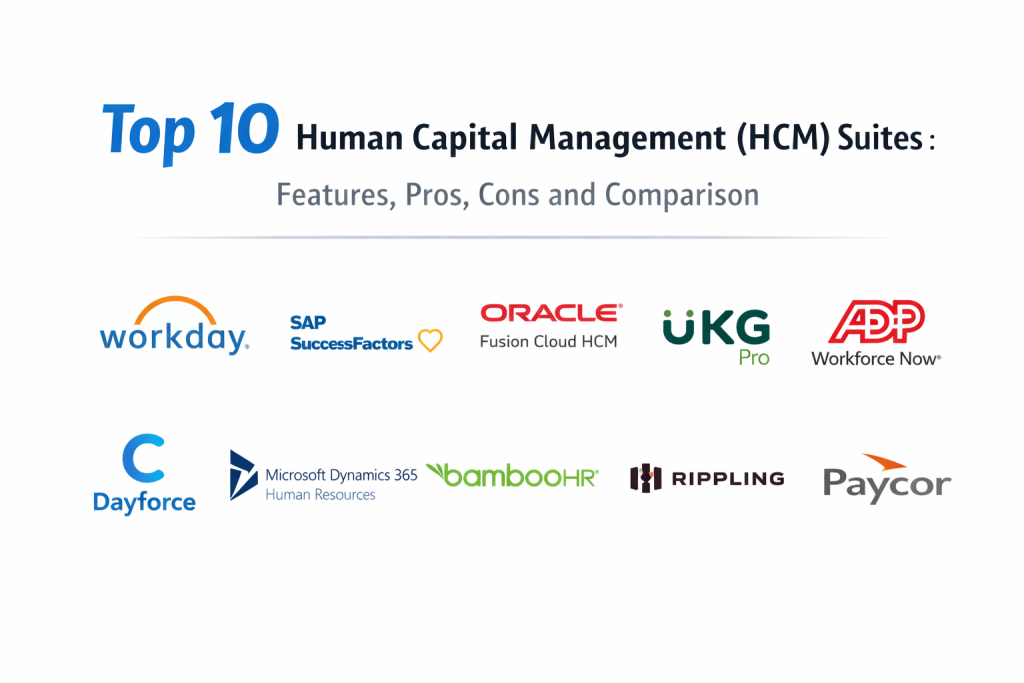
Top 10 Human Capital Management Suites
1 — Workday HCM
Workday HCM is an enterprise-focused suite designed to manage core HR data, organizational structure, approvals, and workforce reporting. It fits organizations that need strong governance, standardized processes, and scalable workflows across departments.
Key Features
- Centralized employee system of record with structured workflows (Varies / N/A)
- Job and org management with approvals and audit history concepts (Varies / N/A)
- Time off and leave policy management concepts (Varies / N/A)
- Performance and talent workflows concepts (Varies / N/A)
- Compensation planning cycles with approvals concepts (Varies / N/A)
- Reporting and analytics dashboards for workforce insights (Varies / N/A)
- Role-based permissions and governance controls concepts (Varies / N/A)
Pros
- Strong governance for complex organizations and policy consistency
- Powerful reporting structure when data standards are well managed
Cons
- Implementation and configuration effort can be significant
- Can be heavier than needed for simpler HR environments
Platforms / Deployment
- Platform(s): Web, iOS, Android (Varies / N/A)
- Deployment: Cloud (Varies / N/A)
Security and Compliance
Not publicly stated
Integrations and Ecosystem
Workday commonly connects to identity systems, payroll providers, finance workflows, and IT onboarding processes.
- Identity and access integrations concepts (Varies / N/A)
- Payroll and finance integration patterns (Varies / N/A)
- APIs for automation and reporting pipelines (Varies / N/A)
Support and Community
Enterprise support model. Success improves with strong governance ownership, training, and clear HR process design.
2 — SAP SuccessFactors
SAP SuccessFactors is a widely adopted HCM suite used for core HR, talent processes, and enterprise workforce governance. It fits organizations that want standardized HR processes and broad coverage across HR functions.
Key Features
- Core HR with employee records and structured workflows (Varies / N/A)
- Time off and policy management concepts (Varies / N/A)
- Performance and goal management concepts (Varies / N/A)
- Talent and development workflows concepts (Varies / N/A)
- Compensation planning workflows concepts (Varies / N/A)
- Workforce reporting aligned to HR analytics concepts (Varies / N/A)
- Role-based access and enterprise governance concepts (Varies / N/A)
Pros
- Strong enterprise fit for standardized HR and talent processes
- Broad suite coverage when you want many HR functions aligned
Cons
- Configuration can become complex across many modules
- User experience quality depends on setup and process design
Platforms / Deployment
- Platform(s): Web, iOS, Android (Varies / N/A)
- Deployment: Cloud (Varies / N/A)
Security and Compliance
Not publicly stated
Integrations and Ecosystem
Often used in enterprise environments where HR data must connect to ERP, payroll, and identity workflows.
- ERP and finance integration patterns (Varies / N/A)
- Payroll connections vary by environment (Varies / N/A)
- APIs and connectors depend on configuration (Varies / N/A)
Support and Community
Enterprise support orientation. Adoption improves when processes are standardized and training is consistent.
3 — Oracle Fusion Cloud HCM
Oracle Fusion Cloud HCM is an enterprise suite that supports core HR processes, workforce governance, and reporting across large organizations. It fits teams that want HR processes aligned to broader enterprise systems and controls.
Key Features
- Core HR system of record with governance workflows (Varies / N/A)
- Workforce structure and job change approvals concepts (Varies / N/A)
- Time off and absence management concepts (Varies / N/A)
- Performance management workflows concepts (Varies / N/A)
- Compensation processes and approvals concepts (Varies / N/A)
- Workforce reporting and analytics concepts (Varies / N/A)
- Role-based permissions for sensitive HR data concepts (Varies / N/A)
Pros
- Strong enterprise governance and reporting alignment
- Useful when HR must connect closely to broader enterprise operations
Cons
- Implementation complexity can be high
- Can be heavy for small teams with simpler HR needs
Platforms / Deployment
- Platform(s): Web, iOS, Android (Varies / N/A)
- Deployment: Cloud (Varies / N/A)
Security and Compliance
Not publicly stated
Integrations and Ecosystem
Often used where HR data must integrate with finance, identity, and operational systems.
- ERP and finance integration patterns (Varies / N/A)
- Payroll and time system connections vary (Varies / N/A)
- APIs for automation and reporting pipelines (Varies / N/A)
Support and Community
Enterprise support model. Strong implementation planning and governance improve long-term success.
4 — UKG Pro
UKG Pro is used for HR and workforce-focused operations where time, attendance, and HR processes need to align cleanly. It fits organizations that care about workforce operations, manager workflows, and structured employee self-service.
Key Features
- Core HR records and employee lifecycle workflows concepts (Varies / N/A)
- Time and attendance alignment concepts depending on setup (Varies / N/A)
- Employee self-service for profile updates and requests concepts (Varies / N/A)
- Manager workflows for approvals and changes concepts (Varies / N/A)
- Reporting for workforce signals and HR metrics concepts (Varies / N/A)
- Role-based access for HR and managers concepts (Varies / N/A)
- Scalable multi-location operations concepts (Varies / N/A)
Pros
- Strong fit when workforce operations and HR workflows must connect
- Practical manager workflows and employee self-service patterns
Cons
- Feature depth varies by modules and configuration
- Large deployments require disciplined process governance
Platforms / Deployment
- Platform(s): Web, iOS, Android (Varies / N/A)
- Deployment: Cloud (Varies / N/A)
Security and Compliance
Not publicly stated
Integrations and Ecosystem
Often used with payroll, identity, and time capture ecosystems depending on organizational needs.
- Payroll and finance integrations vary (Varies / N/A)
- Device and attendance integrations depend on environment (Varies / N/A)
- APIs and connectors vary by plan (Varies / N/A)
Support and Community
Support model varies by plan. Adoption improves with clear HR ownership and standardized policies.
5 — ADP Workforce Now
ADP Workforce Now is often adopted as an HR and payroll-connected suite for organizations that want structured HR processes and reliable workforce reporting. It fits teams that want HR operations tied closely to payroll routines and approvals.
Key Features
- Core HR records and employee change workflows concepts (Varies / N/A)
- Payroll-aligned HR workflows concepts depending on setup (Varies / N/A)
- Time and attendance connections concepts (Varies / N/A)
- Employee self-service for documents and updates concepts (Varies / N/A)
- Manager dashboards for approvals and workforce visibility concepts (Varies / N/A)
- HR reporting for headcount and workforce metrics concepts (Varies / N/A)
- Role-based access controls concepts (Varies / N/A)
Pros
- Strong alignment between HR workflows and payroll operations
- Practical structure for approvals and standardized processes
Cons
- Advanced talent workflows may vary by module and plan
- Reporting flexibility depends on configuration and governance
Platforms / Deployment
- Platform(s): Web, iOS, Android (Varies / N/A)
- Deployment: Cloud (Varies / N/A)
Security and Compliance
Not publicly stated
Integrations and Ecosystem
Often selected when HR data must connect to payroll and finance operations with minimal rework.
- Payroll and finance integrations vary (Varies / N/A)
- Time system integrations depend on setup (Varies / N/A)
- APIs and export pipelines vary by plan (Varies / N/A)
Support and Community
Support tiers vary. Strong payroll calendars and clean data standards improve outcomes.
6 — Ceridian Dayforce
Ceridian Dayforce is used for HR and workforce operations where time, attendance, scheduling, and payroll-related processes need consistent governance. It fits organizations that want operational control and strong manager workflows.
Key Features
- Core HR records and employee lifecycle workflows concepts (Varies / N/A)
- Workforce operations alignment with time and attendance concepts (Varies / N/A)
- Manager approvals and exception handling workflows concepts (Varies / N/A)
- Employee self-service for requests and updates concepts (Varies / N/A)
- Workforce reporting for attendance and labor signals concepts (Varies / N/A)
- Role-based permissions and governance controls concepts (Varies / N/A)
- Scalable workflows for multi-location operations concepts (Varies / N/A)
Pros
- Strong operational workflows and approvals for workforce-heavy teams
- Helpful reporting for attendance and exception patterns
Cons
- Configuration can be detailed depending on policies
- May be more than needed for HR-only use cases
Platforms / Deployment
- Platform(s): Web, iOS, Android (Varies / N/A)
- Deployment: Cloud (Varies / N/A)
Security and Compliance
Not publicly stated
Integrations and Ecosystem
Often used where HR must connect to time, payroll routines, and operational systems.
- Payroll and attendance integrations vary (Varies / N/A)
- Export workflows depend on configuration (Varies / N/A)
- APIs support workflow automation concepts (Varies / N/A)
Support and Community
Enterprise support orientation. Implementation quality and training strongly influence adoption.
7 — Microsoft Dynamics 365 Human Resources
Microsoft Dynamics 365 Human Resources supports core HR processes with workflow and reporting patterns that can fit organizations already using Microsoft business systems. It fits teams looking for HR centralization and structured processes.
Key Features
- Core HR records and employee data management concepts (Varies / N/A)
- HR workflows for job changes, approvals, and policies concepts (Varies / N/A)
- Self-service experiences concepts depending on setup (Varies / N/A)
- Reporting and analytics through connected Microsoft ecosystem concepts (Varies / N/A)
- Role-based permissions concepts (Varies / N/A)
- Integration patterns with Microsoft business applications concepts (Varies / N/A)
- Useful for organizations standardizing business workflows in one ecosystem
Pros
- Fits well when your organization uses Microsoft business tooling broadly
- Flexible workflow patterns depending on implementation approach
Cons
- Feature depth depends on configuration and environment
- Some advanced HR modules may require additional tooling
Platforms / Deployment
- Platform(s): Web (Varies / N/A)
- Deployment: Cloud (Varies / N/A)
Security and Compliance
Not publicly stated
Integrations and Ecosystem
Often used with Microsoft ecosystem services and connected business systems.
- Microsoft ecosystem integration patterns (Varies / N/A)
- Identity and access integration concepts (Varies / N/A)
- APIs and connectors depend on configuration (Varies / N/A)
Support and Community
Support depends on plan and partner ecosystem. Good outcomes come from clear requirements and phased rollout.
8 — BambooHR
BambooHR is commonly used by small and mid-sized organizations for core HR, onboarding, time off, and employee self-service. It fits teams that want a clean user experience and easy HR administration.
Key Features
- Core HR employee records and document storage concepts (Varies / N/A)
- Onboarding workflows and task templates concepts (Varies / N/A)
- Time off tracking with approvals concepts (Varies / N/A)
- Employee self-service for profile updates concepts (Varies / N/A)
- Reporting for HR metrics and workforce signals concepts (Varies / N/A)
- Performance workflows concepts depending on setup (Varies / N/A)
- Role-based permissions concepts (Varies / N/A)
Pros
- Easy to adopt and administer for smaller HR teams
- Strong employee self-service that reduces HR back-and-forth
Cons
- Enterprise-scale governance and complex policy needs may be limited
- Deep payroll and workforce operations capabilities can vary by environment
Platforms / Deployment
- Platform(s): Web, iOS, Android (Varies / N/A)
- Deployment: Cloud
Security and Compliance
Not publicly stated
Integrations and Ecosystem
Often integrated with payroll tools, identity systems, and time tracking platforms.
- Payroll integrations vary (Varies / N/A)
- Time tracking and attendance connections vary (Varies / N/A)
- APIs and connectors vary by plan (Varies / N/A)
Support and Community
Support tiers vary. Adoption is usually strong when policies are kept simple and consistent.
9 — Rippling
Rippling is often used as a modern HCM platform that connects HR processes with employee lifecycle operations and administration workflows. It fits teams that want structured automation around onboarding, changes, and self-service
Key Features
- Core HR records and lifecycle change workflows concepts (Varies / N/A)
- Onboarding and offboarding automation concepts (Varies / N/A)
- Employee self-service and approvals workflows concepts (Varies / N/A)
- Reporting for workforce signals and operational visibility concepts (Varies / N/A)
- Role-based permissions and policy controls concepts (Varies / N/A)
- Integration patterns across business tooling concepts (Varies / N/A)
- Useful for reducing manual admin work across HR operations
Pros
- Strong automation and operational workflow structure
- Good fit for scaling HR processes without growing admin burden too fast
Cons
- Scope can expand quickly depending on modules adopted
- Advanced enterprise requirements may require deeper suite governance
Platforms / Deployment
- Platform(s): Web (Varies / N/A)
- Deployment: Cloud
Security and Compliance
Not publicly stated
Integrations and Ecosystem
Often positioned around connecting HR data with other employee-related systems and workflows.
- Identity and access integrations concepts (Varies / N/A)
- Payroll and finance connections vary by environment (Varies / N/A)
- APIs and connectors vary by plan (Varies / N/A)
Support and Community
Support varies by plan. Best outcomes come from clear process ownership and a staged rollout.
10 — Paycor
Paycor is often used by small and mid-market organizations for HR processes aligned with payroll-related operations, employee self-service, and reporting. It fits teams that want a structured HR platform with practical workflows.
Key Features
- Core HR records and employee change workflows concepts (Varies / N/A)
- Time off tracking and approval workflows concepts (Varies / N/A)
- Employee self-service for documents and updates concepts (Varies / N/A)
- Manager dashboards for approvals and HR visibility concepts (Varies / N/A)
- Reporting for workforce metrics concepts (Varies / N/A)
- Payroll connections concepts depending on environment (Varies / N/A)
- Role-based access concepts (Varies / N/A)
Pros
- Practical HR workflows for small and mid-market operations
- Strong employee self-service for routine HR tasks
Cons
- Enterprise-scale customization and governance may be limited
- Feature depth can vary based on plan and configuration
Platforms / Deployment
- Platform(s): Web, iOS, Android (Varies / N/A)
- Deployment: Cloud
Security and Compliance
Not publicly stated
Integrations and Ecosystem
Often used with payroll and business operations systems depending on the organization.
- Payroll and accounting connections vary (Varies / N/A)
- Export workflows depend on setup (Varies / N/A)
- APIs and connectors vary by plan (Varies / N/A)
Support and Community
Support depends on plan. Adoption improves with standardized HR policies and consistent approvals.
Comparison Table
| Tool Name | Best For | Platform(s) Supported | Deployment (Cloud/Self-hosted/Hybrid) | Standout Feature | Public Rating |
|---|---|---|---|---|---|
| Workday HCM | Enterprise governance and standardized HR processes | Web, iOS, Android (Varies / N/A) | Cloud (Varies / N/A) | Strong workflows and reporting structure | N/A |
| SAP SuccessFactors | Enterprise HR and talent suite standardization | Web, iOS, Android (Varies / N/A) | Cloud (Varies / N/A) | Broad HR suite coverage | N/A |
| Oracle Fusion Cloud HCM | Enterprise HR aligned to broader enterprise systems | Web, iOS, Android (Varies / N/A) | Cloud (Varies / N/A) | Enterprise governance alignment | N/A |
| UKG Pro | Workforce-heavy HR operations with strong self-service | Web, iOS, Android (Varies / N/A) | Cloud (Varies / N/A) | HR plus workforce operations alignment | N/A |
| ADP Workforce Now | HR processes tied closely to payroll workflows | Web, iOS, Android (Varies / N/A) | Cloud (Varies / N/A) | Payroll-aligned HR operations | N/A |
| Ceridian Dayforce | Operational HR with workforce controls and approvals | Web, iOS, Android (Varies / N/A) | Cloud (Varies / N/A) | Strong operational workflows | N/A |
| Microsoft Dynamics 365 Human Resources | HR centralization within Microsoft business ecosystem | Web (Varies / N/A) | Cloud (Varies / N/A) | Ecosystem integration patterns | N/A |
| BambooHR | Simple HR administration for small and mid teams | Web, iOS, Android (Varies / N/A) | Cloud | Easy adoption and clean self-service | N/A |
| Rippling | Automation-heavy HR operations and lifecycle workflows | Web (Varies / N/A) | Cloud | Strong onboarding and change automation | N/A |
| Paycor | Mid-market HR workflows with strong self-service | Web, iOS, Android (Varies / N/A) | Cloud | Practical HR workflows and reporting | N/A |
Evaluation and Scoring of Human Capital Management Suites
Scoring model:
- Each criterion uses a 1–10 score for comparative shortlisting.
- Weighted Total is a directional estimate across this list, not a verified public rating.
- Use scoring to shortlist, then validate through a pilot using real HR workflows and reporting needs.
- Treat must-haves like governance, integrations, and security controls as filters before scoring.
Weights:
- Core features – 25%
- Ease of use – 15%
- Integrations and ecosystem – 15%
- Security and compliance – 10%
- Performance and reliability – 10%
- Support and community – 10%
- Price / value – 15%
| Tool Name | Core (25%) | Ease (15%) | Integrations (15%) | Security (10%) | Performance (10%) | Support (10%) | Value (15%) | Weighted Total (0–10) |
|---|---|---|---|---|---|---|---|---|
| Workday HCM | 9 | 6 | 8 | 7 | 8 | 7 | 4 | 7.05 |
| SAP SuccessFactors | 9 | 6 | 8 | 7 | 8 | 7 | 4 | 7.05 |
| Oracle Fusion Cloud HCM | 9 | 6 | 8 | 7 | 8 | 7 | 4 | 7.05 |
| UKG Pro | 8 | 7 | 7 | 7 | 7 | 7 | 5 | 6.95 |
| ADP Workforce Now | 8 | 7 | 7 | 7 | 7 | 7 | 5 | 6.95 |
| Ceridian Dayforce | 8 | 6 | 7 | 7 | 7 | 7 | 5 | 6.80 |
| Microsoft Dynamics 365 Human Resources | 7 | 6 | 7 | 6 | 7 | 6 | 6 | 6.55 |
| BambooHR | 7 | 9 | 6 | 6 | 7 | 7 | 8 | 7.40 |
| Rippling | 8 | 8 | 8 | 6 | 7 | 7 | 6 | 7.35 |
| Paycor | 7 | 8 | 6 | 6 | 7 | 7 | 7 | 7.00 |
How to interpret these scores:
- Core rewards breadth of HR lifecycle coverage and workflow maturity.
- Ease matters because HR teams, managers, and employees all use the system regularly.
- Integrations matter when payroll, identity, and finance need consistent data flow.
- Value depends on whether the suite reduces admin workload, reporting effort, and process friction.
Which Human Capital Management Suite Is Right for You?
Solo / Freelancer
Most solo users do not need a full HCM suite. If you have a small team, focus on a simple HR platform that supports onboarding tasks, time off tracking, and clean employee records. Prioritize ease of use and employee self-service over deep customization.
SMB
SMBs benefit from quick setup, strong self-service, and consistent workflows without heavy configuration. BambooHR can be a fit when you want clean HR basics and time off processes. Rippling can be a fit when you want more automation for onboarding and changes. Paycor can fit when you want structured HR workflows with a practical mid-market approach.
Mid-Market
Mid-market organizations typically face more approvals, policy complexity, and reporting needs. UKG Pro and ADP Workforce Now can be relevant when HR needs to align with payroll and workforce routines. Ceridian Dayforce can fit where operational controls, time alignment, and manager approvals are critical. Rippling can remain relevant if automation and operational workflows are priorities and your governance requirements fit the model.
Enterprise
Enterprises usually require strong governance, standard workflows across departments, role-based access controls, and consistent reporting. Workday HCM, SAP SuccessFactors, and Oracle Fusion Cloud HCM fit best when enterprise-scale governance, reporting, and workflow control are essential. Microsoft Dynamics 365 Human Resources can be considered when the organization is deeply invested in Microsoft business systems and wants HR processes aligned to that ecosystem.
Budget vs Premium
- Budget-first organizations should prioritize adoption, clean employee records, and reliable workflows for onboarding and time off.
- Premium suites are justified when governance, reporting consistency, and multi-entity workflows reduce high-cost HR friction.
- The hidden cost is manual work: approvals in email, policy confusion, and reporting mismatches.
Feature Depth vs Ease of Use
- If your pain is HR workload and employee questions, prioritize self-service and simple workflows.
- If your pain is governance and audits, prioritize approvals, role-based access, and change history concepts.
- If your pain is reporting and planning, prioritize strong workforce analytics and clean data models.
Integrations and Scalability
HCM suites become much more valuable when they integrate cleanly with payroll, identity, finance, and IT onboarding workflows. Validate how employee changes flow to downstream systems, how cost centers and org structures map, and how exports work for reporting. For scalability, test multi-location permissions, performance under real headcount, and how easily policies can be applied consistently across business units.
Security and Compliance Needs
Even when certification details are not publicly stated, you should still verify role-based access, audit logs, approvals, and sensitive data segmentation. Also ensure your organization defines who can view compensation data, personal identifiers, and documents. A strong permission model prevents data leaks and reduces internal risk while keeping HR processes trustworthy.
Frequently Asked Questions
What is the difference between HR software and an HCM suite?
HR software may cover a narrow set of needs like employee records and time off. An HCM suite typically covers a broader lifecycle including onboarding, performance, compensation workflows, and deeper reporting.
Do we need payroll inside the HCM suite?
Not always. Many organizations use a separate payroll system. What matters is reliable integration and consistent employee data so payroll does not become manual cleanup work.
How long does it take to implement an HCM suite?
It depends on complexity. A simple HR rollout can be faster, while enterprise suites take longer due to workflow design, integrations, and governance setup.
What is the most common mistake during selection?
Choosing based on feature lists instead of real workflows. You should test job changes, approvals, time off policies, reporting needs, and employee self-service in a pilot.
How do we keep employee data accurate over time?
Use clear ownership, role-based access, and standardized processes for updates. Employee self-service with approvals also reduces HR data entry errors.
What reports should leadership expect from an HCM suite?
Headcount by department, hiring and exits, time off trends, role changes, and basic workforce metrics. More advanced analytics depends on the suite and configuration.
Can HCM suites support multiple locations and different policies?
Many can. You should validate policy handling, permissions, and reporting consistency across locations, departments, and worker types during evaluation.
How do we measure success after rollout?
Look for fewer HR tickets, faster onboarding, fewer payroll data issues, clearer approvals, and more consistent reporting that leadership trusts.
Should we migrate all HR data from old systems?
Migrate what you need for reporting, compliance, and workflow continuity. Clean data quality matters more than moving every historical field.
How do we choose between enterprise suites and mid-market platforms?
Choose enterprise suites for deep governance, complex workflows, and large-scale reporting needs. Choose mid-market platforms when speed, usability, and automation matter more than heavy customization.
Conclusion
Human Capital Management suites help organizations run HR with consistency, clarity, and trust. The best choice depends on your size, governance needs, reporting expectations, and how tightly HR must connect to payroll, identity, finance, and onboarding operations. Smaller teams often succeed with platforms that are simple to adopt, easy for employees to use, and strong in onboarding and time off workflows. Mid-market teams usually need better approvals, better reporting, and stronger integration support to avoid manual HR and payroll cleanup. Large organizations benefit from enterprise governance, role-based access controls, and standardized processes that hold up across departments and locations. A practical next step is to shortlist two or three suites, run a pilot using real job changes and approvals, validate reporting accuracy, and confirm integrations work without manual workarounds. When the system fits your workflows, HR becomes predictable and scalable.

Best Cardiac Hospitals Near You
Discover top heart hospitals, cardiology centers & cardiac care services by city.
Advanced Heart Care • Trusted Hospitals • Expert Teams
View Best Hospitals