Introduction
An Applicant Tracking System (ATS) is software that helps teams manage hiring from start to finish. In plain English, it organizes candidates, job openings, applications, interview steps, feedback, and hiring decisions in one place. Instead of searching emails and spreadsheets, recruiters and hiring managers use an ATS to keep the hiring process structured, measurable, and repeatable. A good ATS reduces hiring delays, improves communication, and makes it easier to hire fairly and consistently.
ATS platforms matter because hiring is no longer a “post a job and wait” process. Teams handle multiple roles, many applicants, internal referrals, remote interviews, and compliance expectations. Without a strong system, candidates get lost, feedback is delayed, and decisions become inconsistent. With a strong ATS, you can standardize stages, track who owns each step, improve candidate experience, and see where your process is slow or leaking good talent.
Real-world use cases:
- Managing high-volume hiring with structured stages and shortlists
- Coordinating interviews across multiple teams and time zones
- Capturing feedback consistently and keeping decisions audit-friendly
- Building a repeatable process for referrals, internal moves, and hiring approvals
- Reporting on pipeline health, time-to-fill, and source effectiveness
What buyers should evaluate before choosing:
- Pipeline workflow depth (stages, ownership, approvals, permissions)
- Candidate experience (applications, communications, scheduling, transparency)
- Interview coordination (scorecards, feedback, debrief flows, reminders)
- Collaboration (role-based access, hiring manager views, notes, tasks)
- Integrations (job boards, HRIS, calendar, email, background checks, offers)
- Reporting and analytics (funnel conversion, source quality signals, time-to-hire)
- Automation (templates, follow-ups, rules, routing, duplicate prevention)
- Data governance (audit trail concepts, structured feedback, permissions)
- Scalability (multi-department, multi-location, multiple hiring plans)
- Admin effort (setup complexity, ongoing maintenance, customization limits)
Best for: recruiting teams and hiring managers who need consistent pipelines, fast interview coordination, structured feedback, and reporting that leadership can trust.
Not ideal for: very small teams with occasional hiring, where a lightweight process and basic tracking is sufficient and a full ATS would create overhead.
Key Trends in Applicant Tracking Systems
- Stronger scheduling automation to reduce coordination delays
- More structured interview feedback and scorecards to improve decision quality
- Better workflow controls for approvals and role-based visibility
- Increased focus on candidate experience with clearer communications
- More analytics around pipeline health and source quality signals
- Deeper integration expectations across HRIS, calendars, and assessment tools
- More configurable workflows for different roles, teams, and hiring types
- More automation for screening, routing, and duplicate detection
- Higher demand for audit-friendly processes and consistent documentation
- More emphasis on reducing recruiter admin time through templates and rules
How We Selected These Tools
- Strong adoption and recognition in recruiting operations
- Coverage of core ATS needs: pipeline, communication, scheduling, feedback, reporting
- Evidence of fit across different company sizes and hiring complexity
- Practical integration ecosystems commonly used by HR and recruiting teams
- Balance of enterprise-ready suites and modern recruiter-first platforms
- Emphasis on usability for recruiters, hiring managers, and interviewers
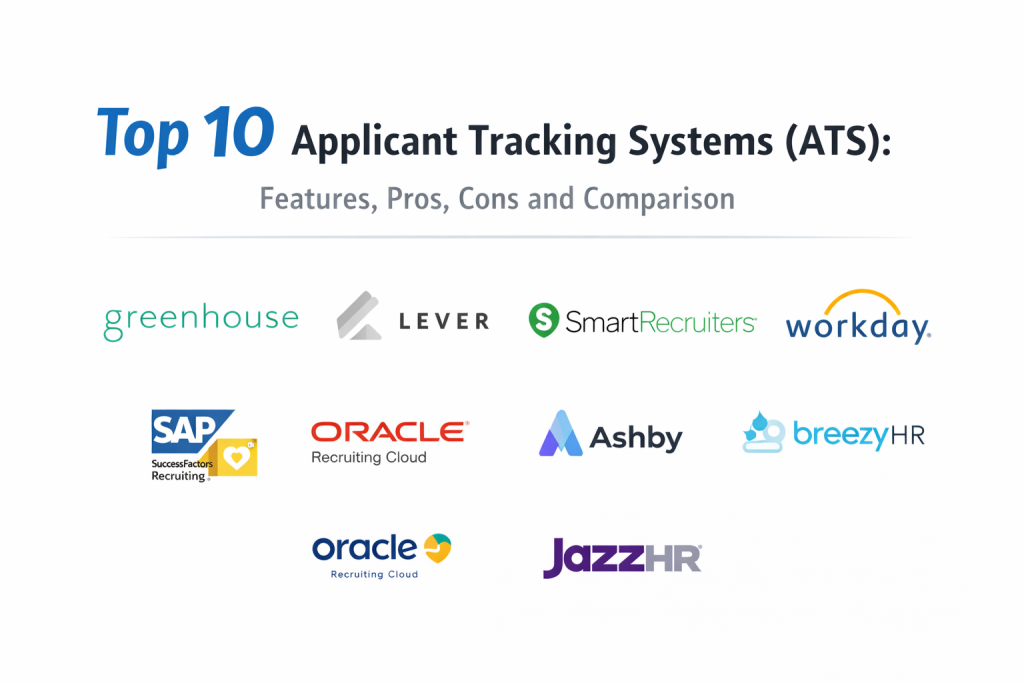
Top 10 Applicant Tracking Systems
1 — Greenhouse
Greenhouse is widely used for structured hiring workflows, scorecards, and strong collaboration between recruiters and hiring teams. It fits organizations that want consistent hiring stages, clear ownership, and repeatable processes across many roles.
Key Features
- Configurable hiring pipelines with structured stages and permissions
- Interview kits and scorecards to standardize feedback and reduce bias risks
- Scheduling and coordination workflows (Varies / N/A)
- Candidate communications and templates for consistent outreach
- Reporting on funnel conversion, bottlenecks, and source performance signals
- Approval workflows and governance concepts (Varies / N/A)
- Integration support across common recruiting ecosystems (Varies / N/A)
Pros
- Strong structure for consistent hiring and interviewer alignment
- Good reporting and workflow clarity for larger hiring teams
Cons
- Setup and customization require careful planning
- Some advanced workflows may require admin expertise
Platforms / Deployment
- Platform(s): Web (Varies / N/A)
- Deployment: Cloud (Varies / N/A)
Security and Compliance
Not publicly stated
Integrations and Ecosystem
Greenhouse is typically used with calendar and email tools, assessment platforms, background checks, and HR systems.
- Calendar and email integrations (Varies / N/A)
- Assessment and interview scheduling tools (Varies / N/A)
- HRIS connections and export workflows (Varies / N/A)
Support and Community
Strong documentation and onboarding resources are commonly expected. Support tiers vary by plan and implementation approach.
2 — Lever
Lever blends ATS workflows with strong candidate relationship workflows and collaboration. It fits teams that want a smooth recruiter experience, fast pipeline movement, and better visibility for hiring managers.
Key Features
- Pipeline management with customizable stages and automation rules
- Candidate communication workflows and templates
- Scheduling support and interview coordination concepts (Varies / N/A)
- Collaboration features for hiring managers and interviewers
- Reporting on pipeline performance and hiring activity signals
- Duplicate detection and candidate record management concepts (Varies / N/A)
- Integrations across common recruiting and HR tools (Varies / N/A)
Pros
- Strong usability for recruiters and hiring managers
- Good pipeline visibility and collaboration for faster decisions
Cons
- Advanced enterprise governance needs may require deeper suite controls
- Some reporting needs can depend on configuration
Platforms / Deployment
- Platform(s): Web (Varies / N/A)
- Deployment: Cloud
Security and Compliance
Not publicly stated
Integrations and Ecosystem
Lever often connects to email, calendars, HR systems, and common recruiting services.
- Calendar and email integrations (Varies / N/A)
- HRIS and payroll-adjacent connections (Varies / N/A)
- Assessment, background, and offer tools (Varies / N/A)
Support and Community
Documentation and onboarding are typically strong. Support depth varies based on plan and service tiers.
3 — SmartRecruiters
SmartRecruiters is used by organizations that need scalable hiring workflows, multi-team collaboration, and structured operations across many roles. It fits teams that want a broader talent acquisition platform feel with configurable processes.
Key Features
- Structured ATS pipelines for multi-role and multi-team hiring
- Collaboration workflows for recruiters, hiring managers, and interview panels
- Candidate communications and workflow automation concepts (Varies / N/A)
- Reporting for funnel conversion and process performance signals
- Support for approvals and governance concepts (Varies / N/A)
- Configurable workflows by department or job family (Varies / N/A)
- Integration ecosystem across common recruiting tools (Varies / N/A)
Pros
- Strong fit for scaling hiring operations across departments
- Useful for standardizing process and improving coordination
Cons
- Implementation can require process design work
- Can be more platform-like than needed for small teams
Platforms / Deployment
- Platform(s): Web (Varies / N/A)
- Deployment: Cloud (Varies / N/A)
Security and Compliance
Not publicly stated
Integrations and Ecosystem
SmartRecruiters is commonly evaluated for ecosystem fit across job posting, sourcing, and hiring workflows.
- Job distribution and sourcing tools (Varies / N/A)
- Calendar, email, and interview coordination tools (Varies / N/A)
- HRIS and reporting exports (Varies / N/A)
Support and Community
Enterprise-oriented support options are common. Outcomes improve with clear workflow ownership and adoption training.
4 — iCIMS
iCIMS is an established enterprise hiring platform used for structured recruiting processes and large-scale hiring operations. It fits organizations that need control, governance, and support for complex hiring programs.
Key Features
- Enterprise pipeline workflows with configurable stages and permissions
- Candidate management at scale with search and filtering concepts (Varies / N/A)
- Communications and engagement tools concepts (Varies / N/A)
- Reporting and dashboards for recruiting performance signals
- Configurable approvals and compliance-friendly process documentation concepts
- Integration support for enterprise HR ecosystems (Varies / N/A)
- Multi-team hiring workflows and governance concepts (Varies / N/A)
Pros
- Strong fit for enterprise-scale hiring operations
- Useful for governance and structured process control
Cons
- Complexity can be high compared to modern SMB tools
- Implementation requires planning, configuration, and change management
Platforms / Deployment
- Platform(s): Web (Varies / N/A)
- Deployment: Cloud (Varies / N/A)
Security and Compliance
Not publicly stated
Integrations and Ecosystem
iCIMS is often used in environments where integrations with HR systems, identity, and reporting are essential.
- HRIS and enterprise system connections (Varies / N/A)
- Assessment, background, and offer tools (Varies / N/A)
- Data export and reporting pipelines (Varies / N/A)
Support and Community
Enterprise support model is common. Success improves with process standardization and training for hiring teams.
5 — Workday Recruiting
Workday Recruiting is often chosen by organizations already using Workday for HR. It fits teams that value unified employee data flows, consistent governance, and recruiting processes connected to internal HR operations.
Key Features
- Recruiting workflows aligned to Workday HR data models concepts (Varies / N/A)
- Candidate pipeline stages and approvals concepts (Varies / N/A)
- Hiring manager collaboration and structured review concepts (Varies / N/A)
- Reporting connected to workforce analytics concepts (Varies / N/A)
- Internal mobility support concepts (Varies / N/A)
- Role-based access and governance controls concepts (Varies / N/A)
- Integrations depend on Workday ecosystem setup (Varies / N/A)
Pros
- Strong when your HR system and recruiting should share one data foundation
- Good governance alignment for larger organizations
Cons
- Can be less flexible than specialized ATS tools in certain workflows
- Best experience often depends on configuration and Workday environment design
Platforms / Deployment
- Platform(s): Web, iOS, Android (Varies / N/A)
- Deployment: Cloud (Varies / N/A)
Security and Compliance
Not publicly stated
Integrations and Ecosystem
Workday Recruiting commonly fits organizations with established enterprise HR workflows.
- HR and workforce analytics alignment (Varies / N/A)
- Identity and access integration concepts (Varies / N/A)
- Recruiting ecosystem integrations vary (Varies / N/A)
Support and Community
Enterprise support orientation. Adoption improves when recruiting workflows are clearly defined and standardized.
6 — SAP SuccessFactors Recruiting
SAP SuccessFactors Recruiting is used by organizations that want recruiting processes aligned with enterprise HR governance and standardized talent operations. It fits teams that prioritize governance, approvals, and consistency across HR functions.
Key Features
- Recruiting workflows aligned to enterprise HR operations concepts (Varies / N/A)
- Pipeline stages, approvals, and role-based permissions concepts
- Hiring manager collaboration and interview feedback workflows concepts
- Reporting aligned to HR analytics concepts (Varies / N/A)
- Support for multi-team hiring and standardized processes concepts
- Integrations across enterprise ecosystems depend on setup (Varies / N/A)
- Internal mobility and talent process alignment concepts (Varies / N/A)
Pros
- Strong fit for enterprise standardization across HR and recruiting
- Helpful governance structure for larger, policy-heavy environments
Cons
- Configuration can be complex across modules
- User experience depends on design and rollout quality
Platforms / Deployment
- Platform(s): Web, iOS, Android (Varies / N/A)
- Deployment: Cloud (Varies / N/A)
Security and Compliance
Not publicly stated
Integrations and Ecosystem
SuccessFactors Recruiting often lives inside broader enterprise HR environments.
- Enterprise HR and identity connections (Varies / N/A)
- Assessment and background tooling integrations vary (Varies / N/A)
- Reporting exports and workflows depend on configuration (Varies / N/A)
Support and Community
Enterprise support model. Adoption improves with training and consistent hiring manager usage.
7 — Oracle Recruiting Cloud
Oracle Recruiting Cloud is used in enterprise environments where recruiting must align closely with broader HR operations and governance. It fits teams that need strong approvals, structure, and reporting alignment.
Key Features
- Enterprise recruiting workflows and candidate pipeline concepts (Varies / N/A)
- Role-based permissions and approvals concepts (Varies / N/A)
- Hiring team collaboration workflows concepts (Varies / N/A)
- Candidate engagement and communication concepts (Varies / N/A)
- Reporting aligned to HR analytics concepts (Varies / N/A)
- Integration patterns depend on Oracle ecosystem and configuration (Varies / N/A)
- Internal mobility alignment concepts (Varies / N/A)
Pros
- Strong fit for organizations already using Oracle HR ecosystems
- Useful governance and process standardization for large teams
Cons
- Implementation can be significant in complex environments
- Flexibility and usability can depend on configuration choices
Platforms / Deployment
- Platform(s): Web, iOS, Android (Varies / N/A)
- Deployment: Cloud (Varies / N/A)
Security and Compliance
Not publicly stated
Integrations and Ecosystem
Often evaluated for fit within broader Oracle HR and reporting environments.
- HR operations alignment (Varies / N/A)
- Identity and access integrations (Varies / N/A)
- Recruiting ecosystem connections vary by setup (Varies / N/A)
Support and Community
Enterprise support is common. Strong internal ownership improves rollout and long-term adoption.
8 — Ashby
Ashby is a modern ATS focused on speed, strong reporting, and clean workflows for hiring teams. It fits organizations that want a recruiter-first experience with analytics that highlight pipeline performance and process issues.
Key Features
- Pipeline management with clean workflow controls and automation concepts
- Structured interview feedback and scorecards concepts (Varies / N/A)
- Strong reporting for pipeline conversion and hiring performance signals
- Candidate communication templates and workflow consistency tools
- Scheduling support concepts (Varies / N/A)
- Collaboration tools for hiring managers and interview teams
- Integration support across common recruiting tools (Varies / N/A)
Pros
- Strong analytics and reporting for improving hiring operations
- Modern user experience that reduces recruiter admin time
Cons
- Enterprise governance needs may require additional controls depending on environment
- Ecosystem fit depends on the tools you already use
Platforms / Deployment
- Platform(s): Web (Varies / N/A)
- Deployment: Cloud
Security and Compliance
Not publicly stated
Integrations and Ecosystem
Ashby is often used with sourcing tools, calendars, and HR systems depending on the stack.
- Calendar and email integrations (Varies / N/A)
- Assessment and background tools vary (Varies / N/A)
- HRIS connections depend on setup (Varies / N/A)
Support and Community
Documentation and onboarding resources are typically important for fast adoption. Support details vary by plan.
9 — Breezy HR
Breezy HR is commonly used by small and growing teams that want a simple ATS with strong usability. It fits teams that want quick setup, clear pipelines, and basic automation without heavy enterprise complexity.
Key Features
- Simple pipeline stages with drag-and-drop workflow patterns (Varies / N/A)
- Candidate messaging templates and communication tracking concepts
- Scheduling support concepts (Varies / N/A)
- Team collaboration and feedback capture concepts
- Basic reporting for pipeline visibility signals
- Career page and job posting workflow concepts (Varies / N/A)
- Integrations with common SMB tools vary (Varies / N/A)
Pros
- Easy to adopt and manage with small recruiting teams
- Good workflow clarity for basic hiring processes
Cons
- Advanced enterprise analytics and governance may be limited
- Complex multi-department workflows may require a larger platform
Platforms / Deployment
- Platform(s): Web (Varies / N/A)
- Deployment: Cloud
Security and Compliance
Not publicly stated
Integrations and Ecosystem
Often chosen when teams want a simple ATS that still connects to key tools.
- Email and calendar integrations (Varies / N/A)
- Job posting and sourcing connections vary (Varies / N/A)
- Exports to HR systems depend on process and configuration (Varies / N/A)
Support and Community
Support is typically important for SMBs. Documentation and onboarding quality influence success.
10 — JazzHR
JazzHR is often used by small and mid-sized organizations to manage hiring pipelines, communications, and basic reporting. It fits teams that want a practical ATS that supports consistent hiring steps and better organization than spreadsheets.
Key Features
- Candidate pipeline management with clear stages and ownership concepts
- Communication templates and candidate tracking concepts
- Interview coordination support concepts (Varies / N/A)
- Team collaboration for feedback and notes concepts
- Basic reporting for funnel and activity signals
- Job posting workflows concepts (Varies / N/A)
- Integrations vary depending on plan and environment (Varies / N/A)
Pros
- Practical ATS structure for small and mid-sized hiring teams
- Helps standardize hiring steps and reduce missed follow-ups
Cons
- Advanced enterprise workflows and analytics may be limited
- Some customization may require careful setup and admin time
Platforms / Deployment
- Platform(s): Web (Varies / N/A)
- Deployment: Cloud
Security and Compliance
Not publicly stated
Integrations and Ecosystem
Often used with common SMB hiring tools, email, and basic HR systems.
- Email and calendar integrations (Varies / N/A)
- Job posting and sourcing tool connections vary (Varies / N/A)
- HRIS and reporting exports depend on setup (Varies / N/A)
Support and Community
Support quality varies by plan. Strong internal hiring discipline improves results more than tool features alone.
Comparison Table
| Tool Name | Best For | Platform(s) Supported | Deployment (Cloud/Self-hosted/Hybrid) | Standout Feature | Public Rating |
|---|---|---|---|---|---|
| Greenhouse | Structured hiring with strong scorecards and consistency | Web (Varies / N/A) | Cloud (Varies / N/A) | Interview kits and standardized feedback | N/A |
| Lever | Recruiter-friendly pipelines with strong collaboration | Web (Varies / N/A) | Cloud | Clean workflows and visibility | N/A |
| SmartRecruiters | Scalable hiring operations across departments | Web (Varies / N/A) | Cloud (Varies / N/A) | Standardized processes for larger teams | N/A |
| iCIMS | Enterprise recruiting workflows and governance | Web (Varies / N/A) | Cloud (Varies / N/A) | Enterprise-scale process control | N/A |
| Workday Recruiting | Recruiting aligned to Workday HR data foundation | Web, iOS, Android (Varies / N/A) | Cloud (Varies / N/A) | HR and recruiting governance alignment | N/A |
| SAP SuccessFactors Recruiting | Recruiting aligned to enterprise HR operations | Web, iOS, Android (Varies / N/A) | Cloud (Varies / N/A) | Standardization across HR processes | N/A |
| Oracle Recruiting Cloud | Enterprise recruiting within Oracle HR ecosystem | Web, iOS, Android (Varies / N/A) | Cloud (Varies / N/A) | Governance and approvals structure | N/A |
| Ashby | Modern ATS with strong analytics and reporting | Web (Varies / N/A) | Cloud | Hiring analytics and process visibility | N/A |
| Breezy HR | Simple ATS for small and growing teams | Web (Varies / N/A) | Cloud | Fast setup and easy workflows | N/A |
| JazzHR | Practical ATS for small and mid-sized hiring teams | Web (Varies / N/A) | Cloud | Standardized pipeline for SMB hiring | N/A |
Evaluation and Scoring of Applicant Tracking Systems
Scoring model:
- Each criterion uses a 1–10 score for comparative shortlisting.
- Weighted Total is a directional estimate across this list, not a verified public rating.
- Use scoring to shortlist, then validate through a pilot using real roles, real interview steps, and real hiring teams.
- Treat must-haves like scheduling fit, feedback workflows, reporting, and integrations as filters before scoring.
Weights:
- Core features – 25%
- Ease of use – 15%
- Integrations and ecosystem – 15%
- Security and compliance – 10%
- Performance and reliability – 10%
- Support and community – 10%
- Price / value – 15%
| Tool Name | Core (25%) | Ease (15%) | Integrations (15%) | Security (10%) | Performance (10%) | Support (10%) | Value (15%) | Weighted Total (0–10) |
|---|---|---|---|---|---|---|---|---|
| Greenhouse | 8 | 7 | 8 | 7 | 7 | 7 | 6 | 7.25 |
| Lever | 8 | 8 | 7 | 7 | 7 | 7 | 6 | 7.25 |
| SmartRecruiters | 8 | 7 | 8 | 7 | 7 | 7 | 5 | 7.10 |
| iCIMS | 9 | 6 | 8 | 7 | 7 | 7 | 5 | 7.20 |
| Workday Recruiting | 8 | 6 | 7 | 7 | 7 | 7 | 4 | 6.65 |
| SAP SuccessFactors Recruiting | 8 | 6 | 7 | 7 | 7 | 7 | 4 | 6.65 |
| Oracle Recruiting Cloud | 8 | 6 | 7 | 7 | 7 | 7 | 4 | 6.65 |
| Ashby | 7 | 8 | 7 | 6 | 7 | 7 | 7 | 7.05 |
| Breezy HR | 6 | 9 | 6 | 6 | 7 | 7 | 8 | 6.95 |
| JazzHR | 6 | 8 | 6 | 6 | 7 | 7 | 7 | 6.65 |
How to interpret these scores:
- Core rewards strong pipelines, interview workflows, and structured feedback that teams actually use.
- Ease matters because hiring moves fast and friction creates delays and missed follow-ups.
- Integrations matter when calendars, email, HRIS, and assessment tools must stay in sync.
- Value depends on hiring volume and how much recruiter admin work the tool removes.
Which Applicant Tracking System Is Right for You?
Solo / Freelancer
If you hire occasionally, you may not need a heavy ATS. Prioritize speed and simplicity: clear pipelines, easy communication templates, and basic scheduling support. Breezy HR or JazzHR can be enough when hiring volume is low and your process is straightforward. The goal at this stage is preventing missed follow-ups and keeping candidate details organized without creating admin overhead.
SMB
SMBs need structure without complexity. Look for fast setup, good candidate communications, and simple interview coordination. Breezy HR and JazzHR are often considered when the process is simple and hiring managers want an easy way to collaborate. If your SMB hires continuously across multiple roles, Lever or Ashby can help you standardize workflows and improve reporting without moving to a heavy enterprise suite.
Mid-Market
Mid-market teams often struggle with consistency across departments. You need stronger workflow controls, clearer approvals, and reporting that explains bottlenecks. Greenhouse and Lever are strong options when structure and collaboration matter. Ashby is useful when analytics and operational visibility are key priorities. SmartRecruiters can fit when you need broader standardization and stronger multi-team coordination.
Enterprise
Enterprises need governance, role-based access, process standardization, and reporting consistency at scale. iCIMS, SmartRecruiters, Workday Recruiting, SAP SuccessFactors Recruiting, and Oracle Recruiting Cloud can be relevant depending on your HR ecosystem and governance needs. If your enterprise already runs a large HR platform, recruiting that aligns to the same data foundation can reduce duplicate data work and improve audit-friendly operations.
Budget vs Premium
- Budget-first teams should prioritize workflow clarity, candidate communication, and scheduling fit without paying for complexity they will not use.
- Premium platforms are justified when hiring volume is high, governance matters, and delays are expensive.
- The hidden cost is recruiter time: manual scheduling, chasing feedback, and rebuilding reports.
Feature Depth vs Ease of Use
- If your pain is slow feedback and inconsistent decisions, prioritize scorecards, structured debriefs, and ownership clarity.
- If your pain is recruiter workload, prioritize templates, automation rules, and scheduling support.
- If your pain is leadership visibility, prioritize analytics that show funnel performance and bottlenecks clearly.
Integrations and Scalability
An ATS becomes far more valuable when it connects cleanly to calendars, email, HRIS systems, assessments, background checks, and offer workflows. During evaluation, test real-life flows: scheduling a panel interview, collecting feedback, moving candidates between stages, and generating reports for leadership. Scalability is not only about headcount; it is also about supporting multiple departments with different hiring processes without breaking reporting consistency.
Security and Compliance Needs
Hiring data is sensitive. Even when certifications are not publicly stated, you should validate role-based access, audit logs, and permission boundaries so interviewers only see what they should. Also confirm how the ATS stores feedback, how changes are tracked, and how exports are managed for internal reporting. Strong governance reduces risk and improves trust in hiring decisions.
Frequently Asked Questions
1.What does an ATS actually do?
It centralizes job openings, candidates, interview stages, communications, and feedback. It helps teams move faster, stay organized, and make decisions with consistent documentation.
2.Do small companies really need an ATS?
If you hire rarely, you may not need one. If you hire continuously, even a lightweight ATS helps prevent missed follow-ups and keeps hiring consistent.
3.How do we reduce delays in the hiring process?
Use structured stages, automated reminders, clear ownership, and scorecards. The biggest delays usually come from scheduling friction and late feedback.
4.What is the most common ATS implementation mistake?
Over-complicating the pipeline early. Start simple with a few clear stages and standard scorecards, then refine after teams adopt the process.
5.How important are integrations in an ATS?
Very important. Calendar and email integrations reduce admin work, and HRIS integrations reduce duplicate data entry and reporting mismatches.
6.Can an ATS help improve hiring quality?
Yes, if it standardizes scorecards and feedback, reduces rushed decisions, and makes debriefs consistent. The tool supports the process, but discipline matters.
7.How should we evaluate reporting in an ATS?
Test real questions: time in stage, offer acceptance rate, source quality signals, and where candidates drop off. If reports need heavy manual work, adoption suffers.
8.Is switching ATS platforms difficult?
It can be. Plan data migration, define what history you truly need, and run parallel workflows briefly. Clean process definitions matter more than moving every old record.
9.How do we improve candidate experience using an ATS?
Use timely communication templates, keep scheduling smooth, and reduce unnecessary steps. Candidates remember silence and confusion more than fancy features.
10.What are good alternatives if we do not want a full ATS?
For very low hiring volume, a structured spreadsheet process plus calendar discipline can work. Once volume grows, an ATS usually becomes cheaper than manual chaos.
Conclusion
Applicant Tracking Systems help teams hire with consistency, speed, and better collaboration. The best ATS depends on hiring volume, workflow complexity, reporting expectations, and how tightly recruiting must connect to HR systems and scheduling tools. Smaller teams often benefit most from simple platforms that reduce recruiter admin work and keep follow-ups consistent. Mid-sized teams typically need stronger scorecards, automation rules, and reporting that exposes bottlenecks clearly. Enterprises usually require governance, approvals, permission controls, and alignment with broader HR ecosystems. A practical next step is to shortlist two or three ATS platforms, run a pilot using a real role and real interview stages, test scheduling and feedback flow, and confirm reporting answers leadership questions without manual effort. When the ATS fits your process, hiring becomes predictable and easier to scale.

Best Cardiac Hospitals Near You
Discover top heart hospitals, cardiology centers & cardiac care services by city.
Advanced Heart Care • Trusted Hospitals • Expert Teams
View Best Hospitals