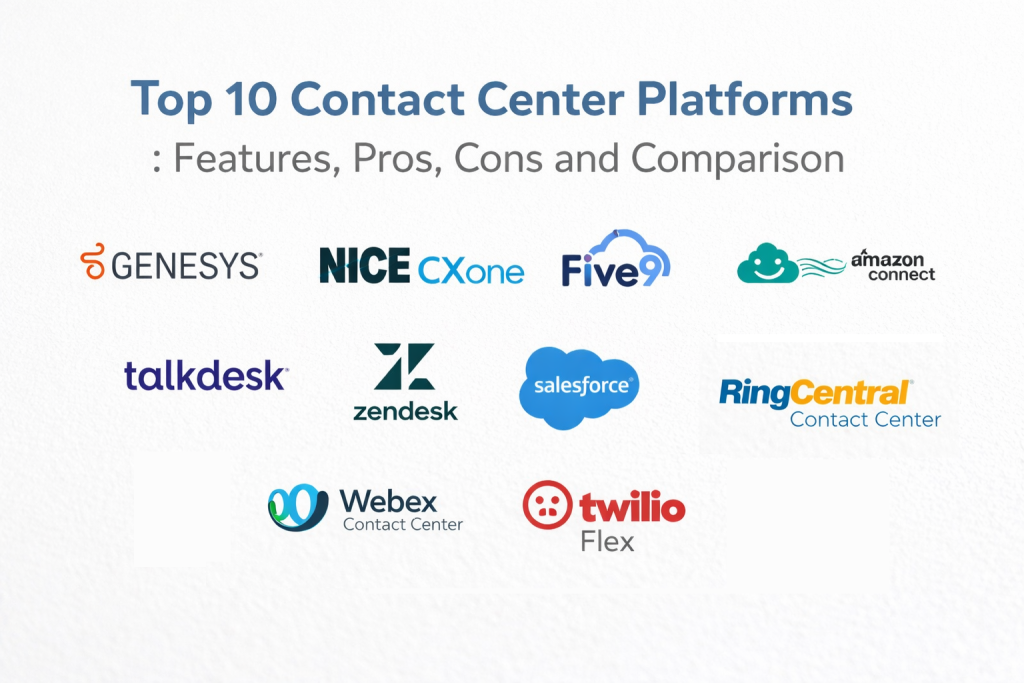
Introduction
Contact center platforms help businesses manage customer conversations across voice, email, chat, messaging, and social channels in one operational system. They power the daily work of support, sales, and service teams by routing interactions to the right agents, tracking customer context, enforcing service processes, and producing performance analytics. A modern platform is not only about taking calls. It also handles omnichannel routing, agent productivity, quality management, workforce scheduling, and integration with CRM and ticketing systems so teams can resolve issues faster and with better consistency.
Real-world use cases include:
- Handling inbound customer support with queues, IVR, and priority routing
- Running outbound sales and renewal calling with reporting and coaching workflows
- Managing omnichannel service across chat, email, voice, and messaging in one view
- Scaling seasonal support with flexible staffing and predictable service levels
- Improving service quality with call monitoring, QA forms, and analytics
What buyers should evaluate before selecting a contact center platform:
- Omnichannel coverage (voice, chat, email, messaging, social support varies)
- Routing depth (skills-based routing, priority rules, callback, queue logic)
- Agent experience (desktop UI, speed, knowledge access, wrap-up flows)
- Supervisor tooling (live monitoring, whisper/barge patterns vary, dashboards)
- Reporting and analytics (real-time, historical, forecasting, custom metrics)
- Quality management (recording, QA scoring, coaching workflows vary)
- Workforce management (scheduling, adherence, forecasting varies / N/A)
- Integrations (CRM, helpdesk, identity, data warehouse, custom APIs)
- Security expectations (SSO, MFA, RBAC, encryption, audit visibility)
- Total cost and operational effort (implementation, telephony, admin ownership)
Best for: support, sales, and service teams that need structured routing, consistent agent workflows, and measurable customer outcomes across multiple channels.
Not ideal for: very small teams that only need a shared inbox, or organizations that do not want to maintain call flows, routing rules, and operational reporting.
Key Trends in Contact Center Platforms
- More demand for omnichannel experiences that feel consistent across voice and digital
- Stronger expectations for “single customer view” by integrating CRM and ticketing context
- Increased use of automation to reduce repetitive work (varies / Not publicly stated)
- Higher focus on agent productivity with unified desktops and guided workflows
- Growing importance of analytics for queue health, staffing, and service-level outcomes
- More attention on compliance, retention, and governance for regulated industries
- Increased adoption of flexible cloud deployment models for rapid scaling
- Rising demand for faster integrations via APIs, connectors, and workflow builders
- More focus on quality management and coaching to reduce escalations
- Greater emphasis on reliability and telephony performance visibility
How We Selected These Tools
- Widely recognized market adoption across SMB, mid-market, and enterprise
- Coverage of core needs: voice, routing, reporting, supervisor tools, integrations
- Practical maturity for contact center operations, not only basic calling
- Ability to support different operating models (inbound, outbound, blended)
- Strength of ecosystem patterns: CRM alignment, developer APIs, partner networks
- Balanced mix of enterprise leaders and flexible developer-friendly platforms
- Realistic suitability for long-term operations and scaling
Top 10 Contact Center Platforms
1 — Genesys Cloud CX
Genesys Cloud CX is commonly used by mid-market and enterprise contact centers that need strong routing, analytics, and omnichannel operations. It is often selected when organizations need complex queue strategies, multi-region operations, and supervisor visibility.
Key Features
- Omnichannel routing for voice and digital channels (varies)
- Skills-based routing, IVR, and queue configuration (varies)
- Agent desktop with interaction handling and wrap-up workflows (varies)
- Supervisor dashboards and real-time monitoring patterns (varies)
- Recording and quality workflows vary / Not publicly stated
- Analytics and reporting for operations (varies)
- Workforce features vary / Not publicly stated
Pros
- Strong routing depth for complex contact center operations
- Scales well for multi-team, multi-site environments
- Good operational analytics for supervisors and leaders
Cons
- Setup requires careful design of queues, skills, and workflows
- Operational ownership is needed to keep routing and reporting clean
- Security and compliance details are Not publicly stated
Platforms / Deployment
- Web (varies)
- Cloud
Security & Compliance
Not publicly stated.
Integrations & Ecosystem
Genesys Cloud CX is typically integrated with CRM, identity systems, and data tools to unify customer context and reporting.
- CRM integrations vary / Not publicly stated
- Identity and SSO patterns vary / Not publicly stated
- APIs and workflow extensibility (varies)
- Data export and analytics integration patterns vary / Not publicly stated
Support & Community
Varies / Not publicly stated.
2 — NICE CXone
NICE CXone is often chosen by enterprises that need large-scale operations, strong governance, and end-to-end contact center capabilities. It is commonly evaluated for environments that also prioritize quality management and workforce processes.
Key Features
- Omnichannel interaction handling patterns (varies)
- Advanced routing, IVR, and queue management (varies)
- Supervisor tools for monitoring and performance tracking (varies)
- Quality workflows vary / Not publicly stated
- Workforce features vary / Not publicly stated
- Reporting and analytics for large operations (varies)
- Automation capabilities vary / Not publicly stated
Pros
- Strong enterprise positioning for contact center operations
- Broad capability coverage across operational needs
- Useful for governance-heavy service environments
Cons
- Complexity can be higher than SMB needs
- Implementation effort can be significant depending on scope
- Security and compliance details are Not publicly stated
Platforms / Deployment
- Web (varies)
- Cloud
Security & Compliance
Not publicly stated.
Integrations & Ecosystem
NICE CXone is commonly integrated into enterprise CRM and service ecosystems to standardize service processes.
- CRM integrations vary / Not publicly stated
- Identity and access integration patterns vary / Not publicly stated
- APIs and extensibility patterns (varies)
- Reporting exports and data integration vary / Not publicly stated
Support & Community
Varies / Not publicly stated.
3 — Five9
Five9 is widely used by mid-market and enterprise teams that want cloud contact center capabilities with strong voice operations and practical omnichannel expansion. It is often selected for teams upgrading from older phone systems and improving supervisor visibility.
Key Features
- Voice routing, IVR, and queue management (varies)
- Omnichannel options vary / Not publicly stated
- Agent desktop and productivity workflows (varies)
- Supervisor monitoring and reporting dashboards (varies)
- Call recording patterns vary / Not publicly stated
- Outbound campaign workflows vary / Not publicly stated
- Integrations vary / Not publicly stated
Pros
- Strong cloud voice foundation for contact center operations
- Good fit for teams modernizing customer service operations
- Practical supervisor tooling for daily performance management
Cons
- Some advanced features depend on packaging and configuration
- Omnichannel depth should be validated for digital-first teams
- Security and compliance details are Not publicly stated
Platforms / Deployment
- Web (varies)
- Cloud
Security & Compliance
Not publicly stated.
Integrations & Ecosystem
Five9 is often connected to CRM and ticketing systems so agents can work with customer context in one flow.
- CRM and helpdesk integrations vary / Not publicly stated
- APIs and workflow extensions vary / Not publicly stated
- Reporting exports vary / Not publicly stated
- Partner ecosystem strength varies / Not publicly stated
Support & Community
Varies / Not publicly stated.
4 — Amazon Connect
Amazon Connect is a cloud contact center service often chosen by organizations that want flexible building blocks, strong scalability, and deep integration potential with cloud services. It fits teams with technical resources that can design and operate call flows and integrations.
Key Features
- Cloud contact center with configurable call flows (varies)
- Skills-based routing and queue management patterns (varies)
- Omnichannel patterns vary / Not publicly stated
- Real-time and historical metrics patterns (varies)
- Integration flexibility through APIs (varies)
- Recording patterns vary / Not publicly stated
- Workforce features vary / Not publicly stated
Pros
- Strong flexibility for custom contact center designs
- Scales well for high-volume operations
- Good fit for teams that want deep integration and control
Cons
- Requires technical ownership for configuration and ongoing improvements
- Operational complexity can grow if workflows are not standardized
- Security and compliance details are Not publicly stated
Platforms / Deployment
- Web (varies)
- Cloud
Security & Compliance
Not publicly stated.
Integrations & Ecosystem
Amazon Connect is often used as a platform layer connected to CRM, data, and automation services.
- APIs and custom integration patterns (varies)
- CRM connectors vary / Not publicly stated
- Data export and analytics pipelines vary / Not publicly stated
- Works best with strong operational documentation and change control
Support & Community
Varies / Not publicly stated.
5 — Talkdesk
Talkdesk is commonly used by mid-market organizations that want a modern cloud contact center with a focus on agent usability and faster implementation. It fits teams that need omnichannel capabilities and supervisor visibility without a heavy enterprise footprint.
Key Features
- Voice and digital interaction handling patterns (varies)
- Routing, IVR, and queue configuration (varies)
- Agent desktop workflows and productivity features (varies)
- Supervisor dashboards and monitoring tools (varies)
- Quality workflows vary / Not publicly stated
- Analytics and reporting patterns (varies)
- Integration options vary / Not publicly stated
Pros
- Good balance of capability and usability for mid-market teams
- Helpful for faster rollout compared to more complex stacks
- Strong for teams modernizing customer support experiences
Cons
- Advanced enterprise governance needs deeper validation
- Some features vary by plan and configuration
- Security and compliance details are Not publicly stated
Platforms / Deployment
- Web (varies)
- Cloud
Security & Compliance
Not publicly stated.
Integrations & Ecosystem
Talkdesk is often connected to CRM, ticketing, and reporting stacks to keep agent work consistent and measurable.
- CRM and helpdesk integrations vary / Not publicly stated
- APIs and automation patterns vary / Not publicly stated
- Reporting exports vary / Not publicly stated
- Best outcomes come from standardized dispositions and QA workflows
Support & Community
Varies / Not publicly stated.
6 — RingCentral Contact Center
RingCentral Contact Center is often selected by organizations that want contact center capabilities aligned with a broader business communications stack. It fits teams looking for consolidated calling operations and standardized admin tooling.
Key Features
- Voice routing, IVR, and queue management (varies)
- Digital channels options vary / Not publicly stated
- Agent desktop with interaction handling workflows (varies)
- Supervisor monitoring and dashboards (varies)
- Reporting and analytics patterns (varies)
- Recording and QA patterns vary / Not publicly stated
- Integration capabilities vary / Not publicly stated
Pros
- Useful for organizations consolidating communications and service operations
- Strong for core inbound voice contact center needs
- Practical admin operations for multi-team environments
Cons
- Omnichannel depth should be validated for digital-first strategies
- Feature coverage varies by plan and configuration
- Security and compliance details are Not publicly stated
Platforms / Deployment
- Web (varies)
- Cloud
Security & Compliance
Not publicly stated.
Integrations & Ecosystem
RingCentral Contact Center is commonly integrated with CRM and support tools to connect calls to customer outcomes.
- CRM integrations vary / Not publicly stated
- Helpdesk integrations vary / Not publicly stated
- APIs and reporting exports vary / Not publicly stated
- Works best when call flows and queue ownership are clearly defined
Support & Community
Varies / Not publicly stated.
7 — Zendesk
Zendesk is widely used for customer support workflows and can support contact center operations through ticketing, channels, and integrated voice patterns (varies). It fits teams that prioritize support operations, case management, and agent workflows centered around tickets.
Key Features
- Ticketing-centric customer support workflows (varies)
- Omnichannel intake patterns (varies)
- Knowledge and self-service patterns (varies)
- Agent productivity features and macros (varies)
- Reporting and analytics for support operations (varies)
- Voice capabilities vary / Not publicly stated
- Workforce features vary / N/A
Pros
- Strong support workflow foundation for service teams
- Good for teams that want structured case management and SLAs
- Large ecosystem for support operations extensions
Cons
- Voice-first contact center depth may be limited for complex telephony needs
- Advanced routing and telephony features require careful validation
- Security and compliance details are Not publicly stated
Platforms / Deployment
- Web (varies)
- Cloud
Security & Compliance
Not publicly stated.
Integrations & Ecosystem
Zendesk is often integrated across CRM, identity, and data stacks to unify customer history and performance reporting.
- CRM integrations vary / Not publicly stated
- App marketplace and extensions vary / Not publicly stated
- APIs and automation patterns (varies)
- Data export options vary / Not publicly stated
Support & Community
Varies / Not publicly stated.
8 — Salesforce Service Cloud
Salesforce Service Cloud is often chosen by organizations that want contact center operations tightly connected to CRM, cases, and customer data. It fits teams that want agents working inside a CRM-centric environment with strong workflow enforcement.
Key Features
- Case management and service workflows (varies)
- Omnichannel routing patterns (varies)
- Agent console with customer context (varies)
- Automation for service processes varies / Not publicly stated
- Reporting and dashboards for service operations (varies)
- Telephony options vary / Not publicly stated
- Quality and workforce features vary / Not publicly stated
Pros
- Strong when service needs to be deeply tied to CRM records and processes
- Useful for governance, approvals, and consistent case handling
- Powerful reporting and data model options for service leaders
Cons
- Complexity can be high depending on customization and scope
- Telephony and contact center features depend on configuration choices
- Security and compliance details are Not publicly stated
Platforms / Deployment
- Web (varies)
- Cloud
Security & Compliance
Not publicly stated.
Integrations & Ecosystem
Salesforce Service Cloud is typically integrated with telephony, support channels, identity, and analytics systems.
- Telephony integration patterns vary / Not publicly stated
- Large partner ecosystem varies / Not publicly stated
- APIs and workflow automation patterns (varies)
- Data and reporting integrations vary / Not publicly stated
Support & Community
Varies / Not publicly stated.
9 — Cisco Webex Contact Center
Cisco Webex Contact Center is often used by enterprises that need governance, reliability, and alignment with broader collaboration and calling environments. It fits organizations with structured IT operations and standardized communication policies.
Key Features
- Cloud contact center routing and queue tools (varies)
- Voice-first operations with expansion patterns (varies)
- Supervisor monitoring and reporting (varies)
- Admin controls and policy management (varies)
- Device and collaboration ecosystem alignment patterns (varies)
- Recording and QA patterns vary / Not publicly stated
- Integration patterns vary / Not publicly stated
Pros
- Strong enterprise fit for governance and structured operations
- Works well when collaboration and calling stacks are standardized
- Useful for multi-site organizations with IT-managed environments
Cons
- Can be heavier than SMB requirements
- Success depends on clear design and admin ownership
- Security and compliance details are Not publicly stated
Platforms / Deployment
- Web (varies)
- Cloud
Security & Compliance
Not publicly stated.
Integrations & Ecosystem
Cisco Webex Contact Center is often evaluated for how well it fits enterprise identity and collaboration ecosystems.
- Identity and access patterns vary / Not publicly stated
- CRM and service tool integrations vary / Not publicly stated
- APIs and extensibility vary / Not publicly stated
- Best results come from standard queue and skill models across teams
Support & Community
Varies / Not publicly stated.
10 — Twilio Flex
Twilio Flex is a programmable contact center platform often chosen by product and engineering teams that want to design a custom agent experience and build unique workflows. It fits organizations that need flexibility beyond standard out-of-the-box routing and UI patterns.
Key Features
- Programmable agent desktop and workflows (varies)
- Flexible routing and queue design patterns (varies)
- Omnichannel communication building blocks (varies)
- APIs for deep integration with internal systems (varies)
- Reporting patterns vary / Not publicly stated
- Recording patterns vary / Not publicly stated
- Workforce features vary / N/A
Pros
- Excellent flexibility for custom workflows and unique experiences
- Strong fit for teams with engineering resources and product ownership
- Integrates well into modern API-driven ecosystems
Cons
- Requires technical ownership for build, maintenance, and upgrades
- Time-to-value depends on implementation scope and team skill
- Security and compliance details are Not publicly stated
Platforms / Deployment
- Web (varies)
- Cloud
Security & Compliance
Not publicly stated.
Integrations & Ecosystem
Twilio Flex is typically integrated through APIs, event pipelines, and custom applications to match internal business systems.
- APIs and extensibility are core strengths (varies)
- CRM and ticketing integrations vary / Not publicly stated
- Data and analytics pipelines vary / Not publicly stated
- Best outcomes come from clear product ownership and operational governance
Support & Community
Varies / Not publicly stated.
Comparison Table
| Tool Name | Best For | Platform(s) Supported | Deployment | Standout Feature | Public Rating |
|---|---|---|---|---|---|
| Genesys Cloud CX | Enterprise omnichannel routing | Web (varies) | Cloud | Deep routing and operational analytics | N/A |
| NICE CXone | Large-scale contact center operations | Web (varies) | Cloud | Broad capability coverage for enterprise service | N/A |
| Five9 | Cloud voice contact centers | Web (varies) | Cloud | Practical voice operations with supervisor tooling | N/A |
| Amazon Connect | Flexible cloud-built contact centers | Web (varies) | Cloud | Configurable building blocks and scalability | N/A |
| Talkdesk | Mid-market modernization | Web (varies) | Cloud | Usability-focused cloud contact center | N/A |
| RingCentral Contact Center | Consolidated communications and service | Web (varies) | Cloud | Contact center aligned to business communications | N/A |
| Zendesk | Ticket-driven customer support operations | Web (varies) | Cloud | Strong case management for support teams | N/A |
| Salesforce Service Cloud | CRM-centered service operations | Web (varies) | Cloud | Service workflows tied to CRM data model | N/A |
| Cisco Webex Contact Center | Enterprise governance and standardization | Web (varies) | Cloud | IT-managed contact center operations | N/A |
| Twilio Flex | Custom, programmable contact center builds | Web (varies) | Cloud | Highly customizable agent desktop and workflows | N/A |
Evaluation & Scoring of Contact Center Platforms
The scores below are a comparative framework to help shortlisting and internal alignment. They are not verified benchmarks, and real outcomes vary by plan, routing design, telecom setup, integrations, and operational maturity. If security and compliance are critical and details are Not publicly stated, treat them as mandatory validation items during procurement. Use these scores to narrow options, then confirm fit with a pilot using real queues, real agents, and real interaction volumes.
Weights:
- Core features – 25%
- Ease of use – 15%
- Integrations & ecosystem – 15%
- Security & compliance – 10%
- Performance & reliability – 10%
- Support & community – 10%
- Price / value – 15%
| Tool Name | Core (25%) | Ease (15%) | Integrations (15%) | Security (10%) | Performance (10%) | Support (10%) | Value (15%) | Weighted Total (0–10) |
|---|---|---|---|---|---|---|---|---|
| Genesys Cloud CX | 9 | 7 | 8 | 7 | 8 | 7 | 6 | 7.55 |
| NICE CXone | 9 | 6 | 8 | 7 | 8 | 7 | 6 | 7.35 |
| Five9 | 8 | 7 | 7 | 7 | 8 | 7 | 7 | 7.40 |
| Amazon Connect | 8 | 6 | 9 | 7 | 8 | 7 | 7 | 7.35 |
| Talkdesk | 8 | 8 | 7 | 7 | 8 | 7 | 7 | 7.60 |
| RingCentral Contact Center | 8 | 7 | 7 | 7 | 8 | 7 | 7 | 7.40 |
| Zendesk | 7 | 8 | 8 | 7 | 7 | 8 | 8 | 7.55 |
| Salesforce Service Cloud | 8 | 6 | 9 | 7 | 8 | 8 | 6 | 7.45 |
| Cisco Webex Contact Center | 8 | 6 | 7 | 7 | 8 | 7 | 6 | 7.00 |
| Twilio Flex | 8 | 5 | 9 | 7 | 8 | 7 | 7 | 7.20 |
How to interpret the scores:
- Higher Core scores suggest stronger routing, supervisor tooling, and operational capability coverage.
- Higher Ease scores suggest faster onboarding and smoother agent adoption.
- Higher Integrations scores suggest better ecosystem fit for CRM, ticketing, and custom workflows.
- Security should be validated directly when details are Not publicly stated.
- Weighted totals help shortlist options, but pilots decide the final choice.
Which Contact Center Platform Is Right for You?
Solo / Freelancer
Most solo operators do not need a full contact center platform. If you only need shared communication, start with a simple support inbox approach. If you truly need routing and reporting, choose an option with simpler setup and a smaller operational footprint.
- Practical fits: Zendesk, Talkdesk
- Watch-outs: avoid highly programmable platforms unless you have technical support
SMB
SMBs usually need inbound queues, simple IVR, basic reporting, and a clean agent workflow. Prioritize usability and value, and keep routing rules simple.
- Practical fits: Talkdesk, Five9, RingCentral Contact Center, Zendesk
- Watch-outs: over-complex skills models that create messy routing and reporting
Mid-Market
Mid-market teams need stronger analytics, better supervisor controls, and dependable integrations with CRM and ticketing. They often benefit from standardizing QA workflows and measuring service levels.
- Practical fits: Genesys Cloud CX, Five9, Talkdesk, Salesforce Service Cloud
- Watch-outs: implementing too many channels at once without training and clear ownership
Enterprise
Enterprises need governance, multi-team operations, strong routing depth, and consistent reporting across regions. They also need structured change control because routing changes can impact thousands of interactions.
- Practical fits: Genesys Cloud CX, NICE CXone, Cisco Webex Contact Center, Salesforce Service Cloud
- Watch-outs: launching without a clear operating model for QA, workforce planning, and data governance
Budget vs Premium
- Budget-leaning: Zendesk (value depends on your voice and routing needs), Amazon Connect (value depends on build effort)
- Balanced: Talkdesk, Five9, RingCentral Contact Center
- Premium enterprise operations: Genesys Cloud CX, NICE CXone, Cisco Webex Contact Center
Premium makes sense when you need deep routing, strict governance, multi-region operations, and strong supervisor tooling.
Feature Depth vs Ease of Use
- Deep operational routing and enterprise control: Genesys Cloud CX, NICE CXone
- Practical cloud voice operations: Five9, RingCentral Contact Center
- Mid-market usability focus: Talkdesk
- Ticket-centric support operations: Zendesk
- CRM-first service process enforcement: Salesforce Service Cloud
- IT-standardized enterprise environment: Cisco Webex Contact Center
- Highly customizable builds: Twilio Flex
- Platform flexibility with technical ownership: Amazon Connect
Integrations & Scalability
Validate these during a pilot:
- CRM and ticketing integration quality, including screen-pop and call logging (varies)
- Data export and reporting pipelines for leadership dashboards (varies)
- Routing behavior under load and during peak hours
- Agent onboarding, permissions, and role-based controls for supervisors
- Consistency of wrap-up codes and dispositions for accurate reporting
Security & Compliance Needs
If you support regulated customers or handle sensitive data, validate these items early:
- SSO and identity alignment (varies / Not publicly stated)
- Role-based permissions and audit visibility (varies / Not publicly stated)
- Retention, recording access rules, and export controls (varies / Not publicly stated)
- Regional telecom requirements and data handling expectations (varies)
- Internal policies for QA access, recording reviews, and coaching workflows
Frequently Asked Questions
- What is the difference between a contact center platform and a VoIP phone system?
A VoIP system focuses on business calling. A contact center platform adds queues, routing logic, agent workflows, supervisor monitoring, and analytics designed for high-volume service operations. - Do we need omnichannel on day one?
Not always. Start with your highest-volume channels, stabilize routing and reporting, then expand. Too many channels early can overwhelm agents and reporting. - How do we choose between an out-of-the-box platform and a programmable platform?
If speed and simplicity matter, choose out-of-the-box. If you need unique workflows and have technical ownership, programmable platforms can be a better long-term fit. - What is the biggest mistake teams make during implementation?
Copying old call flows without simplification. Modern platforms work best when you redesign routing around clear goals and measurable outcomes. - How should we measure success after go-live?
Track service level, abandonment, first-contact resolution, customer satisfaction, and agent adherence. Also monitor call quality and queue health daily. - Are quality management features always included?
Not always. Some platforms treat QA, scoring, and coaching as add-ons or separate modules. Validate what is included in your plan. - How important are CRM integrations?
Very important for most teams. They reduce manual work, improve customer context, and make reporting more accurate. Validate the full agent workflow, not only “it integrates.” - Can these platforms support outbound sales and collections?
Many can, but outbound capabilities vary widely. If outbound is core, validate dialer workflows, compliance needs, and reporting depth. - How long does a typical rollout take?
It depends on routing complexity, integrations, and change management. The safest approach is a phased rollout with a pilot group and clear success metrics. - What should we test in a pilot before committing?
Test real call flows, queue routing, agent usability, supervisor monitoring, analytics accuracy, and CRM ticket creation. A pilot should reflect real volumes and real edge cases.
Conclusion
Contact center platforms are operational systems, not just communication tools. The best choice depends on how you run service: ticket-first support, voice-heavy queues, digital-first messaging, or deeply CRM-driven processes. Strong outcomes come from clean routing design, disciplined reporting, and consistent coaching workflows, not only feature checklists. A practical next step is to shortlist two or three platforms, run a pilot with real queues and real agents, validate CRM and ticketing workflows end-to-end, confirm reporting accuracy for leaders, and review security and governance requirements with your IT team. Once validated, standardize routing rules and QA processes so performance stays consistent as you scale.

Best Cardiac Hospitals Near You
Discover top heart hospitals, cardiology centers & cardiac care services by city.
Advanced Heart Care • Trusted Hospitals • Expert Teams
View Best Hospitals