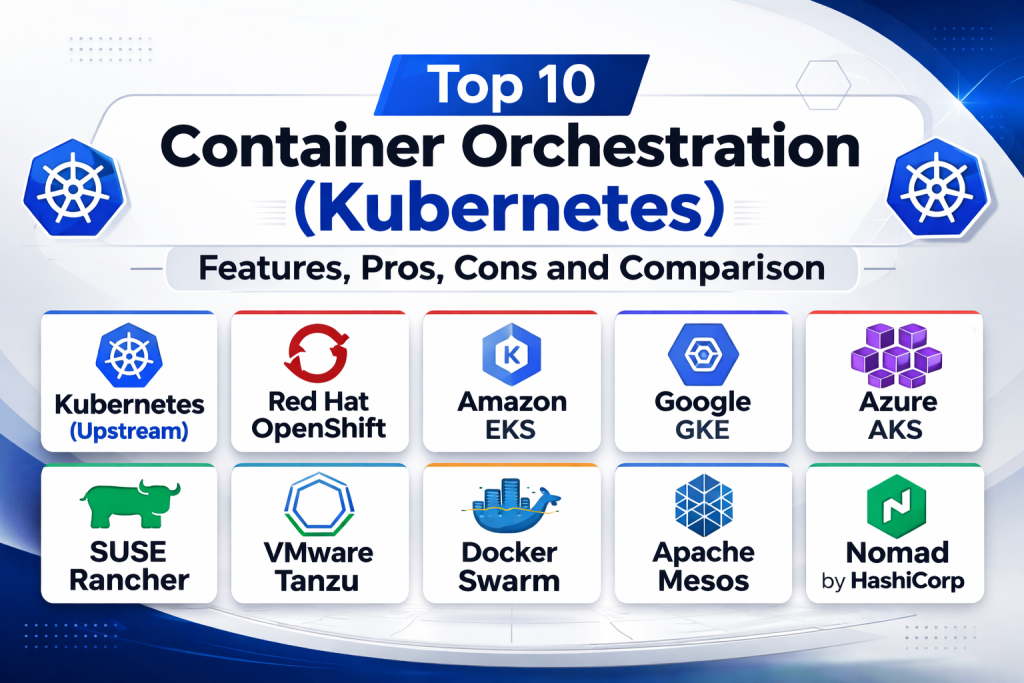
10 Tools Covered
- Kubernetes (Upstream)
- Red Hat OpenShift
- Amazon Elastic Kubernetes Service (EKS)
- Google Kubernetes Engine (GKE)
- Azure Kubernetes Service (AKS)
- SUSE Rancher
- VMware Tanzu Kubernetes Grid
- Docker Swarm
- Apache Mesos
- Nomad by HashiCorp
Introduction
Container orchestration platforms enable teams to manage, scale, and deploy containerized applications efficiently across multiple hosts. Kubernetes has become the de facto standard for container orchestration, but other platforms provide additional features, integrations, and varying levels of control that make them attractive depending on the use case. Whether you’re running microservices in the cloud or managing hybrid environments, the right orchestration platform is crucial for maintaining reliability, scalability, and security.
The importance of container orchestration is increasing, especially with organizations shifting towards microservices, hybrid, and multi-cloud architectures. and beyond, container orchestration is expected to become even more automated, security-focused, and optimized for workloads across different environments, whether on-prem, in the cloud, or at the edge.
Real-world use cases include simplifying deployment pipelines, scaling applications based on traffic, managing complex multi-service environments, and ensuring fault tolerance and availability across cloud-native applications.
Buyers should evaluate the ease of setup, cluster management, cost, integrations with other tools, and the level of vendor support when selecting a container orchestration platform. Security features like role-based access control (RBAC), network segmentation, and compliance support are also crucial to consider.
Best for: DevOps teams, platform engineers, application developers, and cloud infrastructure teams who need efficient management of containers and microservices at scale.
Not ideal for: Small applications with a single container or teams that do not have the operational capacity to manage and maintain a complex orchestration system.
Key Trends in Container Orchestration (Kubernetes) and Beyond
- AI-driven orchestration: AI and machine learning are increasingly being integrated into container orchestration platforms for workload optimization, auto-scaling, and self-healing capabilities.
- Serverless containers: Platforms are moving towards serverless containerized applications, reducing overhead by abstracting infrastructure management.
- Multicloud and hybrid-cloud integration: More tools are emerging to support container orchestration across multiple clouds with consistent management and application portability.
- Service mesh integration: Platforms are offering service mesh support to manage microservices traffic, ensuring improved monitoring, observability, and security.
- Security-first container orchestration: With increasing concerns about vulnerabilities, the focus on container security has become paramount, with more platforms offering automated scanning, compliance enforcement, and encrypted communication.
- Edge computing adoption: Container orchestration platforms are adapting to manage workloads in edge computing environments where low latency and real-time data processing are crucial.
- Optimized cost and resource management: Newer platforms are introducing cost-saving features such as better resource scheduling, cost monitoring, and rightsizing, making container orchestration more cost-effective.
- Improved observability and diagnostics: Enhanced monitoring tools and diagnostic features are being added to orchestration platforms to help organizations quickly identify and resolve issues in complex containerized environments.
How We Selected These Tools (Methodology)
- Market adoption / mindshare: Selected tools based on real-world adoption and their presence in large-scale deployments, making them proven in production environments.
- Feature completeness: Focused on platforms with a robust set of features, including automated scaling, self-healing, load balancing, and network policies.
- Security posture signals: Chose tools with integrated security measures like role-based access control (RBAC), encryption, and image scanning, ensuring secure container deployments.
- Reliability and performance signals: Tools with high availability, performance optimization, and fault tolerance were prioritized.
- Integrations and ecosystem: Considered the breadth of integrations with CI/CD tools, storage, networking, monitoring, and third-party services.
- Customer fit across segments: We selected platforms that cater to a range of teams from small startups to large enterprises.
- Ease of management: Platforms that offer simplified cluster management, user-friendly interfaces, and a streamlined setup were prioritized.
Top 10 Container Orchestration (Kubernetes)
1 — Kubernetes (Upstream)
Kubernetes is the open-source container orchestration platform that has become the industry standard. It enables the deployment, scaling, and management of containerized applications and is highly extensible, making it the most widely used orchestration tool.
Key Features
- Automated container deployment and scaling
- Self-healing with pod replacements and load balancing
- Extensible with custom controllers and operators
- Built-in network policies for microservices communication
- Support for multi-cloud and hybrid cloud environments
- Strong community-driven ecosystem
Pros
- Largest ecosystem with extensive community support
- Highly flexible and extensible for custom use cases
Cons
- Can be complex to set up and manage without Kubernetes expertise
- Requires operational maturity for smooth upgrades and scaling
Platforms / Deployment
- Web / Windows / macOS / Linux
- Self-hosted / Hybrid
Security & Compliance
- RBAC, SSO, MFA, encryption, audit logs
- Compliance certifications: Not publicly stated
Integrations & Ecosystem
- Broad integration with CI/CD pipelines, storage solutions, and monitoring tools
- Cloud provider integrations (AWS, Azure, GCP)
- Strong compatibility with service meshes and API gateways
Support & Community
- Extensive community support and documentation; strong vendor support through enterprise distributions
2 — Red Hat OpenShift
OpenShift is an enterprise Kubernetes platform that provides developer tools, built-in CI/CD pipelines, and integrated security features. It is designed for organizations that want a production-ready Kubernetes distribution with enterprise support.
Key Features
- Kubernetes-based with integrated DevOps tools
- Self-healing and automated scaling for workloads
- Multi-tenant architecture with isolated projects
- Built-in image registry and security features
- Automated patching and upgrades
- Integrated monitoring and logging
Pros
- Enterprise-grade support and security features
- Integrated CI/CD workflows for developers
Cons
- Can be complex for smaller teams or environments
- Licensing costs can be high for smaller organizations
Platforms / Deployment
- Web / Windows / Linux
- Self-hosted / Hybrid
Security & Compliance
- Built-in security features, including RBAC and image scanning
- Compliance certifications: Not publicly stated
Integrations & Ecosystem
- Integration with developer tools, CI/CD pipelines, storage, and cloud platforms
- Broad ecosystem support for monitoring and observability tools
Support & Community
- Excellent enterprise support, extensive documentation, and a large user base
3 — Amazon Elastic Kubernetes Service (EKS)
Amazon Elastic Kubernetes Service (EKS) is a fully managed Kubernetes service from AWS, designed to simplify Kubernetes cluster management while offering seamless integration with AWS services.
Key Features
- Managed Kubernetes control plane with automated updates and scaling
- Integration with AWS Identity and Access Management (IAM)
- Support for AWS networking, load balancing, and storage
- Integrated monitoring and logging with CloudWatch
- Multi-region support for disaster recovery
Pros
- Simplifies Kubernetes management by offloading control plane operations
- Strong integration with AWS services for streamlined cloud-native workloads
Cons
- Tied to AWS infrastructure, which can create vendor lock-in
- Pricing can be expensive for large-scale clusters
Platforms / Deployment
- Web / Linux
- Cloud
Security & Compliance
- IAM integration, encryption, audit logs, RBAC
- Compliance certifications: Not publicly stated
Integrations & Ecosystem
- Seamless integration with AWS networking, storage, and security services
- Monitoring integration with CloudWatch
- Kubernetes ecosystem compatibility
Support & Community
- Excellent AWS support, robust documentation, and large community
4 — Google Kubernetes Engine (GKE)
Google Kubernetes Engine (GKE) is a managed Kubernetes service offered by Google Cloud that simplifies the orchestration and management of Kubernetes clusters while integrating deeply with Google’s cloud infrastructure.
Key Features
- Fully managed Kubernetes control plane
- Integrated with Google Cloud networking, storage, and identity management
- Automatic scaling and load balancing
- Support for multi-cluster management
- Managed node pools with auto-upgrade and auto-healing
Pros
- Excellent integration with Google Cloud tools and services
- Simplifies Kubernetes management with automatic scaling and updates
Cons
- Cloud lock-in with Google Cloud
- May require expertise in GCP-specific integrations and features
Platforms / Deployment
- Web / Linux
- Cloud
Security & Compliance
- IAM, encryption, audit logs, RBAC
- Compliance certifications: Not publicly stated
Integrations & Ecosystem
- Integration with Google Cloud services and third-party monitoring tools
- Kubernetes-native ecosystem tools compatibility
Support & Community
- Strong support via Google Cloud
- Active community and extensive documentation
5 — Azure Kubernetes Service (AKS)
Azure Kubernetes Service (AKS) is a managed Kubernetes service from Microsoft, designed to simplify the deployment, management, and scaling of containerized applications using Kubernetes.
Key Features
- Fully managed Kubernetes control plane
- Integrated with Azure Active Directory (AAD) for access control
- Automated scaling and resource optimization
- Integration with Azure networking and storage services
- Native security integrations like Azure Security Center
Pros
- Seamless integration with Azure services
- Easy to scale and manage for Azure-centric organizations
Cons
- Pricing can become expensive at scale
- Limited to Azure, creating vendor lock-in
Platforms / Deployment
- Web / Linux
- Cloud
Security & Compliance
- AAD integration, RBAC, encryption, audit logs
- Compliance certifications: Not publicly stated
Integrations & Ecosystem
- Integration with Azure services such as Azure Active Directory, Blob Storage, and Monitor
- Kubernetes-native tool integrations
Support & Community
- Comprehensive enterprise support through Azure
- Active Microsoft and Azure communities
6 — SUSE Rancher
SUSE Rancher is an open-source container management platform that simplifies multi-cluster Kubernetes management, offering unified operations across hybrid and multi-cloud environments.
Key Features
- Multi-cluster management and centralized control
- Role-based access and project management
- Integrated CI/CD pipelines for DevOps workflows
- Unified logging, monitoring, and alerting
- Cloud and on-prem deployment support
Pros
- Excellent for managing multiple Kubernetes clusters across environments
- Open-source, with enterprise-level support options
Cons
- May require a bit of learning for teams not familiar with multi-cluster operations
- Not as feature-rich as some premium options
Platforms / Deployment
- Web / Linux
- Self-hosted / Hybrid
Security & Compliance
- RBAC, image scanning, audit logs, access controls
- Compliance certifications: Not publicly stated
Integrations & Ecosystem
- Integration with popular Kubernetes tools, monitoring, and storage solutions
- Cloud and on-prem compatibility
Support & Community
- Solid enterprise support options with community-driven resources
7 — VMware Tanzu Kubernetes Grid
VMware Tanzu Kubernetes Grid is VMware’s enterprise solution for managing Kubernetes clusters, designed to integrate with VMware vSphere environments and enable cloud-native application delivery.
Key Features
- Full-stack Kubernetes management aligned with VMware operations
- Integration with vSphere for simplified virtual infrastructure management
- Integrated with VMware’s network and storage solutions
- Cluster lifecycle management with automated upgrades
- Built-in observability and monitoring tools
Pros
- Seamless VMware integration for businesses already using VMware infrastructure
- Strong enterprise-grade features for larger deployments
Cons
- Best suited for VMware environments, may not be ideal for non-VMware users
- Licensing costs may be high for smaller organizations
Platforms / Deployment
- Web / Windows / Linux
- Self-hosted / Hybrid
Security & Compliance
- RBAC, SSO, encryption, audit logs
- Compliance certifications: Not publicly stated
Integrations & Ecosystem
- Deep integration with VMware tools like vSphere, NSX, and vSAN
- Broad ecosystem compatibility for Kubernetes-based workloads
Support & Community
- Enterprise-level support, with a large VMware ecosystem community
8 — Docker Swarm
Docker Swarm is Docker’s native clustering and orchestration tool, designed to provide an easy-to-use, lightweight solution for container orchestration.
Key Features
- Simplified orchestration for containerized applications
- Built-in load balancing and service discovery
- Secure networking between nodes
- Automatic scaling and self-healing containers
- Seamless integration with Docker containers
Pros
- Simpler and lighter than Kubernetes, easy to set up and use
- Well-suited for small and medium-scale container environments
Cons
- Lacks some advanced features and scalability compared to Kubernetes
- Smaller ecosystem and fewer enterprise integrations
Platforms / Deployment
- Web / Linux / macOS
- Self-hosted
Security & Compliance
- TLS encryption, RBAC, secrets management
- Compliance certifications: Not publicly stated
Integrations & Ecosystem
- Integrates with Docker tools and CI/CD pipelines
- Smaller ecosystem compared to Kubernetes and OpenShift
Support & Community
- Community-driven support; formal enterprise support is available through Docker
9 — Apache Mesos
Apache Mesos is a distributed systems kernel that abstracts resources across clusters and supports running containerized and non-containerized workloads. It’s ideal for large-scale systems requiring flexibility.
Key Features
- Resource management across clusters with container and non-container support
- Built-in fault tolerance and scaling
- Multi-framework and multi-container support
- Advanced resource isolation and scheduling
- Integration with Kubernetes for advanced container orchestration
Pros
- Flexible platform supporting both containerized and non-containerized workloads
- Can manage large-scale clusters effectively
Cons
- Steeper learning curve compared to Kubernetes
- Requires more operational effort for optimal performance
Platforms / Deployment
- Web / Linux
- Self-hosted
Security & Compliance
- Encryption, RBAC, and audit logging features
- Compliance certifications: Not publicly stated
Integrations & Ecosystem
- Integration with Kubernetes, Hadoop, and other container orchestration tools
- Strong ecosystem for big data and large-scale workloads
Support & Community
- Strong community support; enterprise-grade support available
10 — Nomad by HashiCorp
HashiCorp Nomad is a lightweight, flexible container orchestration tool that is optimized for both containerized and non-containerized applications. It focuses on simplicity and scalability, making it ideal for many use cases.
Key Features
- Multi-workload orchestration, supporting containers, VMs, and other workloads
- Strong integration with HashiCorp tools like Consul and Vault
- Simple architecture with minimal operational overhead
- Auto-scaling and workload balancing
- Flexible integration options with existing infrastructure
Pros
- Simple, lightweight, and easy to use compared to Kubernetes
- Excellent for multi-workload environments
Cons
- Fewer built-in features than Kubernetes for container management
- Smaller ecosystem and community than Kubernetes
Platforms / Deployment
- Web / Linux / macOS
- Self-hosted / Hybrid
Security & Compliance
- Integration with Consul and Vault for secrets management
- Compliance certifications: Not publicly stated
Integrations & Ecosystem
- Integration with HashiCorp tools and third-party systems
- APIs for integration and automation
Support & Community
- Strong community support; enterprise support is available from HashiCorp
Comparison Table
| Tool Name | Best For | Platform(s) Supported | Deployment (Cloud/Self-hosted/Hybrid) | Standout Feature | Public Rating |
|---|---|---|---|---|---|
| Kubernetes (Upstream) | Maximum flexibility and ecosystem choice | Web / Windows / macOS / Linux | Self-hosted / Hybrid | Extensible orchestration foundation | N/A |
| Red Hat OpenShift | Enterprise governance and guardrails | Web / Windows / macOS / Linux | Cloud / Self-hosted / Hybrid | Opinionated enterprise platform layer | N/A |
| Amazon Elastic Kubernetes Service (EKS) | AWS-aligned managed Kubernetes | Web / Windows / macOS / Linux | Cloud | Managed control plane with AWS integration | N/A |
| Google Kubernetes Engine (GKE) | Managed Kubernetes with strong operations tooling | Web / Windows / macOS / Linux | Cloud | Mature managed Kubernetes operations | N/A |
| Azure Kubernetes Service (AKS) | Azure-first Kubernetes programs | Web / Windows / macOS / Linux | Cloud | Azure identity and governance alignment | N/A |
| SUSE Rancher | Multi-cluster Kubernetes management | Web / Windows / macOS / Linux | Self-hosted / Hybrid | Central control plane for many clusters | N/A |
| VMware Tanzu Kubernetes Grid | VMware-centric enterprise Kubernetes | Web / Windows / macOS / Linux | Self-hosted / Hybrid | Enterprise standardization for clusters | N/A |
| Docker Swarm | Lightweight orchestration for containers | Web / Linux / macOS | Self-hosted | Simplicity and speed for small clusters | N/A |
| Apache Mesos | Large-scale multi-workload orchestration | Web / Linux | Self-hosted | Flexibility to handle both containerized and non-container workloads | N/A |
| Nomad by HashiCorp | Lightweight orchestration for multi-workload environments | Web / Linux / macOS | Self-hosted / Hybrid | Simple, flexible, and multi-workload support | N/A |
Evaluation & Scoring
| Tool Name | Core (25%) | Ease (15%) | Integrations (15%) | Security (10%) | Performance (10%) | Support (10%) | Value (15%) | Weighted Total (0–10) |
|---|---|---|---|---|---|---|---|---|
| Kubernetes (Upstream) | 9 | 6 | 9 | 8 | 9 | 8 | 9 | 8.35 |
| Red Hat OpenShift | 9 | 7 | 8 | 9 | 8 | 8 | 6 | 7.90 |
| Amazon Elastic Kubernetes Service (EKS) | 8 | 8 | 8 | 8 | 8 | 8 | 7 | 7.85 |
| Google Kubernetes Engine (GKE) | 8 | 8 | 8 | 8 | 8 | 8 | 7 | 7.85 |
| Azure Kubernetes Service (AKS) | 8 | 8 | 8 | 8 | 8 | 8 | 8 | 8.00 |
| SUSE Rancher | 8 | 7 | 8 | 8 | 8 | 7 | 8 | 7.75 |
| VMware Tanzu Kubernetes Grid | 8 | 6 | 8 | 8 | 8 | 7 | 6 | 7.30 |
| Docker Swarm | 7 | 7 | 7 | 7 | 8 | 7 | 8 | 7.25 |
| Apache Mesos | 7 | 6 | 7 | 7 | 7 |
How to interpret the scores:
These scores are comparative across this specific list. A higher score suggests stronger overall capabilities, but the best fit depends on your needs. Consider the platform’s ease of use, security, integrations, and price as well as its core features when making a choice.
Which Container Orchestration Platform Is Right for You?
Solo / Freelancer
If you are new to containers or managing small workloads, Docker Swarm or Nomad by HashiCorp could be a great fit. They are simpler to set up and ideal for small environments.
SMB
SUSE Rancher is an excellent choice for SMBs that need multi-cluster management without the complexity of large enterprise solutions. Kubernetes (Upstream) is also viable for SMBs that want flexibility and scalability.
Mid-Market
Mid-market teams often benefit from a platform that provides strong governance, security, and scalability without excessive complexity. Google Kubernetes Engine (GKE) and Azure Kubernetes Service (AKS) offer cloud-native features with managed simplicity, while Red Hat OpenShift is ideal for organizations that want additional enterprise features and support.
Enterprise
For large enterprises, Kubernetes (Upstream), Red Hat OpenShift, and VMware Tanzu Kubernetes Grid offer extensive features for managing large-scale containerized applications. If your enterprise needs a multi-cloud or hybrid approach, these platforms provide the flexibility to scale while maintaining control.
Budget vs Premium
Docker Swarm and Nomad by HashiCorp are excellent budget-friendly options, whereas OpenShift and VMware Tanzu Kubernetes Grid are premium solutions offering enterprise-grade features, support, and integrations.
Feature Depth vs Ease of Use
Kubernetes (Upstream) offers the most flexibility, but requires more expertise. Managed services like GKE, EKS, and AKS are easier to use but offer fewer customization options. OpenShift and SUSE Rancher balance flexibility with ease of use.
Integrations & Scalability
If you are heavily invested in a particular cloud provider, AKS, GKE, or EKS will make sense. For a more vendor-agnostic approach, Kubernetes (Upstream) and SUSE Rancher allow better integration across different environments.
Security & Compliance Needs
For higher security and compliance needs, Red Hat OpenShift and VMware Tanzu Kubernetes Grid offer built-in features and strong compliance support. Kubernetes (Upstream) can also be made secure but requires more effort to configure securely.
FAQs
1. What is container orchestration?
Container orchestration automates the deployment, management, and scaling of containers. It helps coordinate containers across multiple machines, ensuring high availability, networking, and resource management.
2. How does Kubernetes differ from Docker Swarm?
Kubernetes offers more advanced features like automated scaling, self-healing, and a larger ecosystem of tools. Docker Swarm is simpler and better suited for smaller or less complex environments.
3. What are the advantages of using a managed Kubernetes service?
Managed Kubernetes services like EKS, GKE, and AKS handle the operational burden of managing the control plane, including upgrades, scaling, and security, making it easier for teams to focus on workloads.
4. Can I use multiple container orchestration tools in the same environment?
It’s possible, but managing multiple orchestration systems in the same environment can add complexity. It’s generally better to standardize on a single platform for consistency and ease of operations.
5. How do I scale my containers in a container orchestration platform?
Most platforms, like Kubernetes, allow for automated scaling based on resource usage. You can define scaling policies and limits to ensure the environment scales up or down as needed.
6. What are service meshes, and why are they important in container orchestration?
A service mesh helps manage microservices communication by providing observability, traffic management, and security features. It ensures consistent communication patterns and better monitoring in containerized environments.
7. How do container orchestration platforms help with disaster recovery?
Container orchestration platforms offer built-in self-healing, backup strategies, and multi-region replication to ensure minimal downtime in case of a failure.
8. Are container orchestration platforms suitable for legacy applications?
Yes, many platforms allow you to integrate legacy applications into a containerized ecosystem through compatibility layers, hybrid cloud, or VM-based approaches.
9. What is the role of security in container orchestration?
Security is critical in container orchestration, with features like role-based access control (RBAC), secure container images, network policies, and encryption, all helping protect data and workloads from vulnerabilities.
10. How do I choose the best container orchestration platform?
Choose a platform based on your team’s existing cloud environment, scalability needs, security requirements, ease of use, and the level of support needed. Pilot multiple platforms to determine the best fit for your use case.
Conclusion
Container orchestration platforms provide the foundation for modern cloud-native applications, enabling teams to manage complex, distributed systems with ease. Kubernetes (Upstream) remains the most flexible and widely adopted platform, while managed services like GKE, EKS, and AKS simplify operations for cloud-first teams. Red Hat OpenShift and VMware Tanzu Kubernetes Grid offer enterprise-grade features and support for larger organizations, while SUSE Rancher excels in multi-cluster management. The best platform for you will depend on your existing ecosystem, workload complexity, and operational maturity. Start by selecting two or three options, running a pilot, and validating your platform’s compatibility with your workload, security, and scalability needs.
#Kubernetes, #ContainerOrchestration, #CloudNative, #DevOps, #ContainerManagement

Best Cardiac Hospitals Near You
Discover top heart hospitals, cardiology centers & cardiac care services by city.
Advanced Heart Care • Trusted Hospitals • Expert Teams
View Best Hospitals