Introduction
Performance testing tools help you simulate real user traffic and measure how your apps behave under load. In plain terms, they answer questions like: Will our website slow down during a sale? Will our API time out when many users log in? Can our mobile backend handle peak usage? These tools generate controlled traffic, collect timing metrics, and highlight bottlenecks across servers, databases, networks, and application code.
Performance testing matters more now because systems are more distributed (microservices, APIs, containers, multi-cloud), and user expectations are strict (fast pages, stable apps, zero downtime). Even small latency spikes can impact revenue, user trust, and operational costs. A strong performance testing practice helps you catch scaling failures before production, plan capacity, validate optimizations, and avoid “it worked in staging” surprises.
Common real-world use cases include:
- Load testing a customer portal before marketing campaigns and seasonal peaks
- Stress testing APIs to find breaking points and failure modes
- Soak testing to detect memory leaks and resource exhaustion over time
- Validating autoscaling policies in cloud environments
- Comparing performance across releases to prevent regressions
What buyers should evaluate before choosing a tool:
- Protocol and workload coverage (web, API, mobile, messaging)
- Test design approach (code-based vs GUI vs recorded flows)
- Reporting depth (latency percentiles, errors, trends, correlation)
- Realistic load generation (cloud regions, geo-distribution, concurrency)
- CI/CD fit (automation, APIs, pipelines, versioning)
- Extensibility (plugins, custom metrics, scripting, data handling)
- Team skills required (developers vs QA vs SRE)
- Cost and scalability of load generators
- Security expectations (RBAC, audit logs, secrets handling, SSO)
- Vendor support and community maturity
Best for: QA teams, SRE/DevOps, platform engineering, and product teams that need confidence before launch, migration, or high-traffic events. Works well for SaaS companies, e-commerce, fintech, media streaming, and any business where latency and uptime impact revenue or trust.
Not ideal for: Teams that only need basic uptime checks or synthetic monitoring. If your main goal is “is the site up?” a monitoring tool may be a better fit. Also, if you rarely ship changes and have stable traffic, you might only need lightweight API benchmarking instead of full-scale load platforms.
Key Trends in Performance Testing Tools
- Shift toward code-defined tests that are versioned, reviewed, and reusable across teams
- Tighter CI/CD integration so performance checks run automatically on key pipelines
- Better support for modern APIs and event-driven systems (gRPC, streaming, messaging)
- More focus on end-to-end visibility: linking test results with logs, traces, and infrastructure metrics
- Increased expectations for role-based access, audit trails, and enterprise authentication options
- Cloud-driven load generation for geo-distributed traffic and realistic internet conditions
- Emphasis on cost-aware load testing (efficient generators, right-sizing, test scheduling)
- More “engineer-friendly” workflows, while still offering QA-friendly UI options
- Growing demand for long-running reliability tests (soak tests) and resilience scenarios
- Stronger integration patterns with incident management and observability ecosystems
How We Selected These Tools
- Strong adoption and mindshare across performance engineering and QA communities
- Credible coverage of core load testing needs for web apps and APIs
- Ability to scale load generation in a predictable, controllable way
- Fit across different segments: solo developers, SMB teams, and large enterprises
- Automation readiness: scripting, APIs, pipeline hooks, and repeatable execution
- Extensibility through plugins, integrations, or custom metrics and reporting
- Practical reporting and diagnostics to help teams act on results
- Community strength and documentation quality (or enterprise support where applicable)
- Balanced mix of open-source and commercial tools to match different constraints
- Track record of reliability in real-world test environments
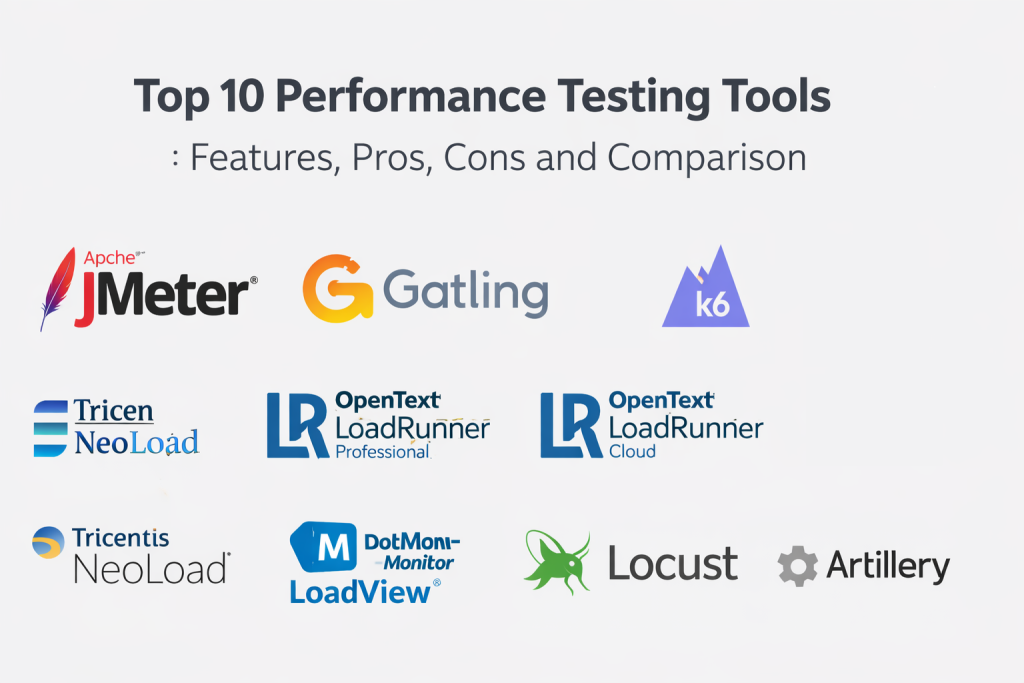
Top 10 Performance Testing Tools
1) Apache JMeter
Apache JMeter is a widely used open-source load testing tool for web applications and many protocols. It’s popular with QA teams and engineers who want a flexible tool that can scale with plugins and distributed test setups.
Key Features
- Supports HTTP/HTTPS, REST-style APIs, and additional protocols via plugins
- GUI for building tests plus non-GUI mode for automation
- Parameterization, assertions, and correlation workflows
- Distributed load testing with multiple generators
- Rich plugin ecosystem for reports, graphs, and protocol support
- CSV-based data feeding and advanced test control
- Extensible scripting and custom samplers
Pros
- Very large community and mature ecosystem
- Works well for many common API and web scenarios
- Strong option when budget is tight and skills exist in-house
Cons
- Test design can become complex at scale without strong conventions
- GUI-based tests can be harder to maintain than code-based tests
- Resource tuning is important for high load generation
Platforms / Deployment
- Windows / macOS / Linux
- Self-hosted (typical), can be run in cloud VMs for load generation
Security & Compliance
- Not publicly stated (open-source tool; security depends on how you run and govern it)
Integrations & Ecosystem
JMeter fits well into CI/CD pipelines and can export results for dashboards and external reporting. Many teams integrate it with build tools and reporting stacks to track latency, error rates, and trends across releases.
- CI runners and pipeline scripts (generic)
- Reporting plugins and external dashboards
- Containerized execution patterns for repeatability
- Results export to common formats (varies by setup)
Support & Community
Large community, extensive tutorials, and many plugins. Official enterprise support is not built-in; support typically comes from community resources or third-party vendors.
2) Gatling
Gatling is a performance testing tool known for a developer-friendly approach and efficient load generation. It’s often chosen when teams prefer tests defined in code and want strong control over scenarios and assertions.
Key Features
- Code-driven test definition with strong maintainability
- High-performance engine suitable for large-scale concurrency
- Detailed reports with latency distributions and error breakdowns
- Scenario modeling (ramp-up, pacing, stages, user journeys)
- Strong fit for API performance testing
- Automation-first execution and repeatability
- Supports distributed execution patterns (varies by edition/setup)
Pros
- Efficient load generation and clean reporting
- Code-based tests are easier to version and review
- Good fit for engineering-led performance programs
Cons
- Learning curve for teams not comfortable with code-driven testing
- Some advanced features depend on commercial offerings
- UI-first users may prefer GUI-based tools
Platforms / Deployment
- Windows / macOS / Linux
- Self-hosted, and cloud patterns depending on edition
Security & Compliance
- Not publicly stated (depends on deployment and edition)
Integrations & Ecosystem
Gatling commonly integrates into CI/CD and can publish results for performance gates. It works well with modern engineering workflows and automated pipelines.
- Pipeline execution and artifact storage
- Metrics export patterns and dashboards (depends on setup)
- Extensible scenario logic and custom data feeders
- API-focused test suites for microservices
Support & Community
Strong community resources and documentation. Commercial support availability varies by edition.
3) Grafana k6
Grafana k6 is a modern, developer-centric performance testing tool that uses scripts to define load tests, especially for APIs and web endpoints. It’s popular for its simple scripting style and automation-first mindset.
Key Features
- Script-based tests that are easy to version-control
- Focus on API load testing and modern workflows
- Flexible scenario configuration and thresholds
- Clear results output and performance assertions
- Supports distributed execution patterns (varies by setup/edition)
- Integrates well with observability workflows
- Works well for continuous testing and performance gates
Pros
- Easy to automate and standardize across teams
- Great for API performance testing and CI/CD checks
- Strong fit with modern engineering toolchains
Cons
- GUI recording workflows are not the primary model
- Complex browser-level user journeys may require more work
- Some enterprise features may depend on paid offerings
Platforms / Deployment
- Windows / macOS / Linux
- Self-hosted and cloud patterns (depends on edition)
Security & Compliance
- Not publicly stated (depends on deployment and edition)
Integrations & Ecosystem
k6 is often paired with dashboards and observability tools so performance tests can be correlated with system metrics. It also fits well into pipelines.
- CI pipeline execution for every release
- Metrics export to dashboards (varies by setup)
- Thresholds for pass/fail decisions in automation
- Extensible scripting for authentication, data, and workflows
Support & Community
Active community and strong documentation. Commercial support options depend on edition.
4) Tricentis NeoLoad
Tricentis NeoLoad is an enterprise performance testing tool designed for large organizations that need advanced protocol support, maintainable testing, and strong integration with delivery pipelines and reporting.
Key Features
- Enterprise-oriented scenario design and maintenance features
- Supports complex application environments (varies by setup)
- Advanced test management, reporting, and collaboration
- CI/CD integration patterns for continuous performance testing
- Analysis tools for finding bottlenecks and trends
- Reusable components and test assets for teams
- Scalable load generation options
Pros
- Strong for enterprise scale and collaboration
- Good tooling for maintainability and test asset reuse
- Designed for ongoing performance programs, not one-off tests
Cons
- Cost can be high for smaller teams
- Requires process maturity to get full value
- Setup and governance can take time
Platforms / Deployment
- Windows / macOS / Linux (varies by components)
- Cloud / Self-hosted / Hybrid (varies by licensing and architecture)
Security & Compliance
- Not publicly stated (vendor documentation required for exact claims)
Integrations & Ecosystem
NeoLoad is commonly used alongside enterprise ALM, CI/CD, and reporting systems. It’s best when performance testing is a shared organizational function.
- Pipeline triggers and automated runs
- Reporting exports and collaboration workflows
- Integration with common delivery toolchains (varies)
- Extensible test assets and reusable libraries
Support & Community
Enterprise-grade support is typically available. Community presence exists but is smaller than large open-source tools.
5) OpenText LoadRunner Professional
OpenText LoadRunner Professional is a well-known enterprise performance testing product with broad protocol coverage and mature capabilities. It is often selected by large organizations with complex testing requirements and established QA performance practices.
Key Features
- Broad protocol support for enterprise systems (varies by licensing)
- Mature scenario modeling and execution controls
- Detailed analytics and reporting options
- Correlation and parameterization workflows for complex apps
- Scalable load generation across distributed agents
- Strong fit for legacy + modern hybrid environments
- Centralized governance patterns for large teams
Pros
- Strong enterprise depth and protocol breadth
- Mature ecosystem for complex testing programs
- Suitable for regulated and large-scale environments
Cons
- Licensing and operating costs can be significant
- Can feel heavy for small teams or simple API testing
- Requires skilled practitioners for best outcomes
Platforms / Deployment
- Windows (common for controllers), Linux agents (varies)
- Self-hosted / Hybrid (varies by architecture)
Security & Compliance
- Not publicly stated (vendor documentation required for exact claims)
Integrations & Ecosystem
LoadRunner Professional is frequently integrated with enterprise QA workflows, reporting, and release processes. It’s typically part of a broader quality engineering toolchain.
- Integration with test management workflows (varies)
- Automation hooks for build and release pipelines
- Reporting and result exports for stakeholders
- Extensibility through add-ons and connectors (varies)
Support & Community
Enterprise support is a key strength. Community resources exist, but most value comes from official documentation and support channels.
6) OpenText LoadRunner Cloud
OpenText LoadRunner Cloud focuses on cloud-based load testing workflows, enabling teams to generate load from multiple regions and scale tests without maintaining as much infrastructure.
Key Features
- Cloud-based execution and scalable load generation
- Geo-distributed load options (varies by plan/regions)
- Browser and API testing patterns (varies)
- Collaboration features for shared reporting
- Test scheduling and repeatable runs
- Reporting focused on trends and comparisons
- Faster onboarding compared to heavy self-hosted setups
Pros
- Reduces infrastructure management for load generators
- Easier scaling for peak tests and distributed traffic
- Good for teams that want managed execution
Cons
- Ongoing costs can increase with frequent high-load testing
- Deep customization may be more limited than self-hosted stacks
- Vendor lock-in concerns for some organizations
Platforms / Deployment
- Web (managed platform)
- Cloud
Security & Compliance
- Not publicly stated (vendor documentation required for exact claims)
Integrations & Ecosystem
Cloud platforms commonly provide APIs and pipeline triggers, making it easier to run standard tests as part of release routines.
- CI/CD triggers and test automation patterns
- Exportable reports for stakeholders
- Common enterprise workflow integrations (varies)
- Team collaboration features for review and sign-off
Support & Community
Enterprise support options are typically available. Community usage exists, but vendor support is often the primary channel.
7) RadView WebLOAD
RadView WebLOAD is a performance testing platform designed for web and API load testing, often used by organizations that want a commercial tool with strong reporting, scripting options, and enterprise workflows.
Key Features
- Web and API performance testing capabilities
- Test scripting and scenario modeling tools
- Reporting and analytics designed for teams
- Load generation scalability across distributed agents
- Parameterization and correlation support for complex apps
- Integration patterns for continuous testing (varies)
- Monitoring hooks to enrich test analysis (varies)
Pros
- Commercial tooling with structured reporting
- Strong for teams that want packaged workflows
- Can fit well in mid-market and enterprise needs
Cons
- Smaller community than major open-source tools
- Cost may not fit very small teams
- Feature depth may vary by edition/licensing
Platforms / Deployment
- Windows / Linux (varies by components)
- Cloud / Self-hosted / Hybrid (varies)
Security & Compliance
- Not publicly stated
Integrations & Ecosystem
WebLOAD typically integrates into release processes and can export results for broader reporting and stakeholder visibility.
- Pipeline execution support (varies)
- Result exports and team dashboards
- Extensible scripting for authentication and data
- Integration with monitoring stacks (varies)
Support & Community
Commercial support is commonly available. Community resources exist but are not as extensive as larger open-source ecosystems.
8) Dotcom-Monitor LoadView
Dotcom-Monitor LoadView is a cloud-based load testing tool aimed at teams that want practical load tests without maintaining their own generators. It’s often used for web app journeys and API testing with a managed approach.
Key Features
- Cloud execution with scalable load generation
- Focus on realistic user journeys (varies by approach)
- Simple onboarding for teams new to load testing
- Reporting designed for non-specialists and stakeholders
- Geo-distributed load options (varies)
- Test scheduling and repeatability features
- Useful for quick validation before launches
Pros
- Easy to start and run meaningful tests quickly
- Managed load generation reduces setup work
- Good for teams that want practical results fast
Cons
- Deep customization may be limited compared to code-first tools
- Costs can rise for large or frequent tests
- Advanced engineering workflows may require extra effort
Platforms / Deployment
- Web (managed platform)
- Cloud
Security & Compliance
- Not publicly stated
Integrations & Ecosystem
Cloud tools typically support exporting results and connecting with broader delivery workflows, though depth varies by product.
- API-based triggers and automation patterns (varies)
- Exportable reports and summaries
- Team workflows for review and sign-off
- Integration depth varies by plan
Support & Community
Support is usually vendor-led. Community and third-party resources are more limited than open-source tools.
9) Locust
Locust is an open-source, code-driven load testing tool that lets you define user behavior in Python. It’s valued by engineering teams who want full control over scenario logic and prefer writing tests as code.
Key Features
- Python-based scenario definition and user behavior modeling
- Distributed execution to scale load across workers
- Flexible data handling and custom logic
- Real-time web UI for monitoring tests
- Works well for APIs and custom protocols (with code)
- Easy to integrate into CI/CD for repeatable runs
- Extensible for complex authentication and workflows
Pros
- Very flexible for custom scenarios and logic
- Great for teams already comfortable with Python
- Open-source approach supports cost-effective scaling
Cons
- Requires coding skill and disciplined test design
- Reporting may need external tooling for deep analytics
- Standardization across teams requires conventions
Platforms / Deployment
- Windows / macOS / Linux
- Self-hosted, often run in containers or cloud VMs
Security & Compliance
- Not publicly stated (depends on how you deploy and govern it)
Integrations & Ecosystem
Locust fits naturally into engineering workflows where tests are stored in repositories and run through pipelines.
- CI pipeline execution and gating
- Custom metrics export patterns (varies by setup)
- Container-based scaling for load generators
- Integration with monitoring tools depends on team setup
Support & Community
Good community presence for an open-source tool. Support is community-driven unless a third party is engaged.
10) Artillery
Artillery is a performance testing tool often used for API and microservice testing, with scenarios defined in a developer-friendly way. It’s commonly adopted by teams that want fast automation and modern test flows.
Key Features
- Scenario-based load testing for APIs and services
- Flexible configuration and scripting patterns
- Works well with CI/CD for automated checks
- Supports test phases, arrival rates, and thresholds
- Useful for distributed systems testing (varies by setup)
- Extensible for authentication and data-driven flows
- Lightweight approach for developer-led performance tests
Pros
- Strong fit for modern API-driven products
- Quick to integrate into engineering workflows
- Good balance of simplicity and capability
Cons
- Advanced enterprise governance may be limited depending on edition
- Deep reporting may require external dashboards
- Some features vary by plan or setup
Platforms / Deployment
- Windows / macOS / Linux
- Self-hosted and cloud execution patterns (varies)
Security & Compliance
- Not publicly stated
Integrations & Ecosystem
Artillery is typically integrated into build pipelines and engineering toolchains for repeatable performance checks.
- Automated test runs per release
- Threshold-based pass/fail checks
- Extensible scenario logic and plugins (varies)
- Reporting integrations vary by setup
Support & Community
Community support is present, with vendor support options varying by edition.
Comparison Table
| Tool Name | Best For | Platform(s) Supported | Deployment (Cloud/Self-hosted/Hybrid) | Standout Feature | Public Rating |
|---|---|---|---|---|---|
| Apache JMeter | Flexible open-source web and API load testing | Windows / macOS / Linux | Self-hosted | Massive plugin ecosystem | N/A |
| Gatling | Engineer-led, code-based load testing | Windows / macOS / Linux | Self-hosted / Cloud (varies) | Efficient load generation engine | N/A |
| Grafana k6 | CI-friendly API performance testing | Windows / macOS / Linux | Self-hosted / Cloud (varies) | Thresholds for automation gates | N/A |
| Tricentis NeoLoad | Enterprise collaboration and maintainability | Varies / N/A | Cloud / Self-hosted / Hybrid (varies) | Test asset reuse for teams | N/A |
| OpenText LoadRunner Professional | Deep enterprise protocol coverage | Varies / N/A | Self-hosted / Hybrid (varies) | Mature enterprise workflow depth | N/A |
| OpenText LoadRunner Cloud | Managed cloud load testing at scale | Web | Cloud | Geo-distributed managed load | N/A |
| RadView WebLOAD | Commercial web and API performance testing | Varies / N/A | Cloud / Self-hosted / Hybrid (varies) | Packaged reporting and workflows | N/A |
| Dotcom-Monitor LoadView | Quick cloud load tests and stakeholder reporting | Web | Cloud | Fast onboarding and managed execution | N/A |
| Locust | Python-defined custom behavior load testing | Windows / macOS / Linux | Self-hosted | Full control with Python scenarios | N/A |
| Artillery | Modern API and microservice load testing | Windows / macOS / Linux | Self-hosted / Cloud (varies) | Lightweight developer-first flows | N/A |
Evaluation & Scoring of Performance Testing Tools
Weights used in scoring:
- Core features – 25%
- Ease of use – 15%
- Integrations & ecosystem – 15%
- Security & compliance – 10%
- Performance & reliability – 10%
- Support & community – 10%
- Price / value – 15%
| Tool Name | Core (25%) | Ease (15%) | Integrations (15%) | Security (10%) | Performance (10%) | Support (10%) | Value (15%) | Weighted Total (0–10) |
|---|---|---|---|---|---|---|---|---|
| Apache JMeter | 8 | 6 | 7 | 6 | 7 | 8 | 9 | 7.40 |
| Gatling | 8 | 7 | 7 | 6 | 8 | 7 | 8 | 7.40 |
| Grafana k6 | 8 | 8 | 8 | 7 | 8 | 7 | 8 | 7.80 |
| Tricentis NeoLoad | 9 | 8 | 8 | 8 | 9 | 8 | 6 | 8.05 |
| OpenText LoadRunner Professional | 9 | 6 | 8 | 8 | 9 | 8 | 5 | 7.60 |
| OpenText LoadRunner Cloud | 8 | 7 | 8 | 8 | 8 | 7 | 6 | 7.45 |
| RadView WebLOAD | 8 | 7 | 7 | 7 | 8 | 7 | 6 | 7.20 |
| Dotcom-Monitor LoadView | 7 | 8 | 6 | 7 | 7 | 7 | 6 | 6.85 |
| Locust | 7 | 7 | 6 | 6 | 8 | 7 | 9 | 7.15 |
| Artillery | 7 | 8 | 7 | 6 | 7 | 6 | 8 | 7.10 |
How to interpret these scores:
- The totals are comparative, not absolute “best vs worst” judgments.
- A slightly lower total can still be the right pick if it matches your workflow and team skills.
- Enterprise tools may score higher on breadth but lower on value due to licensing realities.
- Open-source tools can score high on value, but success depends on internal expertise and standards.
Which Performance Testing Tool Is Right for You?
Solo / Freelancer
If you want maximum value and control with minimal spend, start with Apache JMeter, Locust, or Artillery. Choose based on your comfort level: JMeter is flexible with a GUI, Locust is best if you like Python, and Artillery fits well for API-first products. Keep scope small: test your most critical endpoints, define realistic data, and run short, repeatable tests.
SMB
SMBs usually benefit from fast onboarding and repeatable automation. Grafana k6 is strong when your team is engineering-led and wants pipeline-friendly performance checks. If you want managed execution and quick results, Dotcom-Monitor LoadView can reduce setup effort. If you have QA resources and want a mature open-source path, Apache JMeter remains a reliable backbone.
Mid-Market
Mid-market teams often run into a scale challenge: enough traffic to break things, but not enough specialists to maintain overly complex stacks. Gatling and Grafana k6 work well for continuous testing and standardization. If you need commercial workflows, packaged reporting, and vendor support, consider RadView WebLOAD. The best fit here is often the tool that your team can run consistently, not just the one with the biggest feature list.
Enterprise
Enterprises tend to need broader protocol support, governance, collaboration, and vendor-backed support. Tricentis NeoLoad is strong for organizations building a sustained performance engineering program across many applications. OpenText LoadRunner Professional is commonly chosen for complex enterprise environments. If you want a managed approach for distributed load and simpler operations, OpenText LoadRunner Cloud is worth considering. In large environments, pay attention to governance, access control, test data handling, and repeatable reporting.
Budget vs Premium
- Budget-friendly paths: Apache JMeter, Locust, Artillery
- Premium enterprise depth: Tricentis NeoLoad, OpenText LoadRunner Professional, OpenText LoadRunner Cloud
- Middle ground: Grafana k6, Gatling, RadView WebLOAD, Dotcom-Monitor LoadView
Feature Depth vs Ease of Use
- Deep and broad, but heavier: OpenText LoadRunner Professional, Tricentis NeoLoad
- Balanced, automation-friendly: Grafana k6, Gatling
- Quick start and managed simplicity: Dotcom-Monitor LoadView
- Highly flexible with DIY effort: Locust, Artillery, Apache JMeter
Integrations & Scalability
If your goal is “performance tests as part of delivery,” prioritize Grafana k6, Gatling, Locust, or Artillery for code-defined workflows. If you need standardized reporting and large shared programs across teams, Tricentis NeoLoad or OpenText LoadRunner offerings often fit better.
Security & Compliance Needs
Many organizations require strong access controls, auditability, and standardized user management. Commercial enterprise platforms often provide more built-in governance, while open-source tools depend on your deployment and operational controls. If compliance is a major factor, treat governance requirements as first-class selection criteria and validate them during a pilot.
Frequently Asked Questions (FAQs)
1) What is the difference between load testing and stress testing?
Load testing checks behavior at expected peak usage, while stress testing pushes beyond limits to see where the system breaks. Both are useful: load testing validates readiness, stress testing reveals failure modes and weak points.
2) Do I need a GUI tool, or is code-based testing better?
If your team prefers repeatability and version control, code-based tools are often easier to maintain over time. GUI tools can be faster for early adoption, but they may require extra discipline to keep tests stable as systems change.
3) How do I choose the right test scenario to start with?
Start with the top user journeys and the most revenue-critical APIs. Include login, search, checkout, or core workflows. Then expand to background jobs and less common flows once the main paths are stable.
4) What are common mistakes teams make with performance testing?
The biggest mistakes are unrealistic test data, skipping correlation/auth handling, ignoring warm-up time, and focusing only on average latency instead of percentiles. Another common issue is running tests without monitoring the full system, which hides root causes.
5) How often should we run performance tests?
At minimum, run them before major releases and infrastructure changes. Strong teams run smaller performance checks continuously and schedule larger load or soak tests on a routine cadence, especially before peak business events.
6) How do we interpret latency percentiles during a test?
Percentiles show real user experience better than averages. For example, a higher percentile latency indicates that a portion of users are seeing slower responses. Track percentiles plus error rates to understand reliability under load.
7) Can these tools test mobile apps?
Most performance testing tools focus on backends: APIs, web services, and supporting systems. For mobile experiences, you usually test the backend APIs under load and combine that with separate client-side testing for device and network variability.
8) What is a soak test and when should we use it?
A soak test runs steady load for hours or longer to reveal memory leaks, slow resource exhaustion, and stability issues. Use it when reliability matters and when you suspect issues that only appear after long runtimes.
9) What should we validate during a pilot of a tool?
Validate your hardest authentication flows, realistic data handling, CI/CD integration, reporting needs, and load scaling costs. Also confirm that the tool can reproduce real production patterns and that results are easy to share with stakeholders.
10) Is it okay to use more than one performance testing tool?
Yes. Many organizations use a lightweight tool for continuous checks and a heavier enterprise platform for large events and complex protocol needs. The key is to standardize metrics, scenarios, and reporting so comparisons remain consistent.
Conclusion
Performance testing tools are not just for big launches; they are practical safeguards that help you ship faster with fewer surprises. The right choice depends on how your team works, what you test most often, and how you plan to operationalize performance checks over time. If you want cost-effective flexibility, Apache JMeter, Locust, and Artillery can deliver strong results with the right engineering discipline. If you want automation-first workflows, Grafana k6 and Gatling are excellent for continuous performance testing. For enterprise-scale governance and broad protocol needs, Tricentis NeoLoad and OpenText LoadRunner options can fit well. A smart next step is to shortlist two or three tools, run a small pilot on one critical workflow, validate integrations and reporting, and then expand into a repeatable performance testing routine.

Best Cardiac Hospitals Near You
Discover top heart hospitals, cardiology centers & cardiac care services by city.
Advanced Heart Care • Trusted Hospitals • Expert Teams
View Best Hospitals