Introduction
Test Data Management (TDM) tools help teams create, prepare, protect, and deliver realistic data for testing. In simple terms, they solve a daily testing problem: we need data that looks like production, but we cannot use real customer data, and we need it quickly, consistently, and safely. Without strong test data practices, QA and engineering waste time hunting for records, building messy scripts, or reusing stale datasets that no longer reflect real business flows.
TDM matters because modern systems are distributed, privacy expectations are higher, and releases are frequent. Teams need repeatable environments with consistent data. A good TDM tool supports masking sensitive fields, generating synthetic data, refreshing datasets, and provisioning data to multiple test environments. This reduces delays, improves test reliability, and supports compliance-friendly testing.
Common real-world use cases include:
- Masking sensitive production data for safe lower-environment testing
- Creating synthetic datasets for edge cases and negative tests
- Refreshing test environments with consistent, versioned datasets
- Subsetting large databases into smaller, test-friendly copies
- Provisioning data on-demand for parallel testing and CI pipelines
What buyers should evaluate when selecting a TDM tool:
- Data privacy controls (masking, tokenization, pseudonymization)
- Support for relational and non-relational data stores
- Subsetting and sampling quality (keeping referential integrity)
- Synthetic data generation realism and rule support
- Data refresh automation and scheduling
- Environment provisioning speed and repeatability
- Versioning and rollback for datasets
- Integrations with pipelines, orchestration, and test tooling
- Governance features (RBAC, approvals, audit trails)
- Total operational effort and cost to run at scale
Best for: QA teams, test automation engineers, data engineers, platform teams, and compliance-sensitive organizations (banking, insurance, healthcare, e-commerce) where safe, realistic testing data is a bottleneck.
Not ideal for: Very small apps with minimal data complexity, or teams that can test reliably with simple seed scripts and in-memory datasets. Also, if your tests do not require realistic data (pure unit tests), a TDM platform may be overkill.
Key Trends in Test Data Management Tools
- Stronger privacy requirements pushing more masking and synthetic data adoption
- More focus on fast environment resets for continuous testing and CI workflows
- Growing need to support microservices with multiple data stores
- Increased use of subsetting to avoid copying full production-scale databases
- More emphasis on rule-based synthetic data for edge cases and coverage gaps
- Better support for data versioning and repeatable dataset “snapshots”
- Rising demand for self-service data provisioning for testers and developers
- Integration with DevOps pipelines to reduce manual refresh cycles
- Governance and audit expectations increasing in regulated industries
- Shift toward “data-as-a-product” thinking for testing, not ad-hoc datasets
How We Selected These Tools
- Credible presence in the TDM space with practical enterprise adoption
- Strength in masking, synthetic data, and data provisioning workflows
- Ability to handle multiple data sources and maintain data integrity
- Practical automation features for refresh and environment resets
- Integration patterns with CI pipelines and testing toolchains
- Fit across segments: mid-market to enterprise, plus some modern developer-first tools
- Usability for day-to-day teams, not only specialists
- Governance features where relevant (roles, audit readiness)
- Scalability and performance signals from typical deployments
- Clear value in reducing test delays and improving coverage
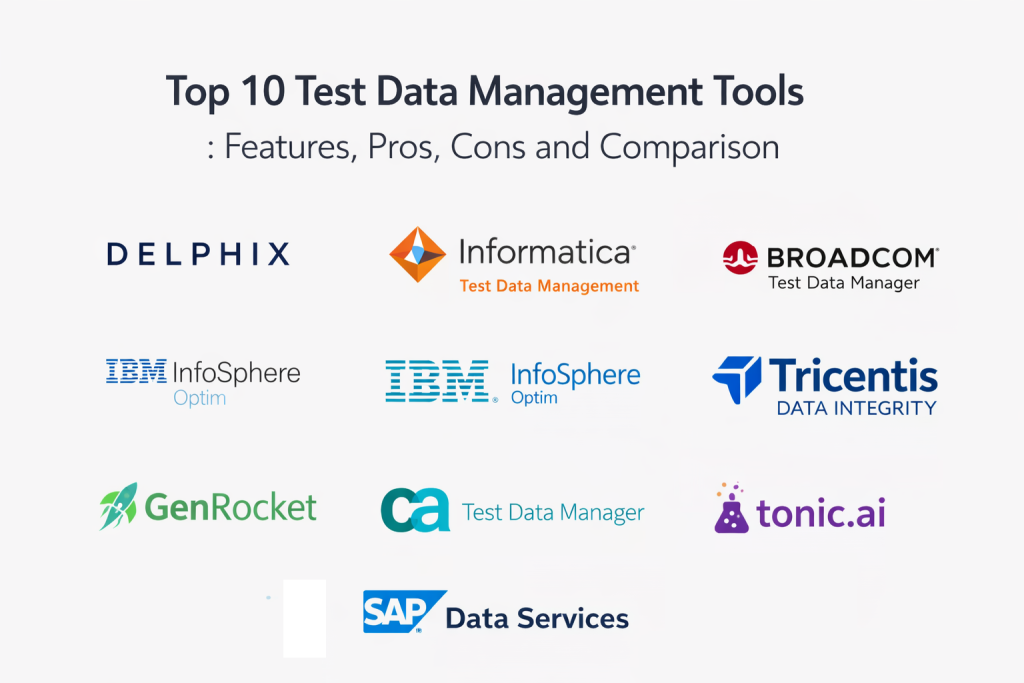
Top 10 Test Data Management Tools
1) Delphix
Delphix is widely known for providing fast, repeatable data environments by virtualizing data and enabling quick refreshes. It is often used when teams need to accelerate test cycles without copying large datasets repeatedly.
Key Features
- Data virtualization and rapid environment provisioning
- Fast refresh and reset workflows for test environments
- Support for managing database copies efficiently
- Automation options for scheduling and repeatability
- Data masking capabilities (varies by setup)
- Useful for parallel testing and multiple teams
- Designed for reducing storage and refresh time overhead
Pros
- Speeds up environment provisioning and refresh cycles
- Helps teams run parallel testing with consistent datasets
- Reduces time wasted waiting for data resets
Cons
- Setup and architecture can be complex
- Best value appears at scale with multiple environments
- Cost can be higher compared to lightweight tools
Platforms / Deployment
- Web
- Cloud / Self-hosted / Hybrid (varies)
Security & Compliance
Not publicly stated
Integrations & Ecosystem
Delphix often integrates into platform engineering workflows, enabling automated environment provisioning and data refresh pipelines.
- Integration patterns with CI orchestration (varies)
- Works with database and environment management flows
- APIs for automation (varies)
- Fits well with enterprise data environment programs
Support & Community
Vendor-led support is typically strong. Community scale is moderate.
2) Informatica Test Data Management
Informatica’s test data management capabilities are commonly used in enterprises that already rely on Informatica for data integration and governance. It often supports masking, subsetting, and consistent data preparation for testing.
Key Features
- Data masking and privacy-oriented transformations
- Subsetting and sampling patterns (varies)
- Support for complex enterprise data ecosystems
- Data profiling and governance-aligned workflows (varies)
- Automation for repeatable data preparation
- Designed for large, regulated environments
- Works well when integrated into broader data management stacks
Pros
- Strong enterprise-grade data handling capabilities
- Fits regulated environments and governance programs
- Useful when organizations already use Informatica tooling
Cons
- Can be heavy for small teams
- Setup and licensing complexity may be significant
- Requires skilled administration for best outcomes
Platforms / Deployment
- Web
- Cloud / Self-hosted / Hybrid (varies)
Security & Compliance
Not publicly stated
Integrations & Ecosystem
Often adopted as part of broader enterprise data management workflows rather than as a standalone isolated tool.
- Connects into enterprise data ecosystems (varies)
- Integration with governance and data quality flows (varies)
- Automation via APIs and scheduling (varies)
- Works alongside test environment provisioning processes
Support & Community
Strong vendor support for enterprises. Community learning is available but often enterprise-driven.
3) Broadcom Test Data Manager
Broadcom Test Data Manager is commonly used to generate and manage test data sets, especially in larger QA programs. It often supports creating realistic data and provisioning it consistently for tests.
Key Features
- Synthetic test data generation capabilities
- Data provisioning for test environments
- Support for data privacy patterns (varies)
- Central repository for reusable data assets
- Automation for scheduled refreshes and dataset delivery
- Designed for enterprise QA operations
- Useful for stable regression data management
Pros
- Helps teams standardize reusable test data assets
- Useful for large QA programs that need consistency
- Can reduce manual effort for test data creation
Cons
- May be complex to implement fully
- Integration depth depends on environment
- Not always lightweight for fast-moving teams
Platforms / Deployment
- Web
- Cloud / Self-hosted / Hybrid (varies)
Security & Compliance
Not publicly stated
Integrations & Ecosystem
Often used in QA programs that have structured testing workflows and need repeatable data provisioning.
- Integrates with testing workflows (varies)
- Automation via APIs or scheduling (varies)
- Works with enterprise data sources
- Reporting and governance patterns vary by setup
Support & Community
Vendor support is typically a key strength. Community presence varies.
4) IBM InfoSphere Optim
IBM InfoSphere Optim is known for enterprise data lifecycle and test data management use cases, including subsetting, masking, and handling complex data relationships in large environments.
Key Features
- Data subsetting with integrity preservation (varies)
- Data masking and privacy transformations (varies)
- Designed for complex enterprise databases
- Supports archiving and data lifecycle workflows (varies)
- Useful for regulated environments needing audit-friendly controls
- Automation options for repeatable refresh cycles
- Works well in large IBM-oriented enterprise stacks
Pros
- Strong fit for large enterprises with complex data
- Subsetting and masking patterns are valuable at scale
- Useful for compliance-driven programs
Cons
- Often heavy in setup and administration
- Best suited to large organizations, not small teams
- Requires skilled operators for ongoing success
Platforms / Deployment
- Web
- Self-hosted / Hybrid (varies)
Security & Compliance
Not publicly stated
Integrations & Ecosystem
Often integrated into enterprise data operations to provide controlled, safe datasets for lower environments.
- Works with enterprise databases and governance processes
- Scheduling and automation patterns (varies)
- Integration into broader IBM ecosystems (varies)
- Test environment provisioning depends on platform design
Support & Community
Enterprise vendor support is typical. Community resources exist but are smaller.
5) Tricentis Data Integrity
Tricentis Data Integrity focuses on ensuring data quality and consistency across systems, which can be crucial for testing where data must be reliable and aligned across multiple applications.
Key Features
- Data validation and integrity checks across systems
- Detects mismatches and inconsistencies in data flows
- Supports testing in complex integration landscapes
- Helps reduce false failures caused by data drift
- Useful for enterprise data-heavy testing programs
- Reporting for data integrity issues and coverage areas
- Fits well for cross-system testing where data correctness matters
Pros
- Helps teams trust data used in tests
- Valuable for complex enterprise integrations
- Reduces time wasted debugging data issues instead of product issues
Cons
- Not a full replacement for masking or synthetic generation tools
- Best value in complex integration landscapes
- Requires planning to model data rules effectively
Platforms / Deployment
- Web
- Cloud / Self-hosted / Hybrid (varies)
Security & Compliance
Not publicly stated
Integrations & Ecosystem
Often used alongside broader testing and data pipelines to validate that data is correct and stable for reliable testing.
- Integrates into enterprise testing workflows (varies)
- Works across multiple connected systems
- Automation patterns depend on setup
- Complements provisioning and masking tools
Support & Community
Vendor support is common. Community size is moderate.
6) GenRocket
GenRocket is known for synthetic test data generation and the ability to create realistic, rule-based datasets. It’s often chosen when teams need many variations and edge cases without using real production data.
Key Features
- Rule-based synthetic data generation
- Supports creating datasets for complex business scenarios
- Helps generate edge cases and negative test data
- Data delivery workflows for repeated runs
- Supports multiple formats and integrations (varies)
- Useful for automation pipelines and CI testing data needs
- Encourages reusable data recipes and templates
Pros
- Strong for generating large amounts of synthetic data
- Helps teams cover edge cases quickly
- Reduces dependency on production extracts
Cons
- Requires time to build good data rules and templates
- May not solve full environment refresh needs alone
- Adoption depends on team discipline and ownership
Platforms / Deployment
- Web
- Cloud / Self-hosted / Hybrid (varies)
Security & Compliance
Not publicly stated
Integrations & Ecosystem
GenRocket is commonly used in automation-heavy environments where synthetic data needs to be provisioned repeatedly.
- Pipeline integration patterns (varies)
- Works with multiple data formats and sources
- API-driven provisioning options (varies)
- Supports reusable data generation recipes
Support & Community
Vendor support is typically important. Community footprint varies by region and industry.
7) CA Test Data Manager
CA Test Data Manager is often referenced in enterprise QA toolchains for creating and provisioning data for testing. It typically supports data generation patterns and repeatable data delivery across environments.
Key Features
- Test data creation and provisioning workflows
- Synthetic data generation patterns (varies)
- Supports repeatable data sets for regression
- Works in enterprise testing toolchains (varies)
- Automation options for data delivery (varies)
- Useful for standardizing data across teams
- Designed for larger QA environments
Pros
- Helps standardize test data usage across teams
- Useful for repeatable regression datasets
- Integrates into enterprise QA processes
Cons
- May feel heavy for smaller teams
- Setup and governance require effort
- Feature depth depends on edition and environment
Platforms / Deployment
- Web
- Cloud / Self-hosted / Hybrid (varies)
Security & Compliance
Not publicly stated
Integrations & Ecosystem
Often used in environments where QA is structured and test data is treated as a shared asset.
- Integrates with enterprise toolchains (varies)
- Scheduling and automation patterns (varies)
- Data provisioning workflows depend on setup
- Works with common enterprise data sources
Support & Community
Vendor-led support is typical. Community scale varies.
8) DATPROF
DATPROF is a test data management solution often used for data masking, subsetting, and creating safe datasets for testing. It is frequently chosen in privacy-sensitive environments.
Key Features
- Data masking and anonymization patterns
- Subsetting and sampling options (varies)
- Support for maintaining data relationships (varies)
- Automation for repeatable masked dataset creation
- Useful for compliance-focused testing needs
- Works with multiple database types (varies)
- Designed to reduce privacy risk in test environments
Pros
- Strong focus on privacy protection through masking
- Helps teams safely use realistic datasets
- Useful for regulated environments
Cons
- Subsetting complexity depends on schema design
- Requires planning to preserve data relationships
- Enterprise integrations depend on setup
Platforms / Deployment
- Web
- Self-hosted / Hybrid (varies)
Security & Compliance
Not publicly stated
Integrations & Ecosystem
DATPROF often integrates into data refresh cycles where masked production-like data is required for testing.
- Masking workflows for lower environments
- Automation and scheduling patterns (varies)
- Integration into CI data refresh depends on architecture
- Works with enterprise database environments
Support & Community
Vendor support is common. Community size is moderate.
9) Tonic.ai
Tonic.ai focuses on creating safe, realistic data for testing and development, often using synthetic approaches to replace sensitive production data while keeping data useful for tests.
Key Features
- Privacy-safe synthetic data generation (varies)
- Preserves data shape and relationships for usefulness (varies)
- Helps reduce reliance on production extracts
- Useful for developer and QA self-service data needs
- Supports workflows for repeated dataset creation
- Can help teams test with realistic data patterns
- Designed for practical adoption in modern dev workflows
Pros
- Helps teams get realistic data without privacy risk
- Useful for fast self-service dataset provisioning
- Encourages consistent test data availability
Cons
- Fit depends on your data store types and constraints
- May require tuning to match edge-case needs
- Enterprise governance needs depend on edition and setup
Platforms / Deployment
- Web
- Cloud / Self-hosted / Hybrid (varies)
Security & Compliance
Not publicly stated
Integrations & Ecosystem
Tonic.ai is often used in modern workflows to provide safer alternatives to production data for test and dev environments.
- API-based workflows for provisioning (varies)
- Integration into dev/test pipelines depends on setup
- Supports repeatable dataset builds
- Works alongside QA automation strategies
Support & Community
Vendor-led support is typical. Community awareness is growing.
10) SAP Data Services
SAP Data Services is often used for data integration and transformation in SAP-heavy environments, and it can support test data preparation workflows when organizations need consistent data movement and transformation for testing.
Key Features
- Data integration and transformation workflows
- Supports building repeatable data preparation jobs
- Useful in SAP-centered data landscapes
- Scheduling and automation for data refresh cycles
- Data quality and cleansing patterns (varies)
- Supports structured data processing for test environments
- Fits enterprise systems with complex data flows
Pros
- Strong fit for SAP-focused enterprises
- Useful for repeatable data preparation and refresh jobs
- Can align test data workflows with integration pipelines
Cons
- Not a dedicated TDM-first product for all teams
- Synthetic data generation is not its primary focus
- Requires skilled setup and administration
Platforms / Deployment
- Windows / Linux (varies)
- Self-hosted / Hybrid (varies)
Security & Compliance
Not publicly stated
Integrations & Ecosystem
Often used as part of broader SAP enterprise data workflows to move and shape data for testing and lower environments.
- Connects to enterprise data sources (varies)
- Scheduling and orchestration patterns (varies)
- Works with governance and data ops processes
- Test environment delivery depends on architecture
Support & Community
Strong vendor support in SAP ecosystems. Community resources vary.
Comparison Table
| Tool Name | Best For | Platform(s) Supported | Deployment (Cloud/Self-hosted/Hybrid) | Standout Feature | Public Rating |
|---|---|---|---|---|---|
| Delphix | Fast environment provisioning and refresh | Web | Cloud / Self-hosted / Hybrid (varies) | Data virtualization for rapid resets | N/A |
| Informatica Test Data Management | Enterprise masking and governance-aligned TDM | Web | Cloud / Self-hosted / Hybrid (varies) | Enterprise-grade data privacy workflows | N/A |
| Broadcom Test Data Manager | Standardizing reusable test data assets | Web | Cloud / Self-hosted / Hybrid (varies) | Synthetic data and provisioning workflows | N/A |
| IBM InfoSphere Optim | Complex subsetting and masking at scale | Web | Self-hosted / Hybrid (varies) | Handles complex enterprise schemas | N/A |
| Tricentis Data Integrity | Validating data correctness across systems | Web | Cloud / Self-hosted / Hybrid (varies) | Data integrity checks to reduce false failures | N/A |
| GenRocket | Rule-based synthetic test data generation | Web | Cloud / Self-hosted / Hybrid (varies) | Reusable synthetic data recipes | N/A |
| CA Test Data Manager | Enterprise test data provisioning | Web | Cloud / Self-hosted / Hybrid (varies) | Repeatable data provisioning for QA programs | N/A |
| DATPROF | Privacy-focused masking and safe datasets | Web | Self-hosted / Hybrid (varies) | Strong masking and anonymization focus | N/A |
| Tonic.ai | Privacy-safe realistic data for dev/test | Web | Cloud / Self-hosted / Hybrid (varies) | Synthetic data that preserves usefulness | N/A |
| SAP Data Services | SAP-centric data preparation workflows | Windows / Linux (varies) | Self-hosted / Hybrid (varies) | Repeatable transformation jobs for refresh cycles | N/A |
Evaluation & Scoring of Test Data Management Tools
Weights:
- Core features – 25%
- Ease of use – 15%
- Integrations & ecosystem – 15%
- Security & compliance – 10%
- Performance & reliability – 10%
- Support & community – 10%
- Price / value – 15%
| Tool Name | Core (25%) | Ease (15%) | Integrations (15%) | Security (10%) | Performance (10%) | Support (10%) | Value (15%) | Weighted Total (0–10) |
|---|---|---|---|---|---|---|---|---|
| Delphix | 9 | 7 | 8 | 7 | 8 | 8 | 6 | 7.70 |
| Informatica Test Data Management | 9 | 6 | 8 | 8 | 8 | 8 | 5 | 7.35 |
| Broadcom Test Data Manager | 8 | 6 | 7 | 7 | 7 | 7 | 6 | 6.85 |
| IBM InfoSphere Optim | 9 | 5 | 7 | 8 | 7 | 7 | 5 | 6.90 |
| Tricentis Data Integrity | 7 | 7 | 7 | 7 | 7 | 7 | 6 | 6.90 |
| GenRocket | 8 | 6 | 7 | 7 | 7 | 7 | 6 | 6.85 |
| CA Test Data Manager | 7 | 6 | 6 | 7 | 6 | 6 | 6 | 6.35 |
| DATPROF | 7 | 7 | 6 | 8 | 7 | 6 | 7 | 6.95 |
| Tonic.ai | 7 | 8 | 6 | 7 | 7 | 6 | 7 | 6.95 |
| SAP Data Services | 7 | 5 | 8 | 7 | 7 | 7 | 5 | 6.55 |
How to interpret these scores:
- Scores are comparative and meant to help shortlist tools for your context.
- “Security” reflects the category’s privacy focus, but real compliance depends on configuration and governance.
- Enterprise tools may score higher on breadth but lower on value due to cost and operational effort.
- A pilot should include your hardest data set, not an easy demo schema.
Which Test Data Management Tool Is Right for You?
Solo / Freelancer
If you work on small projects, heavy enterprise TDM platforms may be unnecessary. You may benefit more from lightweight synthetic data approaches or controlled seed datasets. If you must handle privacy risk and need realistic data patterns, Tonic.ai can be a practical modern option depending on your data sources. Otherwise, focus on small, repeatable datasets and strict separation from real customer data.
SMB
SMBs usually want faster environment refreshes and realistic data without heavy platform overhead. Tonic.ai can help create safe, realistic data. If you need strong masking and privacy controls, DATPROF can be a practical choice. If you are building a more mature environment refresh strategy and have multiple environments, Delphix can become valuable if you can support the operational setup.
Mid-Market
Mid-market teams often have multiple services, multiple environments, and increasing compliance needs. A balanced approach is common: use Delphix for provisioning and fast resets, and add masking or synthetic workflows where privacy is the bottleneck. If your testing failures often come from cross-system data mismatch, Tricentis Data Integrity can reduce time wasted chasing data issues. Choose tools that support self-service so QA does not become dependent on a small data specialist team.
Enterprise
Enterprises with strict governance, multiple data platforms, and strong compliance needs often adopt heavy-duty solutions like Informatica Test Data Management or IBM InfoSphere Optim, especially when they already operate those ecosystems. Large organizations also benefit from virtualization and environment reset capabilities using Delphix, and may use synthetic generation tools like GenRocket to cover edge cases without pulling from production. If your landscape is SAP-centered and you already rely on SAP transformation workflows, SAP Data Services can support structured test data preparation as part of the enterprise data pipeline.
Budget vs Premium
- Budget-friendly (with internal effort): Kiwi-style open tools are less common in TDM, so “budget” often means using scripts plus focused masking patterns rather than a full TDM platform.
- Mid-tier modern approach: Tonic.ai, DATPROF, GenRocket
- Premium enterprise platforms: Delphix, Informatica Test Data Management, IBM InfoSphere Optim, Broadcom Test Data Manager
Feature Depth vs Ease of Use
- Deep enterprise breadth: Informatica Test Data Management, IBM InfoSphere Optim
- Fast provisioning and resets: Delphix
- Synthetic data at scale: GenRocket, Broadcom Test Data Manager
- Data correctness validation across systems: Tricentis Data Integrity
- Practical privacy-first adoption: DATPROF, Tonic.ai
Integrations & Scalability
Scaling TDM is mostly about automation and ownership. Tools that expose APIs and support repeatable workflows will reduce human bottlenecks. Ensure your selection fits your CI approach, environment provisioning strategy, and the diversity of your data stores. Also validate how the tool handles referential integrity and multi-system dataset coordination.
Security & Compliance Needs
Privacy is the number one reason many teams invest in TDM. Validate masking quality, irreversible transformations, access control, and logging. Also confirm that test data provisioning cannot accidentally leak sensitive fields to lower environments. Compliance outcomes depend on how you configure and govern the tool, not just what the tool claims.
Frequently Asked Questions (FAQs)
1) What is test data management in simple words?
It is the process of preparing and delivering safe, realistic data for testing. It includes masking sensitive fields, generating synthetic records, and refreshing datasets so tests remain reliable.
2) Why can’t we just copy production data to test?
Production data often contains sensitive customer information. Copying it increases privacy risk and may violate internal policies or regulations, even if the test environment is internal.
3) What is data masking, and when should we use it?
Masking replaces sensitive values with safe substitutes while keeping data usable for tests. Use it when you need production-like patterns but must protect identities and confidential fields.
4) What is synthetic test data, and when is it better?
Synthetic data is generated data that looks realistic but is not tied to real people. It is better when privacy risk is high or when you need large volumes and edge cases.
5) What is data subsetting and why does it matter?
Subsetting creates a smaller, test-friendly version of a large database while keeping relationships intact. It reduces cost, speeds up refresh cycles, and makes testing easier.
6) How do TDM tools reduce flaky tests?
They provide consistent, repeatable datasets. When data is stable and resettable, tests fail less due to missing records, inconsistent states, or environment drift.
7) How do we support parallel testing with test data?
Use dataset versioning, data virtualization, or on-demand provisioning so each test run has isolated data. Avoid shared mutable datasets across teams.
8) What is the biggest mistake teams make with test data?
They treat test data as an afterthought. Without ownership, standards, and automation, teams end up with stale data, privacy risk, and unpredictable failures.
9) How do we pilot a TDM tool properly?
Pick one real system with complex relationships, define privacy rules, and run a full refresh workflow. Validate referential integrity, speed, and how testers access data.
10) Do we need both masking and synthetic data?
Many teams use both. Masking is useful for production-like patterns; synthetic data is great for edge cases and strict privacy needs. The right mix depends on your risk and use cases.
Conclusion
Test data is one of the biggest hidden bottlenecks in reliable testing. When teams cannot get safe, realistic, repeatable data, automation becomes flaky, manual testing slows down, and releases turn risky. The best test data management tool depends on your environment scale and privacy constraints. If your biggest need is rapid environment refresh and consistent dataset resets, Delphix can be a strong choice. If you operate large, regulated enterprise stacks, Informatica Test Data Management or IBM InfoSphere Optim can support masking and complex subsetting. If your main challenge is creating edge cases and safe data without production extracts, GenRocket or Tonic.ai may fit well. For privacy-focused masking, DATPROF can be valuable, and if your failures often come from cross-system data drift, Tricentis Data Integrity can reduce wasted debugging time. A smart next step is to shortlist two or three tools, run a pilot on your hardest dataset, validate privacy rules and integrity, then automate refresh and provisioning so test data becomes a dependable service, not a daily firefight.

Best Cardiac Hospitals Near You
Discover top heart hospitals, cardiology centers & cardiac care services by city.
Advanced Heart Care • Trusted Hospitals • Expert Teams
View Best Hospitals