Introduction
Artificial Intelligence for IT Operations (AIOps) platforms use machine learning (ML), big data, and advanced analytics to automate and enhance IT operations. These platforms analyze large volumes of data from various sources, such as logs, monitoring systems, and performance metrics, to provide real-time insights, detect anomalies, predict incidents, and automate responses. AIOps platforms are essential for modern IT environments, where the complexity and scale of infrastructure make manual operations increasingly difficult to manage.
In an era where IT systems are highly distributed, dynamic, and complex, organizations face mounting challenges in identifying and resolving issues quickly. AIOps helps teams proactively address performance issues, reduce incident resolution times, and prevent downtime by providing predictive insights and automating routine tasks. By incorporating AI and ML, these platforms can detect patterns in data that human operators might miss and provide intelligent recommendations for remediation.
Common real-world use cases include:
- Real-time anomaly detection and alerting
- Predictive analytics for proactive issue resolution
- Automated root cause analysis (RCA) and incident management
- Automated remediation actions based on predefined workflows
- Proactive capacity planning and infrastructure optimization
- Enhanced visibility across hybrid and multi-cloud environments
What buyers should evaluate:
- AI and ML capabilities for anomaly detection and predictive analytics
- Integration with existing monitoring, ticketing, and observability tools
- Automation features for incident remediation and problem resolution
- Customizability of alerting, workflows, and reporting
- Scalability to support growing IT environments
- Security features such as data privacy, access control, and audit logs
- Usability for both technical and non-technical users
- Real-time performance monitoring and reporting
- Cost and pricing flexibility for different team sizes
- Vendor support and community resources
Best for: IT operations teams, DevOps teams, SRE teams, and enterprise IT environments that require advanced capabilities for managing complex, distributed, and dynamic systems.
Not ideal for: Small businesses with simpler IT infrastructures that do not require advanced AI/ML-driven insights or automation.
Key Trends in AIOps Platforms
- Increased use of machine learning for predictive analytics and root cause analysis
- Greater emphasis on real-time monitoring and anomaly detection
- Integration with existing monitoring, observability, and ITSM tools
- More advanced automation for incident remediation and response
- Support for hybrid and multi-cloud environments, with seamless data ingestion
- Improved user interfaces and visualizations to make complex data actionable
- Self-healing automation to proactively address common issues without manual intervention
- Real-time decision-making for capacity planning and optimization
- Advanced security features to ensure data privacy and regulatory compliance
- Rising importance of governance and audit capabilities in AI-driven operations
How We Selected These Tools
- Proven AI/ML capabilities for anomaly detection and predictive analytics
- Adoption and credibility in complex IT environments
- Strong integration with monitoring, observability, and incident management tools
- Real-time performance tracking and automated incident remediation
- Scalability for growing infrastructures and large data volumes
- Ease of use, with intuitive user interfaces for technical and non-technical teams
- Customization capabilities for workflows, alerting, and reporting
- Strong customer support, documentation, and community involvement
- Cost-effective pricing for different team sizes
- High reliability in high-demand production environments
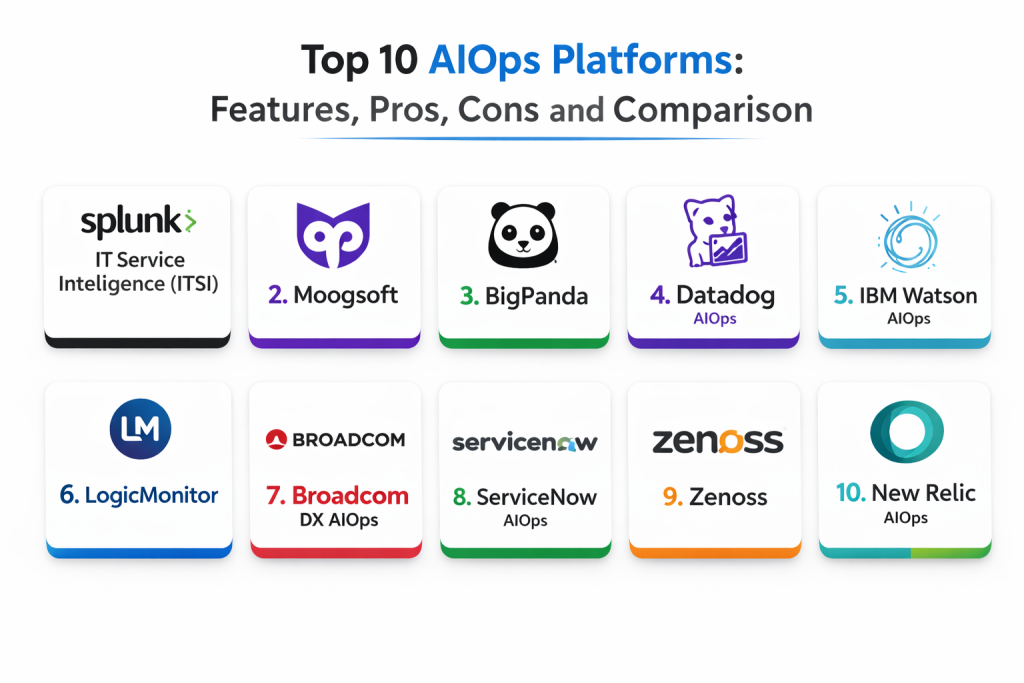
Top 10 AIOps Platforms
1 — Splunk IT Service Intelligence (ITSI)
Splunk ITSI is an AI-driven platform that helps teams improve operational efficiency and reduce downtime by delivering real-time insights into infrastructure health, application performance, and incident management. It leverages machine learning to detect anomalies and predict incidents, offering intelligent recommendations for remediation.
Key Features
- Real-time analytics for infrastructure and application monitoring
- Machine learning-based anomaly detection and predictive alerts
- Root cause analysis with deep service dependency mapping
- Integration with Splunk’s observability and ITSM tools
- Automated incident response and remediation workflows
- Customizable dashboards and reporting for stakeholders
- Mobile app support for incident management
Pros
- Powerful AI and ML capabilities for anomaly detection
- Seamless integration with Splunk’s ecosystem
- Strong root cause analysis and incident management features
Cons
- High price point for smaller teams
- Steep learning curve for new users
- Advanced features require configuration and integration
Platforms / Deployment
- Web / Mobile
- Cloud / On-premises
Security and Compliance
- RBAC, audit logs: Varies / Not publicly stated
- Compliance certifications: Not publicly stated
Integrations and Ecosystem
Splunk ITSI integrates with Splunk’s monitoring, observability, and ITSM tools.
- Integrates with Jira, PagerDuty, ServiceNow, and others
- APIs for automation and reporting
- Best for teams already using Splunk products
Support and Community
Strong support and an extensive community of users and experts.
2 — Moogsoft
Moogsoft is an AIOps platform designed to help teams detect, investigate, and resolve incidents faster by automating the event management process. Moogsoft’s AI-powered algorithms correlate events, reducing alert fatigue and enabling teams to focus on high-priority incidents.
Key Features
- AI-driven event correlation and incident management
- Real-time anomaly detection and alerting
- Root cause analysis and diagnostic insights
- Multi-cloud and hybrid environment support
- Integration with monitoring, ticketing, and chat tools
- Automated remediation workflows and escalation rules
- Customizable dashboards and reporting
Pros
- Excellent event correlation to reduce noise and alert fatigue
- Automated remediation and incident response workflows
- Scalable and flexible for enterprise use
Cons
- Complex setup for advanced use cases
- Requires careful tuning to avoid false positives
- May be expensive for small teams
Platforms / Deployment
- Web / Mobile
- Cloud
Security and Compliance
- RBAC, audit logs: Varies / Not publicly stated
- Compliance certifications: Not publicly stated
Integrations and Ecosystem
Moogsoft integrates with popular monitoring and observability tools.
- Integrates with Datadog, Nagios, ServiceNow, and more
- Supports integration with ticketing and chat tools like Slack and Jira
- API access for advanced automation and custom workflows
Support and Community
Comprehensive documentation and enterprise support available.
3 — BigPanda
BigPanda is an AIOps platform that helps IT operations teams manage complex alerts and incidents. It uses machine learning to correlate, prioritize, and automate responses to events, ensuring that teams can focus on resolving the most critical issues quickly.
Key Features
- Event correlation and noise reduction
- Predictive analytics and anomaly detection
- Multi-channel alerting and escalation policies
- Automated incident response workflows
- Root cause analysis and performance insights
- Real-time and historical reporting
- Integration with monitoring, ITSM, and cloud tools
Pros
- Excellent for reducing alert fatigue and manual work
- Real-time event correlation and insights
- Scalable to large, distributed environments
Cons
- Requires significant configuration to get the most out of the platform
- Pricing can be a challenge for smaller organizations
- Some features may require technical expertise to set up
Platforms / Deployment
- Web
- Cloud
Security and Compliance
- RBAC, audit logs: Varies / Not publicly stated
- Compliance certifications: Not publicly stated
Integrations and Ecosystem
BigPanda integrates with leading monitoring and observability platforms.
- Integrates with Datadog, New Relic, Jira, and more
- API for automation and reporting
- Best for large-scale IT operations teams
Support and Community
Strong enterprise support with documentation and resources for advanced users.
4 — Datadog AIOps
Datadog’s AIOps platform combines observability with machine learning to detect, correlate, and resolve incidents. Datadog’s unified platform provides deep insights into infrastructure, application performance, and logs, helping teams proactively identify and resolve issues.
Key Features
- Real-time monitoring of infrastructure, applications, and logs
- AI-driven anomaly detection and correlation
- Automatic incident detection and response
- Service dependency mapping and root cause analysis
- Integration with Datadog’s observability tools
- Customizable alerting and reporting features
- Automated remediation workflows
Pros
- Comprehensive observability platform with AIOps capabilities
- Seamless integration with Datadog’s suite of monitoring tools
- Intuitive dashboard and real-time visibility
Cons
- Expensive for teams with large environments
- Some advanced features are only available in premium plans
- Requires tuning to avoid false positives in alerts
Platforms / Deployment
- Web / Mobile
- Cloud
Security and Compliance
- RBAC, audit logs: Varies / Not publicly stated
- Compliance certifications: Not publicly stated
Integrations and Ecosystem
Datadog AIOps integrates seamlessly with its monitoring suite.
- Integrates with APM, logs, and infrastructure monitoring tools
- Works with cloud platforms like AWS, Azure, and Google Cloud
- API access for automation and integration
Support and Community
Comprehensive support with a large and active user community.
5 — IBM Watson AIOps
IBM Watson AIOps uses artificial intelligence to help IT teams automate their operations and improve incident resolution times. By analyzing large data sets, Watson AIOps can identify anomalies, predict incidents, and provide actionable insights to resolve issues before they escalate.
Key Features
- Machine learning-powered incident detection
- Root cause analysis and automated remediation
- Integration with observability and monitoring tools
- Real-time insights and performance reporting
- Predictive analytics for proactive issue resolution
- Customizable workflows and alerting rules
Pros
- Powerful AI/ML capabilities for anomaly detection and root cause analysis
- Strong integration with IBM’s ecosystem of tools
- Scalable for enterprise environments
Cons
- Pricing is typically higher for enterprise teams
- May require deep integration and setup to get the most value
- Complexity may be challenging for smaller teams
Platforms / Deployment
- Web
- Cloud
Security and Compliance
- RBAC, audit logs: Varies / Not publicly stated
- Compliance certifications: Not publicly stated
Integrations and Ecosystem
IBM Watson AIOps integrates with monitoring and observability platforms.
- Works well with IBM Cloud, ServiceNow, and other enterprise tools
- Supports cloud, hybrid, and multi-cloud environments
- APIs for automation and integrations
Support and Community
Strong enterprise support, but documentation can be dense for beginners.
6 — LogicMonitor
LogicMonitor is a cloud-based monitoring and observability platform that incorporates AIOps to help IT teams automatically detect and resolve performance issues. It provides end-to-end visibility into IT infrastructure, application performance, and cloud resources.
Key Features
- Real-time monitoring of infrastructure, applications, and cloud resources
- Predictive analytics for anomaly detection
- Automated incident alerts and escalations
- Root cause analysis and performance diagnostics
- Integration with ITSM and incident management tools
- Customizable dashboards and reporting
Pros
- Comprehensive monitoring and observability platform
- Predictive analytics help reduce downtime
- Scalable to large IT environments
Cons
- Pricing can be a barrier for smaller organizations
- Configuration can be complex for new users
- Lacks some advanced AIOps features compared to others
Platforms / Deployment
- Web
- Cloud
Security and Compliance
- RBAC, audit logs: Varies / Not publicly stated
- Compliance certifications: Not publicly stated
Integrations and Ecosystem
LogicMonitor integrates with a wide variety of monitoring, observability, and ITSM tools.
- Integrates with Datadog, ServiceNow, PagerDuty, and more
- API support for automation and incident management
- Best for teams looking for end-to-end monitoring and alerting
Support and Community
Good support with solid documentation; active user community.
7 — Broadcom DX AIOps
Broadcom’s DX AIOps platform provides end-to-end IT operations automation with AI-driven insights to optimize system performance, reduce downtime, and streamline incident management.
Key Features
- AI-powered monitoring and anomaly detection
- Root cause analysis and automated remediation workflows
- Predictive analytics for proactive operations management
- Integration with monitoring, observability, and ITSM tools
- Customizable alerting and notification workflows
- Performance and uptime reporting for incidents and SLAs
Pros
- Strong AI/ML-powered insights for IT operations
- Customizable workflows for automated incident response
- Comprehensive visibility into hybrid and multi-cloud environments
Cons
- Best suited for large enterprises with complex infrastructures
- Pricing may be prohibitive for smaller teams
- Requires time to fully integrate with existing tools and workflows
Platforms / Deployment
- Web
- Cloud / Hybrid
Security and Compliance
- RBAC, audit logs: Varies / Not publicly stated
- Compliance certifications: Not publicly stated
Integrations and Ecosystem
Broadcom DX AIOps integrates well with existing monitoring and observability systems.
- Supports integrations with ServiceNow, Datadog, and more
- API and automation tools for incident response and remediation
- Fits best in complex, hybrid IT environments
Support and Community
Enterprise-level support with robust documentation for large-scale implementations.
8 — ServiceNow AIOps
ServiceNow’s AIOps platform uses machine learning and advanced analytics to automate IT operations, improving efficiency and helping organizations reduce downtime by identifying and responding to incidents more proactively.
Key Features
- AI/ML-driven anomaly detection and incident response
- Automated incident creation, routing, and escalation
- Root cause analysis and proactive issue detection
- Integration with ServiceNow’s ITSM platform
- Real-time monitoring and reporting for infrastructure and services
- Customizable workflows and automation for IT operations
Pros
- Seamless integration with ServiceNow ITSM tools
- Robust automation features for incident management
- Strong reporting and analysis for IT performance
Cons
- May be complex for teams not already using ServiceNow products
- Pricing can be high for small and mid-market teams
- Requires dedicated resources for implementation and configuration
Platforms / Deployment
- Web
- Cloud
Security and Compliance
- RBAC, audit logs: Varies / Not publicly stated
- Compliance certifications: Not publicly stated
Integrations and Ecosystem
ServiceNow AIOps integrates tightly with ServiceNow’s ecosystem.
- Integrates with monitoring, APM, and observability tools
- API support for automation and custom workflows
- Best for teams already using ServiceNow for IT operations
Support and Community
Enterprise-level support with extensive documentation.
9 — Zenoss
Zenoss provides hybrid IT monitoring with AI-powered anomaly detection and automated incident management. It helps teams proactively monitor the health of complex IT environments.
Key Features
- Real-time anomaly detection and alerting
- Multi-cloud and hybrid environment support
- Predictive analytics for proactive performance management
- Integration with monitoring and observability tools
- Automated incident response workflows
- Root cause analysis and performance visibility
- Customizable dashboards and reports
Pros
- Excellent for multi-cloud and hybrid environments
- Strong AI-driven insights for proactive incident resolution
- Comprehensive monitoring across infrastructure and applications
Cons
- More complex to set up than some alternatives
- May require additional resources for integration and configuration
- Can be expensive for smaller organizations
Platforms / Deployment
- Web
- Cloud / Hybrid
Security and Compliance
- RBAC, audit logs: Varies / Not publicly stated
- Compliance certifications: Not publicly stated
Integrations and Ecosystem
Zenoss integrates with various monitoring and ITSM systems.
- Supports integration with ServiceNow, Datadog, AWS, and more
- API access for automation and integration
- Works well for large-scale infrastructure monitoring
Support and Community
Good support and community resources, with strong documentation.
10 — New Relic AIOps
New Relic’s AIOps platform offers a range of observability tools enhanced with AI-driven insights to improve incident response times, detect anomalies, and predict service issues before they escalate.
Key Features
- AI-powered anomaly detection and root cause analysis
- Real-time service health monitoring and diagnostics
- Predictive analytics for proactive incident management
- Integration with New Relic’s observability suite
- Automated alerts and remediation workflows
- Customizable dashboards and reporting for stakeholders
Pros
- Strong integration with New Relic’s observability tools
- Predictive insights help reduce downtime and optimize performance
- Good scalability for large enterprise environments
Cons
- Can be expensive for smaller teams or startups
- Advanced configurations require technical expertise
- Best outcomes require full integration with New Relic’s other products
Platforms / Deployment
- Web
- Cloud
Security and Compliance
- RBAC, audit logs: Varies / Not publicly stated
- Compliance certifications: Not publicly stated
Integrations and Ecosystem
New Relic AIOps integrates seamlessly with New Relic’s monitoring and observability products.
- Integrates with Datadog, PagerDuty, ServiceNow, and more
- API support for automation and incident management
- Best for teams already using New Relic
Support and Community
Comprehensive support with detailed documentation and a large community of users.
Comparison Table
| Tool Name | Best For | Platform(s) Supported | Deployment | Standout Feature | Public Rating |
|---|---|---|---|---|---|
| Splunk ITSI | Predictive analytics and root cause analysis | Web / Mobile | Cloud / On-premises | AI-driven insights and anomaly detection | N/A |
| Moogsoft | Event correlation and incident management | Web / Mobile | Cloud | Event correlation powered by AI | N/A |
| BigPanda | Alert fatigue reduction and incident prioritization | Web | Cloud | Machine learning for event correlation | N/A |
| Datadog AIOps | Real-time performance and incident management | Web / Mobile | Cloud | Predictive analytics and service mapping | N/A |
| IBM Watson AIOps | Proactive incident detection and remediation | Web / Mobile | Cloud | Advanced AI and ML for incident management | N/A |
| LogicMonitor | End-to-end monitoring with AIOps capabilities | Web | Cloud | Unified platform with predictive insights | N/A |
| Broadcom DX AIOps | End-to-end observability and automation | Web | Cloud | Strong integration with observability tools | N/A |
| ServiceNow AIOps | Enterprise-level IT operations automation | Web | Cloud / Hybrid | Full ITSM integration with AIOps | N/A |
| Zenoss | Hybrid IT monitoring with AI-driven insights | Web | Cloud / Hybrid | Proactive issue detection in hybrid environments | N/A |
| New Relic AIOps | Performance optimization and anomaly detection | Web / Mobile | Cloud | AI-driven anomaly detection integrated with observability | N/A |
Evaluation and Scoring of AIOps Platforms
Weights: Core features 25%, Ease of use 15%, Integrations & ecosystem 15%, Security & compliance 10%, Performance & reliability 10%, Support & community 10%, Price / value 15%.
| Tool Name | Core (25%) | Ease (15%) | Integrations (15%) | Security (10%) | Performance (10%) | Support (10%) | Value (15%) | Weighted Total |
|---|---|---|---|---|---|---|---|---|
| Splunk ITSI | 9 | 7 | 10 | 8 | 9 | 8 | 6 | 8.45 |
| Moogsoft | 8 | 9 | 9 | 7 | 8 | 8 | 7 | 8.10 |
| BigPanda | 9 | 8 | 10 | 7 | 9 | 7 | 6 | 8.25 |
| Datadog AIOps | 9 | 8 | 9 | 8 | 9 | 8 | 7 | 8.30 |
| IBM Watson AIOps | 10 | 7 | 10 | 8 | 9 | 8 | 5 | 8.35 |
| LogicMonitor | 8 | 8 | 9 | 7 | 8 | 7 | 6 | 7.85 |
| Broadcom DX AIOps | 9 | 7 | 9 | 8 | 8 | 8 | 6 | 8.10 |
| ServiceNow AIOps | 10 | 7 | 10 | 8 | 9 | 9 | 5 | 8.35 |
| Zenoss | 8 | 8 | 8 | 7 | 8 | 8 | 7 | 7.85 |
| New Relic AIOps | 9 | 8 | 9 | 8 | 9 | 8 | 7 | 8.30 |
Which AIOps Platform Is Right for You
Solo / Freelancer
For smaller teams or individual users, tools like BigPanda and Moogsoft offer simplicity and quick deployment with core AIOps capabilities. These platforms have an intuitive setup and are effective for smaller operations without extensive infrastructure.
SMB
For SMBs, Datadog AIOps and Zenoss provide strong monitoring and incident management features at a reasonable price. They offer robust predictive capabilities and integrations with cloud environments, making them ideal for small to medium-sized businesses.
Mid-Market
Mid-market teams will appreciate the flexibility and scalability of platforms like ServiceNow AIOps and LogicMonitor. These tools offer deeper integrations and can scale as your team grows, providing more advanced automation and incident resolution capabilities.
Enterprise
Enterprises benefit from advanced AI and ML-driven insights offered by IBM Watson AIOps and Splunk ITSI. These platforms provide full integration with monitoring, observability, and ITSM tools, allowing large teams to manage complex, dynamic systems with ease.
Budget vs Premium
For smaller teams or startups, BigPanda and Moogsoft offer cost-effective solutions with strong basic features. However, premium platforms like IBM Watson AIOps and ServiceNow AIOps provide more extensive capabilities for larger teams with complex IT environments.
Feature Depth vs Ease of Use
For teams that prioritize ease of use, BigPanda and Moogsoft provide intuitive user interfaces and basic automation features. If your team requires more in-depth features and advanced AI/ML analytics, platforms like Datadog AIOps and Splunk ITSI offer greater functionality but with a steeper learning curve.
Integrations & Scalability
Teams with complex environments should prioritize platforms like Splunk ITSI, Datadog AIOps, and ServiceNow AIOps, which offer extensive integration options and scalability for large infrastructures.
Security & Compliance Needs
For teams with strict compliance requirements, IBM Watson AIOps and ServiceNow AIOps provide strong governance, role-based access control, and audit logging to ensure security and regulatory compliance.
Frequently Asked Questions
- What is AIOps?
AIOps (Artificial Intelligence for IT Operations) uses machine learning and analytics to automate and enhance IT operations, from detecting anomalies to automating incident remediation. - How do AIOps platforms work?
AIOps platforms ingest data from monitoring tools, analyze it using AI/ML, and provide insights into system health, detect anomalies, and automate responses to incidents. - Can AIOps help with proactive incident management?
Yes, AIOps platforms predict incidents before they occur by analyzing historical data and identifying patterns that indicate potential issues. - What integrations should I look for in an AIOps platform?
Look for integrations with your existing monitoring, observability, incident management, and ticketing tools to ensure seamless automation and incident response. - Is AIOps suitable for small businesses?
AIOps can be helpful for businesses of any size, but small businesses may benefit from platforms with simple interfaces and low-cost entry options like BigPanda or Moogsoft. - How can AIOps improve team efficiency?
By automating repetitive tasks, reducing alert fatigue, and providing predictive insights, AIOps can help teams respond faster to incidents, allowing them to focus on high-impact work. - What is the role of machine learning in AIOps?
Machine learning enables AIOps platforms to analyze large data sets, identify patterns, and predict incidents, improving the accuracy and efficiency of incident management. - What should I consider when choosing an AIOps platform?
Evaluate the platform’s AI/ML capabilities, integration options, scalability, cost, and ease of use to ensure it meets your team’s needs. - How does AIOps improve incident response times?
By automating incident detection, prioritization, and remediation, AIOps can reduce the time spent identifying the root cause and executing resolution steps. - What is the ROI of implementing AIOps?
AIOps can reduce downtime, improve operational efficiency, and speed up incident resolution, leading to cost savings, better customer experiences, and improved system reliability.
Conclusion
AIOps platforms play a crucial role in modern IT environments by providing predictive insights, automating incident response, and optimizing performance. The right AIOps platform depends on your team’s needs, the complexity of your infrastructure, and your budget. For teams with simpler needs, BigPanda and Moogsoft offer solid, easy-to-deploy solutions. For larger teams with more complex requirements, platforms like IBM Watson AIOps, ServiceNow AIOps, and Splunk ITSI provide advanced AI/ML capabilities for managing large-scale environments. A practical next step is to shortlist a few tools, run a pilot with real data, and assess their effectiveness in improving your team’s efficiency and incident resolution times.

Best Cardiac Hospitals Near You
Discover top heart hospitals, cardiology centers & cardiac care services by city.
Advanced Heart Care • Trusted Hospitals • Expert Teams
View Best Hospitals