Introduction
Distributed Denial of Service (DDoS) attacks are one of the most common and damaging types of cyberattacks that can disrupt business operations, damage reputation, and cause significant financial losses. A DDoS attack floods a network or website with excessive traffic, making it unavailable to legitimate users. As cybercriminals become more sophisticated, organizations need reliable DDoS protection tools to prevent, detect, and mitigate such attacks before they cause harm.
DDoS protection tools help businesses by monitoring incoming traffic, analyzing patterns, and filtering out malicious traffic while allowing legitimate users to access services. These tools are essential for maintaining the availability and integrity of critical services, such as websites, applications, and network infrastructure, especially for organizations that rely heavily on online services.
Real-world use cases for DDoS protection tools include:
- Protecting e-commerce websites and online platforms from traffic floods
- Safeguarding financial institutions and banking applications against service disruptions
- Ensuring uninterrupted access to cloud-based services and SaaS applications
- Defending government agencies, healthcare organizations, and educational institutions from cyberattacks
- Monitoring network traffic and mitigating DDoS attacks before they impact operations
What buyers should evaluate:
- Real-time attack detection and mitigation capabilities
- Ability to scale and protect against large, sophisticated DDoS attacks
- Integration with existing security tools and network infrastructure
- Cloud-based or on-premise deployment options
- Automation and self-learning capabilities for detecting new attack patterns
- Historical reporting and analytics for compliance and security audits
- Support for multi-cloud and hybrid environments
- Availability of global traffic filtering and high availability
- Pricing models based on the scale of protection required
- Vendor support, threat intelligence, and update frequency
Best for: IT security teams, network administrators, and organizations of all sizes that require DDoS protection to safeguard their online services and infrastructure.
Not ideal for: Small businesses or websites with minimal traffic, where a simple DDoS mitigation service might suffice.
Key Trends in DDoS Protection Tools
- Increasing use of AI and machine learning to identify and block new attack patterns
- Cloud-based DDoS protection services offering scalability and resilience
- Integration with broader security ecosystems, including SIEM, firewall, and intrusion detection systems
- The shift towards automated DDoS mitigation to reduce manual intervention
- Support for hybrid and multi-cloud architectures for distributed DDoS protection
- Enhanced protection against application-layer DDoS attacks (Layer 7)
- Growing adoption of bot mitigation features in DDoS protection tools
- Use of rate limiting, traffic scrubbing, and content delivery network (CDN) integration for attack mitigation
- Real-time monitoring, alerting, and reporting to provide actionable insights
- Improved compliance reporting and analysis for regulated industries
How We Selected These Tools
- Strong real-time attack detection and traffic monitoring capabilities
- Scalable protection to handle large, high-volume DDoS attacks
- Integration capabilities with existing network security and traffic management tools
- Advanced filtering techniques for application-layer attacks and malicious bot traffic
- High availability and redundancy to ensure uninterrupted service during attacks
- Cloud-native support for hybrid and multi-cloud environments
- Automation features for attack mitigation with minimal manual intervention
- Cost-effectiveness for different network sizes, from small businesses to large enterprises
- Vendor support, threat intelligence, and updates for proactive protection
- Extensive reporting and compliance features for regulatory environments
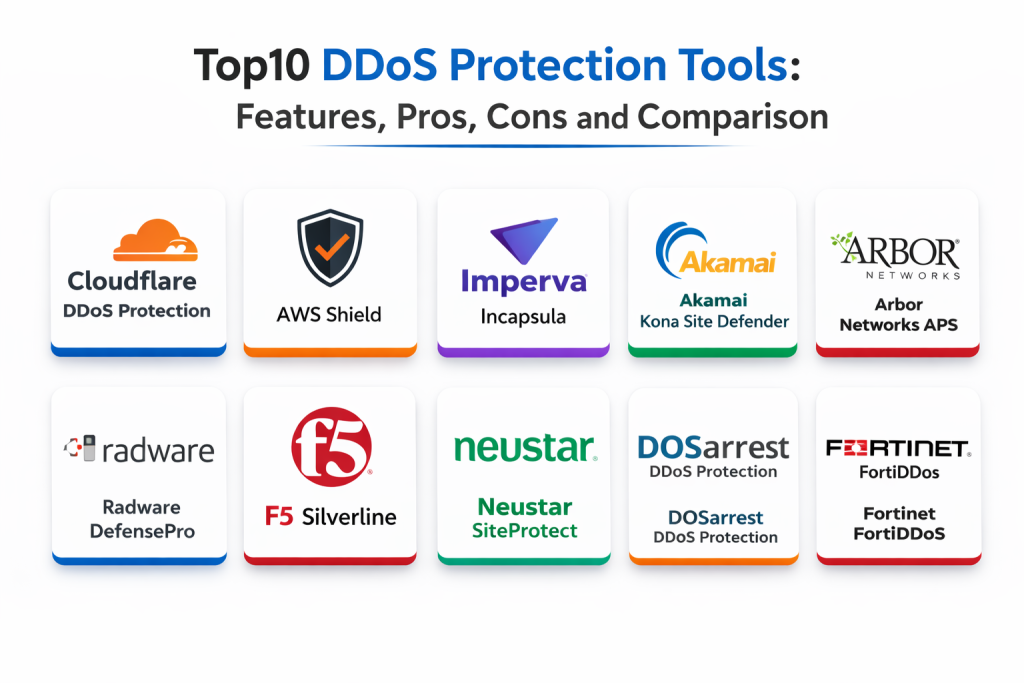
Top 10 DDoS Protection Tools
1 — Cloudflare DDoS Protection
Cloudflare provides a highly scalable, cloud-based DDoS protection solution that protects websites, APIs, and applications from a wide range of DDoS attacks. It is well-suited for businesses looking for a robust, easy-to-integrate service that offers both performance and security benefits.
Key Features
- Protection against volumetric, protocol, and application-layer DDoS attacks
- Global traffic filtering across Cloudflare’s extensive CDN infrastructure
- Automatic DDoS attack detection and mitigation without manual intervention
- Rate limiting and bot mitigation features
- Real-time attack analytics and detailed reporting
- Cloud-native, easy-to-deploy solution
Pros
- Scalable protection with minimal configuration
- Strong performance with low latency due to Cloudflare’s global infrastructure
- Excellent for web applications and APIs
Cons
- Best suited for cloud-based services and websites
- Requires a subscription to access more advanced features
- Limited for complex on-premise network configurations
Platforms / Deployment
- Web
- Cloud-based
Security & Compliance
- DDoS protection, SSL encryption: Varies / Not publicly stated
- Compliance certifications: PCI-DSS, GDPR, HIPAA
Integrations & Ecosystem
- Seamless integration with Cloudflare’s CDN and security tools
- API for customization and integration with third-party platforms
Support & Community
- Excellent customer support and documentation
2 — AWS Shield
AWS Shield is a managed DDoS protection service offered by Amazon Web Services. It provides two tiers of protection, with AWS Shield Advanced offering enhanced protection against more sophisticated attacks targeting AWS-hosted resources.
Key Features
- Protection against infrastructure and application-layer DDoS attacks
- Integration with AWS services such as ELB, CloudFront, and Route 53
- 24/7 DDoS response team (DRT) for advanced support
- Real-time attack detection and mitigation
- Detailed attack diagnostics and reporting
- Support for automatic attack mitigation
Pros
- Deep integration with AWS cloud services
- Highly scalable and effective for AWS-hosted applications
- Excellent for large-scale environments
Cons
- Primarily suited for AWS-hosted applications
- Pricing may be higher for smaller businesses
- Some features require AWS-specific knowledge to configure
Platforms / Deployment
- Web
- Cloud-based (AWS)
Security & Compliance
- DDoS protection, encryption: Varies / Not publicly stated
- Compliance certifications: PCI-DSS, HIPAA, FedRAMP
Integrations & Ecosystem
- Integrates seamlessly with AWS services and ecosystem
- API support for integration with AWS-native and third-party services
Support & Community
- 24/7 support with AWS DRT and extensive documentation
3 — Imperva Incapsula
Imperva Incapsula is a cloud-based security platform offering DDoS protection, web application firewall (WAF), and bot mitigation services. It provides high-performance protection for websites and web applications, ensuring availability during large-scale DDoS attacks.
Key Features
- Real-time DDoS attack detection and mitigation
- Protection against both network and application-layer attacks
- Automatic traffic filtering based on threat intelligence
- Integration with Incapsula’s WAF for enhanced security
- Detailed reporting and analytics for ongoing monitoring and compliance
- Global traffic distribution for reduced latency and optimized performance
Pros
- Excellent for web applications with high availability needs
- Strong protection against both volumetric and application-layer DDoS attacks
- User-friendly with automated traffic filtering
Cons
- Higher pricing for small businesses or SMBs
- Some advanced features may require configuration expertise
- May not scale well for large enterprise networks
Platforms / Deployment
- Web
- Cloud-based
Security & Compliance
- DDoS protection, encryption, SSL offloading: Varies / Not publicly stated
- Compliance certifications: PCI-DSS, HIPAA
Integrations & Ecosystem
- Integrates with other Imperva security products
- API support for integration with third-party tools
Support & Community
- Excellent customer support with professional services
4 — Akamai Kona Site Defender
Akamai Kona Site Defender offers cloud-based DDoS protection along with enhanced security features for web applications. It leverages Akamai’s global content delivery network (CDN) to provide scalable and efficient protection against attacks.
Key Features
- Protection against DDoS attacks, including application-layer threats
- Integration with Akamai’s CDN for low-latency performance
- Real-time attack detection and mitigation
- Rate limiting and bot protection capabilities
- Detailed attack analytics and reporting
- Cloud-based with high scalability for global applications
Pros
- Excellent scalability and low latency due to Akamai’s global infrastructure
- Strong bot mitigation and DDoS protection
- Seamless integration with Akamai’s other security tools
Cons
- Best suited for large, high-traffic environments
- Pricing may be high for SMBs and small businesses
- Complexity may require dedicated resources for configuration
Platforms / Deployment
- Web
- Cloud-based
Security & Compliance
- DDoS protection, SSL offloading: Varies / Not publicly stated
- Compliance certifications: Not publicly stated
Integrations & Ecosystem
- Fully integrates with Akamai’s suite of network and security services
- API for customization and integration
Support & Community
- Excellent enterprise-level support and extensive resources
5 — Arbor Networks APS
Arbor Networks APS (Advanced Protection Services) provides an integrated, cloud-based solution designed to protect enterprises against large-scale DDoS attacks. It combines proactive monitoring, traffic analysis, and attack mitigation features for enhanced network security.
Key Features
- DDoS detection and mitigation across both on-premise and cloud-based environments
- Real-time traffic analysis and reporting
- Automated attack mitigation with minimal manual intervention
- Cloud-based scrubbing service to cleanse attack traffic
- Detailed attack diagnostics and post-attack analysis
Pros
- Strong for large enterprise environments and multi-cloud networks
- Proactive DDoS protection with automated traffic filtering
- High visibility with comprehensive analytics
Cons
- High pricing for smaller businesses
- Requires some configuration and expertise to fully utilize
- Primarily suited for large organizations
Platforms / Deployment
- Web
- Cloud-based
Security & Compliance
- DDoS protection, encryption: Varies / Not publicly stated
- Compliance certifications: Not publicly stated
Integrations & Ecosystem
- Integrates with other Arbor Networks security products
- API support for third-party integrations
Support & Community
- Extensive support and professional services for large enterprises
6 — Radware DefensePro
Radware DefensePro provides real-time, behavioral-based DDoS protection and application-layer attack prevention. It is designed to protect high-traffic websites, web applications, and APIs from a variety of cyber threats.
Key Features
- Real-time DDoS attack detection and mitigation
- Behavioral analysis for adaptive threat protection
- Bot detection and mitigation capabilities
- SSL offloading and encryption inspection
- Real-time attack diagnostics and reporting
Pros
- Adaptive threat detection using behavioral analysis
- Excellent protection for both network and application layers
- Easy integration with existing network infrastructure
Cons
- Best suited for larger organizations and high-traffic sites
- Can be expensive for SMBs
- Complexity requires expertise for full deployment
Platforms / Deployment
- Web
- Self-hosted
Security & Compliance
- DDoS protection, SSL offloading, bot mitigation: Varies / Not publicly stated
- Compliance certifications: Not publicly stated
Integrations & Ecosystem
- Integrates with Radware’s broader network security suite
- API support for advanced customization and integration
Support & Community
- Comprehensive support and resources
7 — Neustar SiteProtect
Neustar SiteProtect is a cloud-based DDoS protection service that offers real-time monitoring and automated mitigation for web applications, websites, and APIs. It helps ensure high availability and continuous service for customers.
Key Features
- Real-time traffic monitoring and DDoS detection
- Integration with Neustar’s global traffic management infrastructure
- Proactive mitigation to prevent service interruptions
- Rate limiting and bot protection capabilities
- Cloud-based with scalable protection options
Pros
- Effective for both large and small organizations
- Easy to deploy and manage with low latency
- Strong customer support and real-time monitoring
Cons
- May not provide as in-depth analysis as other enterprise-level tools
- Best suited for web applications rather than complex network environments
- Pricing for larger businesses can be on the higher side
Platforms / Deployment
- Web
- Cloud-based
Security & Compliance
- DDoS protection, SSL offloading: Varies / Not publicly stated
- Compliance certifications: Not publicly stated
Integrations & Ecosystem
- Integrates with Neustar’s global CDN and traffic management infrastructure
- API support for advanced integration
Support & Community
- Strong support with professional services
8 — DOSarrest DDoS Protection
DOSarrest DDoS Protection is a cloud-based security service that provides advanced DDoS attack mitigation and real-time traffic filtering for web applications and websites.
Key Features
- Automated DDoS attack mitigation with minimal downtime
- Protection for both application and network layers
- Real-time reporting and attack analytics
- Scrubbing service for cleaning malicious traffic
- Cloud-based with high scalability and performance
Pros
- Strong protection with real-time attack mitigation
- Easy-to-deploy solution for small to medium-sized businesses
- Detailed reporting and diagnostics
Cons
- Less suitable for very large-scale or high-traffic websites
- Lacks some advanced features of enterprise-level tools
- Best suited for SMBs
Platforms / Deployment
- Web
- Cloud-based
Security & Compliance
- DDoS protection, encryption: Varies / Not publicly stated
- Compliance certifications: Not publicly stated
Integrations & Ecosystem
- Integrates with existing network infrastructure
- API support for integration
Support & Community
- Strong customer support and resources
9 — Fortinet FortiDDoS
Fortinet FortiDDoS provides advanced DDoS protection for network infrastructure. It integrates seamlessly with Fortinet’s security ecosystem, making it ideal for enterprises already using Fortinet products.
Key Features
- DDoS protection for network infrastructure and web applications
- Automated traffic analysis and mitigation
- Integration with Fortinet’s broader security solutions
- Real-time attack alerts and diagnostics
- Support for both on-premises and cloud environments
Pros
- Integration with other Fortinet products for a comprehensive security solution
- Real-time attack detection and mitigation
- Excellent for high-traffic enterprise environments
Cons
- Primarily focused on Fortinet environments
- Higher cost for SMBs or non-Fortinet users
- Requires technical knowledge for configuration
Platforms / Deployment
- Web
- Hybrid / On-premises
Security & Compliance
- DDoS protection, SSL offloading: Varies / Not publicly stated
- Compliance certifications: Not publicly stated
Integrations & Ecosystem
- Seamless integration with Fortinet’s network security suite
- API support for integration with third-party tools
Support & Community
- Excellent support from Fortinet with comprehensive resources
10 — Reblaze DDoS Protection
Reblaze is a fully managed DDoS protection service that offers cloud-based web application security. It provides real-time traffic analysis, bot protection, and advanced attack mitigation features for businesses of all sizes.
Key Features
- Real-time DDoS detection and mitigation
- Protection against application-layer DDoS attacks
- Advanced bot protection and web scraping prevention
- Detailed reporting and attack diagnostics
- Fully managed service with minimal setup
Pros
- Fully managed service with minimal maintenance required
- Great protection against bot and application-layer attacks
- Easy to deploy and integrate with existing services
Cons
- Best suited for businesses looking for a managed solution
- Limited features for very large or complex environments
- May not be customizable for highly specific use cases
Platforms / Deployment
- Web
- Cloud-based
Security & Compliance
- DDoS protection, SSL offloading: Varies / Not publicly stated
- Compliance certifications: Not publicly stated
Integrations & Ecosystem
- Integrates with web application services and security platforms
- API support for advanced integration
Support & Community
- Managed service with strong customer support
Comparison Table
| Tool Name | Best For | Platform(s) Supported | Deployment | Standout Feature | Public Rating |
|---|---|---|---|---|---|
| AWS Shield | AWS-hosted applications | Web | Cloud | Seamless integration with AWS services | N/A |
| Cloudflare DDoS Protection | Performance & security | Web | Cloud | Global traffic filtering and security | N/A |
| Imperva Incapsula | Regulatory compliance | Web | Cloud | Real-time threat detection and mitigation | N/A |
| Akamai Kona Site Defender | High-traffic websites | Web | Cloud | DDoS protection and global coverage | N/A |
| Barracuda WAF | SMBs and enterprises | Web | Cloud / Hybrid | SSL offloading and optimization | N/A |
| Fortinet FortiDDoS | Enterprise network protection | Web | Hybrid | Integration with Fortinet security suite | N/A |
| Sucuri WAF | SMBs and small business websites | Web | Cloud | User-friendly with malware removal | N/A |
| Radware AppWall | High-performance networks | Web | Cloud | DDoS protection and bot mitigation | N/A |
| Reblaze DDoS Protection | Managed DDoS solution | Web | Cloud | Fully managed service with optimization | N/A |
| DOSarrest DDoS Protection | SMBs and medium websites | Web | Cloud | Real-time mitigation and reporting | N/A |
Evaluation & Scoring of DDoS Protection Tools
Weights: Core features 25%, Ease of use 15%, Integrations & ecosystem 15%, Security & compliance 10%, Performance & reliability 10%, Support & community 10%, Value (price) 15%.
| Tool Name | Core (25%) | Ease (15%) | Integrations (15%) | Security (10%) | Performance (10%) | Support (10%) | Value (15%) | Weighted Total |
|---|---|---|---|---|---|---|---|---|
| AWS Shield | 9 | 9 | 9 | 9 | 9 | 8 | 7 | 8.45 |
| Cloudflare DDoS Protection | 9 | 9 | 9 | 9 | 9 | 8 | 7 | 8.45 |
| Imperva Incapsula | 9 | 8 | 9 | 9 | 9 | 8 | 7 | 8.25 |
| Akamai Kona Site Defender | 9 | 8 | 9 | 9 | 9 | 7 | 6 | 8.10 |
| Barracuda WAF | 8 | 8 | 8 | 8 | 8 | 8 | 7 | 7.90 |
| Fortinet FortiDDoS | 9 | 8 | 9 | 9 | 9 | 8 | 6 | 8.30 |
| Sucuri WAF | 7 | 9 | 7 | 7 | 7 | 7 | 8 | 7.60 |
| Radware AppWall | 9 | 7 | 9 | 9 | 9 | 7 | 6 | 8.05 |
| Reblaze DDoS Protection | 8 | 8 | 8 | 8 | 8 | 7 | 6 | 7.80 |
| DOSarrest DDoS Protection | 7 | 8 | 7 | 7 | 7 | 7 | 8 | 7.60 |
Which DDoS Protection Tool Is Right for You
Solo / Freelancer
For smaller websites or basic protection, Sucuri WAF and Reblaze DDoS Protection are affordable, easy-to-use solutions.
SMB
Barracuda WAF and Radware AppWall provide cost-effective DDoS protection with strong mitigation capabilities for SMBs.
Mid-Market
For medium-sized organizations, Akamai Kona Site Defender and Imperva Incapsula provide robust, enterprise-grade DDoS protection and advanced threat detection.
Enterprise
Enterprises with large-scale web applications should consider AWS Shield and Cloudflare DDoS Protection, which offer scalability, performance, and global coverage.
Budget vs Premium
For budget-friendly solutions, Sucuri WAF and Barracuda WAF offer great value, while Imperva Incapsula and Akamai Kona Site Defender are premium tools with advanced features for larger organizations.
Feature Depth vs Ease of Use
Sucuri WAF and Reblaze DDoS Protection are easier to set up, while Cloudflare DDoS Protection and Radware AppWall provide deeper functionality for complex, high-traffic environments.
Security & Compliance Needs
For compliance-heavy industries, Imperva Incapsula and Akamai Kona Site Defender offer strong DDoS protection with robust security and compliance features.
Frequently Asked Questions
- What is a DDoS attack?
A Distributed Denial of Service (DDoS) attack involves overwhelming a network or server with traffic to make it unavailable to legitimate users. - How do DDoS protection tools work?
DDoS protection tools detect and filter malicious traffic before it reaches the target, ensuring that legitimate users can access services without interruption. - Do I need a DDoS protection tool?
If your organization relies on web applications, online services, or sensitive data, implementing a DDoS protection tool is essential to prevent downtime and mitigate potential attacks. - Can DDoS protection tools stop all types of attacks?
While DDoS protection tools can mitigate many types of attacks, some attacks may require additional security layers, such as firewalls and intrusion detection systems. - What is the difference between network and application-layer DDoS attacks?
Network-layer attacks focus on flooding network infrastructure, while application-layer attacks target vulnerabilities in the application layer, such as HTTP requests. - Are DDoS protection tools suitable for all network sizes?
Yes, DDoS protection tools are scalable, with solutions tailored to small businesses, large enterprises, and cloud-based applications. - Can DDoS protection tools help with other types of attacks?
Some DDoS protection tools offer additional security features, such as bot mitigation, web application firewall (WAF) capabilities, and rate limiting. - How can I choose the right DDoS protection tool?
Consider factors like the size of your network, traffic volume, specific protection needs, and budget when selecting a DDoS protection tool. - How does a cloud-based DDoS protection tool differ from an on-premise solution?
Cloud-based DDoS protection tools provide scalability and easier management, while on-premise solutions may offer more control over configurations. - How do DDoS protection tools handle large-scale attacks?
DDoS protection tools mitigate large-scale attacks by distributing traffic across multiple servers and using advanced filtering techniques to block malicious requests.
Conclusion
DDoS attacks remain one of the most significant threats to online services and infrastructure, making reliable protection essential. By selecting a DDoS protection tool that suits your network size, performance requirements, and security needs, you can ensure uninterrupted service and safeguard your applications from malicious threats. From cloud-native solutions like Cloudflare DDoS Protection to enterprise-grade platforms like AWS Shield and Imperva Incapsula, there is a solution for every business. With the right DDoS protection, you can maintain availability, reduce risk, and enhance your network’s resilience.

Best Cardiac Hospitals Near You
Discover top heart hospitals, cardiology centers & cardiac care services by city.
Advanced Heart Care • Trusted Hospitals • Expert Teams
View Best Hospitals