Introduction
Identity Verification tools help organizations confirm that a person is real, is who they claim to be, and can be trusted for the action they are trying to complete. These tools typically combine document checks, selfie and liveness, fraud signals, and workflow rules to reduce fake accounts, identity theft, and onboarding abuse. In many businesses, IDV also supports stronger trust and safer growth by reducing manual review and making decisions consistent across channels.
Common use cases include verifying new customers in fintech, validating sellers in marketplaces, confirming age or identity for regulated services, step up checks for high value actions, and identity recovery when an account is locked or compromised. When buying an IDV tool, evaluate document coverage, liveness quality, fraud detection, decision logic, review workflows, SDK experience, API reliability, regional support, privacy controls, reporting, and total cost.
Best for
Fraud and risk teams, compliance teams, product leaders, and engineering teams at fintech, payments, lending, marketplaces, gig platforms, mobility, gaming, crypto, and any online business that needs trusted onboarding and secure account actions.
Not ideal for
Very low risk products with no account value, businesses that only need email and phone verification, or teams with strict offline identity processes where a digital IDV flow will not be used.
Key Trends in Identity Verification Tools
- More advanced liveness and injection attack resistance to counter deepfake style fraud
- Higher adoption of step up verification tied to risky actions, not only onboarding
- Better workflow orchestration that lets teams mix multiple checks based on risk signals
- More KYB support and business verification options inside broader identity platforms
- Greater focus on conversion, reducing drop off while still blocking fraud
- Increased demand for privacy controls, data minimization, and flexible retention
- More configurable manual review tooling to handle edge cases and reduce false rejects
- Stronger device and network signals combined with identity verification outcomes
- Wider support for reusable identity and re verification without repeating every step
- More analytics focused on fraud rates, approval quality, and reviewer productivity
How We Selected These Tools (Methodology)
- Chose tools with strong recognition in identity verification and digital trust markets
- Looked for breadth across document checks, biometrics, liveness, and fraud signals
- Considered integration friendliness through APIs, SDKs, and implementation patterns
- Included tools that fit different company sizes and use cases, from startups to enterprise
- Focused on operational maturity, reviewer workflow strength, and scalability readiness
- Favored vendors that support both onboarding and ongoing identity events
- Avoided assuming certifications, ratings, or pricing details that are not clearly known
- Balanced product led platforms with enterprise grade solutions and orchestration options
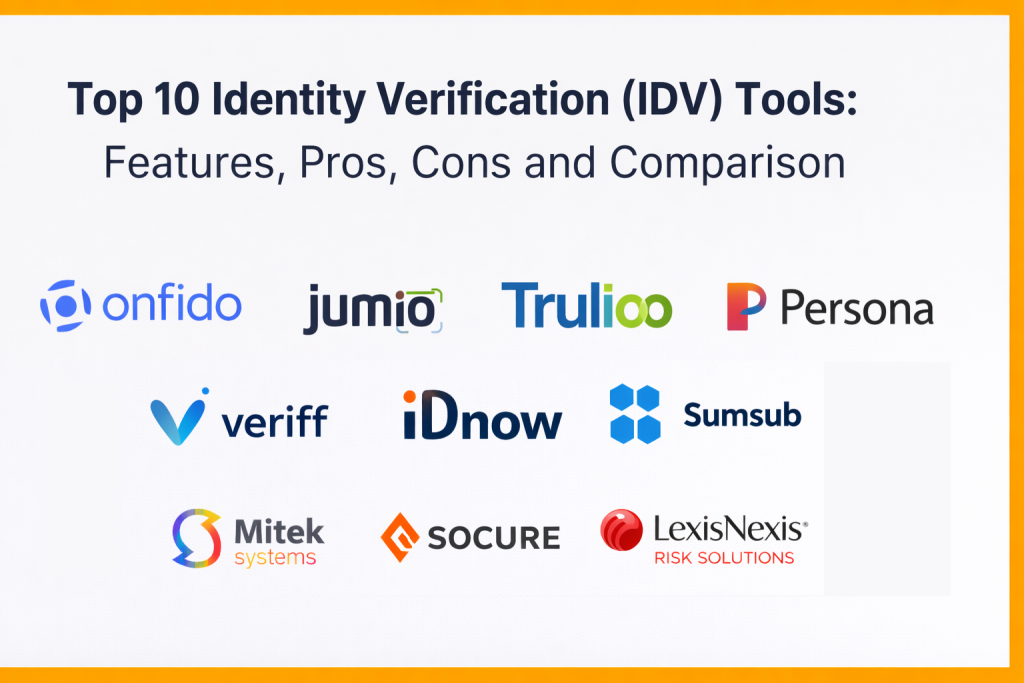
Top 10 Identity Verification Tools
1 — Onfido
Identity verification platform focused on document checks, biometric verification, and risk based workflows. Often used by fintech and marketplaces that need fast onboarding with reliable fraud controls.
Key Features
- Document verification with authenticity checks
- Biometric selfie verification and liveness workflows
- Risk based step up verification journeys
- Manual review tooling for exception handling
- Fraud signals and decision support outputs
- Support for multiple documents and regions
- Operational reporting for conversion and review queues
Pros
- Strong balance between conversion and fraud controls
- Practical reviewer workflows for edge cases
- Works well for onboarding and step up events
Cons
- Some advanced reporting depends on configuration
- Screening and compliance checks may require separate tooling
- Performance varies by region and document type mix
Platforms and Deployment
Web, iOS, Android, Cloud
Security and Compliance
SSO, RBAC, encryption, and audit logs are expected in this category; specific certifications: Not publicly stated.
Integrations and Ecosystem
Onfido commonly integrates into signup, account upgrades, and identity recovery flows through APIs and SDKs. Teams typically connect outcomes to fraud engines, support tools, and risk decision services to automate approvals and escalations.
- API based integration for verification results
- SDK patterns for web and mobile capture
- Hooks into risk scoring and decision engines
- Exports into analytics and reporting pipelines
Support and Community
Documentation is generally implementation focused. Support tiers and onboarding depth: Varies / Not publicly stated.
2 — Jumio
IDV solution designed for regulated onboarding and identity proofing using document verification and biometric checks. Commonly used by organizations that need consistent identity checks at scale.
Key Features
- Document authenticity verification
- Biometric verification with liveness options
- Configurable verification flows by risk
- Manual review queues and reviewer tooling
- Signals for fraud detection and identity confidence
- Analytics for conversion and processing outcomes
- Broad document type support across many regions
Pros
- Strong for regulated onboarding patterns
- Useful review workflows for operations teams
- Mature approach to identity proofing use cases
Cons
- Some use cases need additional fraud tools for full coverage
- Configuration and tuning can take time for best results
- Coverage validation is needed for niche regions
Platforms and Deployment
Web, iOS, Android, Cloud
Security and Compliance
Encryption and audit logging are common expectations; certifications: Not publicly stated.
Integrations and Ecosystem
Jumio is typically embedded into onboarding services and connected to risk and compliance workflows for automated approvals, reviewer escalations, and evidence retention.
- API integration into product onboarding flows
- Mobile and web capture workflows
- Integration into case and support operations
- Data outputs into reporting and analytics stacks
Support and Community
Support and onboarding depth vary by plan. Documentation is generally clear for implementers: Varies / Not publicly stated.
3 — Trulioo
Identity verification focused on data driven verification and global coverage signals. Frequently used by teams that operate across regions and want flexible verification logic backed by multiple data sources.
Key Features
- Data source based identity checks across countries
- Configurable match rules and thresholds
- Support for consumer and business verification patterns
- Verification outputs designed for decision engines
- Coverage options that vary by region
- API first integration for scalable workflows
- Reporting outputs for audit style requirements
Pros
- Strong option for global onboarding needs
- Good fit for custom decisioning approaches
- Helps reduce friction where data checks are sufficient
Cons
- Coverage and depth vary by country
- Requires tuning to reduce false mismatches
- Document and biometric flows may require pairing
Platforms and Deployment
Web, Cloud
Security and Compliance
Access control and logging are common expectations; certifications: Not publicly stated.
Integrations and Ecosystem
Trulioo often powers an internal verification service that routes users through different checks depending on region, risk, and product requirements.
- API integration into onboarding services
- Works with risk scoring and rules engines
- Can pair with document and selfie verification tools
- Exports to analytics and compliance reporting systems
Support and Community
Support is typically structured for regulated onboarding teams. Specific support tiers: Varies / Not publicly stated.
4 — Persona
Identity workflow platform that combines verification steps into configurable journeys, often used by product teams that want flexible onboarding, step up verification, and identity recovery flows.
Key Features
- Configurable verification workflows and routing
- Document and biometric verification options
- Step up verification for risky actions
- Manual review and escalation tooling
- Decision outputs with workflow context
- Analytics for funnel performance and review outcomes
- Support for multiple identity use cases beyond onboarding
Pros
- Very flexible for product led identity flows
- Strong for step up verification and recovery scenarios
- Helps tune conversion without losing control
Cons
- Some capabilities depend on selected modules
- Advanced fraud prevention may need additional signals
- Requires governance to keep workflows consistent
Platforms and Deployment
Web, iOS, Android, Cloud
Security and Compliance
SSO, RBAC, and audit logging are typical expectations; certifications: Not publicly stated.
Integrations and Ecosystem
Persona often acts as a workflow layer connected to internal services, risk engines, customer support tools, and data platforms for reporting.
- API integration for verification outcomes
- Connections to fraud and risk decision services
- Workflow integration with support and case tools
- Export capabilities into analytics environments
Support and Community
Implementation documentation is commonly strong. Support depth by plan: Varies / Not publicly stated.
5 — Veriff
Identity verification tool known for document and selfie checks and focus on fraud prevention during onboarding. Often chosen by digital businesses that want fast verification experiences and solid automation.
Key Features
- Document verification and authenticity signals
- Selfie based biometric checks and liveness
- Automated decisioning with manual review fallback
- Configurable flows for different risk levels
- Fraud pattern detection signals
- Dashboard reporting on approvals and exceptions
- Support for multiple document types and regions
Pros
- Good onboarding speed and automation fit
- Helpful for reducing manual review volume
- Works well for consumer focused onboarding
Cons
- Regional performance needs validation in your target markets
- Some advanced reporting depends on plan and setup
- Full compliance needs may require additional tooling
Platforms and Deployment
Web, iOS, Android, Cloud
Security and Compliance
Standard security controls expected; certifications: Not publicly stated.
Integrations and Ecosystem
Veriff typically integrates into signup and account upgrade flows and sends decision results to fraud and risk systems to automate approvals and escalations.
- APIs for verification and decision events
- SDK patterns for capture and liveness
- Links to risk rules and fraud monitoring services
- Exports to analytics and reporting workflows
Support and Community
Support models vary by customer segment. Documentation: Varies / Not publicly stated.
6 — IDnow
Identity verification platform often associated with European identity and compliance use cases. Used by organizations that want structured identity checks and configurable verification options.
Key Features
- Document verification workflows
- Biometric and liveness options depending on package
- Configurable verification processes by risk
- Review operations and escalation controls
- Support for different verification modes and channels
- Reporting and evidence capture for audits
- Regional focus patterns that may support local requirements
Pros
- Useful for organizations with regional compliance expectations
- Supports structured verification processes
- Often fits enterprise onboarding governance needs
Cons
- Fit depends on region and verification approach required
- Implementation complexity can vary by workflow needs
- Feature depth varies by selected modules
Platforms and Deployment
Web, iOS, Android, Cloud
Security and Compliance
Common controls expected; certifications: Not publicly stated.
Integrations and Ecosystem
IDnow is typically integrated into onboarding and account verification flows and connected to compliance review operations and reporting systems.
- API integration for verification results
- Workflow integration with case and support systems
- Exports for audit evidence and reporting
- Connections to risk decision services
Support and Community
Support tiers vary. Documentation and onboarding depth: Varies / Not publicly stated.
7 — Sumsub
Unified identity verification and compliance oriented workflows often used by fast moving digital platforms. Supports configurable verification steps and reviewer tooling for exceptions.
Key Features
- Document verification and authenticity checks
- Biometric verification and liveness options
- Configurable verification flows and step up checks
- Manual review tools and case style routing
- Support for consumer and business checks depending on package
- Monitoring style alerts depending on configuration
- Operational dashboards and reporting outputs
Pros
- Useful all in one approach for many onboarding needs
- Good workflow flexibility for different customer segments
- Helps teams iterate verification flows quickly
Cons
- Coverage depth needs validation by region
- Advanced controls may depend on plan selection
- Review policy management requires ongoing effort
Platforms and Deployment
Web, iOS, Android, Cloud
Security and Compliance
Standard security expectations apply; certifications: Not publicly stated.
Integrations and Ecosystem
Sumsub integrates into onboarding services and connects to review teams, risk decision workflows, and analytics environments for monitoring and reporting.
- API integration for verification events
- SDK based capture and liveness flows
- Connects to fraud monitoring and risk services
- Data export paths for reporting and analysis
Support and Community
Support varies by customer size and package. Documentation: Varies / Not publicly stated.
8 — Mitek Systems
Identity verification capabilities commonly used in digital banking style workflows, often associated with document capture, identity proofing, and user experience optimization.
Key Features
- Document capture and verification workflows
- Identity proofing signals and checks
- Workflow support for onboarding and account actions
- Automation with manual review options
- Analytics for capture quality and funnel outcomes
- Capabilities aligned to financial services requirements
- Integration patterns for mobile and digital channels
Pros
- Strong fit for banking style onboarding experiences
- Useful document capture and quality controls
- Works well in mobile first identity flows
Cons
- Feature scope depends on selected modules
- Some use cases may require pairing with fraud signals
- Regional document coverage needs validation
Platforms and Deployment
Web, iOS, Android, Cloud
Security and Compliance
Typical security controls expected; certifications: Not publicly stated.
Integrations and Ecosystem
Mitek is usually embedded into digital onboarding and connected to back office review workflows and risk services to automate identity decisions.
- Integration into mobile and web onboarding
- Decision outputs to internal risk engines
- Connections to review teams and support systems
- Data outputs into reporting workflows
Support and Community
Support structure varies by customer segment. Exact details: Varies / Not publicly stated.
9 — Socure
Identity and risk focused platform often used for digital identity trust, fraud reduction, and decision support in high risk onboarding. Frequently considered by teams with strong fraud pressures.
Key Features
- Identity verification signals with risk scoring
- Fraud and synthetic identity detection focus
- Decisioning support for onboarding approvals and escalations
- Configurable workflows for risk based checks
- Review support for exceptions and investigations
- Analytics on approvals, fraud outcomes, and performance
- Integration patterns suited to high volume onboarding
Pros
- Strong for fraud heavy onboarding environments
- Useful risk scoring and decision support
- Helps reduce synthetic identity style risk
Cons
- Some data and coverage varies by region
- Configuration requires governance for best results
- Feature scope depends on selected modules
Platforms and Deployment
Web, Cloud
Security and Compliance
Standard access control and logging expected; certifications: Not publicly stated.
Integrations and Ecosystem
Socure is commonly integrated into onboarding decision pipelines and connected to fraud, risk, and compliance operations for automated approvals and escalations.
- APIs into identity and risk decision services
- Integration with case and review workflows
- Data outputs for analytics and monitoring
- Works alongside document and biometric tools as needed
Support and Community
Support tiers vary. Documentation: Varies / Not publicly stated.
10 — LexisNexis Risk Solutions
Broad risk and identity services used by regulated organizations that need layered identity signals and enterprise risk integration. Often used as part of a larger risk ecosystem.
Key Features
- Identity related risk signals and verification support
- Fraud prevention and risk analytics options
- Decision support for onboarding and account actions
- Tools for investigations and evidence capture
- Integration patterns for enterprise environments
- Reporting and governance capabilities depending on solution
- Support for layered risk programs across products
Pros
- Strong fit for enterprise risk ecosystems
- Useful for layered decisioning and investigations
- Works well when identity is part of a broader risk program
Cons
- Scope can be wide and requires careful scoping
- Implementation complexity varies by chosen modules
- Specific feature depth differs by region and contract
Platforms and Deployment
Varies / N/A
Security and Compliance
Controls depend on solution and contract; certifications: Not publicly stated.
Integrations and Ecosystem
LexisNexis Risk Solutions commonly integrates into enterprise risk engines, fraud platforms, and compliance operations, feeding identity signals into decision workflows.
- Enterprise integrations into risk decision stacks
- Connections to investigations and case operations
- Data exports into analytics environments
- Works alongside document and biometric verification tools
Support and Community
Support is typically enterprise structured. Exact details: Varies / Not publicly stated.
Comparison Table
| Tool Name | Best For | Platform(s) Supported | Deployment | Standout Feature | Public Rating |
|---|---|---|---|---|---|
| Onfido | Scalable onboarding identity verification | Web, iOS, Android | Cloud | Strong document and biometric verification workflows | N/A |
| Jumio | Regulated identity proofing | Web, iOS, Android | Cloud | Mature identity proofing operations and review tooling | N/A |
| Trulioo | Global data driven verification | Web | Cloud | Broad region coverage through data source checks | N/A |
| Persona | Flexible identity workflows | Web, iOS, Android | Cloud | Configurable journeys for onboarding and step up checks | N/A |
| Veriff | Fast automated verification | Web, iOS, Android | Cloud | Strong automation with manual review fallback | N/A |
| IDnow | Structured verification for regional needs | Web, iOS, Android | Cloud | Governance oriented verification workflows | N/A |
| Sumsub | Unified verification workflows | Web, iOS, Android | Cloud | Configurable onboarding checks and reviewer tooling | N/A |
| Mitek Systems | Digital banking style identity flows | Web, iOS, Android | Cloud | Strong document capture and funnel optimization | N/A |
| Socure | Fraud heavy onboarding risk | Web | Cloud | Identity trust signals and fraud reduction focus | N/A |
| LexisNexis Risk Solutions | Enterprise identity and risk programs | Varies / N/A | Varies / N/A | Layered risk signals and enterprise integrations | N/A |
Evaluation and Scoring of Identity Verification Tools
The scores below help compare tools across common buying criteria. A higher weighted total suggests a stronger overall balance for many teams, but the best choice depends on your user base, fraud pressure, regions, conversion goals, and internal review capacity. Use these results to shortlist candidates, then validate with real user tests, sample documents, and integration checks. Scoring is comparative, not absolute.
Weights used: Core 25 percent, Ease 15 percent, Integrations 15 percent, Security 10 percent, Performance 10 percent, Support 10 percent, Value 15 percent.
| Tool Name | Core (25%) | Ease (15%) | Integrations (15%) | Security (10%) | Performance (10%) | Support (10%) | Value (15%) | Weighted Total |
|---|---|---|---|---|---|---|---|---|
| Onfido | 9 | 8 | 8 | 8 | 8 | 7 | 7 | 8.05 |
| Jumio | 9 | 7 | 7 | 8 | 8 | 7 | 7 | 7.80 |
| Trulioo | 8 | 7 | 8 | 8 | 8 | 7 | 7 | 7.70 |
| Persona | 8 | 9 | 8 | 7 | 7 | 7 | 7 | 7.80 |
| Veriff | 8 | 8 | 7 | 7 | 7 | 7 | 8 | 7.60 |
| IDnow | 7 | 7 | 7 | 7 | 7 | 7 | 7 | 7.00 |
| Sumsub | 8 | 8 | 7 | 7 | 7 | 7 | 8 | 7.60 |
| Mitek Systems | 7 | 7 | 7 | 7 | 7 | 7 | 7 | 7.00 |
| Socure | 8 | 7 | 7 | 7 | 8 | 7 | 6 | 7.20 |
| LexisNexis Risk Solutions | 8 | 6 | 7 | 8 | 8 | 7 | 6 | 7.15 |
Which Identity Verification Tool Is Right for You
Solo / Freelancer
If you are a solo builder or a small team, you should avoid heavy platforms that require lots of operational management. If identity verification is truly required, prioritize a tool that is easy to integrate and can automate most decisions. Persona or Sumsub can be practical choices because they support configurable flows and can scale with you. If your use case is light, you may not need full IDV and can rely on simpler checks until risk grows.
SMB
SMBs typically need a strong balance of conversion and fraud control, plus clear exception handling without adding too many reviewers. Onfido, Veriff, and Jumio are common shortlists for onboarding identity checks. Persona is strong when you want flexible step up checks and identity recovery flows. Trulioo is valuable when you operate in multiple regions and data based verification can reduce friction.
Mid Market
Mid market companies often face higher fraud pressure and more diverse user segments. A good approach is to choose an IDV platform that handles most onboarding decisions automatically, and then build clean escalation paths for edge cases. Onfido or Jumio can work well for identity proofing, while Persona helps when your product needs many identity journeys beyond onboarding. Socure can be a fit when fraud is a major pain and you need stronger synthetic identity resistance.
Enterprise
Enterprise buyers usually prioritize governance, audit readiness, scale, and consistent policy enforcement across products. LexisNexis Risk Solutions can fit when identity verification is part of a broader risk and fraud program. Jumio and Onfido can work well for large scale onboarding if you need stable operations and review tooling. IDnow can be considered when regional workflows and structured processes matter for your organization.
Budget vs Premium
Budget focused teams should pick a tool that offers reliable automation and minimal operational overhead rather than paying for complex features they will not use. Veriff or Sumsub can be practical in many onboarding scenarios. Premium programs often justify higher spend when fraud costs are high, regulatory exposure is significant, or global coverage requirements are complex, where tools like Onfido, Jumio, or broader risk ecosystems may fit better.
Feature Depth vs Ease of Use
If you want speed and simplicity, prioritize a platform with good default flows, clear SDKs, and easy reviewer experiences. If you need deeper control, choose a platform with flexible policy tuning, routing, and evidence capture. Persona is strong for flexible journeys, while Onfido and Jumio are strong for core proofing patterns. Trulioo is better when you want data driven checks and customization.
Integrations and Scalability
If your product stack includes a risk engine, case tooling, analytics warehouses, and customer support flows, integration quality matters as much as verification accuracy. Tools that fit well into API first architectures will scale more smoothly. Trulioo and Persona often align well with internal decisioning services, while Onfido and Jumio offer patterns that support both product and compliance workflows.
Security and Compliance Needs
For high scrutiny environments, focus on access control, audit logs, reviewer accountability, evidence retention, and privacy controls. Treat any specific certification claim as Not publicly stated unless you have vendor documentation during procurement. The safest approach is to validate security controls during vendor review and confirm how data is stored, retained, and deleted.
Frequently Asked Questions
1. What is an identity verification tool used for?
It helps confirm that a user is real and matches the identity they claim, usually by checking documents, selfies, and fraud signals. This reduces fake accounts, fraud, and risky onboarding.
2. Do all businesses need identity verification?
No. If your product has low risk and low value accounts, you may not need full identity verification. It becomes important when fraud is costly, regulations apply, or account actions have real financial impact.
3. What is the difference between document verification and liveness checks?
Document verification checks the authenticity of an ID and data consistency. Liveness checks help confirm a real person is present, reducing spoofing and replay attacks.
4. How do we reduce customer drop off during verification?
Use risk based flows so low risk users see fewer steps, optimize capture experience, and create clear error handling. Track funnel metrics and tune thresholds based on real review outcomes.
5. What should we log for audits and investigations?
Keep decision outcomes, reviewer notes, evidence references, and timestamps for key actions. Also keep policy versions and escalation reasons so you can explain why a decision happened.
6. Can identity verification help with account takeover prevention?
Yes. Many teams use step up verification when a user changes payout details, resets credentials, or performs high risk actions. This adds friction only when risk is higher.
7. How long does implementation usually take?
It ranges from quick integrations to longer rollouts depending on SDK complexity, review workflows, and internal governance. The timeline depends on how many verification journeys you plan to support.
8. Should we use one vendor globally or different vendors by region?
A single vendor is simpler, but some teams use different vendors for certain regions to improve coverage or conversion. If you do this, you need strong orchestration and consistent policies.
9. How do we handle false rejects and customer complaints?
Provide clear escalation paths, allow re submission when appropriate, and train review teams with consistent guidelines. Monitor rejection reasons to identify capture issues and policy tuning needs.
10. What is the best way to choose the right tool?
Shortlist two or three tools, run a pilot using real user patterns, validate conversion and fraud outcomes, and test integrations and reporting. Choose the tool that fits your risk profile and operational capacity.
Conclusion
Identity verification tools can protect growth, reduce fraud costs, and create stronger trust across onboarding and high risk actions. However, there is no single best tool for every business. Some teams prioritize conversion and need a smooth capture experience with strong automation, while others prioritize fraud resistance, governance, and evidence trails for audits. The right decision depends on your region mix, customer types, fraud pressure, reviewer capacity, and how tightly you must align with internal risk policies. A practical next step is to shortlist two or three tools from this list, run a focused pilot with realistic traffic and edge cases, compare approval quality and manual review load, and confirm that security controls, reporting outputs, and integrations match your operational needs before scaling.

Best Cardiac Hospitals Near You
Discover top heart hospitals, cardiology centers & cardiac care services by city.
Advanced Heart Care • Trusted Hospitals • Expert Teams
View Best Hospitals