Introduction
Data quality tools ensure that the data used for decision-making, reporting, and analytics is accurate, consistent, complete, and trustworthy. These tools help organizations validate, cleanse, and monitor data across different systems, ensuring that it adheres to defined quality standards. High-quality data is essential for operational efficiency, accurate reporting, and reliable insights, especially as organizations continue to rely on data-driven decisions. Data quality tools are crucial in detecting and fixing data issues, including duplicates, missing values, inconsistent formats, and outliers, often preventing problems before they reach business teams or downstream systems.
Real world use cases include cleansing customer data for CRM systems, validating financial records for audits, ensuring compliance with data governance regulations, standardizing product information across multiple databases, and monitoring real-time data streams for errors or inconsistencies. When selecting a data quality tool, evaluate features like data profiling, cleansing, validation, error detection, monitoring, integration with existing systems, scalability, automation, and reporting capabilities.
Best for
Data engineers, data analysts, business intelligence teams, and data governance professionals who need to ensure the integrity, consistency, and accuracy of their organization’s data.
Not ideal for
Organizations with relatively simple data environments or small datasets that do not require complex cleansing and validation. Also, companies that are in early stages of their data maturity and have yet to establish robust data governance.
Key Trends in Data Quality Tools
- Increased focus on automation for real-time data quality monitoring
- Enhanced integration with cloud data platforms and analytics tools
- More emphasis on machine learning for anomaly detection and predictive quality insights
- Rise of self-service data quality tools for non-technical users
- Integration with data governance platforms to enforce quality standards
- Stronger support for monitoring data quality in multi-cloud and hybrid environments
- More emphasis on data lineage and impact analysis to identify quality issues
- Growth in tools providing root cause analysis for data quality failures
- More collaboration between business users and data teams to define quality standards
- Increasing use of AI to automate data cleansing and pattern recognition
How We Selected These Tools (Methodology)
- Selected tools widely adopted for data quality management across industries
- Balanced cloud-based and on-premises solutions, with support for both batch and real-time data processing
- Focused on tools that support end-to-end data quality processes, including profiling, cleansing, validation, and monitoring
- Prioritized ease of integration with data pipelines, analytics platforms, and data lakes/warehouses
- Considered scalability for both small-scale and large enterprise environments
- Avoided claiming certifications, ratings, or pricing not clearly known
- Chose tools that remain practical for modern data governance and quality programs
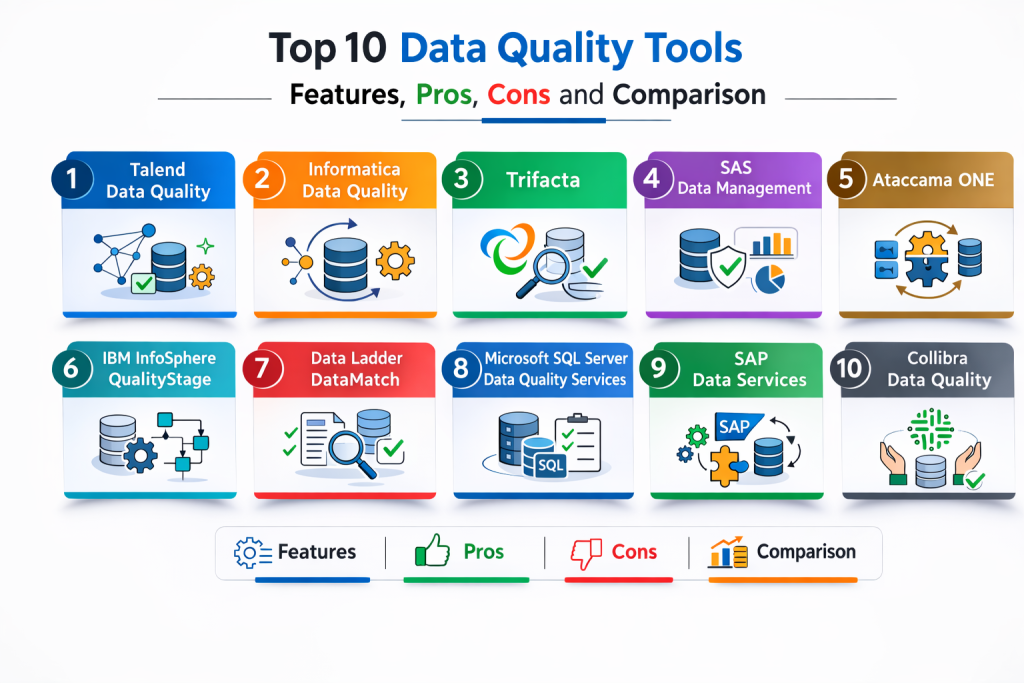
Top 10 Data Quality Tools
1 — Talend Data Quality
A comprehensive suite for data quality management, providing data profiling, cleansing, validation, and monitoring capabilities. Talend is well-suited for large data integration projects and integrates well with a variety of platforms and sources.
Key Features
- Real-time data quality monitoring and cleansing
- Data profiling and analysis for deep insight into data quality issues
- Advanced cleansing, matching, and de-duplication features
- Strong integration with cloud and on-premises platforms
- Supports data lineage and governance for compliance
- Collaboration tools for teams to define data quality rules
- Scalable for enterprise-wide data quality initiatives
Pros
- Comprehensive suite with strong data integration capabilities
- Good fit for complex data environments and large organizations
- Strong governance and lineage support
Cons
- Requires training to master advanced features
- Can be resource-intensive for smaller teams
- Complex deployment and setup for some environments
Platforms and Deployment
Web, Cloud, Self-hosted, Hybrid
Security and Compliance
Role-based access expected; certifications: Not publicly stated.
Integrations and Ecosystem
Talend integrates with cloud platforms, data lakes, and data warehouses to provide full-scale data quality management across the entire data pipeline.
- Integrates with data lakes, warehouses, and BI tools
- Works with cloud and on-premises environments
- Supports integration with data governance platforms
- Fits enterprise data quality management programs
Support and Community
Enterprise support model. Documentation: Varies / Not publicly stated.
2 — Informatica Data Quality
A robust toolset for profiling, cleansing, and monitoring data across the enterprise. Informatica is known for its data governance and quality capabilities and is often used in large organizations to ensure trusted, reliable data.
Key Features
- Data profiling and standardization tools for ensuring data consistency
- Advanced data cleansing features like matching and deduplication
- Real-time monitoring and validation of incoming data
- Extensive metadata management for data governance
- Integration with cloud, on-premises, and hybrid systems
- Supports automated workflows for data quality tasks
- Reporting and alerting for data quality failures
Pros
- Strong governance and data quality capabilities
- Comprehensive toolset for all aspects of data quality management
- Scalable for enterprise data quality programs
Cons
- Cost can be prohibitive for smaller teams
- Setup and customization can be complex
- Best fit for larger organizations with enterprise-level data needs
Platforms and Deployment
Web, Cloud, Self-hosted, Hybrid
Security and Compliance
Access control and encryption; certifications: Not publicly stated.
Integrations and Ecosystem
Informatica integrates with data lakes, warehouses, and cloud services to deliver end-to-end data quality solutions.
- Integrates with multiple platforms including cloud and hybrid systems
- Works with data governance and BI tools
- Provides full metadata management and lineage tracking
- Fits large scale enterprise data management environments
Support and Community
Enterprise support options. Documentation: Varies / Not publicly stated.
3 — Trifacta
A popular tool for data wrangling and cleaning, Trifacta is known for its user-friendly interface and strong transformation capabilities. It is widely used for preparing data for analytics by cleaning and enriching datasets.
Key Features
- Visual data wrangling and transformation interface
- Supports structured, semi-structured, and unstructured data
- Automation of data quality checks and cleaning tasks
- Real-time data validation and profiling features
- Strong integration with cloud storage and data analytics platforms
- AI-powered suggestions for data transformations
- Easily integrates with data lakes and warehouses
Pros
- User-friendly interface for data analysts and engineers
- Powerful transformation capabilities with AI-driven suggestions
- Good integration with cloud platforms and analytics tools
Cons
- Focuses more on data wrangling than full-fledged data quality management
- Some advanced data quality tasks may require manual intervention
- Limited governance features compared to other tools
Platforms and Deployment
Web, Cloud
Security and Compliance
Role-based access controls; certifications: Not publicly stated.
Integrations and Ecosystem
Trifacta integrates seamlessly with data lakes, analytics platforms, and cloud services to ensure high-quality data preparation.
- Works with data lakes and cloud storage systems
- Integrates with BI and analytics platforms
- Supports data transformation and enrichment workflows
- Fits data wrangling and preparation tasks for analytics
Support and Community
Strong community support. Enterprise support options: Varies / Not publicly stated.
4 — SAS Data Management
A data management platform that includes robust data quality tools. It helps teams ensure high-quality data by providing data cleansing, validation, and profiling capabilities along with strong governance.
Key Features
- Data profiling, cleansing, and validation
- Real-time data quality monitoring and alerts
- Supports data governance and lineage tracking
- High level of integration with SAS analytics tools
- Automated data quality checks and workflows
- Data transformation capabilities
- Metadata management for better data oversight
Pros
- Strong governance and data quality features
- Good integration with SAS analytics products
- Enterprise-ready with automated data quality tasks
Cons
- Best suited for teams using SAS tools, limiting flexibility
- Complex to set up and integrate for non-SAS environments
- Pricing may be high for small organizations
Platforms and Deployment
Cloud, Self-hosted, Hybrid
Security and Compliance
Enterprise-level security controls; certifications: Not publicly stated.
Integrations and Ecosystem
SAS integrates well with its own suite of analytics tools and other enterprise systems for comprehensive data management.
- Works well with SAS analytics and data storage systems
- Integrates with data governance platforms
- Supports cloud and hybrid data environments
- Fits large scale enterprise data quality programs
Support and Community
Enterprise support model. Documentation: Varies / Not publicly stated.
5 — Ataccama ONE
Ataccama is an AI-powered data quality management platform that provides end-to-end data governance, profiling, and cleansing. Its AI capabilities make it ideal for large-scale data operations.
Key Features
- AI-powered data profiling, cleansing, and validation
- Real-time monitoring for data quality issues
- Data governance and policy enforcement
- Automated metadata management
- Data lineage tracking for audit purposes
- Easy integration with data lakes and warehouses
- Supports both structured and unstructured data
Pros
- Strong AI and automation features for large-scale data management
- Integrates well with modern cloud environments
- Excellent governance and lineage capabilities
Cons
- Can be complex to implement initially
- Pricing may be too high for small organizations
- Not ideal for teams with minimal data quality processes
Platforms and Deployment
Web, Cloud, Self-hosted
Security and Compliance
Role-based access controls; certifications: Not publicly stated.
Integrations and Ecosystem
Ataccama ONE integrates with modern data platforms and BI tools to manage data quality across the pipeline.
- Works with cloud platforms, data lakes, and analytics tools
- Integrates with data governance and metadata management systems
- Fits enterprise data quality management needs
Support and Community
Enterprise support options. Documentation: Varies / Not publicly stated.
6 — IBM InfoSphere QualityStage
A robust data quality solution for enterprise environments, IBM InfoSphere QualityStage supports profiling, cleansing, matching, and standardization. It is often used in highly regulated industries like finance and healthcare.
Key Features
- Data profiling, standardization, and validation
- Advanced matching and deduplication features
- Supports real-time monitoring and reporting
- Integration with IBM’s larger data governance and management suite
- Works with both structured and unstructured data
- Batch and real-time data cleansing capabilities
- Strong integration with IBM analytics tools
Pros
- Advanced matching and deduplication for complex datasets
- Strong governance and integration with IBM data tools
- Well-suited for large enterprise environments
Cons
- High complexity and cost for smaller teams
- Heavy reliance on IBM ecosystem for maximum benefit
- Requires skilled personnel for implementation
Platforms and Deployment
Linux, Cloud, Self-hosted, Hybrid
Security and Compliance
Enterprise-level security controls; certifications: Not publicly stated.
Integrations and Ecosystem
IBM InfoSphere integrates with IBM’s data governance and analytics tools to provide a complete data quality and management solution.
- Integrates with IBM data governance tools
- Works with IBM analytics and reporting systems
- Supports hybrid and cloud environments
- Fits enterprise scale data quality programs
Support and Community
Enterprise support model. Exact details: Varies / Not publicly stated.
7 — Data Ladder DataMatch
DataMatch provides advanced data matching, cleansing, and de-duplication tools. It is ideal for teams looking for accurate record matching and data quality improvements.
Key Features
- Advanced data matching algorithms for deduplication
- Cleansing, validation, and standardization features
- Easy to use interface for data analysts
- Real-time data quality monitoring
- Supports cloud and on-premises deployment
- Strong support for address, name, and entity matching
- Good for CRM, marketing, and data migration projects
Pros
- Strong matching and deduplication features
- User-friendly interface for non-technical users
- Good for small to mid-sized data projects
Cons
- Not as scalable for large enterprise environments
- Limited automation compared to larger platforms
- Focuses mainly on data matching and less on full data governance
Platforms and Deployment
Windows, Self-hosted, Hybrid
Security and Compliance
Role-based access controls; certifications: Not publicly stated.
Integrations and Ecosystem
Data Ladder integrates with CRM systems, marketing platforms, and data warehouses to improve data quality across systems.
- Works with CRM, ERP, and marketing platforms
- Supports hybrid and on-premises data deployments
- Fits mid-sized data quality needs
Support and Community
Community and commercial support options available: Varies / Not publicly stated.
8 — Microsoft SQL Server Data Quality Services
Microsoft’s SQL Server Data Quality Services (DQS) helps teams profile, cleanse, and manage their data within SQL Server environments, making it ideal for Microsoft-centric data teams.
Key Features
- Data cleansing and matching for SQL Server databases
- Integration with SQL Server Integration Services (SSIS)
- Real-time data quality monitoring and error handling
- Built-in knowledge base for data standardization
- Supports batch and incremental updates
- Easy integration with other Microsoft tools and services
Pros
- Strong fit for SQL Server-based environments
- Built-in knowledge base reduces manual configuration
- Easy integration with other Microsoft services
Cons
- Best suited for SQL Server environments, limiting flexibility
- Lacks advanced governance features for enterprise scale
- Complex setup for non-SQL Server databases
Platforms and Deployment
Windows, Self-hosted
Security and Compliance
Access control through SQL Server security; certifications: Not publicly stated.
Integrations and Ecosystem
SQL Server DQS integrates with SSIS and other Microsoft data tools to provide end-to-end data quality services.
- Integrates with SQL Server and SSIS
- Works with Microsoft BI and reporting tools
- Fits SQL Server-centric data quality management needs
Support and Community
Support depends on Microsoft agreements. Documentation: Varies / Not publicly stated.
9 — SAP Data Services
SAP Data Services is an enterprise data integration and quality management platform designed to profile, cleanse, and integrate data for SAP ecosystems and beyond.
Key Features
- Data profiling, cleansing, and enrichment tools
- Advanced matching and deduplication features
- Supports integration with SAP and non-SAP sources
- Real-time monitoring and issue resolution
- Data quality validation for analytics and reporting
- Integrates with SAP data governance and analytics solutions
- Suitable for large, complex enterprise environments
Pros
- Strong integration with SAP and large-scale data environments
- Comprehensive data governance and cleansing capabilities
- Good for complex enterprise data quality management
Cons
- Best value is in SAP-heavy environments
- Complex and expensive for smaller teams
- Not as flexible for non-SAP data ecosystems
Platforms and Deployment
Linux, Cloud, Self-hosted, Hybrid
Security and Compliance
Enterprise-level security controls; certifications: Not publicly stated.
Integrations and Ecosystem
SAP Data Services integrates with SAP environments and supports non-SAP integrations for broader enterprise data quality needs.
- Integrates with SAP data governance and analytics tools
- Works with both structured and unstructured data sources
- Fits enterprise-scale data quality and integration programs
Support and Community
Enterprise support model. Exact details: Varies / Not publicly stated.
10 — Collibra Data Quality
Collibra’s Data Quality solution integrates seamlessly with its data governance platform, providing teams with end-to-end data management and quality services.
Key Features
- Comprehensive data quality management suite
- Integration with Collibra governance platform
- Data quality monitoring, profiling, and validation
- Customizable rules and checks for data standards
- Automated reporting and alerts for data quality issues
- Strong data lineage and impact analysis tools
- Supports collaboration for defining quality standards
Pros
- Strong integration with governance platforms
- Comprehensive data quality and governance capabilities
- Useful for cross-team collaboration on data quality standards
Cons
- Best suited for large organizations with a governance focus
- Can be complex for smaller teams or less mature data environments
- Pricing may be high for smaller businesses
Platforms and Deployment
Web, Cloud, Self-hosted, Hybrid
Security and Compliance
Role-based access controls; certifications: Not publicly stated.
Integrations and Ecosystem
Collibra integrates with its data governance platform and other enterprise data systems to ensure quality and compliance.
- Integrates with enterprise data systems and governance platforms
- Works with data catalogs, lineage, and reporting tools
- Fits governance-driven data quality programs
Support and Community
Enterprise support model. Exact details: Varies / Not publicly stated.
Comparison Table
| Tool Name | Best For | Platform(s) Supported | Deployment | Standout Feature | Public Rating |
|---|---|---|---|---|---|
| Talend Data Quality | Enterprise data quality management | Web | Cloud, Self-hosted, Hybrid | Full suite of data quality and integration features | N/A |
| Informatica Data Quality | Large scale enterprise quality workflows | Web | Cloud, Self-hosted, Hybrid | Strong metadata and governance support | N/A |
| Trifacta | Data wrangling and preparation | Web | Cloud | AI-driven data wrangling and transformation | N/A |
| SAS Data Management | Enterprise data management | Cloud, Self-hosted | Hybrid | Advanced integration and governance features | N/A |
| Ataccama ONE | AI-driven data quality | Web, Cloud | Cloud, Self-hosted | AI-powered cleansing and data governance | N/A |
| IBM InfoSphere QualityStage | Enterprise data quality integration | Linux, Cloud | Hybrid | High-performance matching and cleansing | N/A |
| Data Ladder DataMatch | Data matching and deduplication | Windows | Self-hosted | Advanced matching algorithms | N/A |
| Microsoft SQL Server Data Quality Services | SQL Server-based environments | Windows | Self-hosted | Easy integration with SQL Server | N/A |
| SAP Data Services | SAP-based enterprise environments | Linux | Self-hosted, Hybrid | Strong integration with SAP tools | N/A |
| Collibra Data Quality | Governance-driven data quality | Web | Cloud, Self-hosted, Hybrid | Strong integration with governance systems | N/A |
Evaluation and Scoring of Data Quality Tools
The scores below compare data quality tools across common selection criteria. A higher weighted total suggests a stronger overall balance, but the best choice depends on whether you need enterprise-scale cleansing, real-time monitoring, or AI-powered data management. Tools focused on governance and metadata management are best for regulated environments, while those that support large-scale matching and transformation are better for more complex data environments. Use these scores to shortlist options, then validate with pilot projects to ensure data quality metrics and workflows fit your needs. Scoring is comparative and should be interpreted based on your priorities.
Weights used: Core 25 percent, Ease 15 percent, Integrations 15 percent, Security 10 percent, Performance 10 percent, Support 10 percent, Value 15 percent.
| Tool Name | Core (25%) | Ease (15%) | Integrations (15%) | Security (10%) | Performance (10%) | Support (10%) | Value (15%) | Weighted Total |
|---|---|---|---|---|---|---|---|---|
| Talend Data Quality | 9 | 8 | 9 | 7 | 8 | 7 | 6 | 8.05 |
| Informatica Data Quality | 9 | 6 | 9 | 7 | 8 | 8 | 5 | 7.85 |
| Trifacta | 8 | 9 | 7 | 6 | 8 | 7 | 7 | 7.70 |
| SAS Data Management | 9 | 6 | 9 | 8 | 8 | 8 | 5 | 7.80 |
| Ataccama ONE | 9 | 7 | 8 | 7 | 8 | 7 | 6 | 7.80 |
| IBM InfoSphere QualityStage | 9 | 6 | 9 | 8 | 9 | 8 | 5 | 8.05 |
| Data Ladder DataMatch | 8 | 8 | 7 | 6 | 7 | 7 | 8 | 7.35 |
| Microsoft SQL Server Data Quality Services | 7 | 9 | 6 | 6 | 7 | 7 | 8 | 6.90 |
| SAP Data Services | 9 | 6 | 8 | 7 | 8 | 8 | 5 | 7.70 |
| Collibra Data Quality | 8 | 7 | 9 | 7 | 7 | 7 | 5 | 7.50 |
Which Data Quality Tool Is Right for You
Solo / Freelancer
For small teams or freelance projects, focus on tools with fast setup and easy integration. Trifacta offers a user-friendly interface for data wrangling, while Data Ladder DataMatch works well for simple matching and cleansing tasks.
SMB
SMBs should focus on cost-effective solutions with strong support for automated data cleansing and monitoring. Tools like Data Ladder DataMatch or Trifacta provide the right balance of functionality and ease of use.
Mid Market
Mid-market teams often need more robust governance and monitoring features. Talend and Ataccama are strong contenders, providing powerful data quality capabilities along with good integration options.
Enterprise
For large-scale, enterprise-level data quality management, Informatica, IBM InfoSphere, and SAP Data Services are ideal. These platforms provide the governance, scalability, and performance required to manage complex data environments with high volumes.
Budget vs Premium
If your budget is tight, consider Trifacta or Data Ladder DataMatch for smaller-scale data quality operations. However, for more extensive use cases, Talend and Informatica provide comprehensive solutions, albeit at a higher cost.
Feature Depth vs Ease of Use
If ease of use is paramount, Trifacta offers a simple interface for data wrangling and cleansing. However, if you require more advanced governance, metadata management, and matching capabilities, Informatica or IBM InfoSphere may be better suited to your needs.
Integrations and Scalability
For enterprise-level integrations and scalability, Informatica, Talend, and SAP Data Services are the best choices. They support integration with a wide range of systems and can handle large datasets across multiple environments.
Security and Compliance Needs
For regulated industries, SAP Data Services, IBM InfoSphere, and Talend are best suited due to their strong governance and compliance features. These tools ensure that data quality processes are fully auditable and meet security standards.
Frequently Asked Questions
1. What is data quality management?
Data quality management involves processes and tools to ensure that data is accurate, consistent, and usable for decision-making. It includes data profiling, cleansing, validation, and monitoring.
2. Why is data quality important for analytics?
Poor data quality leads to inaccurate insights, poor decision-making, and potentially costly mistakes. Ensuring high-quality data ensures that your analytics are reliable and actionable.
3. What are the main types of data quality issues?
Common data quality issues include duplicates, missing values, inconsistent formats, outliers, and invalid data entries. These issues can lead to unreliable insights if not addressed.
4. How do data quality tools handle profiling?
Data quality tools typically provide profiling features that analyze data sets to identify anomalies, patterns, and quality issues, helping teams understand where cleansing is needed.
5. What is data cleansing?
Data cleansing is the process of identifying and correcting data quality issues, such as removing duplicates, filling missing values, and correcting errors in data entries.
6. Can data quality tools help with compliance?
Yes, many data quality tools include features for governance, auditing, and lineage tracking, which are essential for maintaining compliance with regulations like GDPR, HIPAA, and CCPA.
7. How do I choose the right data quality tool?
Choose a tool that fits your organization’s size, complexity, and governance needs. Consider features like automation, scalability, integration capabilities, and monitoring.
8. How often should I run data quality checks?
Data quality checks should be performed regularly to ensure ongoing data integrity, especially for high-priority datasets that are crucial for daily operations.
9. What is data profiling?
Data profiling involves analyzing data sets to understand their structure, content, and relationships. It helps identify quality issues and sets the stage for data cleansing.
10. How do I integrate data quality tools with my data pipeline?
Many data quality tools offer integrations with ETL platforms, data lakes, and warehouses. These integrations help ensure that data quality is maintained throughout the data pipeline.
Conclusion
Data quality tools are essential for ensuring that organizations can rely on their data for decision-making, reporting, and analytics. The right tool depends on the complexity of your data environment and the specific features you need, whether it’s for small-scale cleansing or enterprise-wide governance. Tools like Informatica and IBM InfoSphere provide comprehensive solutions for large organizations, while Trifacta and Data Ladder DataMatch offer simpler, more cost-effective options. Start by evaluating your organization’s data maturity, governance requirements, and scalability needs to choose the best tool for your business. A practical next step is to run a pilot with real data, validate error detection and cleansing capabilities, and test integration with your existing data platforms before scaling.

Best Cardiac Hospitals Near You
Discover top heart hospitals, cardiology centers & cardiac care services by city.
Advanced Heart Care • Trusted Hospitals • Expert Teams
View Best Hospitals