Introduction
Master Data Management tools help you keep the most important business data consistent across systems. “Master data” usually means the core entities every department depends on, such as customers, products, suppliers, locations, employees, assets, and chart-of-accounts style reference values. Without a clear system of record, these entities drift across CRM, ERP, ecommerce, data warehouses, spreadsheets, and line-of-business apps, creating duplicates, mismatched attributes, and reporting that no one fully trusts.
A strong MDM program brings order to that chaos by standardizing definitions, controlling changes, and distributing “trusted master records” to downstream systems. In practice, MDM tools reduce operational errors, speed up analytics, improve customer experiences, and support governance programs that demand traceability and accountability.
Common real-world use cases include:
- Building a consistent Customer 360 view for sales, service, marketing, and analytics
- Standardizing product catalogs across regions, channels, and ecommerce platforms
- Harmonizing supplier and vendor data to reduce procurement risk and duplication
- Aligning location and hierarchy data for planning, budgeting, and performance reporting
- Improving data quality for downstream BI, AI models, and regulatory reporting
When evaluating MDM tools, buyers typically compare:
- Multi-domain coverage (customer, product, supplier, reference, hierarchy)
- Match/merge quality, survivorship rules, and identity resolution
- Stewardship workflows, approvals, and auditability
- Data quality controls (validation, standardization, enrichment)
- Integration patterns (APIs, connectors, event streaming, ETL/ELT)
- Metadata, lineage, and governance alignment
- Scalability for high-volume records and high-concurrency usage
- Security controls (RBAC, SSO, audit logs, encryption)
- Deployment fit (cloud, self-hosted, hybrid)
- Implementation effort, cost, and ongoing operating model
Best for
MDM tools are most useful for data leaders, enterprise architects, analytics teams, and operations teams in organizations where multiple systems create or consume “the same” entities. They are widely used in retail, manufacturing, healthcare, finance, logistics, telecom, and public sector environments where data correctness impacts revenue, risk, and customer satisfaction.
Not ideal for
MDM may be unnecessary if you have a single operational system for each entity, a small number of records, and minimal cross-team reuse. If the real need is only product content management for ecommerce, a dedicated PIM might be a better starting point. If the focus is only integration and movement of data, an integration platform or data quality tool might address the immediate pain without the full MDM operating model.
Key Trends in Master Data Management Tools
- AI-assisted matching and data stewardship that suggests merges, detects anomalies, and flags risky changes
- Stronger identity resolution for customer and party data, including relationship modeling and householding
- More “composable” architectures where MDM integrates tightly with catalogs, governance tools, and data quality engines
- Real-time synchronization patterns using events and streaming instead of batch-only publishing
- Wider adoption of cloud-first deployments for faster scaling and easier integration with modern data stacks
- Domain expansion beyond customer/product into reference data, hierarchies, and multi-entity graphs
- Better governance alignment through deeper audit trails, approvals, and policy-based controls
- Increasing demand for privacy-friendly designs (minimization, access controls, masking strategies)
- Faster implementation expectations driven by templates, accelerators, and low-code workflow configuration
- Hybrid patterns that keep certain sensitive domains on controlled infrastructure while syncing to cloud analytics
How We Selected These Tools
- Strong market visibility and frequent inclusion in enterprise shortlists
- Proven coverage across common MDM domains and patterns (registry style, consolidated style, coexistence)
- Practical stewardship and workflow depth for day-to-day operations
- Integration flexibility with both legacy enterprise systems and modern cloud data platforms
- Usability for both technical administrators and business data stewards
- Fit across segments, from mid-market to complex global enterprise environments
- Signals of maturity in security controls, role separation, and auditability
- Ability to scale in record volume, attribute complexity, and organizational adoption
- Ecosystem strength: connectors, APIs, partner network, and implementation support
- Balance across enterprise heavyweights and modern cloud-native approaches
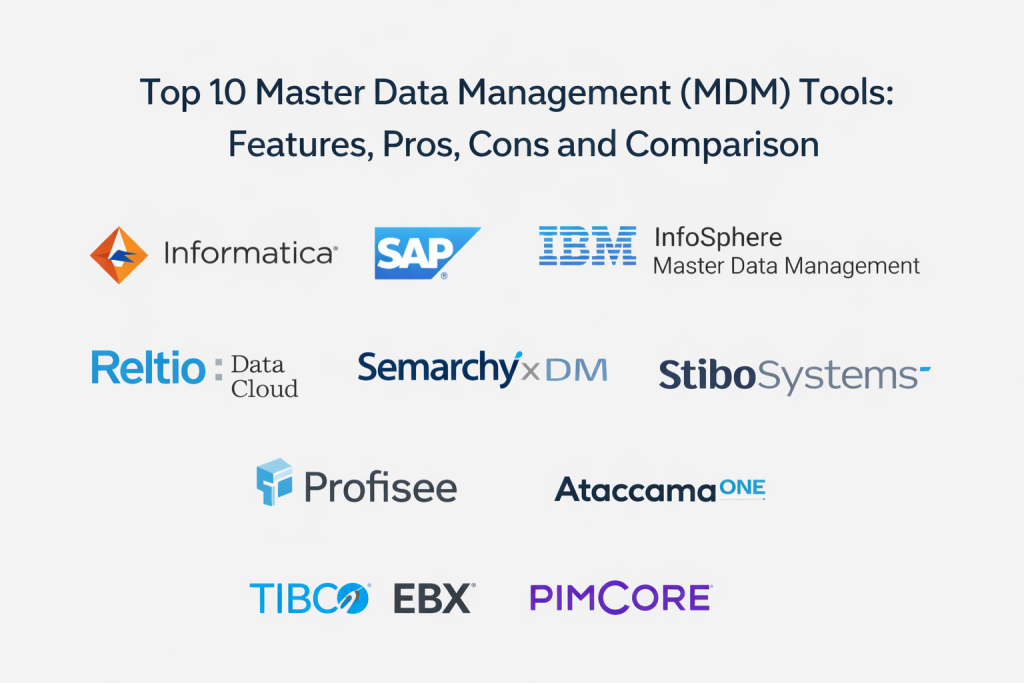
Top 10 Master Data Management Tools
Tool 1 — Informatica MDM
Informatica MDM is widely used in large organizations that need strong multi-domain mastering, governance alignment, and high-scale match/merge capabilities. It is often chosen when data landscapes are complex and the organization needs a consistent operational backbone for master entities across many systems and regions.
Key Features
- Multi-domain mastering with configurable models and hierarchies
- Advanced match/merge logic with survivorship and rule configuration
- Stewardship workbenches for review, approvals, and exception handling
- Data quality controls and validations embedded into mastering flows
- Support for coexistence patterns where upstream systems keep partial ownership
- Publishing and syndication patterns to downstream apps and analytics
- Monitoring and governance-friendly auditability for changes and approvals
Pros
- Strong breadth for complex enterprise environments with multiple domains
- Mature stewardship workflows that support real operational governance
Cons
- Implementation can be demanding and requires a clear operating model
- Total cost can be high when scaling across many domains and teams
Platforms / Deployment
- Cloud / Self-hosted / Hybrid (Varies)
Security & Compliance
- SSO/SAML, RBAC, encryption, audit logs (Varies by deployment)
- Certifications: Not publicly stated
Integrations & Ecosystem
Informatica ecosystems often connect to major ERPs, CRMs, and data platforms. Integration is typically achieved through connectors, APIs, and common enterprise integration patterns.
- ERP and finance systems
- CRM and customer platforms
- Data warehouses and lakehouses
- ETL/ELT and integration tooling
- APIs for custom apps
Support & Community
Typically strong enterprise support options, structured onboarding through partners, and extensive documentation. Community strength varies by region and partner footprint.
Tool 2 — SAP Master Data Governance
SAP Master Data Governance is frequently selected by organizations with significant SAP footprints. It fits well when governance workflows and mastering need to align closely with SAP business processes, security models, and enterprise data standards.
Key Features
- Central governance workflows for approvals and controlled changes
- Strong alignment with SAP data models and enterprise processes
- Duplicate checks, validations, and rule-based controls
- Domain support for business partners, products, and other enterprise entities (Varies)
- Change request management with audit trails and role separation
- Consolidation and distribution options to connected systems
- Integration patterns suited to SAP-centric landscapes
Pros
- Excellent fit for SAP-heavy environments with enterprise process alignment
- Strong governance workflow orientation for stewardship teams
Cons
- Less attractive if your core systems are mostly non-SAP
- Configuration and rollout can be complex without experienced resources
Platforms / Deployment
- Cloud / Self-hosted / Hybrid (Varies)
Security & Compliance
- RBAC, audit trails, role separation, enterprise authentication (Varies)
- Certifications: Not publicly stated
Integrations & Ecosystem
SAP ecosystems often connect naturally across SAP ERP, analytics, and integration layers, plus external systems via integration patterns.
- SAP ERP and finance suites
- CRM and customer systems
- Integration layers and middleware
- Data platforms for analytics
- APIs and interfaces for custom apps
Support & Community
Strong enterprise support and partner ecosystem. Documentation is typically extensive. Community tends to be strong where SAP adoption is high.
Tool 3 — IBM InfoSphere Master Data Management
IBM InfoSphere Master Data Management is commonly associated with large, regulated organizations that need mature governance controls, robust mastering patterns, and long-running operational stability. It is often evaluated where legacy integration complexity is high and reliability is a top priority.
Key Features
- Multi-domain mastering with configurable entity models
- Match/merge and identity resolution features for deduplication
- Stewardship workflows and exception management
- Support for complex hierarchies and relationship modeling
- Publishing patterns for downstream applications
- Auditability and operational governance controls
- Hybrid-friendly deployment options (Varies)
Pros
- Strong fit for complex enterprise mastering programs
- Mature controls suited to regulated environments
Cons
- Modernizing user experience and integration patterns may take effort
- Implementation can require specialized skill sets
Platforms / Deployment
- Cloud / Self-hosted / Hybrid (Varies)
Security & Compliance
- SSO, RBAC, audit logs, encryption (Varies)
- Certifications: Not publicly stated
Integrations & Ecosystem
Often used with enterprise integration stacks and long-established data platforms.
- Enterprise integration tools and middleware
- Data warehouses and analytics platforms
- CRM and ERP applications
- APIs for internal systems
- Batch and event-driven patterns (Varies)
Support & Community
Enterprise-grade support options and structured service models. Community visibility varies, but experienced partners are often available.
Tool 4 — Reltio Data Cloud
Reltio Data Cloud is known for cloud-native MDM patterns and real-time synchronization capabilities. It is often shortlisted when organizations want modern integration styles, faster time-to-value, and strong identity resolution for customer or party data.
Key Features
- Cloud-native mastering and stewardship experiences
- Identity resolution and relationship modeling
- Flexible rules for survivorship and golden record creation
- Real-time publishing patterns to downstream apps
- Data quality checks and governance-friendly auditing (Varies)
- APIs and event-driven integration approaches
- Supports customer-centric and multi-domain scenarios (Varies)
Pros
- Strong fit for cloud-first architectures and modern integration styles
- Good alignment with real-time “Customer 360” expectations
Cons
- Cloud-first approach may not fit strict on-prem-only environments
- Costs can rise as usage and domains expand
Platforms / Deployment
- Cloud (Primarily)
Security & Compliance
- SSO/SAML, RBAC, encryption, audit logs (Varies)
- Certifications: Not publicly stated
Integrations & Ecosystem
Often integrates well with cloud CRMs, customer platforms, and modern analytics stacks.
- CRM and customer engagement platforms
- Data warehouses and lakehouses
- API-based internal services
- Event and streaming pipelines (Varies)
- ETL/ELT tools
Support & Community
Typically strong onboarding models and documentation. Community strength varies, but cloud ecosystems often provide many integration patterns.
Tool 5 — Semarchy xDM
Semarchy xDM is often chosen by organizations that want flexible modeling and a pragmatic approach to multi-domain mastering without the heaviest enterprise overhead. It is frequently evaluated for mid-market and growing enterprise programs where agility matters.
Key Features
- Flexible data modeling across multiple domains
- Match/merge capabilities with survivorship configuration
- Stewardship workflow and data validation controls
- Support for hierarchies and reference data (Varies)
- Integration options through APIs and common data tooling
- Configurable business rules for governance
- Practical rollout patterns for phased adoption
Pros
- Good balance of flexibility and governance structure
- Often faster to implement than very heavyweight stacks
Cons
- Extremely large-scale global rollouts may require careful architecture
- Out-of-the-box connectors may vary by use case
Platforms / Deployment
- Cloud / Self-hosted / Hybrid (Varies)
Security & Compliance
- RBAC, audit logs, authentication integration (Varies)
- Certifications: Not publicly stated
Integrations & Ecosystem
Semarchy deployments often integrate with typical enterprise apps and data platforms.
- CRM and ERP systems
- Data warehouses and BI tools
- ETL/ELT pipelines
- APIs for custom services
- Data catalog and governance tools (Varies)
Support & Community
Usually offers structured support and implementation partners. Documentation tends to be practical for administrators and stewards.
Tool 6 — Stibo Systems Platform
Stibo Systems Platform is commonly evaluated where product and customer data complexity is high, especially in industries with large catalogs and many channels. It is often used for multi-domain programs that require strong workflows and data distribution across commerce and operations.
Key Features
- Multi-domain mastering with strong workflow orientation
- Support for product and customer entity complexity (Varies)
- Hierarchy management for categories, org structures, and relationships
- Validation, approvals, and stewardship operations
- Syndication patterns for multi-channel distribution (Varies)
- Data governance features aligned with enterprise operating models
- Integration support for enterprise stacks
Pros
- Strong fit for catalog-heavy and multi-channel organizations
- Mature workflow patterns for stewardship teams
Cons
- Implementation can be substantial for broad multi-domain scope
- Cost may be challenging for smaller organizations
Platforms / Deployment
- Cloud / Self-hosted / Hybrid (Varies)
Security & Compliance
- RBAC, audit logs, authentication integration (Varies)
- Certifications: Not publicly stated
Integrations & Ecosystem
Commonly integrates with commerce, ERP, CRM, and analytics.
- Ecommerce platforms
- ERP and supply chain systems
- CRM and customer platforms
- Data platforms for analytics
- APIs and integration middleware
Support & Community
Enterprise-focused support and partner ecosystems. Best results typically come with clear stewardship ownership and governance processes.
Tool 7 — Profisee
Profisee is often selected by organizations that want a practical, stewardship-friendly MDM platform without heavy complexity. It is frequently used in mid-market environments and in organizations with strong Microsoft-centric technology stacks.
Key Features
- Multi-domain mastering for core entities (Varies)
- Match/merge and survivorship rules for golden records
- Stewardship UI for review, approvals, and exceptions
- Data modeling and validation controls
- Integration patterns that align well with common enterprise stacks
- Publishing and synchronization approaches (Varies)
- Governance support through workflows and auditing (Varies)
Pros
- Generally approachable for teams building MDM capabilities step-by-step
- Often a good fit where stewardship adoption is a key priority
Cons
- Some advanced enterprise scenarios may require additional design work
- Connector depth depends on the broader integration approach
Platforms / Deployment
- Cloud / Self-hosted / Hybrid (Varies)
Security & Compliance
- RBAC, audit logs, encryption, enterprise authentication (Varies)
- Certifications: Not publicly stated
Integrations & Ecosystem
Profisee commonly connects through APIs and standard integration tooling.
- CRM and ERP systems
- Data warehouses and analytics
- Integration pipelines and orchestration tools
- APIs for internal services
- Governance tooling alignment (Varies)
Support & Community
Often noted for practical onboarding and documentation. Support models vary by contract tier.
Tool 8 — Ataccama ONE
Ataccama ONE is often considered when buyers want a broader “data management platform” approach that combines data quality, profiling, governance capabilities, and MDM. It can be attractive when MDM needs to be closely tied to quality and discovery workflows.
Key Features
- MDM capabilities integrated with broader data quality features (Varies)
- Profiling and data discovery patterns that support better mastering outcomes
- Match/merge and standardization workflows
- Stewardship experience with approvals and exception handling
- Metadata and governance alignment features (Varies)
- Integration flexibility for enterprise stacks
- Automation assistance for quality and validation rules (Varies)
Pros
- Strong alignment between data quality and mastering work
- Useful when governance and catalog alignment is part of the program
Cons
- Platform breadth can increase implementation scope if not managed tightly
- Requires clear prioritization to avoid “doing everything at once”
Platforms / Deployment
- Cloud / Self-hosted / Hybrid (Varies)
Security & Compliance
- RBAC, audit logs, encryption, authentication integration (Varies)
- Certifications: Not publicly stated
Integrations & Ecosystem
Often integrated with data platforms and enterprise apps.
- Data warehouses and lakehouses
- ETL/ELT tools and pipelines
- ERP and CRM systems
- APIs for custom workflows
- Governance ecosystems (Varies)
Support & Community
Support and onboarding typically align with enterprise platform expectations. Community footprint varies by region and partner reach.
Tool 9 — TIBCO EBX
TIBCO EBX is commonly used where governance workflows, reference data management, and controlled stewardship are central priorities. It is often selected for structured, policy-driven data management and multi-domain governance programs.
Key Features
- Strong workflow engine for approvals and stewardship operations
- Reference data and hierarchy management patterns (Varies)
- Data modeling and validation rule configuration
- Stewardship-focused UI for controlled changes
- Integration via APIs and enterprise middleware
- Auditability for governance and operational traceability
- Fits “coexistence” mastering patterns in complex landscapes
Pros
- Excellent for governance-heavy programs and controlled change management
- Strong fit for reference and hierarchy-driven enterprise needs
Cons
- Requires thoughtful process design for best results
- User experience depends heavily on configuration and governance choices
Platforms / Deployment
- Cloud / Self-hosted / Hybrid (Varies)
Security & Compliance
- RBAC, audit logs, authentication integration (Varies)
- Certifications: Not publicly stated
Integrations & Ecosystem
Commonly used with enterprise integration architectures.
- Middleware and integration platforms
- ERP/CRM and line-of-business apps
- Data platforms for analytics
- APIs for custom workflows
- Master/reference data publishing patterns
Support & Community
Enterprise support models are common. Community size varies, but experienced implementers and partners are typically available.
Tool 10 — Pimcore
Pimcore is often evaluated in scenarios that blend product data, content needs, and structured mastering. It can be useful when teams want flexibility and control over data models, especially in product-centric and multi-channel environments.
Key Features
- Flexible data modeling for product and related domains (Varies)
- Stewardship workflows and validation patterns (Varies)
- Strong support for product information and enrichment workflows
- Integration possibilities via APIs and connectors (Varies)
- Hierarchies and classification structures for catalogs
- Support for multi-channel distribution patterns (Varies)
- Extensible architecture for custom requirements
Pros
- Flexible modeling, especially for product and catalog-heavy use cases
- Useful when product information and governance workflows intersect
Cons
- Requires strong implementation discipline to keep the model clean
- Enterprise-scale governance programs may need additional design rigor
Platforms / Deployment
- Self-hosted / Cloud / Hybrid (Varies)
Security & Compliance
- RBAC, audit logs, authentication integration (Varies)
- Certifications: Not publicly stated
Integrations & Ecosystem
Pimcore is commonly integrated through APIs and broader data tooling.
- Ecommerce and commerce systems
- ERP and supply chain systems
- DAM and content workflows (Varies)
- Data platforms and BI tools
- APIs for custom services
Support & Community
Support and community vary based on deployment approach and partner involvement. Documentation is generally available, but implementation quality drives outcomes.
Comparison Table
| Tool Name | Best For | Platform(s) Supported | Deployment | Standout Feature | Public Rating |
|---|---|---|---|---|---|
| Informatica MDM | Large enterprises with complex multi-domain mastering | Varies / N/A | Cloud / Self-hosted / Hybrid | Enterprise-grade match/merge and stewardship depth | N/A |
| SAP Master Data Governance | SAP-centric governance and controlled master data processes | Varies / N/A | Cloud / Self-hosted / Hybrid | Strong workflow governance aligned to SAP processes | N/A |
| IBM InfoSphere Master Data Management | Regulated enterprises needing mature controls and stability | Varies / N/A | Cloud / Self-hosted / Hybrid | Robust enterprise mastering with governance orientation | N/A |
| Reltio Data Cloud | Cloud-first Customer 360 and real-time integration patterns | Web | Cloud | Cloud-native identity resolution and real-time publishing | N/A |
| Semarchy xDM | Mid-market to enterprise teams needing flexible modeling | Varies / N/A | Cloud / Self-hosted / Hybrid | Agile modeling and pragmatic multi-domain approach | N/A |
| Stibo Systems Platform | Product and customer mastering with strong workflow | Varies / N/A | Cloud / Self-hosted / Hybrid | Workflow-driven multi-domain mastering for complex catalogs | N/A |
| Profisee | Practical stewardship-led MDM adoption with balanced complexity | Varies / N/A | Cloud / Self-hosted / Hybrid | Steward-friendly mastering with strong operating model fit | N/A |
| Ataccama ONE | MDM plus data quality-driven platform approach | Varies / N/A | Cloud / Self-hosted / Hybrid | Tight link between quality, discovery, and mastering | N/A |
| TIBCO EBX | Governance-heavy reference data and controlled stewardship | Varies / N/A | Cloud / Self-hosted / Hybrid | Workflow-centric governance and reference data management | N/A |
| Pimcore | Product-centric data modeling and multi-channel enrichment | Varies / N/A | Cloud / Self-hosted / Hybrid | Flexible product data and hierarchy management | N/A |
Evaluation & Scoring
Scoring is comparative and is meant to help you quickly shortlist tools based on typical MDM buyer priorities. A higher score does not mean a tool is universally “better,” it means it is stronger in that criterion relative to the others for common enterprise scenarios. Your real score should be validated through a pilot using your data volumes, stewardship workflows, and integration needs. If a criterion matters more to you than the default weights, you should adjust the weights and recompute the totals.
Weights used:
- Core features 25%
- Ease of use 15%
- Integrations & ecosystem 15%
- Security & compliance 10%
- Performance & reliability 10%
- Support & community 10%
- Price / value 15%
| Tool Name | Core (25%) | Ease (15%) | Integrations (15%) | Security (10%) | Performance (10%) | Support (10%) | Value (15%) | Weighted Total |
|---|---|---|---|---|---|---|---|---|
| Informatica MDM | 9 | 7 | 9 | 8 | 9 | 8 | 6 | 8.0 |
| SAP Master Data Governance | 8 | 6 | 8 | 8 | 8 | 8 | 6 | 7.3 |
| IBM InfoSphere Master Data Management | 8 | 6 | 8 | 8 | 8 | 7 | 6 | 7.1 |
| Reltio Data Cloud | 8 | 8 | 8 | 7 | 8 | 7 | 6 | 7.5 |
| Semarchy xDM | 8 | 8 | 7 | 7 | 7 | 7 | 7 | 7.5 |
| Stibo Systems Platform | 8 | 7 | 7 | 7 | 8 | 7 | 6 | 7.2 |
| Profisee | 7 | 8 | 7 | 7 | 7 | 7 | 8 | 7.4 |
| Ataccama ONE | 8 | 7 | 7 | 7 | 7 | 7 | 6 | 7.1 |
| TIBCO EBX | 7 | 7 | 7 | 7 | 7 | 7 | 6 | 6.9 |
| Pimcore | 6 | 7 | 6 | 6 | 6 | 6 | 8 | 6.5 |
Which MDM Tool Is Right for You
Solo / Freelancer
Most solo operators do not need full MDM. If you manage product data for a small commerce setup or need structured catalog control, Pimcore can be considered, but only if you are ready to maintain the model and workflows. Otherwise, simpler operational discipline and validation rules in your primary system may be enough.
SMB
SMBs usually need fast wins: fewer duplicates, clearer definitions, and consistent reporting. Profisee and Semarchy xDM often fit SMB-to-mid-market trajectories because they support stewardship workflows without forcing an overwhelming program scope. If your SMB is product-heavy with many channels, Pimcore can also be relevant.
Mid-Market
Mid-market firms typically have multiple systems (CRM, ERP, eCommerce, analytics) and expanding data reuse. Semarchy xDM and Profisee can work well for phased adoption. Ataccama ONE can be compelling when data quality, profiling, and mastering must be tackled together so the golden record stays credible as new sources are added.
Enterprise
Enterprises usually need mature stewardship operations, complex survivorship rules, and high-scale distribution patterns. Informatica MDM, SAP Master Data Governance, and IBM InfoSphere Master Data Management are common fits when multi-domain mastering must operate reliably across large global organizations. Stibo Systems Platform is frequently evaluated where catalog complexity and multi-channel distribution are essential.
Budget vs Premium
If cost discipline matters most, focus on tighter scope first: one domain, a few critical attributes, and a controlled publishing workflow. Profisee, Semarchy xDM, and Pimcore may feel more manageable depending on your environment. Premium enterprise stacks usually make sense only when the operational risk of bad master data is high and the organization can fund governance, stewardship staffing, and long-term ownership.
Feature Depth vs Ease of Use
Feature depth helps when you master many domains, integrate multiple systems, and need complex survivorship. Informatica MDM and IBM InfoSphere Master Data Management can be strong here. Ease of use matters when adoption is your biggest risk; stewardship teams need a workable daily experience, and change processes must be clear. Profisee, Semarchy xDM, and Reltio Data Cloud can perform well for adoption-focused programs depending on deployment needs.
Integrations & Scalability
If you publish master data to many downstream systems and need stable operations, prioritize integration patterns and operational monitoring. Informatica MDM, SAP Master Data Governance, IBM InfoSphere Master Data Management, and Reltio Data Cloud are typical shortlists for integration-driven programs. If your primary need is product distribution across channels, Stibo Systems Platform and Pimcore can be relevant.
Security & Compliance Needs
Security success in MDM is usually about operating model design: who can approve changes, how access is separated, how sensitive attributes are protected, and how audits are produced. Choose a tool that supports RBAC, audit logs, and enterprise authentication, then validate how well it matches your internal controls. For strict governance environments, SAP Master Data Governance, IBM InfoSphere Master Data Management, and Informatica MDM are often considered, but you should validate actual controls in a pilot rather than relying on assumptions.
Frequently Asked Questions
1. What problem does an MDM tool solve that a data warehouse does not?
A data warehouse is optimized for analytics, while MDM is built for governing and distributing trusted operational records. MDM focuses on creating and maintaining “golden records” with stewardship workflows and publishing them back to business systems.
2. How long does an MDM implementation usually take?
It depends on scope. A single-domain rollout with clear ownership can be delivered faster than a multi-domain program across many systems. Timelines vary widely based on data quality, integration complexity, and stewardship readiness.
3. What are the most common reasons MDM programs fail?
The biggest reasons are unclear data ownership, weak stewardship adoption, trying to master too many domains at once, and underestimating integration work. Successful programs start small, prove value, then expand.
4. Do MDM tools replace data quality tools?
Not always. Many MDM tools include validation and standardization features, but dedicated data quality platforms can provide deeper profiling and cleansing at scale. The best approach depends on whether quality is centralized within MDM or handled as a shared service.
5. How should we choose the first domain to master?
Pick a domain that is widely reused and causes measurable pain when incorrect, such as customer or product. Start with a small set of “must-trust” attributes, then grow gradually once publishing and stewardship stabilize.
6. How do match and merge rules work in practice?
They typically use matching logic to identify duplicates and survivorship rules to decide which system “wins” for each attribute. Good implementations define rules transparently so stewards can understand why a record became the golden record.
7. Is cloud MDM always better than self-hosted MDM?
Cloud can simplify scaling and modern integrations, but self-hosted or hybrid may be needed for strict infrastructure controls. The right answer depends on your security requirements, integration landscape, and operational constraints.
8. Can we run MDM without dedicated data stewards?
It’s risky. Even with automation, stewardship is needed to review exceptions, approve changes, manage policies, and keep trust high. Without stewardship, MDM becomes a technical system that users do not rely on.
9. How hard is it to switch from one MDM tool to another?
Switching is possible but requires careful planning. Data models, survivorship logic, workflows, and publishing patterns must be rebuilt and tested. The effort is reduced if you maintain clear documentation, mapping, and governance policies.
10. What are practical alternatives if we are not ready for full MDM?
You can start with stronger data standards, validation rules in source systems, and a focused deduplication process for a single domain. You can also improve integration discipline and create a controlled reference data process before expanding into full mastering.
Conclusion
Master Data Management succeeds when it is treated as an operational capability, not just a software purchase. The tools in this guide can all support golden records, stewardship workflows, and publishing patterns, but the best choice depends on what you are mastering, how many systems create the data, and how disciplined your governance model is. If you are early in the journey, start with one domain, define a small set of trusted attributes, and establish clear ownership with approval workflows. If you are scaling, prioritize integration patterns, monitoring, and stewardship adoption so the golden record stays credible over time. The simplest next step is to shortlist two or three tools, run a pilot with real data, validate match/merge outcomes, and confirm publishing and security controls before expanding scope.

Best Cardiac Hospitals Near You
Discover top heart hospitals, cardiology centers & cardiac care services by city.
Advanced Heart Care • Trusted Hospitals • Expert Teams
View Best Hospitals