Introduction
Data governance is critical for organizations aiming to ensure that their data is accurate, secure, and compliant with regulations. It encompasses the policies, procedures, and tools required to ensure proper management of data throughout its lifecycle. A well-structured data governance program helps businesses reduce risk, ensure data integrity, maintain compliance, and drive better decision-making.
As businesses rely more on data to drive insights, maintain operations, and meet compliance requirements, the need for robust data governance solutions is growing. Today, data governance platforms are essential tools for enterprises to maintain control over their data, ensuring it is secure, compliant, and used effectively across the organization. Beyond, organizations are focusing on improving data governance with stronger AI-driven data classification, real-time monitoring, and deeper regulatory compliance tools.
Best for:
- Roles: Data governance teams, IT managers, Chief Data Officers (CDOs), Compliance officers.
- Industries: Healthcare, finance, retail, manufacturing, and government.
- Company Size: Large enterprises, mid-market organizations, and regulated industries.
Not ideal for:
- Small businesses with limited data and fewer regulatory pressures.
- Organizations that don’t yet manage large datasets or require complex governance processes.
Key Trends in Data Governance Platforms and Beyond
- AI-Driven Classification: Increasing use of AI and machine learning to automate data classification, ensuring real-time monitoring and governance across unstructured and structured data.
- Cloud-Native Data Governance: Many organizations are shifting towards cloud-native solutions to ensure scalability and flexibility, allowing data governance policies to extend across hybrid and multi-cloud environments.
- Real-Time Monitoring and Auditing: Real-time capabilities to monitor and audit data in motion, ensuring compliance, detecting anomalies, and managing risks proactively.
- Data Privacy and Compliance: Heightened focus on integrating data governance tools with data privacy regulations like GDPR, CCPA, and HIPAA, especially as data privacy laws evolve worldwide.
- Data Stewardship and Lineage: Stronger lineage tracking, ensuring that data’s flow and transformations are documented for transparency, accuracy, and compliance.
- Automated Data Quality: Automation of data quality checks and corrections within governance platforms to improve data reliability and trustworthiness.
- Decentralized Governance: Allowing departments to manage data governance policies with centralized oversight, promoting business unit autonomy while maintaining corporate control.
- Increased Integration with Other Data Platforms: More integration with data lakes, analytics platforms, and business intelligence tools to ensure governance is embedded in the entire data ecosystem.
- Collaboration-Driven Tools: Platforms that emphasize collaboration between data stewards, analysts, and compliance teams to improve data stewardship across organizations.
- Comprehensive Reporting: Offering powerful reporting features that provide insight into data quality, compliance status, and governance risks across the organization.
How We Selected These Tools
The following top 10 data governance platforms were selected based on:
- Market adoption and reputation: Tools widely recognized by industry analysts and frequently used in data governance programs.
- Feature completeness: Platforms offering a full suite of governance capabilities such as data cataloging, policy management, compliance tracking, and lineage tracking.
- Scalability: Platforms that support enterprises of various sizes and can scale with growing data and compliance needs.
- Security and compliance features: Emphasis on security and privacy features to ensure data governance is in line with regulations.
- Integrations: The ability to integrate seamlessly with other data management systems such as data lakes, data warehouses, BI tools, and other enterprise applications.
- User experience: Tools that offer a balance of functionality and ease of use, ensuring accessibility to both technical users and business stakeholders.
- Vendor support and community: The availability of strong support, training resources, and an active user community.
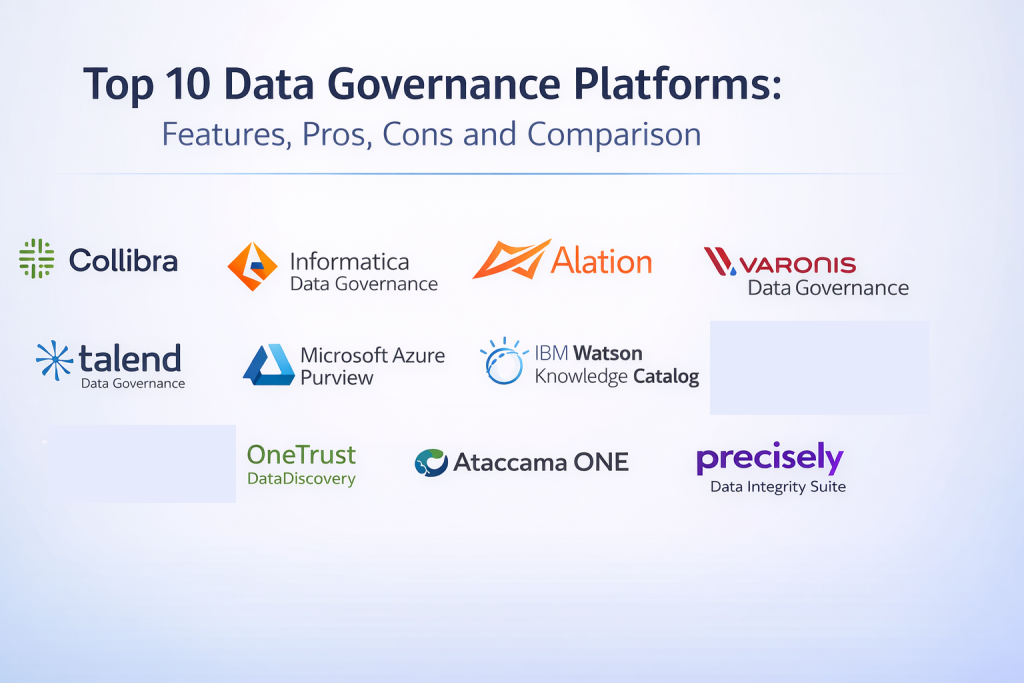
Top 10 Data Governance Platforms
1. Collibra
Collibra is one of the most widely recognized data governance platforms, offering a comprehensive suite of tools for data cataloging, data stewardship, and compliance management. It helps organizations unify and manage data across business units, ensuring data quality, privacy, and regulatory compliance.
Key Features
- Data cataloging and metadata management
- Automated data quality checks
- Compliance with GDPR, CCPA, and other privacy laws
- Real-time collaboration for data stewards
- Data lineage tracking and visualization
Pros
- Strong integration with other data management tools
- User-friendly interface for business users and technical staff
Cons
- May require customization for large-scale implementations
- High cost for small businesses
Platforms / Deployment
- Cloud / Hybrid
Security & Compliance
- SOC 2, ISO 27001, GDPR, CCPA
Integrations & Ecosystem
- Data lakes, data warehouses, BI tools, cloud storage platforms
Support & Community
- Extensive documentation, customer support, and an active community forum
2. Informatica Data Governance
Informatica’s Data Governance platform is designed for large enterprises that need to manage data quality, privacy, and compliance across complex data ecosystems. It offers AI-driven capabilities for data governance, ensuring businesses maintain data integrity while reducing the risk of non-compliance.
Key Features
- AI-powered data quality management
- Automated compliance checks for regulatory requirements
- Data lineage and impact analysis
- Collaboration tools for data stewardship
- Integration with Informatica’s data integration tools
Pros
- Strong AI capabilities for automating data quality checks
- Seamless integration with other Informatica tools
Cons
- High cost and complexity for smaller organizations
- Initial setup can be resource-intensive
Platforms / Deployment
- Cloud / Hybrid / On-premise
Security & Compliance
- SOC 2, ISO 27001, GDPR, HIPAA
Integrations & Ecosystem
- Data lakes, cloud storage, analytics platforms, ETL tools
Support & Community
- Comprehensive support with global resources and training
3. Alation
Alation focuses on simplifying data governance by offering robust data cataloging, policy management, and collaborative features. It is used by organizations to ensure proper data stewardship and compliance while improving the accessibility of governed data.
Key Features
- Data cataloging and discovery
- Automated data stewardship workflows
- Data quality and governance policy enforcement
- Integration with cloud and on-prem data sources
- Real-time data monitoring
Pros
- Easy-to-use interface for business users
- Strong support for both structured and unstructured data
Cons
- Limited support for complex multi-domain governance scenarios
- May require significant customization for large enterprises
Platforms / Deployment
- Cloud / Hybrid
Security & Compliance
- SOC 2, ISO 27001, GDPR, CCPA
Integrations & Ecosystem
- BI tools, data lakes, cloud storage platforms
Support & Community
- Excellent customer support and training materials
4. Varonis Data Governance
Varonis offers a data governance platform primarily focused on data security, compliance, and data activity monitoring. It helps organizations protect sensitive data and ensures compliance with data privacy laws like GDPR and HIPAA.
Key Features
- Sensitive data discovery and classification
- Real-time data activity monitoring
- Access control and auditing
- Compliance reporting for GDPR, HIPAA, and other regulations
- Incident detection and response workflows
Pros
- Strong security and compliance tracking capabilities
- Excellent for protecting sensitive data in large enterprises
Cons
- Limited focus on data stewardship and collaboration features
- Primarily focused on security, rather than comprehensive data governance
Platforms / Deployment
- Cloud / On-premise
Security & Compliance
- GDPR, HIPAA, SOC 2, ISO 27001
Integrations & Ecosystem
- Data lakes, BI tools, cloud storage platforms
Support & Community
- Active customer support and a dedicated community forum
5. IBM Watson Knowledge Catalog
IBM Watson Knowledge Catalog helps organizations manage and govern data at scale. With features for data cataloging, policy enforcement, and data lineage, it ensures businesses can meet regulatory compliance and drive data-driven decision-making.
Key Features
- Data cataloging and classification
- Data lineage visualization
- Data privacy and compliance management
- Integration with IBM and third-party data platforms
- AI-driven metadata management
Pros
- Strong AI and machine learning capabilities for data governance
- Easy integration with IBM’s data and AI products
Cons
- Pricing can be a barrier for small businesses
- Focused primarily on IBM ecosystems, which may limit external integrations
Platforms / Deployment
- Cloud / Hybrid
Security & Compliance
- SOC 2, ISO 27001, GDPR, CCPA
Integrations & Ecosystem
- IBM data tools, cloud platforms, third-party analytics platforms
Support & Community
- Extensive enterprise support and a large user community
6. Talend Data Governance
Talend provides a comprehensive data governance solution for organizations looking to manage data quality, integration, and compliance. The platform integrates data stewardship with powerful data integration and ETL capabilities.
Key Features
- Data quality and validation management
- Integration with ETL processes
- Stewardship workflows and policy management
- Real-time data monitoring and alerting
- Automated compliance reporting
Pros
- Strong integration capabilities with existing data management tools
- Affordable pricing for mid-market organizations
Cons
- User interface can be overwhelming for non-technical users
- Some advanced features require a more technical skillset
Platforms / Deployment
- Cloud / Hybrid / On-premise
Security & Compliance
- GDPR, HIPAA, SOC 2
Integrations & Ecosystem
- Cloud platforms, data lakes, BI tools, ETL solutions
Support & Community
- Excellent support with detailed documentation and training resources
7. Microsoft Azure Purview
Azure Purview is a unified data governance service from Microsoft, focusing on data classification, cataloging, and compliance. It integrates seamlessly with Azure’s ecosystem, making it ideal for organizations already using Azure cloud services.
Key Features
- Data cataloging and discovery
- Automated data classification using AI
- Data privacy and governance for Azure workloads
- Data lineage tracking for Azure-based applications
- Integration with Microsoft Power BI and other Azure services
Pros
- Strong integration with Azure ecosystem
- AI-powered classification and metadata management
Cons
- Primarily designed for Azure users; may not integrate as well with other platforms
- Limited to data governance and doesn’t cover all aspects of data quality
Platforms / Deployment
- Cloud (Azure)
Security & Compliance
- SOC 2, ISO 27001, GDPR
Integrations & Ecosystem
- Azure services, Power BI, Office 365
Support & Community
- Excellent support from Microsoft with extensive online documentation
8. Informatica Cloud Data Governance
Informatica Cloud Data Governance is a cloud-native platform designed for organizations that need to manage their data governance and compliance processes across various cloud environments. It supports data quality, privacy, and metadata management.
Key Features
- Automated metadata management and data cataloging
- AI-driven data classification and privacy management
- Data quality rules and policy enforcement
- Integration with cloud data sources and applications
- Real-time data monitoring and auditing
Pros
- Scalable cloud-based architecture
- AI-driven automation features
Cons
- High cost for smaller organizations
- May require technical expertise for full implementation
Platforms / Deployment
- Cloud
Security & Compliance
- GDPR, SOC 2, ISO 27001
Integrations & Ecosystem
- AWS, Google Cloud, Azure, Salesforce
Support & Community
- 24/7 customer support, comprehensive knowledge base
9. Data360 Govern by OneTrust
Data360 Govern by OneTrust is a data governance and privacy management solution designed to help organizations protect sensitive data and comply with privacy regulations. It offers strong data classification and lineage tracking features.
Key Features
- Sensitive data discovery and classification
- Data lineage tracking for transparency
- Data privacy management for compliance with GDPR, CCPA
- Integration with third-party data management tools
- Automated audit and compliance reporting
Pros
- Strong focus on data privacy and compliance
- Easy to integrate with other OneTrust privacy tools
Cons
- Primarily focused on privacy management, not comprehensive governance
- May require customization for complex environments
Platforms / Deployment
- Cloud / Hybrid
Security & Compliance
- GDPR, CCPA, SOC 2, ISO 27001
Integrations & Ecosystem
- Third-party data tools, Salesforce, AWS, Microsoft Azure
Support & Community
- Dedicated support and a large, active user community
10. Ataccama Data Governance
Ataccama offers a comprehensive suite of data governance tools focused on data quality, privacy, and security. It helps organizations ensure that their data is clean, secure, and compliant with regulations.
Key Features
- Data quality management and data validation
- Privacy management and automated compliance tracking
- Data lineage and metadata management
- AI-powered data classification
- Real-time data monitoring and stewardship
Pros
- Excellent for automating data quality checks and privacy management
- Strong AI capabilities for data classification
Cons
- More suitable for large enterprises than SMBs
- Complex setup and configuration for some features
Platforms / Deployment
- Cloud / On-premise
Security & Compliance
- GDPR, CCPA, SOC 2
Integrations & Ecosystem
- Salesforce, SAP, Microsoft, Amazon Web Services
Support & Community
- Robust support system with extensive training and a growing community
Comparison Table
| Tool Name | Best For | Platform(s) Supported | Deployment | Standout Feature | Public Rating |
|---|---|---|---|---|---|
| Collibra | Large enterprises | Cloud / Hybrid | Hybrid | AI-powered data cataloging | N/A |
| Informatica Data Governance | Complex enterprises | Cloud / Hybrid / On-premise | Hybrid | AI-driven data quality checks | N/A |
| Alation | SMB to mid-market | Cloud / Hybrid | Cloud | Collaborative data stewardship | N/A |
| Varonis Data Governance | Security-centric | Cloud / On-premise | On-premise | Sensitive data discovery | N/A |
| IBM Watson Knowledge Catalog | Enterprises | Cloud | Hybrid | Metadata and AI-driven insights | N/A |
| Talend Data Governance | Mid-market to large enterprises | Cloud / Hybrid | Cloud / Hybrid | ETL integration for governance | N/A |
| Microsoft Azure Purview | Azure users | Cloud | Cloud | Integration with Azure services | N/A |
| Informatica Cloud Data Governance | Cloud-first enterprises | Cloud | Cloud | Cloud-native governance | N/A |
| OneTrust Data360 Govern | Privacy-focused | Cloud | Cloud / Hybrid | Privacy management and compliance | N/A |
| Ataccama Data Governance | Enterprises with data quality needs | Cloud / On-premise | Hybrid | AI-powered data classification | N/A |
Evaluation & Scoring
| Tool Name | Core (25%) | Ease (15%) | Integrations (15%) | Security (10%) | Performance (10%) | Support (10%) | Value (15%) | Weighted Total |
|---|---|---|---|---|---|---|---|---|
| Collibra | 9 | 8 | 9 | 9 | 8 | 9 | 8 | 8.6 |
| Informatica Data Governance | 9 | 7 | 9 | 9 | 8 | 8 | 7 | 8.2 |
| Alation | 8 | 9 | 8 | 8 | 8 | 7 | 7 | 8.0 |
| Varonis Data Governance | 7 | 7 | 8 | 9 | 9 | 8 | 6 | 7.7 |
| IBM Watson Knowledge Catalog | 8 | 8 | 8 | 9 | 8 | 7 | 6 | 7.8 |
| Talend Data Governance | 8 | 8 | 9 | 8 | 7 | 8 | 7 | 7.9 |
| Microsoft Azure Purview | 7 | 9 | 9 | 8 | 7 | 8 | 7 | 7.8 |
| Informatica Cloud Data Governance | 9 | 7 | 9 | 8 | 8 | 8 | 6 | 8.0 |
| OneTrust Data360 Govern | 8 | 8 | 7 | 9 | 8 | 7 | 7 | 7.8 |
| Ataccama Data Governance | 8 | 7 | 8 | 9 | 8 | 7 | 7 | 7.7 |
Which Data Governance Platform Is Right for You?
Solo / Freelancer
For smaller operations or solo practitioners, Alation or Ataccama Data Governance are affordable choices, though both are ideal when data complexity is moderate.
SMB
SMBs typically benefit from platforms like Talend Data Governance or OneTrust Data360 Govern, which are powerful enough to meet their needs without overwhelming them with enterprise-grade complexity.
Mid-Market
Mid-market organizations that need to balance scalability with ease of use should consider Microsoft Azure Purview or Informatica Cloud Data Governance, which both offer cloud-native scalability and easy integrations.
Enterprise
For enterprises with highly regulated data environments or complex data ecosystems, Collibra and Informatica Data Governance are ideal choices, offering comprehensive, AI-powered governance capabilities with strong security and compliance features.
Budget vs Premium
If your budget is a concern, Ataccama Data Governance and OneTrust Data360 Govern offer cost-effective solutions with strong features. For premium capabilities, Collibra and IBM Watson Knowledge Catalog provide top-tier governance and integration capabilities, though they come at a higher cost.
Feature Depth vs Ease of Use
If your focus is deep governance capabilities and robust features, Informatica Data Governance and Collibra are solid options. If ease of use is paramount, Alation and Talend Data Governance offer user-friendly interfaces while still providing strong governance functionality.
Security & Compliance Needs
For organizations
that need to meet stringent regulatory compliance, Varonis Data Governance and Informatica Cloud Data Governance provide strong security and privacy management features to ensure data is protected.
Frequently Asked Questions (FAQs)
1. What is data governance?
Data governance involves the policies, processes, and tools used to ensure that data is accurate, consistent, secure, and accessible.
2. How do data governance platforms improve data quality?
They provide tools to enforce data quality rules, detect anomalies, and track data lineage, helping ensure that data remains trustworthy across systems.
3. What are the key features of data governance platforms?
Key features include data cataloging, data quality management, security controls, compliance tracking, metadata management, and workflow automation.
4. How much do data governance platforms cost?
Costs vary depending on deployment, scale, and features, with enterprise-grade platforms generally priced higher due to their advanced functionality.
5. What is the difference between data governance and data management?
Data governance focuses on establishing rules, policies, and procedures for managing data, while data management includes the processes of storing, using, and sharing data.
6. Can data governance platforms be integrated with existing data systems?
Yes, most modern platforms offer integration capabilities with other data systems like ERPs, CRMs, and cloud-based data warehouses.
7. What are the common challenges in implementing data governance?
Common challenges include resistance to change, lack of clear ownership, poor data quality, and insufficient resources or budget for long-term implementation.
8. Are there any free data governance tools?
Some open-source tools are available, but they may lack the advanced features, scalability, and support offered by commercial platforms.
9. How can data governance help with compliance?
Data governance platforms help organizations stay compliant by automating compliance checks, maintaining audit trails, and ensuring data access is controlled.
10. How long does it take to implement a data governance platform?
Implementation times vary based on the complexity of your data environment, the platform chosen, and the organizational readiness for data governance, but it typically ranges from a few weeks to several months.
Conclusion
Choosing the right data governance platform depends on the size of your organization, the complexity of your data systems, and the regulatory environment you operate in. Platforms like Collibra, Informatica, and Varonis offer strong enterprise-grade governance capabilities, while options like Alation and Talend cater well to smaller organizations or those starting their data governance journey. As the need for data privacy, compliance, and quality management grows, investing in a robust data governance platform will pay off by ensuring that your organization’s data is trustworthy, secure, and ready for the future.

Best Cardiac Hospitals Near You
Discover top heart hospitals, cardiology centers & cardiac care services by city.
Advanced Heart Care • Trusted Hospitals • Expert Teams
View Best Hospitals