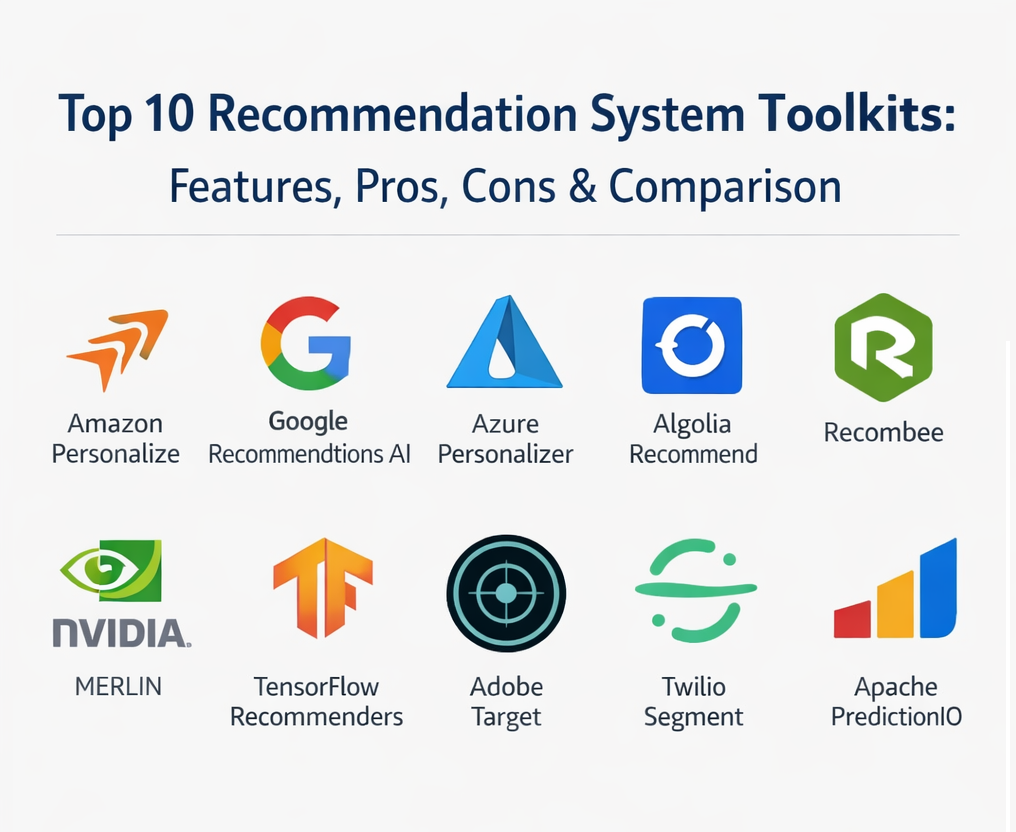
Recommendation System Toolkits are sophisticated frameworks and sets of APIs that enable businesses to deliver personalized content, product suggestions, and tailored experiences to their users. These systems analyze vast amounts of behavioral data to predict what a user might want to see next, effectively reducing digital noise and streamlining the path to conversion. In the modern landscape, where digital fatigue is high, these toolkits serve as the engine for engagement by transforming a generic interface into a curated storefront or feed.
The primary goal of these systems is to solve the paradox of choice. By filtering a massive catalog of items—whether they are movies, retail products, or news articles—the system presents only the most relevant options. This technology is foundational for platforms looking to increase retention and lifetime value through automated, data-driven decision-making.
Real-world applications are diverse and impactful:
- E-commerce platforms use them to show related products and frequently bought items.
- Streaming services rely on them to populate discovery feeds based on viewing history.
- News outlets leverage them to suggest articles that align with a reader’s specific interests.
- SaaS products use them to recommend features or templates to new users.
When evaluating these toolkits, decision-makers should consider factors such as latency, scalability, the ability to handle new users with no prior history, and the ease of integrating with existing data pipelines.
Best for: Medium to large enterprises, high-traffic retail sites, and content-heavy media platforms that require automated personalization at scale.
Not ideal for: Very small businesses with a limited number of items or static websites where user behavior does not vary significantly.
Key Trends in Recommendation System Toolkits
- The rise of hybrid models that combine collaborative filtering with content-based logic to improve accuracy.
- Deep learning integration for processing unstructured data like images and video to find visual similarities.
- Focus on privacy-preserving techniques that allow for personalization without exposing sensitive user identifiers.
- Shift toward real-time inference, where suggestions update instantly based on the current session’s activity.
- Increased use of vector databases to handle high-dimensional data for faster similarity searches.
- Automation of feature engineering, reducing the manual work required by data scientists to prepare training sets.
- Deployment of lightweight models at the edge to reduce server load and improve mobile responsiveness.
- Enhanced explainability features that allow developers to see why a specific recommendation was generated.
How We Selected These Tools
The selection of these ten tools is based on a structured evaluation of the current market and technical landscape. The methodology prioritized:
- Market presence and proven performance in high-volume production environments.
- The breadth of algorithmic support, ranging from simple associations to complex neural networks.
- The quality of the developer experience, including the robustness of APIs and SDKs.
- The ability to scale vertically and horizontally to meet the demands of global user bases.
- Security standards and the presence of enterprise-grade access controls.
- Integration capabilities with major cloud providers and data management platforms.
- Community feedback and the reliability of technical documentation.
1.Amazon Personalize
Amazon Personalize is a managed service that brings high-level machine learning capabilities to developers without requiring deep data science expertise. It utilizes pre-built recipes based on years of experience in global retail to deliver highly relevant suggestions.
Key Features
- Pre-configured recipes for common scenarios like user personalization and personalized ranking.
- Intelligent user segmentation based on behavioral patterns.
- Real-time recommendation updates that react to clicks and views instantly.
- Batch processing for email campaigns and offline marketing.
- Metadata integration to include product attributes in the decision-making process.
Pros
- Highly scalable infrastructure backed by the global AWS network.
- Minimal manual maintenance required for model training and deployment.
Cons
- Significant integration costs if the existing stack is not on AWS.
- Complex pricing structures based on data ingestion and throughput.
Platforms / Deployment
- Web / Cloud
Security & Compliance
- Support for encryption at rest, identity and access management, and multi-factor authentication. SOC 2 and ISO compliance are standard features.
Integrations & Ecosystem
This toolkit is deeply embedded in the AWS ecosystem. It works fluidly with storage, computing, and streaming services to create automated data loops.
- Amazon S3
- AWS Lambda
- Amazon Kinesis
- AWS Glue
Support & Community
Extensive documentation and enterprise-tier support are available. The community of certified cloud practitioners provides a wealth of shared knowledge and troubleshooting resources.
2.Google Recommendations AI
This platform leverages the research and infrastructure behind major global search and video engines. It focuses on providing a highly intuitive interface for marketers and developers to deploy transformer-based models that understand user intent.
Key Features
- Optimized models for retail-specific goals such as “Others also viewed” or “Recommended for you.”
- Omnichannel support to keep the user experience consistent across mobile and desktop.
- Automatic model retraining to account for seasonal changes and trends.
- Built-in A/B testing tools to measure the actual business impact of suggestions.
- Handling of negative feedback to avoid recommending items a user has explicitly ignored.
Pros
- Access to industry-leading AI research through a simple cloud console.
- Excellent visualization tools for monitoring model performance and data health.
Cons
- Requires a substantial amount of high-quality data to reach peak accuracy.
- Technical setup can be challenging for teams unfamiliar with big data environments.
Platforms / Deployment
- Web / Cloud
Security & Compliance
- Includes VPC service controls, data encryption, and comprehensive audit logs. Compliant with major global privacy standards.
Integrations & Ecosystem
Optimized for the Google marketing and data stack, allowing for seamless data flow from warehouses to user interfaces.
- Google BigQuery
- Google Analytics
- Vertex AI
- Cloud Pub/Sub
Support & Community
Technical assistance is provided through Google Cloud Support. There is a strong community presence with numerous case studies and whitepapers.
3.Azure Personalizer
Azure Personalizer uses reinforcement learning to help applications make the best choice regarding which content or product to show a user. It focuses on maximizing a specific reward signal, such as a click or a purchase.
Key Features
- Continuous learning that adapts in real-time to user feedback.
- Multi-slot personalization for tailoring different sections of a single page simultaneously.
- Apprentice mode that learns from current human-led decisions before taking over.
- Exploration capabilities that test new content to prevent recommendations from becoming stale.
- Lightweight API that integrates easily into existing web applications.
Pros
- Faster adaptation to changing user preferences compared to batch-trained systems.
- Low-code options that allow developers to implement AI with simple API calls.
Cons
- Defining the right “reward” function requires careful strategy to avoid unintended results.
- Primarily focused on “next best action” rather than large-scale catalog discovery.
Platforms / Deployment
- Web / Cloud
Security & Compliance
- Features include managed identities, directory-based access control, and robust encryption. Compliant with HIPAA and SOC standards.
Integrations & Ecosystem
Part of the broader cognitive services family, it connects easily with data streaming and analytics tools within the Azure cloud.
- Azure Synapse
- Azure Event Hubs
- Power BI
- Azure Functions
Support & Community
Backed by Microsoft’s enterprise support. The platform has a large following in the corporate sector with extensive documentation.
4.Algolia Recommend
Built on top of a world-renowned search engine, Algolia Recommend provides an API-first approach to personalization. It is designed for speed and ease of use, making it a favorite for e-commerce developers who need results fast.
Key Features
- Frequently bought together models to increase average order value.
- Related products based on item attributes and user behavior.
- High-speed global delivery network ensuring sub-millisecond response times.
- A user-friendly dashboard that allows non-technical users to set business rules.
- Simplified data ingestion via pre-built connectors.
Pros
- Extremely fast implementation with minimal development overhead.
- Predictable performance even during high-traffic peaks like holiday sales.
Cons
- Less control over the underlying machine learning math compared to pure AI frameworks.
- Pricing can grow quickly for companies with massive product catalogs.
Platforms / Deployment
- Web / iOS / Android / Cloud
Security & Compliance
- Provides API key security, role-based access control, and standard data encryption. SOC 2 Type II compliant.
Integrations & Ecosystem
Strong focus on the modern web stack and e-commerce platforms.
- Shopify
- Magento
- Commercetools
- React and Vue SDKs
Support & Community
Highly regarded for its clear documentation and active developer forums. Technical support is responsive and knowledgeable.
5.Recombee
Recombee is an independent SaaS engine that offers a massive variety of algorithms via a single API. It is particularly effective for media companies and businesses with diverse, rapidly changing content.
Key Features
- Hybrid engine that balances user history with item similarities.
- Visual search and image-based recommendations using deep learning.
- Real-time processing that incorporates the latest user action immediately.
- Advanced filtering logic to prioritize specific business goals like high-margin items.
- Dynamic content injection for email newsletters.
Pros
- High degree of flexibility in how algorithms are combined and weighted.
- Good value for mid-market companies that need enterprise features without the cloud overhead.
Cons
- The dashboard interface has a steeper learning curve for beginners.
- Documentation is detailed but can be technically dense.
Platforms / Deployment
- Web / iOS / Android / Cloud
Security & Compliance
- Uses API keys and secure transport protocols. GDPR compliance is a core focus.
Integrations & Ecosystem
Offers a wide range of SDKs for various programming languages and marketing platforms.
- Mailchimp
- WordPress
- Segment
- Google Tag Manager
Support & Community
Direct access to developers is available on higher-tier plans. The community is smaller but highly engaged in the media and e-commerce space.
6.NVIDIA Merlin
NVIDIA Merlin is an open-source framework designed to accelerate the entire recommendation system pipeline on GPUs. It is built for organizations that need to train and deploy massive models with maximum efficiency.
Key Features
- High-performance data preprocessing libraries that run entirely on GPUs.
- Specialized training frameworks for models with billions of parameters.
- Optimized inference server for low-latency production deployment.
- Support for large embedding tables that exceed CPU memory limits.
- End-to-end acceleration from data loading to model serving.
Pros
- Unrivaled processing speed for large-scale datasets.
- Reduces the physical server footprint by maximizing GPU utilization.
Cons
- Requires specialized knowledge of MLOps and GPU programming.
- Infrastructure costs can be high if GPU hardware is not already available.
Platforms / Deployment
- Linux / Cloud / Self-hosted
Security & Compliance
- Security is managed at the infrastructure level by the user. Supports standard enterprise security patterns.
Integrations & Ecosystem
Deeply integrated with the data science and containerization ecosystem.
- PyTorch
- TensorFlow
- Kubernetes
- Docker
Support & Community
Very active GitHub community and extensive technical blogs provided by NVIDIA engineers.
7.TensorFlow Recommenders
TensorFlow Recommenders is an open-source library that simplifies the process of building, evaluating, and serving sophisticated recommendation models using the TensorFlow ecosystem.
Key Features
- Modular components for building retrieval and ranking stages.
- Native support for multi-task learning to optimize for multiple goals.
- Integration with specialized layers for handling categorical and numerical data.
- Seamless deployment via TensorFlow Serving for production environments.
- Tools for evaluating model accuracy and bias.
Pros
- Total transparency and control over model architecture.
- No licensing fees, making it a cost-effective choice for custom development.
Cons
- Significant development effort is required to build and maintain the system.
- Responsibility for scaling and reliability rests entirely on the internal team.
Platforms / Deployment
- Windows / macOS / Linux / Cloud / Self-hosted
Security & Compliance
- Dependent on the implementation and hosting environment chosen by the user.
Integrations & Ecosystem
Works perfectly with the entire Python-based data science stack.
- Pandas
- NumPy
- Scikit-learn
- Keras
Support & Community
One of the largest AI communities in the world. Thousands of tutorials and a massive collection of shared models are available.
8.Adobe Target
Adobe Target is an enterprise experience platform that includes robust AI-driven recommendation capabilities. It is specifically designed for marketing teams who want to personalize the customer journey without deep coding.
Key Features
- Automated personalization that matches specific content to individual users.
- Visual editor for placing recommendation widgets on websites and apps.
- Unified customer profiles that pull data from the entire Adobe suite.
- Auto-allocate features that push traffic to the best-performing models.
- Category-specific templates for retail, media, and finance.
Pros
- Very accessible for marketers and product managers.
- Strong synergy with other Adobe marketing tools for a holistic view of the customer.
Cons
- High entry cost makes it inaccessible for smaller businesses.
- Can be slower to deploy compared to lightweight API-first tools.
Platforms / Deployment
- Web / iOS / Android / Cloud
Security & Compliance
- Enterprise-grade security with multiple certifications including SOC 2 and ISO 27001. Compliant with HIPAA and GDPR.
Integrations & Ecosystem
Tight integration with the Adobe Experience Cloud.
- Adobe Analytics
- Adobe Experience Manager
- Adobe Real-Time CDP
- Marketo
Support & Community
Premium support and dedicated account management. A global network of agencies provides specialized implementation services.
9.Twilio Segment
Segment is a customer data platform that provides a personalization module to create real-time recommendation logic. It focuses on using unified user data to drive relevant experiences across every channel.
Key Features
- Real-time identity resolution to track users across different devices.
- Computed traits that automatically categorize users based on their behavior.
- Real-time audience triggers that update recommendations as users act.
- Profile API for fetching user preferences instantly at the point of interaction.
- Data governance tools to ensure privacy and compliance across the board.
Pros
- Ensures that recommendations are based on clean, consistent data from all sources.
- Extremely easy to sync audiences and traits to other marketing tools.
Cons
- Not a dedicated deep-learning engine; best for logic-based personalization.
- High volume data processing can become very expensive.
Platforms / Deployment
- Web / iOS / Android / Cloud
Security & Compliance
- Features include data privacy portals and role-based access. SOC 2 Type II and GDPR compliant.
Integrations & Ecosystem
The industry leader in data connectivity.
- Snowflake
- Salesforce
- Braze
- Facebook Ads
Support & Community
Excellent technical documentation and training programs. There is a vast ecosystem of third-party developers and consultants.
10.Apache PredictionIO
Apache PredictionIO is an open-source machine learning server built on top of a powerful big data stack. it is designed for developers who want to build and deploy their own recommendation engines at scale.
Key Features
- Built on Apache Spark for high-speed, large-scale data processing.
- Template gallery with pre-built engines for common recommendation tasks.
- Real-time query server that handles high volumes of requests.
- Data management tools for organizing training and evaluation sets.
- Scalable architecture that supports both cloud and on-premise deployments.
Pros
- No recurring software costs or vendor lock-in.
- Highly customizable for unique business requirements.
Cons
- Requires significant expertise in managing big data technologies like Spark and HBase.
- Slower release cycle compared to commercial SaaS products.
Platforms / Deployment
- Linux / Self-hosted / Hybrid
Security & Compliance
- Security configurations are the responsibility of the user’s infrastructure team.
Integrations & Ecosystem
Fits naturally into the Hadoop and Spark big data ecosystems.
- Apache Spark
- Apache HBase
- Elasticsearch
- HDFS
Support & Community
Community-driven support via mailing lists and GitHub. Some third-party specialized consulting is available for enterprise users.
Comparison Table
| Tool Name | Best For | Platform(s) Supported | Deployment | Standout Feature | Public Rating |
| Amazon Personalize | AWS Enterprises | Web | Cloud | Pre-built Recipes | N/A |
| Google Recommendations AI | Retail & Media | Web | Cloud | Transformer Models | N/A |
| Azure Personalizer | Next Best Action | Web | Cloud | Reinforcement Learning | N/A |
| Algolia Recommend | E-commerce Speed | Web / Mobile | Cloud | Global Edge API | N/A |
| Recombee | Media Flexibility | Web / Mobile | Cloud | Visual Similarity AI | N/A |
| NVIDIA Merlin | Performance Scaling | Linux | Hybrid | GPU Acceleration | N/A |
| TensorFlow Recommenders | Custom AI Research | All | Self-hosted | Total Model Control | N/A |
| Adobe Target | Enterprise Marketers | Web / Mobile | Cloud | Marketing UI Integration | N/A |
| Twilio Segment | Unified Data | Web / Mobile | Cloud | Identity Resolution | N/A |
| Apache PredictionIO | Open Source Big Data | Linux | Hybrid | Spark-based Scaling | N/A |
Evaluation & Scoring of Recommendation System Toolkits
The following scores provide a comparative view of how each toolkit performs across critical business and technical dimensions.
| Tool Name | Core (25%) | Ease (15%) | Integrations (15%) | Security (10%) | Performance (10%) | Support (10%) | Value (15%) | Weighted Total |
| Amazon Personalize | 9 | 8 | 9 | 10 | 9 | 9 | 7 | 8.65 |
| Google Recommendations AI | 9 | 8 | 8 | 10 | 9 | 9 | 7 | 8.50 |
| Azure Personalizer | 8 | 9 | 8 | 10 | 8 | 9 | 8 | 8.35 |
| Algolia Recommend | 7 | 10 | 9 | 9 | 10 | 9 | 7 | 8.40 |
| Recombee | 9 | 8 | 8 | 7 | 9 | 8 | 9 | 8.35 |
| NVIDIA Merlin | 10 | 4 | 7 | 8 | 10 | 8 | 8 | 7.85 |
| TensorFlow Recommenders | 10 | 3 | 7 | 6 | 9 | 9 | 10 | 7.70 |
| Adobe Target | 8 | 8 | 8 | 10 | 7 | 9 | 5 | 7.85 |
| Twilio Segment | 6 | 9 | 10 | 10 | 8 | 9 | 6 | 8.05 |
| Apache PredictionIO | 7 | 4 | 7 | 6 | 8 | 6 | 9 | 6.65 |
These scores are based on comparative analysis. A higher score in ease of use indicates a lower technical barrier to entry, while a high score in core features reflects the sophistication of the underlying algorithms. Use these totals as a guide to match a tool to your team’s specific strengths and constraints.
Which Recommendation System Toolkits Is Right for You?
Solo / Freelancer
For independent operators, Recombee offers an excellent entry point with its flexible API and manageable learning curve. If you have deep technical skills and no budget, TensorFlow Recommenders allows for building custom solutions for free, provided you have your own hosting.
SMB
Small to medium businesses should prioritize speed and low maintenance. Algolia Recommend is often the best fit here because it can be integrated quickly into most e-commerce platforms and requires very little ongoing data science support to remain effective.
Mid-Market
Companies that have scaled beyond the basics but aren’t ready for custom-built neural networks should look at Amazon Personalize or Azure Personalizer. These offer enterprise-grade AI with the convenience of managed services, allowing your team to focus on the product rather than the infrastructure.
Enterprise
Large organizations with massive data volumes and strict security requirements are best served by Adobe Target or Google Recommendations AI. These tools provide the necessary compliance, sophisticated user management, and deep integration into broad enterprise ecosystems.
Budget vs Premium
If minimizing software costs is the priority, open-source options like Apache PredictionIO or TensorFlow Recommenders are the logical choice. However, if the cost of engineering time is higher than the subscription fee, a premium managed service like Adobe Target or Amazon Personalize will provide a better return on investment.
Feature Depth vs Ease of Use
Developers looking for total control over model architecture will prefer TensorFlow or NVIDIA Merlin. Marketers and product owners who need to launch campaigns without writing code will find Adobe Target or Algolia to be much more efficient.
Integrations & Scalability
Twilio Segment is the leader for companies that need to sync recommendations across dozens of different marketing channels. For pure technical scalability, the cloud-native toolkits from AWS and Google remain the benchmark for handling millions of concurrent users.
Security & Compliance Needs
Financial and healthcare organizations should prioritize toolkits from the major cloud providers (AWS, Google, Microsoft) or Adobe, as they maintain the most rigorous global certifications and offer the most detailed security controls.
Frequently Asked Questions (FAQs)
What is the common pricing model for these toolkits?
Most commercial tools use a combination of monthly subscription fees and usage-based charges. Usage is typically measured by the number of items in your database, the amount of data processed during training, and the total number of recommendation requests made each month.
How long does it typically take to deploy a new system?
Implementation time varies significantly. API-first tools like Algolia can be live in a week or two, whereas custom-built systems using frameworks like TensorFlow may take several months to develop, test, and move into a production environment.
Can these tools work without a dedicated data science team?
Several options like Adobe Target and Algolia are designed specifically for use by marketers and developers without requiring a data scientist. However, more complex tools like NVIDIA Merlin or Apache PredictionIO definitely require specialized machine learning expertise.
What happens if a new user visits my site for the first time?
This is known as the cold start problem. Most modern toolkits handle this by using metadata-based recommendations, showing popular items, or using real-time session behavior to make educated guesses until more data is collected.
Are these systems compatible with data privacy laws?
Yes, most top-tier providers offer tools to help you comply with GDPR and CCPA. This includes features for data anonymization, user consent management, and the ability to delete specific user profiles upon request.
Can I use these toolkits for mobile applications?
Absolutely. Most of these services provide RESTful APIs or dedicated SDKs for iOS and Android, allowing you to deliver personalized experiences across web, mobile, and even IoT devices through a single backend.
What is the difference between search and recommendations?
Search is a reactive process where the user provides a keyword. Recommendations are proactive, using historical and contextual data to predict what the user might want without them having to ask for it.
How do I know if the recommendations are actually working?
Success is typically measured through A/B testing. You compare a group of users seeing recommendations against a control group that does not. Key metrics include click-through rates, conversion rates, and total revenue per user.
What are the common mistakes when choosing a tool?
The most common mistake is choosing a tool that is too complex for the team’s technical ability. This leads to long implementation cycles and models that are never fully optimized. It is often better to start simple and scale up.
Is it possible to switch from one toolkit to another?
While possible, it can be difficult because each tool uses different data formats and model logic. Using a customer data platform like Segment can make this easier by keeping your source data organized and ready to be sent to a new destination.
Conclusion
Choosing the right Recommendation System Toolkit is a balance between technical capability, budget, and business objectives. In an era where users expect relevance at every turn, these tools are essential for cutting through the noise and delivering value. The most effective approach is to start with a clear understanding of your data quality and your team’s ability to maintain a machine learning system.
The ideal toolkit is one that doesn’t just provide an algorithm, but fits seamlessly into your existing workflow to drive measurable engagement. To move forward, identify your primary goal—whether it is increasing average order value or improving content discovery—and run a pilot project with one of the tools that best fits your technical profile.

Best Cardiac Hospitals Near You
Discover top heart hospitals, cardiology centers & cardiac care services by city.
Advanced Heart Care • Trusted Hospitals • Expert Teams
View Best Hospitals