Introduction
A Manufacturing Execution System (MES) is a comprehensive software solution that tracks and documents the transformation of raw materials into finished goods. In plain English, if an ERP (Enterprise Resource Planning) system handles the “office” side of a business (orders and finance), the MES handles the “factory floor” side. it provides real-time visibility into production, helping manufacturers bridge the gap between high-level planning and actual shop-floor execution.
In the context of, MES platforms have evolved into the “digital backbone” of the smart factory. Modern systems now leverage Artificial Intelligence to optimize schedules on the fly and use Industrial IoT (IIoT) to capture data from every sensor in the facility. As global supply chains face increasing volatility, a robust MES is essential for maintaining agility, ensuring product quality, and meeting the growing demands for sustainability and traceability.
Real-world use cases:
- Electronics Assembly: Tracking every individual component’s serial number through a high-speed SMT line to ensure 100% traceability.
- Food & Beverage: Managing complex recipe changes and monitoring shelf-life and allergen contamination across multiple production batches.
- Aerospace & Defense: Replacing paper-based “travelers” with digital work instructions to ensure technicians follow strict regulatory assembly procedures.
Buyers should evaluate:
- Deployment Model: (Cloud-native vs. On-premises vs. Hybrid).
- Ease of Integration: Compatibility with existing ERP (SAP, Oracle) and PLC/SCADA systems.
- Scalability: Ability to roll out the system across multiple global sites.
- Real-time Analytics: Strength of the OEE (Overall Equipment Effectiveness) dashboards.
- User Interface: Mobile accessibility for operators on the plant floor.
- Compliance Support: Built-in features for ISO, FDA, or GDPR requirements.
- Customization: Low-code capabilities for tailoring workflows without heavy programming.
- Total Cost of Ownership: Including licensing, implementation, and long-term maintenance.
- Best for: Production managers, IT directors, and operations leads in complex discrete or process manufacturing environments who need to eliminate paper and optimize efficiency.
- Not ideal for: Very small “mom-and-pop” workshops with simple processes, or companies that only require basic inventory tracking without real-time production monitoring.
Key Trends in Manufacturing Execution Systems (MES) and Beyond
- AI-Driven Autonomous Scheduling: Modern MES tools now use machine learning to automatically reschedule production runs when a machine breaks down or a raw material shipment is delayed.
- Low-Code/No-Code Customization: To reduce reliance on expensive consultants, 2026 MES platforms offer drag-and-drop workflow builders for plant managers to tweak processes.
- SaaS and Multi-Tenant Cloud: A massive shift toward cloud-native MES has occurred, allowing for faster deployments and lower upfront hardware costs for mid-market manufacturers.
- Digital Twins and Threads: The MES now creates a “digital thread” that follows a product from design through manufacturing, capturing every test result and assembly step.
- Edge Computing Integration: To handle the massive data from 5G-enabled sensors, MES platforms use edge gateways to process data locally before sending summaries to the cloud.
- ESG and Sustainability Tracking: Built-in modules now calculate the carbon footprint of every manufactured unit by monitoring energy and water consumption in real-time.
- Augmented Reality (AR) Integration: Direct integration with AR glasses to provide hands-free work instructions and remote assistance to shop-floor operators.
How We Selected These Tools
The “Top 10” MES platforms were chosen based on the following evaluation logic:
- Market Share & Mindshare: Selection of industry leaders recognized by major analyst firms and global manufacturers.
- Industry Breadth: A mix of tools catering to both “Discrete” (cars, planes) and “Process” (chemicals, food) manufacturing.
- IIoT Connectivity: Prioritizing systems that can natively ingest data from modern sensors and legacy PLCs.
- Cloud Readiness: Favoring platforms that offer modern, web-native architectures over legacy “thick-client” systems.
- Standardization Potential: Tools that allow large enterprises to standardize processes across multiple global locations.
- Reliability: Proven track records in high-uptime, mission-critical production environments.
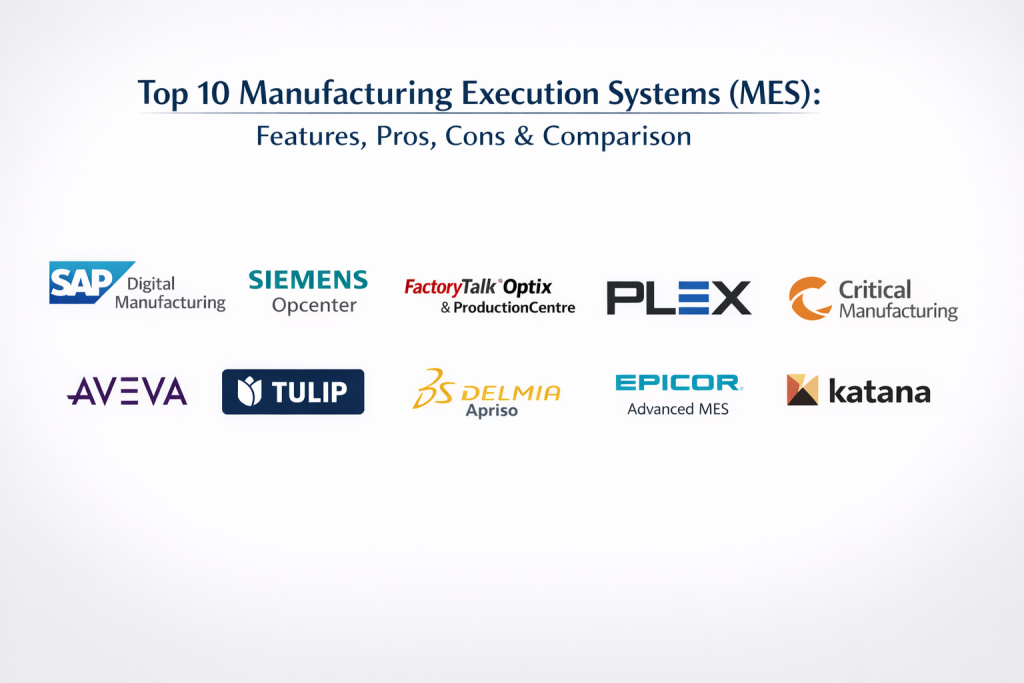
Top 10 Manufacturing Execution Systems (MES)
1 — SAP Digital Manufacturing
A cloud-native MES designed to provide high-level visibility and execution control, integrating seamlessly with the SAP S/4HANA ecosystem.
Key Features
- Resource Orchestration: Advanced scheduling and labor management tools.
- Digital Twin Support: Visualizing production assets in real-time via 3D models.
- Native S/4HANA Integration: Direct, real-time sync with enterprise orders and finance.
- Production Operator Dashboard (POD): A highly customizable web-based interface for shop-floor workers.
- AI-Enhanced Insights: Predictive analytics for equipment maintenance and quality trends.
Pros
- The best choice for enterprises already running SAP ERP, offering a “single source of truth.”
- Excellent global scalability and localized compliance support.
Cons
- Implementation can be complex and requires specialized SAP consultants.
- Higher cost of ownership compared to standalone mid-market MES solutions.
Platforms / Deployment
- Web / iOS / Android
- Cloud / Hybrid
Security & Compliance
- SOC 2, ISO 27001, and GDPR compliant; supports MFA and SAP Cloud Identity RBAC.
Integrations & Ecosystem
Deeply embedded in the SAP Business Technology Platform.
- Seamless SAP ERP and PLM integration.
- OPC UA and MQTT for shop-floor connectivity.
- Broad partner network for specialized industry add-ons.
Support & Community
Massive enterprise support infrastructure. Extensive documentation via SAP Help Portal and a huge global user group (ASUG).
2 — Siemens Opcenter
A comprehensive, modular MES portfolio that covers everything from R&D to production and quality management.
Key Features
- Advanced Planning and Scheduling (APS): Industry-leading tools for optimizing complex production sequences.
- Quality Management (QMS): Integrated statistical process control (SPC) and non-conformance tracking.
- Manufacturing Intelligence: Deep data-mining capabilities to find hidden inefficiencies.
- Paperless Manufacturing: Full electronic batch records (EBR) and device history records (DHR).
- Modular Architecture: Choose specific modules like Opcenter Execution Discrete or Process.
Pros
- Unrivaled integration with the Siemens Xcelerator portfolio (PLM, CAD, Automation).
- Strongest performance in high-complexity discrete industries like Aerospace and Automotive.
Cons
- The interface can be overwhelming for simpler manufacturing operations.
- Significant training is required to master the full suite of modules.
Platforms / Deployment
- Web / Windows
- Cloud / Self-hosted / Hybrid
Security & Compliance
- Compliant with IEC 62443 standards; supports audit trails for FDA 21 CFR Part 11.
Integrations & Ecosystem
A core pillar of the Siemens Digital Industries software suite.
- Native TIA Portal and PLC integration.
- Mendix low-code platform for custom app development.
Support & Community
Global technical support with a vast network of certified solution partners and extensive “Siemens Learning” paths.
3 — Rockwell Automation FactoryTalk Optix & Production Centre
A scalable, multi-site MES that focuses on highly automated environments, particularly in North American manufacturing.
Key Features
- FactoryTalk InnovationSuite: Combines MES with AR and IoT via PTC integration.
- Quality Management: Real-time SPC and automated data collection from sensors.
- Genealogy & Track/Trace: Detailed parent-child relationship tracking for components.
- Web-native Visualization: Modern dashboards accessible from any device via FactoryTalk Optix.
- Warehouse Integration: Syncs shop-floor production with raw material and finished goods movement.
Pros
- Premier choice for facilities using Allen-Bradley hardware.
- Excellent reliability for high-speed discrete manufacturing.
Cons
- Can feel “heavy” for companies that do not use the full Rockwell software ecosystem.
- Total cost is high when adding specialized modules for analytics and AR.
Platforms / Deployment
- Web / Windows
- Cloud / Self-hosted
Security & Compliance
- Supports FactoryTalk Security for centralized user management; compliant with major industrial standards.
Integrations & Ecosystem
Central to the Rockwell “Connected Enterprise” vision.
- Native EtherNet/IP and Studio 5000 integration.
- Strong partnership with PTC (ThingWorx and Vuforia).
Support & Community
Strongest support network in North America; “TechConnect” contracts provide high-level engineering assistance.
4 — Plex Smart Manufacturing Platform
A pioneer in cloud-native MES, Plex provides a unified platform for manufacturing, quality, and supply chain management.
Key Features
- Multi-tenant SaaS: Always on the latest version with no manual upgrades needed.
- Integrated ERP/MES: One database for everything from the plant floor to the balance sheet.
- Mobile-First Design: Operators can manage production entirely from tablets and scanners.
- Control Panel: Real-time visualization of machine health and production status.
- Compliance Automation: Automated tracking for ISO 9001, IATF 16949, and SQF.
Pros
- Faster implementation times compared to traditional on-premises MES.
- Eliminates the “IT headache” of maintaining local servers and databases.
Cons
- Requires a constant, high-speed internet connection (less ideal for remote regions).
- Limited customization compared to “build-your-own” modular systems.
Platforms / Deployment
- Web / iOS / Android
- Cloud (SaaS)
Security & Compliance
- SOC 2 Type II certified; data encryption at rest and in transit.
Integrations & Ecosystem
Now part of Rockwell Automation, expanding its integration capabilities.
- Native PLC connectors.
- API-driven integration for third-party shipping and finance tools.
Support & Community
Active user community (“Plex Community”) and a dedicated “Plex Education” portal for training.
5 — Critical Manufacturing MES
A modern, highly flexible MES designed specifically for high-tech industries like semiconductors, medical devices, and electronics.
Key Features
- State-of-the-Art UI: Based on HTML5/Angular for a modern, responsive user experience.
- Equipment Integration: Deep “Connect IoT” layer for high-speed machine communication.
- 3D Digital Twin: Integrated 3D factory floor visualization.
- Dynamic Scheduling: Visual drag-and-drop production planning.
- Advanced Experiments: Support for R&D within the production environment (Design of Experiments).
Pros
- The most modern and visually appealing interface in the MES category.
- Exceptional handling of complex, multi-level BOMs (Bills of Materials).
Cons
- Niche focus may make it less suitable for simple heavy industries (e.g., metal forging).
- Implementation partners are fewer in number than SAP or Siemens.
Platforms / Deployment
- Web
- Cloud / Self-hosted / Hybrid
Security & Compliance
- Strong RBAC and audit trail features; built for highly regulated high-tech sectors.
Integrations & Ecosystem
Part of the ASMPT group.
- Strong SMT and semiconductor equipment connectivity.
- REST APIs for enterprise integration.
Support & Community
Highly specialized support for high-tech clients; detailed documentation and training via “Critical University.”
6 — AVEVA Manufacturing Execution System
A model-driven MES that focuses on standardization and operational excellence across the “process” and “hybrid” industries.
Key Features
- Model-Driven Content: Reusable business logic templates for global standardization.
- Edge-to-Enterprise: Integrated with AVEVA PI System for massive data ingestion.
- Inventory & Quality: Real-time tracking of raw material consumption and quality specs.
- Workflow Management: Digitalized SOPs (Standard Operating Procedures) for operators.
- OEE Monitoring: High-performance dashboards for downtime analysis.
Pros
- The best choice for “Process” industries (Food, Beverage, CPG) with many sites.
- Deep integration with the AVEVA System Platform (SCADA).
Cons
- Can be technical to configure; often requires AVEVA-certified integrators.
- Licensing models can be complex.
Platforms / Deployment
- Web / Windows
- Cloud / Self-hosted / Hybrid
Security & Compliance
- Not publicly stated (supports standard encryption and RBAC).
Integrations & Ecosystem
Integrates with the full AVEVA and Schneider Electric industrial portfolios.
- Native PI System connectivity.
- OPC UA, MQTT, and 300+ industrial drivers.
Support & Community
Vast partner ecosystem; professional support via “Customer FIRST” programs.
7 — Tulip Interfaces
A “frontline operations platform” that uses a no-code approach to build custom MES-like apps for the shop floor.
Key Features
- No-Code App Builder: Operators and engineers can build their own interfaces.
- Edge Connectivity: Easy connection to sensors, cameras, and calipers via Tulip Edge devices.
- Computer Vision: Native AI features for visual inspection and “pick-to-light.”
- Human-Centric: Focuses on helping the worker rather than just tracking the machine.
- Real-time Analytics: Instant dashboards created as users interact with the apps.
Pros
- Extremely fast time-to-value; apps can be built and deployed in days.
- Highly flexible; can be used as a full MES or to “fill the gaps” in a legacy system.
Cons
- Lacks some of the “heavy” scheduling and enterprise resource planning of traditional MES.
- Subscription costs can grow quickly as you add more users and devices.
Platforms / Deployment
- Web / iOS / Android / Windows
- Cloud (SaaS)
Security & Compliance
- SOC 2 Type II, GDPR, and GxP compliant (supports 21 CFR Part 11).
Integrations & Ecosystem
Modern, API-first architecture.
- Connectors for SAP, NetSuite, and Microsoft Dynamics.
- Native Node-RED and MQTT support.
Support & Community
Thriving “Tulip Community” forum and an extensive library of pre-built app templates in the Tulip Library.
8 — Dassault Systèmes DELMIA Apriso
A global enterprise MES that focuses on operational agility and business process lifecycle management across large manufacturing networks.
Key Features
- Global Process Manager: Centralized control for deploying process changes globally.
- Just-in-Sequence (JIS): Specialized tools for automotive and complex assembly.
- Integrated Quality: Continuous improvement tools and root-cause analysis.
- Maintenance Management: Integrated tool for managing shop-floor asset uptime.
- Warehouse Management: Tightly coupled production and logistics execution.
Pros
- Unequaled for global manufacturers needing strict process standardization.
- Deeply integrated with the 3DEXPERIENCE platform for a “design-to-manufacture” loop.
Cons
- Very high technical barrier to entry; requires a dedicated internal team.
- One of the most expensive solutions on the market.
Platforms / Deployment
- Web / Windows
- Cloud / Self-hosted / Hybrid
Security & Compliance
- High-level enterprise security; ISO 27001 and industry-specific certifications.
Integrations & Ecosystem
A core part of the 3DEXPERIENCE platform.
- Deep PLM and CAD integration.
- Broad ERP connectivity suite.
Support & Community
World-class enterprise support and a large network of global strategic partners (consultancies).
9 — Epicor Advanced MES (Mattec)
A focused, easy-to-use MES known for its strength in “Rubber and Plastics” and high-speed discrete manufacturing.
Key Features
- Real-time Production Monitoring: Direct machine connection for accurate OEE data.
- Statistical Process Control (SPC): Automated quality alerts and trend tracking.
- Maintenance Management: Preventive and predictive maintenance scheduling.
- Visual Scheduling: Simple drag-and-drop tool for managing machine load.
- Energy Monitoring: Tracks energy consumption per part or machine.
Pros
- Much simpler to implement and maintain than “Big Enterprise” systems.
- Specifically optimized for the challenges of plastic injection molding and extrusion.
Cons
- Lacks the “Digital Twin” and AI features of top-tier 2026 competitors.
- The user interface is functional but feels slightly dated.
Platforms / Deployment
- Windows / Web
- Cloud / Self-hosted
Security & Compliance
- Not publicly stated (supports standard RBAC).
Integrations & Ecosystem
Designed to work with Epicor ERP but supports other systems via middleware.
- OPC UA and PLC drivers included.
- REST API for third-party connections.
Support & Community
Solid support for mid-market clients; active user groups in North America and Europe.
10 — Katana Cloud Manufacturing
A modern, SMB-focused MES and ERP platform that prioritizes ease of use and visual inventory management for growing makers.
Key Features
- Live Inventory Management: Real-time tracking of raw materials and finished goods.
- Visual Production Planning: Easy-to-understand “drag-and-drop” priority list.
- Contract Manufacturing Support: Track production happening at external partners.
- Shop Floor App: Simple tablet interface for workers to mark tasks as done.
- E-commerce Integration: Direct sync with Shopify, WooCommerce, and BigCommerce.
Pros
- The easiest MES to set up; “plug-and-play” for small manufacturing businesses.
- Very affordable pricing for companies graduating from spreadsheets.
Cons
- Lacks the deep machine integration (PLC/SCADA) of industrial-grade systems.
- Not suitable for complex, highly regulated industries like Aerospace.
Platforms / Deployment
- Web / iOS / Android
- Cloud (SaaS)
Security & Compliance
- GDPR compliant; data encrypted via AWS.
Integrations & Ecosystem
Focused on the “modern tech stack” for small business.
- Shopify, QuickBooks, Xero.
- Make (formerly Integromat) and Zapier for custom automations.
Support & Community
Excellent customer service and a helpful blog/academy for small manufacturers.
Comparison Table (Top 10)
| Tool Name | Best For | Platform(s) Supported | Deployment | Standout Feature | Public Rating |
| SAP Digital Mfg | SAP ERP Users | Web, iOS, Android | Cloud | S/4HANA Native Sync | N/A |
| Siemens Opcenter | Complex Discrete | Web, Windows | Hybrid | Integrated APS | N/A |
| Rockwell FT | AB Hardware Users | Web, Windows | Self-hosted | FactoryTalk Optix UI | N/A |
| Plex | Cloud-first SMB/Mid | Web, iOS, Android | Cloud (SaaS) | All-in-one ERP/MES | N/A |
| Critical Mfg | High-Tech/Semicon | Web | Hybrid | 3D Digital Twin | N/A |
| AVEVA MES | Process Industries | Web, Windows | Hybrid | Model-driven Templates | N/A |
| Tulip | No-code / Lean Mfg | Web, Mobile, Win | Cloud (SaaS) | App-based Builder | N/A |
| DELMIA Apriso | Global Enterprises | Web, Windows | Hybrid | Global Process Mgr | N/A |
| Epicor Adv. MES | Plastics / Rubber | Web, Windows | Hybrid | Energy Monitoring | N/A |
| Katana | SMB / E-commerce | Web, Mobile | Cloud (SaaS) | Visual Inventory | N/A |
Evaluation & Scoring of Manufacturing Execution Systems (MES)
| Tool Name | Core (25%) | Ease (15%) | Integrations (15%) | Security (10%) | Performance (10%) | Support (10%) | Value (15%) | Weighted Total |
| SAP Digital Mfg | 10 | 6 | 10 | 10 | 9 | 10 | 6 | 8.60 |
| Siemens Opcenter | 10 | 6 | 9 | 9 | 10 | 9 | 7 | 8.50 |
| Rockwell FT | 9 | 7 | 9 | 9 | 10 | 9 | 7 | 8.40 |
| Plex | 8 | 9 | 8 | 9 | 8 | 8 | 9 | 8.35 |
| Critical Mfg | 9 | 8 | 8 | 9 | 9 | 8 | 8 | 8.50 |
| AVEVA MES | 9 | 7 | 9 | 9 | 9 | 8 | 8 | 8.40 |
| Tulip | 7 | 10 | 9 | 9 | 8 | 9 | 9 | 8.40 |
| DELMIA Apriso | 10 | 5 | 9 | 10 | 10 | 9 | 5 | 8.15 |
| Epicor Adv. MES | 8 | 8 | 7 | 8 | 9 | 8 | 8 | 7.95 |
| Katana | 6 | 10 | 8 | 8 | 7 | 9 | 10 | 8.05 |
Scoring Interpretation:
- Core (25%): Depth of scheduling, traceability, and OEE features.
- Ease (15%): Simplicity for the operator and time-to-value for the business.
- Value (15%): Capability delivered relative to implementation and licensing costs.
- Weighted Total: Comparative ranking for 2026 industrial requirements.
Which Manufacturing Execution Systems (MES) Is Right for You?
Solo / Freelancer
While “solo” manufacturers are rare, boutique makers or contract consultants should look at Katana. It provides the inventory and production control needed to scale without the $100k+ entry price of industrial systems.
SMB
For small-to-mid-sized manufacturers, Plex or Tulip are excellent choices. Plex offers an all-in-one “office to floor” solution, while Tulip allows a small team to build exactly the digital tools they need without hiring a developer.
Mid-Market
Companies with 1–3 large plants should evaluate Critical Manufacturing or Epicor Advanced MES. Critical Manufacturing offers the most future-proof UI, while Epicor provides a solid, tried-and-true platform for specific industries like plastics.
Enterprise
Global organizations with multi-country footprints should stick with the “Big Four”: SAP, Siemens, Dassault (DELMIA), or Rockwell. These systems have the global support and “Master Process” capabilities required to manage dozens of sites.
Budget vs Premium
- Budget: Katana and Tulip (Lower entry costs, flexible).
- Premium: DELMIA Apriso and SAP Digital Manufacturing (High cost, but unmatched enterprise power).
Feature Depth vs Ease of Use
- Feature Depth: Siemens Opcenter (Advanced scheduling and PLM integration).
- Ease of Use: Tulip (No-code simplicity).
Integrations & Scalability
For sheer connectivity to industrial hardware (PLCs/SCADA), Rockwell and Siemens are the leaders. For global software standardization across 50 factories, DELMIA Apriso is the industry standard.
Frequently Asked Questions (FAQs)
What is the main difference between ERP and MES?
ERP manages the business (orders, finance, HR), while MES manages the shop floor (machine downtime, operator instructions, component traceability). ERP tells the factory what to make; MES tells them how to make it and records how it was made.
Can an MES help with FDA or ISO compliance?
Yes. Modern MES platforms like Siemens and Critical Manufacturing provide automated Electronic Batch Records (EBR) and 21 CFR Part 11 compliance, making audits significantly faster and less risky.
How much does an MES cost to implement?
Small SaaS systems like Katana start at a few hundred dollars a month. Enterprise implementations (SAP/Siemens) typically start at $250k and can reach several million dollars for global rollouts.
Is cloud-based MES safe for production?
In, most MES vendors use “Edge-Cloud” hybrids. Critical control happens locally at the edge (so production doesn’t stop if the internet fails), while data analytics and management happen in the secure cloud.
What is “OEE” and why does MES track it?
OEE stands for Overall Equipment Effectiveness (Availability x Performance x Quality). It is the primary metric an MES uses to tell you how efficiently your factory is actually running.
How long does a typical MES implementation take?
A no-code tool like Tulip can show value in days. A full enterprise MES rollout typically takes 6 to 18 months depending on the number of machine integrations required.
Can I build my own MES using Excel?
While many start this way, Excel lacks real-time machine connectivity, audit trails, and multi-user synchronization. As soon as you require “traceability” or “OEE,” moving to a dedicated MES is essential.
Does an MES require me to replace my old machines?
No. Most modern MES platforms use “Edge Gateways” or OPC UA converters to pull data from legacy PLCs and even older “dumb” machines using basic electrical sensors.
What is “Paperless Manufacturing”?
It is the process of replacing paper work orders, clipboards, and printed SOPs with digital tablets and integrated data collection, reducing errors and saving time on data entry.
What is a “Digital Twin” in the context of MES?
In an MES, a digital twin is a virtual representation of your production line that updates in real-time based on sensor data, allowing you to visualize bottlenecks and simulate changes before making them physically.
Conclusion
The Manufacturing Execution Systems (MES) market is no longer just about “counting parts.” It is about digital transformation. Whether you choose a high-end enterprise solution like SAP or Siemens, or a modern no-code platform like Tulip, the goal remains the same: complete visibility into your operations.
The “best” MES is the one that integrates most naturally with your existing hardware and your team’s digital maturity. We recommend shortlisting 2-3 tools based on your industry focus, running a small pilot on a single production line, and ensuring your shop-floor operators find the interface intuitive before committing to a global rollout.

Best Cardiac Hospitals Near You
Discover top heart hospitals, cardiology centers & cardiac care services by city.
Advanced Heart Care • Trusted Hospitals • Expert Teams
View Best Hospitals