Introduction
Business Intelligence for Finance refers to the specialized application of data analysis, visualization, and reporting tools to financial data sets. In plain English, these platforms take the raw numbers from accounting software, ERPs, and spreadsheets and transform them into interactive dashboards that tell the story of a company’s health. Unlike traditional static reports, these tools allow finance professionals to investigate specific transactions, forecast future cash flows, and identify cost-saving opportunities in real-time.
As the professional landscape evolves, the ability to pivot strategy based on live data has become a critical survival tool. Modern finance teams no longer spend weeks consolidating reports; instead, they use automated systems to maintain a continuous close and provide strategic advisory to the board. This shift replaces stagnant spreadsheets with dynamic dashboards that ensure every financial decision is backed by current data.
Real-world use cases include:
- Predictive Cash Flow Management: Using historical trends to predict potential liquidity gaps before they occur.
- Dynamic Budgeting and Variance Analysis: Comparing actual spend against budgets across multiple departments and triggering alerts for overages.
- Profitability Analysis by Segment: Tracking margins across different product lines or regions to optimize the service mix.
- Automated Regulatory Compliance: Generating audit-ready financial statements that comply with local and international standards.
What buyers should evaluate:
- Data Connector Depth: Native connectivity to specific ERP systems.
- Artificial Intelligence Capabilities: Ability to generate forecasts or identify anomalies automatically.
- Governance and Security: Row-level security controls for sensitive payroll data.
- Self-Service Usability: Ease of use for non-technical finance staff.
- Performance with Large Datasets: Processing speed for millions of ledger entries.
- Collaborative Features: Ability to leave comments or tag colleagues within a report.
- Mobile Accessibility: Robust applications for checking KPIs on the go.
- Total Cost of Ownership: Implementation and maintenance costs.
Mandatory paragraph
- Best for: CFOs, financial planning managers, and data analysts in mid-market to enterprise-level companies who need to consolidate disparate financial data.
- Not ideal for: Micro-businesses with very simple bookkeeping needs where a standard accounting tool or a basic spreadsheet is sufficient.
Key Trends in Business Intelligence for Finance
- Agentic Intelligence for Financial Analysis: The shift toward agents that can autonomously perform variance analysis and explain budget deviations.
- Zero-Copy Data Architecture: Querying data directly in warehouses to eliminate the risks and delays of data replication.
- Natural Language Financial Modeling: Allowing finance teams to describe complex scenarios and receive instant generated models.
- Embedded ESG Reporting: Integrated modules for tracking Environmental, Social, and Governance metrics alongside financial KPIs.
- Continuous Accounting Integration: Deep connections with the closing process to provide real-time reconciliation.
- Hyper-Personalized Executive Cockpits: Dashboards that learn which metrics an executive prioritizes and surface them automatically.
- Verified Audit Trails: Use of distributed ledger technology within platforms to provide immutable proof of data lineage.
- Consumption-Based Pricing Maturity: A move toward pay-per-query models that align costs directly with usage.
How We Selected These Tools (Methodology)
Our selection process for the top 10 tools was based on a rigorous evaluation of the current professional software market:
- Market Adoption: Prioritizing tools with high user trust and industry-standard status.
- Finance-Specific Feature Completeness: Evaluation of built-in financial logic, such as currency conversion and fiscal year handling.
- Reliability and Performance: Assessing the ability to handle massive financial datasets without compromising speed.
- Security Posture: Selection based on enterprise-grade security features and global compliance standards.
- Integration Ecosystem: Searching for platforms with robust connectors for major ERP and accounting systems.
- Customer Fit: Reflecting a balance of tools suited for startups, mid-market growth companies, and global enterprises.
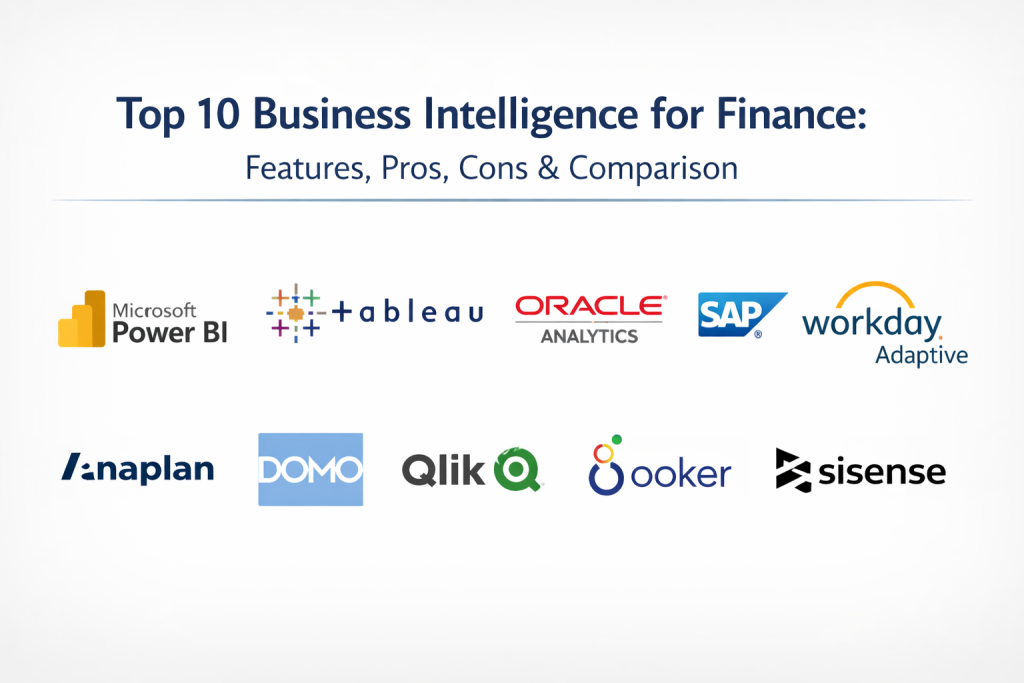
Top 10 Business Intelligence for Finance Tools
1.Microsoft Power BI
This platform leverages a familiar ecosystem and is a primary choice for finance teams who want to turn data into enterprise-grade interactive dashboards.
Key Features
- Natural language queries to create reports and summarize financial trends.
- High-performance connectivity for real-time analysis without data movement.
- Sophisticated formula language for calculating complex financial measures.
- Integration to trigger workflows directly from data changes.
- Capability to generate pixel-perfect financial statements for printing.
Pros
- Deep integration with common office productivity suites.
- Highly competitive pricing for organizations already using certain ecosystem licenses.
Cons
- The formula language has a steep learning curve for non-technical users.
- Limited authoring options for certain operating systems.
Platforms / Deployment
- Web / Windows / iOS / Android
- Cloud / Hybrid
Security & Compliance
- SSO, MFA, end-to-end encryption, row-level security.
- SOC 2, ISO 27001, GDPR, HIPAA.
Integrations & Ecosystem
The tool lives within an extensive ecosystem, pulling data from various work platforms.
- Major CRM and ERP platforms.
- Large-scale cloud data warehouses.
- Standard office spreadsheet applications.
Support & Community
Unparalleled community strength with millions of users and a vast network of certified partners.
2.Tableau
Considered a high standard for data visualization, this tool is ideal for analysts who need to explore complex datasets and create presentation-ready reports.
Key Features
- Intelligence-powered personalized insights delivered in plain language.
- Integration with broad platforms to provide predictive modeling.
- Superior mapping for analyzing global financial performance.
- Visual tools for cleaning and shaping messy financial data.
- Natural language processing for visual answers to data questions.
Pros
- Best-in-class visualization capabilities for complex scenarios.
- Strong self-service culture that empowers business users.
Cons
- Pricing can be high for large organizations with many viewers.
- Performance can lag on very large datasets if not properly optimized.
Platforms / Deployment
- Web / Windows / macOS / iOS / Android
- Cloud / Self-hosted / Hybrid
Security & Compliance
- SAML, OpenID, MFA, Row-level security.
- SOC 2, ISO 27001, GDPR, HIPAA.
Integrations & Ecosystem
Deeply integrated with major CRM platforms and various cloud data warehouses.
- Large cloud databases.
- Common enterprise data sources.
- Visual integration tools.
Support & Community
Highly passionate user community and robust enterprise support tiers.
3.Oracle Analytics Cloud
An enterprise-grade platform that is particularly effective for organizations needing complex financial consolidation and global reporting.
Key Features
- Automated finding of hidden patterns and outliers in financial data.
- Automatically generated textual summaries of financial charts.
- Seamless data flow with enterprise performance management tools.
- Built-in forecasting and clustering without needing to write code.
- Intelligent applications that push relevant financial KPIs before meetings.
Pros
- Superior handling of complex, multi-currency global financial structures.
- High performance when querying very large enterprise databases.
Cons
- The user interface can feel more traditional compared to newer tools.
- Implementation often requires specialized consulting.
Platforms / Deployment
- Web / iOS / Android
- Cloud / Hybrid
Security & Compliance
- Identity management, SSO, encryption, RBAC.
- SOC 2, ISO 27001, GDPR.
Integrations & Ecosystem
Designed to be the analytical layer for a specific suite of enterprise applications.
- Major ERP and HCM suites.
- Autonomous database systems.
- Cloud infrastructure services.
Support & Community
Strong enterprise support and a large global network of implementation partners.
4.SAP Analytics Cloud
An all-in-one platform that combines analysis and financial planning, serving as a definitive choice for large enterprises.
Key Features
- Ability to edit budgets and see the impact on dashboards in the same screen.
- Automated identification of key drivers behind financial KPIs.
- Queries data without moving it to the cloud for certain enterprise systems.
- Pre-built templates for P&L, Balance Sheet, and Cash Flow reporting.
- Visual maps showing how operational changes impact financial outcomes.
Pros
- Deepest possible integration for specific enterprise customers.
- Combines strategy, planning, and analysis into a single experience.
Cons
- Can be overkill for companies not already invested in the specific ecosystem.
- Certain data models can be complex to set up.
Platforms / Deployment
- Web / iOS / Android
- Cloud
Security & Compliance
- SAML, SSO, MFA.
- SOC 1/2/3, ISO 27001, GDPR.
Integrations & Ecosystem
Central to a strategy of an intelligent enterprise.
- Global procurement and human capital systems.
- Common cloud storage and productivity apps.
- SQL databases.
Support & Community
Excellent documentation and a massive global support infrastructure.
5.Workday Adaptive Planning
Focusing on planning and visualization, this leader is designed for finance-led organizations that prioritize forecasting.
Key Features
- Powerful engine allowing for unlimited dimensions in financial modeling.
- Drag-and-drop report builder designed specifically for finance users.
- Ease of creating and comparing multiple future versions and scenarios.
- Dynamic linking of data to common office documents for board reporting.
- Intelligence that flags unusual entries during the closing process.
Pros
- Very finance-friendly interface with low reliance on technical teams.
- Excellent for collaborative budgeting and forecasting across large teams.
Cons
- Visualizations are not as flexible as general-purpose analysis tools.
- Primarily focused on financial data rather than broad big data.
Platforms / Deployment
- Web / iOS / Android
- Cloud
Security & Compliance
- SAML, MFA, SOC 2, RBAC.
- ISO 27001, GDPR, HIPAA.
Integrations & Ecosystem
Built within an open ecosystem to ensure financial data flows smoothly.
- Major cloud ERP systems.
- Top-tier CRM platforms.
- Financial data sources.
Support & Community
Excellent customer success model and an active user community focused on best practices.
6.Anaplan
A high-end planning platform known for its unique architecture, designed for the most complex enterprise modeling challenges.
Key Features
- Intelligence agents that help users build and optimize models.
- Handling of massive complexity in organizational hierarchies.
- Real-time calculation where changes ripple through global models instantly.
- A library of pre-built applications for specific finance use cases.
- Enhanced encryption where the customer manages security keys.
Pros
- Extreme scalability for global firms with interconnected models.
- High degree of flexibility to build custom models for any industry.
Cons
- Requires a high level of specialized expertise to maintain.
- Implementation projects are typically long and investment-heavy.
Platforms / Deployment
- Web / iOS / Android
- Cloud
Security & Compliance
- SAML, OAuth, SSO, MFA, Audit logs.
- SOC 1/2, ISO 27001, HIPAA.
Integrations & Ecosystem
Built to act as an orchestration layer for enterprise data.
- Human capital and customer relationship platforms.
- Major data integration and middleware services.
- Cloud infrastructure providers.
Support & Community
Strong professional community and high-touch enterprise support.
7.Domo
A cloud-native platform that prioritizes speed to insight, excellent for teams needing to aggregate data from many cloud apps.
Key Features
- Over a thousand native connectors for various data sources.
- Drag-and-drop tools for non-technical users to transform data.
- Integrated generative intelligence to help build cards and queries.
- Flexible calculation engine for creating custom financial metrics.
- Built-in collaboration features tied directly to data points.
Pros
- Extremely fast deployment; dashboards can be running in hours.
- Mobile-first design widely considered to be highly effective.
Cons
- No option for on-premises or private local deployment.
- Costs can escalate quickly as data volume and user count grow.
Platforms / Deployment
- Web / iOS / Android
- Cloud
Security & Compliance
- SAML, MFA, SSO, encryption.
- SOC 2, ISO 27001, GDPR, HIPAA.
Integrations & Ecosystem
Unrivaled in its ability to connect to many cloud applications.
- Accounting and payment processing systems.
- Marketing and e-commerce platforms.
- Cloud analytics services.
Support & Community
Excellent onboarding support and a robust educational platform.
8.Qlik Sense
Powered by a unique engine that allows exploration in any direction, this is a favorite for deep forensic analysis.
Key Features
- Engine that shows unrelated data to highlight gaps and insights.
- Intelligence assistant that generates visualizations and warns of bias.
- No-code editor to trigger actions in other apps based on insights.
- Capability to move data from legacy systems to the cloud in real-time.
- Integrated learning for building predictive models without specialists.
Pros
- Superior at exploratory analysis where the exact question is unknown.
- Flexible deployment options across cloud and local environments.
Cons
- The associative logic requires a different mental model for analysts.
- Interface for dashboard creation is less intuitive than competitors.
Platforms / Deployment
- Web / Windows / iOS / Android
- Cloud / Self-hosted / Hybrid
Security & Compliance
- Encryption standards, SAML, OIDC, MFA.
- SOC 2, ISO 27001, GDPR.
Integrations & Ecosystem
Strong focus on data integration through specialized acquisitions.
- Major data warehouses and cloud databases.
- Cloud data platform giants.
- Legacy server systems.
Support & Community
Highly mature support system and an active global community of developers.
9.Looker
A modern, developer-centric platform that uses a centralized modeling language to ensure total data consistency.
Key Features
- Central code layer ensuring everyone defines metrics identically.
- Integration combining governance with ease of use.
- Version control allowing teams to track every change to a model.
- Standalone modeling layer that can feed other analysis tools.
- Intelligence-powered assistance for writing code and summaries.
Pros
- Highest level of data governance and a single version of truth.
- Web-native architecture makes embedding dashboards into portals easy.
Cons
- Requires knowledge of a proprietary language to set up.
- Not a simple drag-and-drop tool for initial configurations.
Platforms / Deployment
- Web
- Cloud
Security & Compliance
- Identity management, encryption keys, SSO.
- SOC 2, ISO 27001, GDPR, HIPAA.
Integrations & Ecosystem
The analytical heart of a major cloud data platform.
- Large-scale cloud warehouses.
- Common online spreadsheet tools.
- Leading database services.
Support & Community
Strong technical support and a growing community of data engineers.
10.Sisense
A leader in embedded analytics, perfect for teams wanting to build custom financial data products or portals for clients.
Key Features
- Developer toolkit to build custom data-driven applications.
- Proprietary engine optimizing cache for fast queries on large data.
- Intelligence assistant providing text-based explanations.
- High-performance analytical database joining disparate sources.
- Intelligence-driven filters that guide users through data paths.
Pros
- Unbeatable for embedding analysis into other software products.
- Efficiently handles complex data joins across multiple sources.
Cons
- Pricing model can be opaque and investment-heavy.
- Requires technical skill to fully leverage the developer features.
Platforms / Deployment
- Web / Windows / Linux / iOS / Android
- Cloud / Self-hosted / Hybrid
Security & Compliance
- SSO, MFA, RBAC, Encryption.
- SOC 2, ISO 27001, GDPR, HIPAA.
Integrations & Ecosystem
Strong APIs for developers and connectors for data warehouses.
- Industry-leading cloud warehouses.
- Customer support and CRM platforms.
- Major productivity suites.
Support & Community
Good documentation and responsive technical support for developers.
Comparison Table
| Tool Name | Best For | Platform(s) Supported | Deployment | Standout Feature | Public Rating |
| Microsoft Power BI | Ecosystem Users | Web, Win, Mobile | Cloud / Hybrid | Intelligence Assistant | N/A |
| Tableau | Visualization | Web, Win, Mac, Mobile | Cloud / Self / Hybrid | Intelligence Pulse | N/A |
| Oracle Analytics | Oracle Users | Web, Mobile | Cloud / Hybrid | Auto-Insights | N/A |
| SAP Analytics | SAP Users | Web, Mobile | Cloud | Unified Planning | N/A |
| Workday Adaptive | Planning Teams | Web, Mobile | Cloud | Hypercube Engine | N/A |
| Anaplan | Complex Modeling | Web, Mobile | Cloud | Modeling Agent | N/A |
| Domo | Rapid Aggregation | Web, Mobile | Cloud | Thousand+ Connectors | N/A |
| Qlik Sense | Forensic Analysis | Web, Win, Mobile | Cloud / Self / Hybrid | Associative Engine | N/A |
| Looker | Governance | Web | Cloud | Central Modeling | N/A |
| Sisense | Embedded Products | Web, Win, Linux, Mob | Cloud / Self / Hybrid | Developer Toolkit | N/A |
Evaluation & Scoring of Business Intelligence for Finance
The scoring reflects effectiveness within a modern financial department.
| Tool Name | Core (25%) | Ease (15%) | Integrations (15%) | Security (10%) | Performance (10%) | Support (10%) | Value (15%) | Weighted Total |
| Power BI | 9 | 8 | 10 | 10 | 9 | 10 | 10 | 9.25 |
| Tableau | 9 | 9 | 9 | 9 | 8 | 9 | 7 | 8.55 |
| Oracle Analytics | 10 | 6 | 9 | 10 | 10 | 8 | 7 | 8.40 |
| SAP Analytics | 10 | 7 | 10 | 10 | 9 | 9 | 7 | 8.70 |
| Workday Adaptive | 8 | 10 | 8 | 9 | 9 | 9 | 8 | 8.65 |
| Anaplan | 10 | 5 | 8 | 10 | 10 | 8 | 6 | 7.95 |
| Domo | 8 | 10 | 10 | 9 | 8 | 9 | 8 | 8.75 |
| Qlik Sense | 9 | 7 | 9 | 10 | 9 | 9 | 8 | 8.55 |
| Looker | 9 | 6 | 9 | 10 | 10 | 8 | 8 | 8.35 |
| Sisense | 8 | 7 | 8 | 9 | 9 | 8 | 8 | 7.95 |
Interpreting the scores:
- 9.0+: Elite tools offering a balance of power, security, and ecosystem value.
- 8.5 – 8.9: High performers, often the best choice within a specific parent platform.
- Below 8.5: Specialized tools for specific niches where lower ease of use is a trade-off for capability.
- Note: Scoring is comparative and based on typical finance department requirements.
Which Business Intelligence for Finance Tool Is Right for You?
Solo / Freelancer
For a solo consultant, a full enterprise suite is likely unnecessary. Focus on advanced features within common spreadsheet applications or free tiers of basic online analysis tools. If a dedicated tool is required, look for those with low barriers to entry for cloud data.
SMB
For small to medium businesses, the platform integrated with your primary office suite is often the champion due to pricing and familiarity. High-growth startups with many cloud applications may prefer tools prioritized for speed and rapid aggregation.
Mid-Market
Companies in the medium revenue range should look at planning-led tools if their strategy is finance-driven, or visualization-focused tools if they have a dedicated data team. Tools that bridge the gap between legacy servers and the cloud are also excellent choices.
Enterprise
At the enterprise level, the decision is often driven by the existing ecosystem. Organizations running major global ERPs should prioritize the analytical platforms offered by those same providers to ensure data integrity and seamless flow.
Budget vs Premium
Common office-linked tools and free studio versions represent the best budget value. More complex modeling platforms are premium choices requiring higher investment but delivering specialized power.
Feature Depth vs Ease of Use
Certain tools are designed for finance users to master quickly with zero coding. Others offer extreme depth but require technical specialists to manage the underlying logic and language.
Integrations & Scalability
Platforms within massive corporate ecosystems offer the best integrations. For pure scalability in query performance on massive datasets, look toward web-native tools built for the modern cloud era.
Security & Compliance Needs
Organizations with extreme security requirements should prioritize platforms with long histories of serving highly regulated sectors like government and defense.
Frequently Asked Questions (FAQs)
How is this different from a standard ERP?
An ERP is for recording transactions, while these tools are for analyzing them. While an ERP gives you a list of invoices, this software tells you which customer group is most likely to pay late.
Do I need to be a developer to use these?
No. Most modern platforms emphasize interfaces that do not require coding. However, some specialized tools require an administrator to set up the initial data models.
Can these tools help with the month-end close?
Yes. Modern platforms integrate directly with the close process, providing real-time reconciliation and reducing the manual effort of data consolidation.
Is artificial intelligence useful here?
Absolutely. It is used for anomaly detection to spot incorrect entries and for natural language forecasting, which are practical, time-saving features.
What is the biggest mistake when buying?
The most common mistake is selecting a tool without checking if it natively connects to your specific ERP. Manual data exports defeat the entire purpose of the system.
Are these secure enough for payroll data?
Yes, provided you use row-level security. This ensures that while a manager can see their budget, they cannot see the individual salaries in another department.
How long does implementation take?
A simple setup can take a few weeks. A global enterprise-wide rollout can take several months depending on the complexity of the financial hierarchies.
Can I switch tools easily?
Not easily. While your data stays in your database, the logic and dashboards are usually specific to the tool and would need to be rebuilt.
Is the common spreadsheet still relevant?
Yes. Most of these tools talk to spreadsheet applications. The spreadsheet remains best for ad-hoc math, while the platform is the system of record for reporting.
What are the alternatives?
Developers might look at open-source options or custom-built solutions. For very small teams, basic automation tools and spreadsheets can sometimes act as a minimal system.
Conclusion
The selection of a platform in this category is about which system best integrates with your existing data and provides the strongest governance over your financial truth. For most, the decision will come down to a choice between deep ecosystem value, visualization brilliance, or finance-first planning.
Shortlist two tools that match your specific organizational framework and run a pilot to validate the data integrations and user adoption.

Best Cardiac Hospitals Near You
Discover top heart hospitals, cardiology centers & cardiac care services by city.
Advanced Heart Care • Trusted Hospitals • Expert Teams
View Best Hospitals