Introduction
Retail merchandising tools are software platforms that help retail teams decide what to sell, how much to buy, where to place it, and how to price and promote it—while keeping inventory, margin targets, and store execution aligned. In and beyond, merchandising matters more because customer demand shifts faster, supply chains remain volatile, and omnichannel fulfillment makes inventory accuracy a direct driver of revenue (not just an operations metric). The best merchandising tools turn strategy into repeatable workflows: planning, space/planograms, pricing governance, allocation and replenishment alignment, and ongoing performance feedback.
Real-world use cases:
- Assortment planning by store cluster and channel (localized ranges, option counts)
- Space planning and planograms (shelf layouts, store layouts, range resets)
- Merchandise financial planning (sales/margin/inventory investment targets)
- Pricing and promotion governance (regular, clearance, events)
- In-season trading (react to signals, reduce overstocks and stockouts)
What buyers should evaluate:
- Assortment localization depth (store clustering, channel-specific assortments)
- Space planning capability (planograms, floor plans, automation, execution support)
- Inventory and data foundation (single inventory view, item/location master data quality)
- Pricing workflow controls (approval chains, event scheduling, audit trails)
- Planning-to-execution alignment (constraints, exception workflows, reconciliation)
- Integrations (POS, ERP, WMS, ecommerce, BI/data warehouse)
- Collaboration and governance (workflows, approvals, change tracking)
- Time-to-value (implementation complexity, admin overhead, training needs)
- Scalability (multi-brand, multi-country, multi-format, multi-channel)
- Total cost of ownership (licenses + services + integration + ongoing governance)
Mandatory paragraph
- Best for: merchandising leaders, category managers, planners, and retail ops teams in multi-store and multi-channel retail (specialty, grocery, fashion, convenience) that need structured planning and consistent store execution.
- Not ideal for: very small retailers with a limited catalog and simple replenishment needs; spreadsheets plus POS reporting can be sufficient until localization, space planning, or planning governance becomes a bottleneck.
Key Trends in Retail Merchandising Tools and Beyond
- AI-assisted localization is becoming mainstream: tools increasingly support demand-driven store clustering and scalable localization without planning store-by-store.
- Planogram automation is accelerating: automated planogram generation and store-specific planograms help reduce manual effort and speed up range resets.
- “Plan-to-shelf” unification is the goal: retailers want assortments that respect financial targets and store space constraints, so plans remain executable.
- Single source of truth planning is a priority: platforms emphasize reconciliation of changes back into merchandise and financial plans to reduce spreadsheet drift and version conflicts.
- Exception-based workflows replace manual review: more tools focus on flagging what needs action (outliers, underperformers, rule violations) instead of showing everything.
- Competitive context is moving closer to the merchant: retail intelligence platforms are increasingly used to inform pricing, assortment, and site merchandising with market benchmarks.
- Omnichannel inventory dependency is rising: merchandising decisions increasingly hinge on accurate inventory views to support fulfillment and reduce lost sales.
- Modular stacks beat monoliths in many orgs: a core merchandising system is often paired with best-of-breed space planning and intelligence tools.
- Integration-first rollouts are non-negotiable: APIs, data pipelines, and well-defined data models matter as much as UI.
- Governance pressure is growing: pricing changes, range resets, and supplier decisions increasingly require approvals, audit trails, and controlled change.
How We Selected These Tools (Methodology)
- Prioritized tools with strong market adoption and frequent presence in retail enterprise shortlists.
- Chose a balanced mix across merchandising sub-domains: core merchandising execution, planning, space/planograms, and retail intelligence.
- Favored tools with clearly merchandising-relevant capabilities (assortment, space, pricing, sales audit, inventory foundation).
- Considered scalability signals such as multi-store localization, automation, and the ability to standardize processes across teams.
- Looked for reliability/performance signals through “enterprise-grade” positioning and common deployment patterns (without guessing SLAs).
- Used security posture signals only when clearly known; otherwise marked “Not publicly stated.”
- Considered ecosystem fit: integration patterns with POS/ERP/WMS/ecommerce/BI and support for data exports.
- Considered segment fit across SMB, mid-market, and enterprise (including specialized vs suite-oriented tools).
- Avoided guessing pricing, certifications, and ratings; used “Not publicly stated” or “Varies / N/A” when unclear.
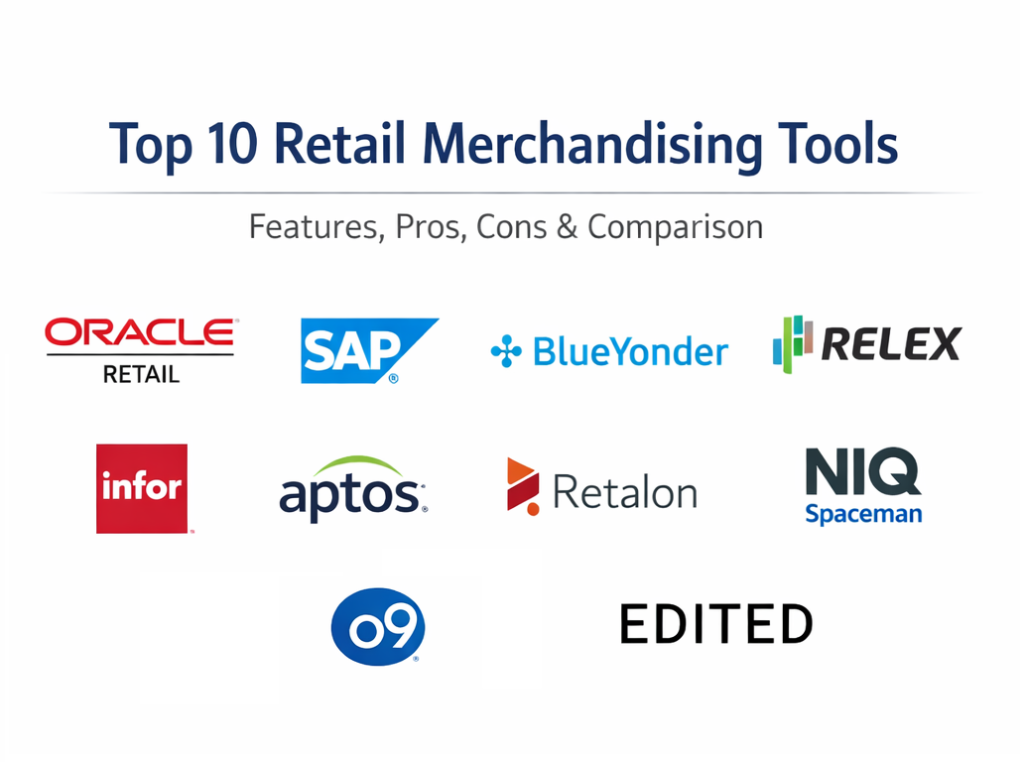
Top 10 Retail Merchandising Tools
1 — Oracle Retail Merchandising (Foundation Cloud Service)
A core retail merchandising backbone designed to support day-to-day merchandising operations (items, suppliers, purchasing, pricing, inventory, and sales audit workflows). It’s typically used by large retailers that want enterprise governance and a consistent foundation feeding store and digital selling systems.
Key Features
- Core merchandising workflows (merchandise management, purchasing, replenishment concepts).
- Sales auditing workflows for validating sales transactions before downstream processing.
- Pricing workflows for defining, approving, and publishing price changes and clearance events.
- Import and trading partner process support (where applicable).
- Centralized inventory visibility and perpetual inventory positioning for replenishment and fulfillment decisions.
- Foundation data management (items, locations, suppliers) for consistent operations.
- Exception handling for audit/pricing/inventory workflows (Varies / N/A).
Pros
- Broad coverage of core merchandising execution in one foundation platform.
- Strong fit when pricing governance and audit integrity are operational priorities.
- Good alignment for retailers standardizing enterprise item and inventory processes.
Cons
- Implementation can be complex and data-heavy without strong retail master data discipline.
- Often requires governance maturity (roles, approvals, exception ownership) to realize value.
- Can be more than needed for smaller, simpler retail operations.
Platforms / Deployment
- Web (Varies / N/A)
- Cloud
Security & Compliance
Not publicly stated.
Integrations & Ecosystem
Oracle core merchandising systems typically sit at the center of retail architecture, so integration quality determines success.
- POS sales feeds into sales audit and inventory updates (Varies / N/A)
- Price event publishing to selling channels (stores and ecommerce) (Varies / N/A)
- ERP/finance integrations for financial close and reconciliation (Varies / N/A)
- WMS/DC integrations for receiving and inventory movement (Varies / N/A)
- Data warehouse exports for reporting and analytics (Varies / N/A)
- APIs/integration tooling (Varies / N/A)
Support & Community
Enterprise vendor documentation is typically available, with support quality depending on licensing and implementation partners. Community-driven guidance varies by region and customer base (Varies / Not publicly stated).
2 — SAP Retail
An enterprise retail software approach often used to connect merchandising-related processes with finance, supply chain, and master data governance. It’s best for large retailers standardizing end-to-end processes across many countries, formats, and teams.
Key Features
- Enterprise retail process standardization (Varies / N/A).
- Strong alignment to master data governance and financial controls (Varies / N/A).
- Retail execution support through integrated enterprise workflows (Varies / N/A).
- Reporting and analytics patterns for retail operations (Varies / N/A).
- Extensibility for retail-specific workflows (Varies / N/A).
- Ecosystem support for large-scale enterprise integration (Varies / N/A).
Pros
- Good fit for enterprises connecting merchandising with finance and supply chain.
- Strong for governance-heavy environments where controls matter.
- Often supports multi-country operating models (Varies / N/A).
Cons
- Can be heavy for smaller teams seeking rapid time-to-value.
- Feature depth depends on selected components and implementation design.
- Requires strong internal ownership and process discipline.
Platforms / Deployment
Varies / N/A.
Security & Compliance
Not publicly stated.
Integrations & Ecosystem
SAP-centric retail architectures often integrate broadly across enterprise systems, with results depending on data ownership and integration design.
- ERP/finance integration patterns (Varies / N/A)
- POS and ecommerce integration patterns (Varies / N/A)
- Supply chain, replenishment, and allocation integrations (Varies / N/A)
- BI/data lake integration patterns (Varies / N/A)
- APIs/connectors (Varies / N/A)
Support & Community
Large enterprise partner ecosystems are common, with support tiers varying by contract. Documentation and training availability depend on your deployment and agreements (Varies / Not publicly stated).
3 — Blue Yonder Space Management
A space planning and category space optimization platform focused on planograms and store-specific space decisions. It’s best for retailers and CPG teams that treat shelf space as a managed asset and want consistent, scalable planogram workflows.
Key Features
- Automated planogram creation and store-specific planograms (Varies / N/A).
- Micro and macro space planning (planograms + floor planning concepts) (Varies / N/A).
- Floor plan creation for optimizing store layout (Varies / N/A).
- Optimized space allocation by category at store level (Varies / N/A).
- Space productivity and optimization workflows (Varies / N/A).
- Category management support through space planning processes (Varies / N/A).
Pros
- Strong fit for planogram automation and localized execution at scale.
- Useful when you need consistent planogram processes across many stores.
- Helps translate category strategy into shelf reality.
Cons
- Space tools don’t fix bad data; you still need accurate item and fixture attributes.
- Value depends on store execution compliance, not just plan generation.
- Can require training and change management for store teams.
Platforms / Deployment
Varies / N/A.
Security & Compliance
Not publicly stated.
Integrations & Ecosystem
Space planning works best when connected to assortment planning, replenishment, and store execution workflows.
- POS sales and performance feeds for space analysis (Varies / N/A)
- Planogram publishing to store execution tools (Varies / N/A)
- Replenishment alignment so shelf capacity supports on-shelf availability (Varies / N/A)
- Master data connections for item dimensions and fixture data (Varies / N/A)
- Data exports/APIs for analytics (Varies / N/A)
Support & Community
Space planning rollouts are typically enterprise and services-led, with documentation and support varying by contract. Public community depth varies (Varies / Not publicly stated).
4 — RELEX Solutions (Assortment & Space Planning)
A platform often evaluated for flexible assortment planning, and in many deployments, combined space and assortment planning. It’s best for retailers that want category decisions grounded in performance analysis and scalable localization.
Key Features
- Assortment analysis to identify underperforming and exceptional products (Varies / N/A).
- Flexible assortment planning workflows (Varies / N/A).
- Combined space and assortment planning approach (Varies / N/A).
- Store-specific assortment strategies and localization concepts (Varies / N/A).
- Category management workflows linking planning to execution signals (Varies / N/A).
- Forecast-informed planning narratives (Varies / N/A).
Pros
- Strong fit for performance-led assortment decisions and rationalization.
- Helpful when you want space and assortment teams working from shared logic.
- Supports retailers pushing toward localized category strategies.
Cons
- Can create “analysis paralysis” without clear category rules and decision cadence.
- Data harmonization and integration effort can be significant.
- Adoption depends on governance and role clarity (who decides what, when).
Platforms / Deployment
Varies / N/A.
Security & Compliance
Not publicly stated.
Integrations & Ecosystem
Assortment and space planning tools rely on sales, inventory, and item data—and often need to push decisions into execution systems.
- POS and sales history ingestion (Varies / N/A)
- Item master and attribute integrations for localization rules (Varies / N/A)
- Replenishment and allocation alignment (Varies / N/A)
- Space execution and publishing workflows (Varies / N/A)
- Data exports/APIs for reporting and interoperability (Varies / N/A)
Support & Community
Support is typically vendor-led with customer success and services for implementation; community visibility varies compared to mass-market retail tools (Varies / Not publicly stated).
5 — NIQ Spaceman
A space management tool centered on planograms and shelf optimization, positioned around planogram automation and productivity insights. It’s best for retailers and CPGs that need repeatable shelf execution workflows and measurable space productivity.
Key Features
- Planogram-focused space management workflows (Varies / N/A).
- Planogram automation positioning (Varies / N/A).
- Tools for analyzing planograms and identifying improvement opportunities (Varies / N/A).
- Space planning workflows designed for shelf optimization (Varies / N/A).
- Insights and reporting to support merchandising efficiency (Varies / N/A).
- Support for large planogram libraries and rollout processes (Varies / N/A).
Pros
- Strong fit for planogram-centric merchandising operating models.
- Helps standardize shelf execution and reduce manual planogram effort.
- Practical when shelf compliance is a recurring challenge.
Cons
- Specialized for space; you’ll likely need separate tools for core merchandising execution and financial planning.
- Store execution still requires process and compliance management.
- Integration quality with inventory/replenishment systems matters for full benefit.
Platforms / Deployment
Varies / N/A.
Security & Compliance
Not publicly stated.
Integrations & Ecosystem
Space tools are most valuable when connected to sales and replenishment signals so shelf capacity and inventory flow match.
- POS data and sales performance feeds (Varies / N/A)
- Replenishment alignment for on-shelf availability (Varies / N/A)
- Item master/attribute data for planograms (Varies / N/A)
- Store publishing and execution workflows (Varies / N/A)
- Data exports for BI and analytics (Varies / N/A)
Support & Community
Vendor-led support and professional services are common, while public community varies by region and adoption (Varies / Not publicly stated).
6 — Infor (CloudSuite Retail / Retail Solutions)
A suite-oriented retail software approach often evaluated for planning and operations capabilities that touch merchandising, assortment, inventory, and supplier collaboration. It’s best for retailers that want broad platform coverage and strong operational integration.
Key Features
- Assortment planning positioning within broader retail suite (Varies / N/A).
- Demand forecasting themes (Varies / N/A).
- Supplier collaboration and inventory control themes (Varies / N/A).
- Planning and supply chain alignment narratives (Varies / N/A).
- Reporting and analytics patterns (Varies / N/A).
- Platform approach that can reduce point-tool sprawl (Varies / N/A).
Pros
- Broad suite footprint can simplify enterprise architecture decisions.
- Useful when planning must connect tightly to inventory control and supplier workflows.
- Good for retailers looking to consolidate platforms (Varies / N/A).
Cons
- Exact merchandising depth depends on selected modules and deployment scope.
- Integration and data governance work is still required for clean outcomes.
- Rollouts can be complex across multiple business units (Varies / N/A).
Platforms / Deployment
Varies / N/A.
Security & Compliance
Not publicly stated.
Integrations & Ecosystem
Infor-style suites are typically evaluated as part of an end-to-end retail stack spanning ERP, supply chain, and selling channels.
- POS and ecommerce integration patterns (Varies / N/A)
- Supplier and procurement data exchange (Varies / N/A)
- WMS/fulfillment integrations (Varies / N/A)
- BI/data lake exports (Varies / N/A)
- APIs/connectors (Varies / N/A)
Support & Community
Enterprise support is typically contract-based and partner-supported; documentation exists, while public community varies (Varies / Not publicly stated).
7 — Aptos Merchandising
A merchandising system positioned to support enterprise inventory and merchandising operations across channels and locations. It’s best for retailers that want merchandising integrated with broader retail operations and consistent inventory control.
Key Features
- Enterprise inventory and merchandising operations across channels/locations (Varies / N/A).
- Integrated workflows spanning purchasing, pricing, receiving, allocation, replenishment (Varies / N/A).
- Centralized database positioning for shared accuracy (Varies / N/A).
- Exception alerting and performance-by-location analysis (Varies / N/A).
- Allocation and replenishment features positioned as flexible and interactive (Varies / N/A).
- Support for operational controls needed in multi-location retail (Varies / N/A).
Pros
- Strong integrated “inventory + merchandising operations” orientation.
- Useful when allocation/replenishment and pricing must be governed consistently.
- Can support multi-location operational discipline (Varies / N/A).
Cons
- You may still need specialized tools for planograms/space or competitive intelligence.
- Implementation outcomes depend heavily on item data quality and process standardization.
- Advanced localization often requires additional planning layers (Varies / N/A).
Platforms / Deployment
Varies / N/A.
Security & Compliance
Not publicly stated.
Integrations & Ecosystem
Core merchandising systems must integrate tightly with selling channels and supply chain systems to keep item, price, and inventory consistent.
- POS sales feeds and inventory updates (Varies / N/A)
- Ecommerce catalog and pricing synchronization (Varies / N/A)
- WMS and distribution center integrations (Varies / N/A)
- Finance/accounting integrations (Varies / N/A)
- Data exports and APIs (Varies / N/A)
Support & Community
Support is typically vendor-led and contract-based; documentation is usually available, while public community size varies (Varies / Not publicly stated).
8 — Retalon (Merchandise Planning)
A merchandise planning platform positioned around AI-assisted planning that turns high-level targets into granular, actionable plans. It’s best for planning teams trying to replace spreadsheet-heavy processes and keep plans reconciled as assumptions change.
Key Features
- Turn high-level targets into granular merchandise plans (Varies / N/A).
- Reconcile changes back into merchandise and financial plans (single source of truth positioning) (Varies / N/A).
- Demand forecasting emphasis to reduce guesswork (Varies / N/A).
- Automated updates across sales, pricing, inventory, purchase orders, and shipping data (Varies / N/A).
- Dashboards and “on-the-fly” optimization recommendations positioning (Varies / N/A).
- Planning narratives spanning pre-season and in-season decision cycles (Varies / N/A).
Pros
- Strong for reducing spreadsheet fragmentation and version conflicts in planning.
- Helpful when you want planning that stays synchronized as inputs change.
- Can improve decision cadence by focusing attention on exceptions (Varies / N/A).
Cons
- Success depends on clean, integrated internal data (sales, inventory, pricing, supply).
- Planning outputs still require governance and human accountability to drive action.
- Change management is needed to shift teams away from spreadsheets.
Platforms / Deployment
Varies / N/A.
Security & Compliance
Not publicly stated.
Integrations & Ecosystem
Planning tools depend on ingestion from operational systems and outputs into execution systems; integration design is a major success factor.
- POS and sales history ingestion (Varies / N/A)
- Inventory and supply chain feeds (Varies / N/A)
- Pricing and promotion system alignment (Varies / N/A)
- ERP/finance planning connections (Varies / N/A)
- Data exports/APIs for BI and downstream execution (Varies / N/A)
Support & Community
Typically vendor-led onboarding and enablement; public community footprint varies compared to large suite vendors (Varies / Not publicly stated).
9 — o9 Solutions (Assortment Planning)
An enterprise planning platform positioned to localize assortments by location and channel while staying aligned to financial targets and inventory constraints. It’s best for retailers that need demand-driven clustering and constraint-aware assortment decisions at scale.
Key Features
- Localized assortment by location/channel/need with financial and inventory constraint alignment (Varies / N/A).
- Demand-driven store clustering concepts (Varies / N/A).
- Continuous alignment with merchandise financial planning and open-to-buy concepts (Varies / N/A).
- Space-aware validation of assortments against store constraints (Varies / N/A).
- Attribute-based intelligence for evaluating new products (Varies / N/A).
- Connected planning framework positioning that links strategy to downstream execution (Varies / N/A).
Pros
- Strong for scaling localization while maintaining governance (targets + constraints).
- Useful when planning must be continuous rather than seasonal snapshots.
- Good for enterprise environments that need standardized planning language.
Cons
- Enterprise rollouts can be complex and require cross-functional alignment.
- Requires strong change management and a defined planning cadence.
- Benefits depend on disciplined data and consistent definitions across teams.
Platforms / Deployment
Varies / N/A.
Security & Compliance
Not publicly stated.
Integrations & Ecosystem
Assortment planning systems typically integrate with execution systems for pricing, replenishment, and assortment publication.
- Integration with MFP/OTB and finance planning layers (Varies / N/A)
- Inventory and supply constraints ingestion (Varies / N/A)
- Space planning alignment for store execution (Varies / N/A)
- POS and ecommerce demand signals ingestion (Varies / N/A)
- Data pipelines and APIs for interoperability (Varies / N/A)
Support & Community
Typically enterprise support with services-led onboarding; community visibility varies compared to mass-market tools (Varies / Not publicly stated).
10 — EDITED (Retail Intelligence Platform)
A retail intelligence platform positioned to connect competitor, internal, and customer data to support faster merchandising decisions. It’s best for merchandising and ecommerce teams that want market-aware assortment, pricing, and site merchandising signals.
Key Features
- Competitive intelligence positioning combining competitor and internal signals (Varies / N/A).
- Decision support for assortment, pricing, and site merchandising (Varies / N/A).
- AI-driven insight positioning (Varies / N/A).
- Pre-season planning, in-season trading, and post-season analysis positioning (Varies / N/A).
- Market benchmarking and assortment gap identification concepts (Varies / N/A).
- Workflow support for insights-to-action via reporting and collaboration (Varies / N/A).
Pros
- Strong for adding market context to internal performance to improve decision quality.
- Useful as a complement to core merchandising execution systems.
- Helps teams move faster when competitive dynamics are intense.
Cons
- Not a replacement for transactional merchandising execution (POs, stock ledger, price publishing).
- Insight trust depends on data matching and how well teams operationalize outputs.
- Integration effort may be more data-pipeline focused than transactional.
Platforms / Deployment
Varies / N/A.
Security & Compliance
Not publicly stated.
Integrations & Ecosystem
Retail intelligence platforms often integrate through data ingestion and exports into BI or planning workflows.
- Internal data ingestion (sales, inventory, pricing, web analytics) (Varies / N/A)
- BI/data warehouse exports (Varies / N/A)
- Planning and trading workflow alignment (Varies / N/A)
- APIs/connectors for automation (Varies / N/A)
- Collaboration integrations (tasks, notifications) (Varies / N/A)
Support & Community
Support is typically vendor-led with customer success and enablement; public community footprint is usually smaller than core suite vendors (Varies / Not publicly stated).
Comparison Table (Top 10)
| Tool Name | Best For | Platform(s) Supported | Deployment (Cloud/Self-hosted/Hybrid) | Standout Feature | Public Rating |
|---|---|---|---|---|---|
| Oracle Retail Merchandising (RMFCS) | Enterprise core merchandising execution | Web (Varies / N/A) | Cloud | Sales audit + pricing governance in a merchandising foundation | N/A |
| SAP Retail | Enterprise retail backbone | Varies / N/A | Varies / N/A | Enterprise process standardization + governance alignment | N/A |
| Blue Yonder Space Management | Space planning + planograms at scale | Varies / N/A | Varies / N/A | Automated planograms and store-specific space workflows | N/A |
| RELEX (Assortment & Space) | Category teams optimizing assortment + space | Varies / N/A | Varies / N/A | Performance-led assortment analysis + combined space/assortment approach | N/A |
| NIQ Spaceman | Planogram-driven shelf optimization | Varies / N/A | Varies / N/A | Planogram-centric space management with automation positioning | N/A |
| Infor Retail Solutions | Suite-oriented retail planning signals | Varies / N/A | Varies / N/A | Broad retail suite footprint across planning and operations | N/A |
| Aptos Merchandising | Integrated inventory + merchandising operations | Varies / N/A | Varies / N/A | Operational integration across purchasing/pricing/allocation/replenishment | N/A |
| Retalon Merchandise Planning | AI-assisted merchandise planning | Varies / N/A | Varies / N/A | Target-to-plan merchandise planning with reconciliation positioning | N/A |
| o9 Assortment Planning | Constraint-aware localization at scale | Varies / N/A | Varies / N/A | Localization aligned to financial targets and constraints positioning | N/A |
| EDITED | Market-informed merchandising decisions | Varies / N/A | Varies / N/A | Competitive intelligence positioning for pricing and assortment | N/A |
Evaluation & Scoring of Retail Merchandising Tools
Scoring model:
- Each criterion is scored 1–10.
- Weighted Total uses: Core 25%, Ease 15%, Integrations 15%, Security 10%, Performance 10%, Support 10%, Value 15%.
- Scores are comparative guidance for shortlisting, not absolute rankings.
| Tool Name | Core (25%) | Ease (15%) | Integrations (15%) | Security (10%) | Performance (10%) | Support (10%) | Value (15%) | Weighted Total (0–10) |
|---|---|---|---|---|---|---|---|---|
| Oracle Retail Merchandising (RMFCS) | 9 | 5 | 8 | 7 | 8 | 7 | 5 | 7.05 |
| SAP Retail | 8 | 5 | 8 | 8 | 8 | 7 | 5 | 6.95 |
| Blue Yonder Space Management | 8 | 6 | 7 | 7 | 8 | 6 | 6 | 7.00 |
| RELEX (Assortment & Space) | 8 | 7 | 7 | 7 | 8 | 6 | 6 | 7.15 |
| NIQ Spaceman | 7 | 7 | 6 | 7 | 7 | 6 | 6 | 6.60 |
| Infor Retail Solutions | 8 | 6 | 7 | 7 | 8 | 6 | 6 | 6.95 |
| Aptos Merchandising | 7 | 7 | 6 | 7 | 7 | 6 | 6 | 6.65 |
| Retalon Merchandise Planning | 8 | 7 | 6 | 7 | 7 | 6 | 6 | 6.95 |
| o9 Assortment Planning | 8 | 6 | 7 | 7 | 8 | 6 | 5 | 6.70 |
| EDITED | 7 | 8 | 7 | 7 | 7 | 6 | 6 | 6.95 |
How to interpret the scores:
- Core reflects domain depth, but “depth” differs by sub-domain (execution vs space vs planning vs intelligence).
- If adoption risk is high, weigh Ease and Support more than maximum features.
- If your stack is complex, weigh Integrations heavily; data flow quality determines trust and usage.
- Treat Value as total ROI: time saved, fewer markdowns, fewer stockouts, better range resets—not just license cost.
- Use the table to shortlist, then run a real pilot with real categories, fixtures, and store constraints.
Which Retail Merchandising Tools Is Right for You?
Solo / Freelancer
If you’re an independent merchandiser or a tiny retailer, enterprise merchandising systems are usually overkill. Start with clear assortment rules, basic pricing discipline, and reliable POS reporting; add specialized tools only when SKU count and store count demand it.
SMB
SMBs typically need practical assortment discipline, inventory visibility, and basic pricing governance without a long implementation. A suite approach can work if you want one backbone, but many SMBs should prioritize process first (clean item data, consistent calendars) before buying advanced planning tools.
Mid-Market
Mid-market retailers often struggle with inconsistent assortments across stores, spreadsheet-based OTB, and slow range reset execution. A strong pattern here is: core merchandising foundation + a dedicated space tool (if shelf execution is key) + a planning layer if localization and constraints are driving complexity.
Enterprise
Enterprises should optimize for governance, auditability, and integration: pricing approval → store execution → sales audit → financial reconciliation. Enterprise ecosystems often work best when you define a clear operating model (who owns item data, who approves prices, who resolves exceptions) and enforce it across business units.
Budget vs Premium
Budget setups can work when categories are simple and decision cadence is slow. Premium platforms pay off when they reduce stockouts/overstocks, accelerate range resets, and keep pricing and inventory aligned across channels—especially at multi-store scale.
Feature Depth vs Ease of Use
Space and planning platforms can be powerful but fail if daily workflows become too complex. If your organization struggles with adoption, pick fewer tools, standardize definitions (SKU, option count, cluster, fixture), and build repeatable cadences before expanding.
Integrations & Scalability
Merchandising depends on clean inputs (POS sales, inventory, item master) and reliable outputs (pricing publication, replenishment constraints, store execution). Validate integration patterns early: batch ingestion for analytics is different from near-real-time execution sync, and both may be needed.
Security & Compliance Needs
If pricing changes and assortment decisions require auditability, ask for RBAC, approval workflows, audit logs, and data segregation options. If certifications or security controls aren’t clearly documented, treat them as Not publicly stated and request vendor proof during procurement.
Frequently Asked Questions (FAQs)
What’s the difference between “merchandising tools” and “retail planning tools”?
Merchandising tools focus on assortment, pricing, and category execution; planning tools emphasize financial targets, forecasting, and inventory investment. Many vendors blend these, so confirm which workflows are truly supported end-to-end.
Do I need a planogram tool if I’m not grocery?
Not always. Planograms become valuable whenever shelf capacity, fixture constraints, and frequent range resets affect sales—common in beauty, pharmacy, electronics accessories, and convenience.
What is “store clustering” and why does it matter?
Store clustering groups stores by demand behavior so assortments can be localized efficiently. It matters because it improves relevance without planning every store individually.
How do merchandising tools reduce overstocks and stockouts?
They improve decision quality (assortment and allocation logic) and enforce constraints (space, financial targets, inventory). The biggest wins usually come from better master data and tighter plan-to-execution feedback loops.
What data do I need before implementing?
At minimum: clean item master, store/location hierarchy, sales history, inventory snapshots, and price/promo history. Space planning also needs fixture and item dimensions.
How long does implementation take?
It varies widely. Intelligence tools can onboard faster, while core merchandising foundations typically require longer data, integration, and process work. A phased rollout (one category or one region) is usually the safest path.
What are common mistakes during rollout?
Trying to localize everything immediately, importing messy SKU data, and building dashboards without changing decision cadence. Another mistake is unclear ownership: who approves prices, who resolves exceptions, who owns item data.
How should I pilot a merchandising tool?
Choose one category and run the full cycle: assortment decisions → planogram/space (if relevant) → pricing events → store execution → performance review. Measure outcomes like sell-through, availability, and markdown rate.
Can these tools integrate with POS and ecommerce?
Often yes, but integration depth varies. Some tools are transactional (syncing prices and inventory updates), others are analytics-driven (ingesting data and exporting recommendations). Validate using real flows like returns, markdowns, and range resets.
If my team uses spreadsheets today, where should we start?
Start with the most painful spreadsheet process (OTB, assortment lists, or planograms) and replace that first. Prioritize a single source of truth and reconciliation so you don’t recreate spreadsheet chaos inside a tool.
Do we need retail intelligence if we already have BI?
BI tells you what happened; intelligence tools aim to add market context and faster decision support. They’re most useful when competitive pricing and assortment benchmarking drive daily decisions.
How hard is it to switch tools later?
Switching is possible but expensive because data models, calendars, and hierarchies become embedded. Reduce switching risk by keeping master data clean, documenting processes, and ensuring you can export data and decision history.
Conclusion
Retail merchandising tools are most valuable when they connect decisions (assortment, space, pricing) to reliable inventory data and real store execution. There isn’t one universal “best” tool—core merchandising foundations, space/planogram tools, planning platforms, and intelligence layers each solve different problems. The practical next step is to shortlist 2–3 tools based on your top constraint (inventory accuracy, localization, shelf execution, or pricing governance), run a pilot on a single category, and validate integrations, security expectations, and team adoption before scaling.

Best Cardiac Hospitals Near You
Discover top heart hospitals, cardiology centers & cardiac care services by city.
Advanced Heart Care • Trusted Hospitals • Expert Teams
View Best Hospitals