Introduction
Corporate Travel Booking Platforms are specialized digital ecosystems designed to streamline the procurement of flights, hotels, and ground transportation for business purposes. Unlike consumer-facing travel sites, these platforms are engineered to integrate directly with company travel policies, ensuring that every booking remains within budget and meets safety standards. In a globalized economy, these tools act as the essential bridge between organizational oversight and employee mobility, providing a centralized interface for complex itineraries.
The shift toward these platforms is driven by the need for data-driven decision-making and efficient spend management. Modern platforms leverage vast inventories and real-time data to offer competitive pricing that is often unavailable to the general public. They provide crucial visibility into “invisible” spend, allowing finance teams to identify patterns and negotiate better rates with preferred suppliers. When selecting a platform, key considerations include the breadth of global inventory, the sophistication of the policy engine, mobile accessibility for travelers on the move, and the robustness of the reporting suite.
Best for: Organizations of all sizes looking to centralize travel data, enforce spending limits, and provide a secure, supported booking experience for their employees.
Not ideal for: Organizations with zero travel requirements or those that prefer to let employees book entirely via consumer sites without any centralized oversight or safety tracking.
Key Trends in Corporate Travel Booking Platforms
- New Distribution Capability Adoption: Platforms are increasingly integrating direct airline content to bypass traditional distribution fees and offer more personalized fare options.
- Sustainability-First Booking: Highlighting eco-friendly travel options and providing carbon footprint estimates at the point of sale is becoming a standard requirement.
- Mobile-Centric Trip Lifecycle: The focus has shifted from desktop booking to managing the entire trip—including changes and check-ins—via high-performance mobile applications.
- AI-Driven Itinerary Curation: Machine learning algorithms now analyze past behavior to suggest the most convenient and policy-compliant options instantly.
- Fintech Integration: Seamless links between booking platforms and corporate credit cards allow for instant transaction matching and automated expense generation.
- Enhanced Duty of Care: Real-time traveler tracking and localized risk alerts are now natively integrated into the booking workflow to ensure employee safety.
- Personalized Loyalty Management: Systems are becoming better at automatically applying traveler loyalty program details to ensure benefits are maximized.
- Frictionless Approval Flows: Moving away from email-based approvals toward one-click mobile notifications that prevent booking delays.
How We Selected These Tools (Methodology)
The selection of the following platforms was based on a rigorous evaluation process designed to identify the most reliable and feature-rich options available. The methodology included:
- Evaluation of market adoption and historical performance within the corporate travel sector.
- Assessment of inventory depth, specifically the ability to provide global air, hotel, and rail options in a single view.
- Analysis of the policy engine’s flexibility, checking how easily complex corporate rules can be digitized.
- Verification of security protocols and data privacy standards to ensure corporate and traveler information is protected.
- Review of the integration capabilities with major accounting, ERP, and HRIS systems.
- Examination of the user experience for both the traveler and the travel administrator.
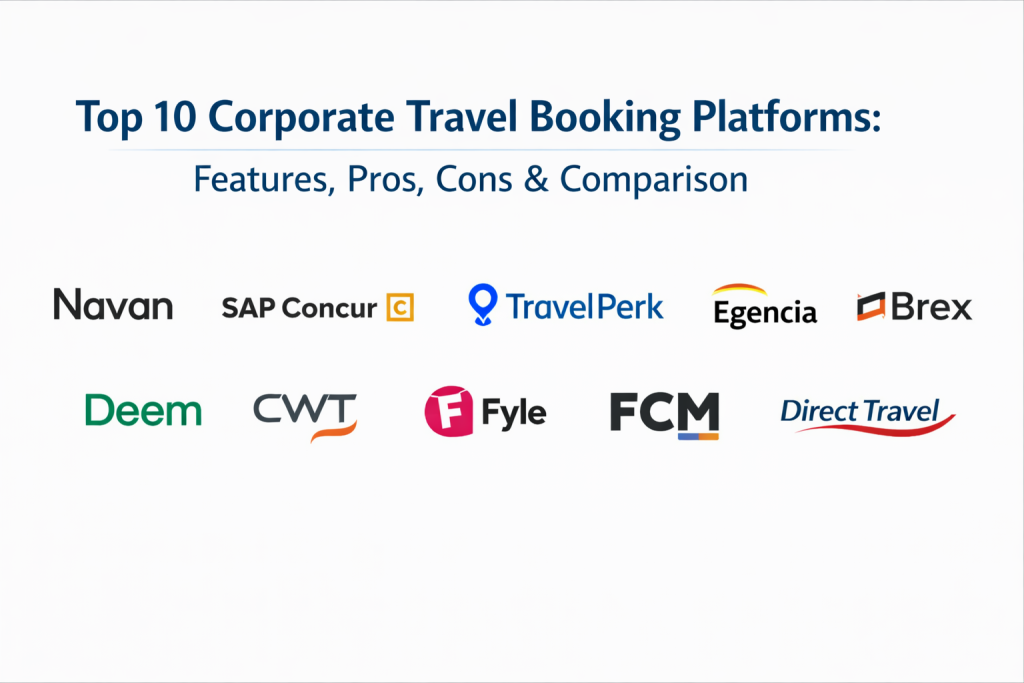
Top 10 Corporate Travel Booking Platforms
1.Navan
Navan is a modern, unified platform that combines travel booking with corporate card and expense management. It is built on a cloud-native architecture designed to feel as intuitive as a consumer application while providing enterprise-grade control.
Key Features
- Global Inventory Access: Direct connections to airlines, hotels, and rail providers worldwide.
- Automated Policy Enforcement: Real-time checks that prevent out-of-policy bookings before they occur.
- Traveler Rewards: Incentivizes employees to save company money by offering personal travel rewards.
- Real-Time Dashboards: Provides instant visibility into global travel spend and employee locations.
- Mobile-First Design: A comprehensive app that handles booking, support, and expense management.
Pros
- High adoption rates among employees due to the user-friendly interface.
- Significant time savings for finance teams through automated reconciliation.
Cons
- The full feature set is best utilized when adopting their native corporate card.
- Configuration for highly niche international tax rules can require extra setup.
Platforms / Deployment
- Web / iOS / Android
- Cloud
Security & Compliance
- SSO/SAML, MFA, RBAC, Encryption
- SOC 2, GDPR, PCI DSS
Integrations & Ecosystem
Navan integrates with a wide variety of modern business tools to ensure a seamless data flow.
- NetSuite
- Workday
- Slack
- Okta
- Microsoft Dynamics
Support & Community
Navan provides 24/7 global support via chat and phone. They offer a detailed knowledge base and dedicated success managers for larger corporate accounts.
2.SAP Concur
SAP Concur is widely regarded as the global leader in integrated travel and expense management. It is specifically designed to handle the complex requirements of large-scale multinational organizations.
Key Features
- Granular Policy Control: Unlimited flexibility in setting travel rules based on any organizational variable.
- Connected Ecosystem: Direct integration with the broader SAP suite of business products.
- Audit Services: Automated and human-led auditing of travel bookings and expenses.
- Sustainability Tracking: Detailed reporting on the environmental impact of corporate travel.
- App Center: A massive marketplace of third-party applications to extend platform functionality.
Pros
- Unrivaled ability to manage complex international compliance and tax requirements.
- Deep reporting capabilities that satisfy the most demanding finance departments.
Cons
- The interface can feel more technical and less intuitive than newer SaaS competitors.
- Implementation projects are typically longer and require more resources.
Platforms / Deployment
- Web / iOS / Android
- Cloud
Security & Compliance
- SSO/SAML, MFA, Encryption, Audit Logs
- ISO 27001, SOC 1 & 2, GDPR, FedRAMP
Integrations & Ecosystem
Has the most extensive integration library in the industry, connecting with nearly every major enterprise tool.
- SAP S/4HANA
- Oracle
- Salesforce
- ADP
- Microsoft Office 365
Support & Community
SAP Concur offers comprehensive enterprise support, a global user community, and extensive certification programs for travel managers.
3.TravelPerk
TravelPerk focuses on providing a frictionless booking experience for growing businesses. It stands out for its vast inventory and innovative flexibility features that simplify the booking process.
Key Features
- FlexiPerk: Allows for the cancellation of any booking for any reason with a guaranteed refund.
- VAT Recovery: Specialized tools to help companies reclaim international tax on their travel spend.
- Consolidated Invoicing: One simple invoice for all travel bookings regardless of the provider.
- Concierge Service: High-touch support for complex or custom travel requests.
- Carbon Offsetting: Integrated tools to calculate and offset the impact of corporate trips.
Pros
- Extremely fast setup and a very shallow learning curve for new users.
- One of the largest inventories of “low-cost” travel options in the market.
Cons
- The internal expense management module is not as deep as specialized T&E platforms.
- Advanced reporting features may require higher-tier subscriptions.
Platforms / Deployment
- Web / iOS / Android
- Cloud
Security & Compliance
- SSO/SAML, Encryption, RBAC
- SOC 2, GDPR
Integrations & Ecosystem
Integrates well with popular HR and accounting software used by growing technology companies.
- BambooHR
- Xero
- QuickBooks
- Expensify
- Slack
Support & Community
TravelPerk is known for its “human-first” support model, providing 24/7 access to experts without relying on automated bots.
4.Egencia
Egencia, backed by the infrastructure of American Express Global Business Travel, combines advanced technology with a massive global supply network.
Key Features
- Smart Mix AI: Intelligently ranks search results to balance company savings with traveler convenience.
- Consolidated Profile Management: Synchronizes traveler preferences and loyalty data across all devices.
- Visual Analytics: Interactive dashboards that help identify leakage and savings opportunities.
- Risk Management Suite: Integrated traveler tracking and emergency communication tools.
- Global Counselor Access: Direct connection to professional travel agents for high-touch service.
Pros
- Access to highly competitive negotiated rates through the Amex GBT network.
- A consistent booking experience across all global regions.
Cons
- The onboarding process can be more formal and structured than self-service tools.
- Customizing certain UI elements can be limited compared to newer startups.
Platforms / Deployment
- Web / iOS / Android
- Cloud
Security & Compliance
- SSO/SAML, MFA, Encryption, Audit Logs
- ISO 27001, GDPR, PCI DSS
Integrations & Ecosystem
Leverages a robust API to connect with enterprise HRIS and finance systems.
- Workday
- NetSuite
- Microsoft Dynamics
- Salesforce
Support & Community
Provides 24/7 global support and a dedicated account management structure to help optimize travel programs over time.
5.Brex
Brex is a financial technology platform that has natively integrated travel booking into its corporate card and spend management ecosystem.
Key Features
- Automated Reconciliation: Booking a trip instantly creates a tracked expense tied to a corporate card.
- Budget-Based Controls: Set specific travel budgets that are enforced at the point of purchase.
- Global Currency Support: Issue cards and book travel in multiple currencies seamlessly.
- No Receipt Requirements: Automatically generates digital receipts for thousands of travel vendors.
- Real-Time Visibility: Instant reporting on travel spend as soon as the card is swiped.
Pros
- Eliminates the need for manual expense reports for travel.
- Very modern, high-speed interface that appeals to technology-driven organizations.
Cons
- Travel inventory is managed via partners and may not be as deep as a full-service TMC.
- The platform is most effective when using Brex as the primary corporate card.
Platforms / Deployment
- Web / iOS / Android
- Cloud
Security & Compliance
- SSO/SAML, MFA, Encryption, RBAC
- SOC 2, GDPR
Integrations & Ecosystem
Focuses on deep, bi-directional sync with leading accounting and ERP tools.
- NetSuite
- Sage Intacct
- QuickBooks
- Xero
- Slack
Support & Community
Brex provides 24/7 support and is highly regarded for its digital-first support experience and clear documentation.
6.Deem
Deem is a specialized booking platform that focuses on providing a highly accessible and mobile-centric experience for the modern workforce.
Key Features
- Etta Experience: A sleek, mobile-optimized booking interface that guides travelers.
- Safety Integration: Provides real-time safety scores and neighborhood intelligence during booking.
- Eco-Friendly Filters: Clearly identifies green hotel and flight options for sustainability goals.
- Accessibility Compliance: Built to high standards of digital accessibility for diverse users.
- Agency Agnostic: Can be used with a wide range of different travel management companies.
Pros
- One of the most user-friendly mobile apps in the corporate travel category.
- Strong focus on traveler well-being and localized safety data.
Cons
- Requires a separate tool for full expense management.
- Advanced customization options for administrators are less extensive than enterprise rivals.
Platforms / Deployment
- Web / iOS / Android
- Cloud
Security & Compliance
- SSO/SAML, Encryption, RBAC
- SOC 2, GDPR
Integrations & Ecosystem
Integrates with various expense and HR providers to complete the travel workflow.
- SAP Concur
- Chrome River
- Workday
- Oracle
Support & Community
Deem provides comprehensive online resources and 24/7 traveler support through its partner networks and direct channels.
7.CWT
CWT is a global travel giant that has modernized its service through the myCWT platform, offering a blend of high-tech booking and high-touch counseling.
Key Features
- Multi-Channel Booking: Book via web, mobile app, or through direct messaging with an agent.
- Traveler 360: A unified view of the traveler’s journey, preferences, and security status.
- Price Tracking: Automated systems that re-shop fares to ensure the lowest price is always secured.
- Specialized Consulting: Access to experts who help design and refine corporate travel policies.
- Global Scale: Localized support and inventory in almost every country.
Pros
- The messaging-based booking feature is a favorite for busy executives.
- Massive global reach for companies with complex international footprints.
Cons
- The pricing and contract structures are tailored for larger corporate accounts.
- Implementation can be complex due to the depth of service options.
Platforms / Deployment
- Web / iOS / Android / Messaging
- Cloud / Hybrid
Security & Compliance
- SSO/SAML, MFA, Encryption, Audit Logs
- ISO 27001, GDPR, PCI DSS
Integrations & Ecosystem
Connects with major enterprise platforms and global security providers.
- International SOS
- Workday
- SAP
- Various ERP Systems
Support & Community
CWT provides 24/7 global counselor support and a dedicated consultancy group for program optimization.
8.Fyle
Fyle is an expense-first platform that offers a unique “inside-the-app” experience for tracking and booking travel expenses from everyday tools.
Key Features
- Application Integration: Capture expenses directly from Outlook, Gmail, and Slack.
- Any-Card Feed: Connects with any existing corporate or personal credit card.
- AI Receipt Extraction: Automatically reads and categorizes travel receipts with high accuracy.
- Policy Audit Engine: Flags potential violations or duplicates in real-time.
- Automated Reimbursements: Fast-tracks the return of funds to employees for out-of-pocket spend.
Pros
- Easiest platform for employees who dislike traditional expense apps.
- Very flexible and works with almost any existing banking relationship.
Cons
- Lacks a native booking engine; requires an external partner for the booking phase.
- Reporting features are focused primarily on expenses rather than travel logistics.
Platforms / Deployment
- Web / iOS / Android / Browser Extensions
- Cloud
Security & Compliance
- SSO/SAML, MFA, Encryption, RBAC
- SOC 2, GDPR
Integrations & Ecosystem
Excels at connecting with mid-market accounting software for automated bookkeeping.
- Sage Intacct
- QuickBooks
- Xero
- Microsoft Dynamics
- NetSuite
Support & Community
Fyle provides 24/7 customer support and extensive documentation for both users and administrators.
9.FCM Travel
FCM Travel offers a highly flexible and personalized booking platform supported by a global network of travel experts.
Key Features
- FCM Platform: A proprietary, customizable interface that brings all travel data into one place.
- Sam Assistant: An AI-powered digital assistant that handles itinerary updates and alerts.
- Local Expertise: Access to regional travel teams who understand local market nuances.
- Hub Reporting: A centralized dashboard for global travel spend and compliance.
- Flexible Implementation: Tailors the platform setup to the specific culture of the company.
Pros
- Highly responsive regional support that feels personal even at scale.
- The digital assistant provides excellent proactive support during trips.
Cons
- May be more complex than necessary for small businesses with simple needs.
- Platform features can vary slightly depending on the regional configuration.
Platforms / Deployment
- Web / iOS / Android
- Cloud
Security & Compliance
- SSO/SAML, Encryption, Audit Logs
- ISO 27001, GDPR, PCI DSS
Integrations & Ecosystem
Integrates with major corporate systems to ensure data continuity.
- Workday
- SAP Concur
- Oracle
- HRIS Tools
Support & Community
FCM provides 24/7 global support with a strong emphasis on human counselors and dedicated account teams.
10.Direct Travel
Direct Travel focuses on delivering a personalized service model for mid-market and enterprise companies through an integrated technology suite.
Key Features
- Direct2U Mobile: A high-performance app for booking and managing corporate itineraries.
- DirectView Analytics: Provides deep insights into supplier performance and spending trends.
- Automated Quality Control: Checks every booking for accuracy and policy compliance.
- Duty of Care Integration: Real-time tracking and alert systems for traveler safety.
- Custom Portals: Branded booking environments for individual corporate clients.
Pros
- High level of account management and personalized configuration.
- Strong focus on the mid-market, offering enterprise tools with more agility.
Cons
- Does not have the same level of brand recognition as some global giants.
- Technology updates may happen less frequently than at pure SaaS companies.
Platforms / Deployment
- Web / iOS / Android
- Cloud / Hybrid
Security & Compliance
- SSO/SAML, Encryption, RBAC
- SOC 2, GDPR
Integrations & Ecosystem
Integrates with leading expense and HR tools to provide a comprehensive solution.
- Chrome River
- SAP Concur
- Workday
- Expensify
Support & Community
Offers 24/7 support via multiple channels and emphasizes a partnership-based approach to travel management.
Comparison Table (Top 10)
| Tool Name | Best For | Platform(s) Supported | Deployment | Standout Feature | Public Rating |
|---|---|---|---|---|---|
| Navan | Modern teams | Web, iOS, Android | Cloud | Unified T&E + Rewards | 4.7/5 |
| SAP Concur | Large enterprise | Web, iOS, Android | Cloud | Deep ERP Integration | 4.0/5 |
| TravelPerk | Growing SMBs | Web, iOS, Android | Cloud | FlexiPerk Flexibility | 4.6/5 |
| Egencia | Amex GBT users | Web, iOS, Android | Cloud | Amex Negotiating Power | N/A |
| Brex | Tech-forward firms | Web, iOS, Android | Cloud | Card-Travel Integration | 4.8/5 |
| Deem | Mobile-first users | Web, iOS, Android | Cloud | Safety & Accessibility | N/A |
| CWT | Complex global travel | Web, App, Messaging | Hybrid | Messaging-led Support | N/A |
| Fyle | Multi-app tracking | Web, Mobile, Apps | Cloud | Tracking via Slack/Email | 4.6/5 |
| FCM Travel | Flexible global scale | Web, iOS, Android | Cloud | Sam AI Assistant | N/A |
| Direct Travel | Mid-market firms | Web, iOS, Android | Hybrid | High-Touch Service | N/A |
Evaluation & Scoring of Corporate Travel Booking Platforms
| Tool Name | Core (25%) | Ease (15%) | Integrations (15%) | Security (10%) | Performance (10%) | Support (10%) | Value (15%) | Weighted Total |
|---|---|---|---|---|---|---|---|---|
| Navan | 9 | 10 | 9 | 9 | 9 | 9 | 8 | 9.05 |
| SAP Concur | 10 | 6 | 10 | 10 | 9 | 8 | 7 | 8.55 |
| TravelPerk | 8 | 10 | 8 | 9 | 9 | 9 | 9 | 8.70 |
| Egencia | 9 | 7 | 8 | 9 | 9 | 9 | 7 | 8.15 |
| Brex | 8 | 10 | 9 | 9 | 10 | 8 | 9 | 8.90 |
| Deem | 7 | 9 | 7 | 9 | 9 | 8 | 8 | 7.95 |
| CWT | 9 | 7 | 8 | 9 | 8 | 10 | 7 | 8.15 |
| Fyle | 7 | 10 | 9 | 9 | 9 | 9 | 9 | 8.55 |
| FCM Travel | 8 | 8 | 8 | 9 | 8 | 9 | 8 | 8.15 |
| Direct Travel | 8 | 8 | 8 | 9 | 8 | 9 | 8 | 8.15 |
How to Interpret the Scores
The scoring table provides a relative performance index for each platform across seven critical categories. A high score in “Core” reflects the platform’s inventory depth and booking capabilities, while “Ease” measures the intuitiveness of the interface. Organizations should prioritize different categories based on their internal goals; for example, a company with strict compliance needs may prioritize “Security” and “Integrations” over “Ease of Use.” These scores are based on comparative analysis and market feedback and should be used to shortlist tools for further internal evaluation.
Which Corporate Travel Booking Platform Is Right for You?
Solo / Freelancer
For individuals, enterprise-grade booking platforms are often unnecessary. Instead, focus on tools that help with organization and itinerary management without requiring a corporate contract. Simple receipt-tracking apps or consumer sites with professional “for business” profiles are usually sufficient for one-person operations.
SMB
Small and medium businesses should prioritize ease of use and low administrative overhead. Platforms that offer self-service setup and intuitive mobile apps ensure that employees can book for themselves while the company still maintains control over the budget.
Mid-Market
Companies in the mid-market segment should look for a balance between automated technology and professional support. Platforms that offer dedicated account management alongside modern APIs allow for a more personalized experience as the company scales.
Enterprise
For large-scale global organizations, deep integration with ERP systems and the ability to handle complex international tax and compliance rules are mandatory. These organizations should prioritize platforms with a proven track record of managing massive volumes across multiple regions.
Budget vs Premium
Budget-focused organizations should look for platforms with transaction-based pricing or those that offer free software in exchange for card usage. Premium seekers should prioritize “high-touch” platforms that offer 24/7 human counselor support and specialized consulting to optimize travel ROI.
Feature Depth vs Ease of Use
There is often a trade-off between the depth of a tool’s configuration and its simplicity. Newer SaaS platforms focus on an easy user experience, while traditional enterprise tools offer nearly unlimited configuration options at the cost of a steeper learning curve.
Integrations & Scalability
A platform that cannot communicate with your HRIS or accounting software will lead to manual data entry errors. Ensure the tool you select has a robust integration library that matches your current tech stack and can scale as your travel volume grows.
Security & Compliance Needs
Organizations in regulated industries must prioritize tools with the highest levels of security certification and detailed audit logs. Ensuring the platform meets your internal IT and legal standards is the first step in any procurement process.
Frequently Asked Questions (FAQs)
What is a corporate travel booking platform?
It is a centralized software solution used by businesses to book and manage employee travel. It integrates company policies, negotiated rates, and safety tracking into a single interface for employees and administrators.
How do these platforms save money for a business?
They save money by providing access to exclusive corporate rates, enforcing travel policies at the time of booking to prevent overspending, and using AI to rebook trips when prices drop.
Can employees still book their own travel?
Yes, most platforms are designed for self-service. Employees can search and book within the app, but they are restricted by the rules and budgets set by the company’s travel manager.
How long does it take to set up a new platform?
Modern SaaS tools can be implemented in a few days, while complex enterprise systems requiring deep integration with corporate ERPs can take several months to fully deploy.
What is duty of care and how is it supported?
Duty of care is a company’s legal obligation to ensure employee safety. Platforms support this by providing real-time maps of traveler locations and instant alert systems during global emergencies.
Are these platforms compatible with my existing corporate credit cards?
Most top-tier platforms allow you to connect your existing corporate cards via direct bank feeds. Some even offer their own native cards for a more seamless, real-time reconciliation experience.
Do these platforms handle international travel?
Yes, the top global platforms provide access to international airlines, rail providers, and hotel chains, along with multi-currency support and localized tax compliance features.
Is there a fee for every trip booked?
Pricing models vary. Some charge a monthly subscription per user, while others charge a small transaction fee for every trip booked. Some modern fintech platforms offer the software for free.
Can I set different travel rules for different departments?
Yes, advanced platforms allow you to create granular policies. For example, you can set higher hotel budgets for executives or restrict international travel to specific departments.
What happens if a traveler needs help in the middle of the night?
Leading platforms provide 24/7 support via phone or app chat. This ensures that travelers can get immediate human assistance with cancellations, delays, or emergency rebookings at any time.
Conclusion
The selection of a corporate travel booking platform is a foundational decision for any organization that values financial control and employee safety. Whether you choose a high-growth SaaS platform like Navan or a established enterprise giant like SAP Concur, the objective remains to eliminate the chaos of manual bookings and replace it with a unified, policy-compliant system. By centralizing your travel data, you not only save money but also empower your employees with the tools they need to stay productive while on the move. We recommend evaluating your specific integration needs and traveler volume to select the platform that best fits your organizational culture.

Best Cardiac Hospitals Near You
Discover top heart hospitals, cardiology centers & cardiac care services by city.
Advanced Heart Care • Trusted Hospitals • Expert Teams
View Best Hospitals