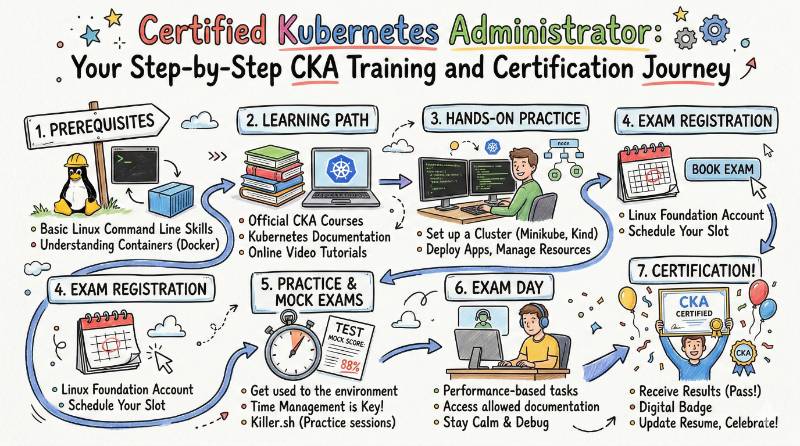
The way we manage software systems has gone through a massive transformation. Not long ago, we were concerned with physical servers and manual configurations. Today, we live in an era of automation and abstraction. At the center of this change is Kubernetes. It has become the standard for how we run applications at scale.
For any engineer or manager, especially those working in India or with global teams, understanding Kubernetes is no longer a luxury. It is a core requirement. However, simply knowing the basics is not enough. You need to prove that you can handle a production environment under pressure. This is where the Certified Kubernetes Administrator (CKA) Certification Training Course becomes a vital asset for your career.
I have watched the industry move from traditional data centers to the cloud. I have seen many tools come and go, but Kubernetes has stayed because it solves the hardest problems in software delivery. This guide is meant to act as your roadmap, helping you understand how to master this technology and where it can take you.
The Big Picture: Modern IT Certification Landscape
Before we focus on one specific path, it is important to see how different certifications work together. Whether you are interested in security, reliability, or cost management, there is a specialized track for you.
The following table provides a clear view of the top certifications available today. This helps you understand where the Certified Kubernetes Administrator (CKA) Certification Training Course sits in the broader world of DevOps and Cloud Engineering.
Master Certification Overview Table
| Certification Name | Track | Level | Who it’s for | Prerequisites | Skills Covered | Recommended Order |
| Certified Kubernetes Administrator (CKA) | Kubernetes | Associate | SysAdmins, DevOps, SREs | Basic Linux & Containers | Cluster Setup, Networking, Storage, Troubleshooting | High Priority |
| Certified Kubernetes Application Developer (CKAD) | DevOps | Associate | Software Engineers | Basic K8s Concepts | Designing and deploying apps on Kubernetes clusters | Second Step |
| Certified Kubernetes Security Specialist (CKS) | DevSecOps | Advanced | Security Engineers | Must hold a valid CKA | Hardening clusters, auditing, and system security | After CKA |
| SRE Certified Professional | SRE | Professional | SREs, Ops Leads | IT Ops Experience | Reliability, SLOs, Error Budgets, Uptime | After CKA |
| MLOps Certified Professional | AIOps | Advanced | ML Engineers | Python, ML basics | Scaling and monitoring ML models at scale | Specialized |
| DataOps Certified Professional | DataOps | Intermediate | Data Engineers | Data Pipeline basics | Managing data agility and pipeline flows | Specialized |
| FinOps Certified Practitioner | FinOps | Professional | Managers, Cloud Leads | Cloud Fundamentals | Cloud Cost Optimization and Budgeting | Management Track |
A Detailed Look: Certified Kubernetes Administrator (CKA)
The Certified Kubernetes Administrator (CKA) Certification Training Course is unique because it is not a written test. It is a practical challenge. You have to prove your skills in a live environment. When I look at a candidate’s profile, seeing a CKA tells me they can actually fix a broken system, not just talk about it.
What it is
The Certified Kubernetes Administrator (CKA) Certification Training Course is a hands-on, performance-based program. It is designed to ensure that administrators have the skills to build and manage production-ready Kubernetes clusters. During the final exam, you are given a terminal and a list of problems to solve. You might have to fix a networking error, configure a storage volume, or secure the cluster. It is the most respected way to prove your technical competence.
Who should take it
This course is built for the professionals who keep modern infrastructure running smoothly every day.
- Working Engineers: Who want to move from traditional system administration to modern cloud-native roles.
- Software Engineers: Developers who want to understand the environment where their code actually lives and runs.
- Engineering Managers: Leaders who need a deep technical understanding to help their teams make better infrastructure choices.
- Platform Engineers: Those who are building the internal tools and environments used by other developers.
Skills you’ll gain
By the end of this training, you will have a deep understanding of how the internal components of Kubernetes work together. You will move from being a basic user to a master of the cluster, capable of managing complex workloads.
- Cluster Bootstrapping: You will learn how to build a cluster from the ground up using tools like
kubeadm. - Networking Mastery: You will understand pod-to-pod communication, service discovery, and external traffic management.
- Storage Solutions: You will learn how to manage persistent data so your applications don’t lose information when they restart.
- Cluster Security: You will master Role-Based Access Control (RBAC) to ensure only the right people have access to the right resources.
- Troubleshooting Expertise: You will gain the skills to diagnose and fix failures in nodes, pods, and cluster components quickly.
Real-world projects you should be able to do
The real value of this training is being able to handle high-impact tasks at your workplace. These projects show that you are ready for the responsibilities of a senior role.
- Production Cluster Design: You will be ready to build a multi-node cluster that can handle thousands of users without failing.
- Secure Multi-Tenancy: You can set up “Namespaces” and isolation policies so different teams can share a cluster safely.
- Reliable Disaster Recovery: You will know how to back up the cluster’s configuration and restore it if a major failure occurs.
- Application Exposure: You can set up Ingress rules to manage how web traffic reaches your different services across the cluster.
Preparation plan (7–14 days / 30 days / 60 days)
The time you need to prepare depends on your current level of experience. Here is a simple way to plan your study time.
- 7–14 Days (The Expert Sprint): This path is for those who already use Kubernetes in their daily jobs. Spend your time on timed practice labs. Focus on the areas you don’t use often, like manual cluster upgrades or etcd backups.
- 30 Days (The Standard Path): This is the best choice for most working engineers. Spend the first two weeks learning core concepts like networking and storage. Spend the next two weeks doing labs every day and taking mock exams.
- 60 Days (The Deep Study): If you are new to containers and Linux, take your time. Spend the first month learning the Linux command line and Docker basics. Spend the second month following the standard Kubernetes training plan.
Common mistakes
I have seen many people fail because they were not prepared for the format of the exam. It is a race against the clock.
- Trying to type every file: You don’t have time to write YAML from scratch. You must learn to use commands that generate your files for you.
- Forgetting the Context: The exam uses several different clusters. Always check which cluster you are in before you run a command, or you might fix the wrong system.
- Getting stuck on a hard task: If a problem is too difficult, skip it and move to the next one. You can always come back later if you have time.
- Not knowing the documentation: You are allowed to use the official documentation website. You must know exactly where the information is so you don’t waste time searching.
Planning Your Career Journey
Getting your CKA is a huge achievement, but you should always be looking for the next step. The tech world moves fast, and staying ahead means always learning.
Best next certification after this
Once you have earned your CKA, you have a solid foundation. Based on data for top software engineers, you should look at these three options for your next move:
- Same track (Technical Mastery): Certified Kubernetes Security Specialist (CKS). This is the natural next step. It teaches you how to lock down your clusters and protect them from attacks.
- Cross-track (Automation): Certified Kubernetes Application Developer (CKAD). This helps you understand things from the developer’s perspective, making you a more balanced engineer.
- Leadership (Management): FinOps Certified Practitioner. If you want to move into management, you need to understand how to control the costs of the cloud.
Choose your path (6 Learning Paths)
- DevOps Path: Focus on the speed of building and releasing software.
- DevSecOps Path: Focus on making security a part of every step of the process.
- SRE Path: Focus on keeping systems reliable and always online.
- AIOps/MLOps Path: Learn how to manage and scale AI models on Kubernetes.
- DataOps Path: Focus on the safe and fast flow of data across a company.
- FinOps Path: Learn how to manage the business and cost side of the cloud.
Role → Recommended certifications mapping
- DevOps Engineer: CKA, Certified Kubernetes Application Developer, Terraform training.
- SRE: CKA, Certified Kubernetes Security Specialist, SRE Foundation.
- Platform Engineer: CKA, CKS, CKAD.
- Cloud Engineer: CKA, Solutions Architect Associate.
- Security Engineer: CKS, DevSecOps Professional.
- Data Engineer: DataOps Professional, CKA.
- FinOps Practitioner: FinOps Practitioner, CKA.
- Engineering Manager: FinOps Practitioner, SRE Foundation.
Top Institutions for CKA Training
Choosing the right place to learn is essential. You need a school that gives you real labs and mentors who have done the work. Here are the top institutions that provide excellent help with the Certified Kubernetes Administrator (CKA) Certification Training Course.
- DevOpsSchool: This is a top choice for many engineers. They offer very practical, hands-on training that covers everything you need for the exam and for a real job. Their labs are designed to mimic real production problems.
- Cotocus: Known for high-quality technical training. They provide detailed sessions that cover complex enterprise setups, making them a great choice for experienced engineers.
- Scmgalaxy: They have a very large community and provide many resources for learning. Their training is built around the modern software lifecycle and focuses on automation.
- BestDevOps: This school aims to make learning simple and effective. They focus on the most important skills you need to become a professional in a short amount of time.
- devsecopsschool: If you want to learn with a focus on security, this is the place. They put security into every part of the Kubernetes administration training.
- sreschool: This school focuses on reliability. They teach you how to manage clusters so they stay online even when things go wrong.
- aiopsschool: Perfect for those moving into the AI space. They show you how to use Kubernetes to power big machine learning projects.
- dataopsschool: They specialize in data-heavy systems. Their course shows you how to manage Kubernetes clusters that handle massive amounts of data.
- finopsschool: This is for the business side of tech. They help you run Kubernetes while keeping your cloud bills low.
FAQs (General Career & Outcomes)
1. Is the CKA certification still valuable in today’s market?
Yes, it is one of the most respected certifications because it is difficult to pass. It proves you have real, practical skills that companies need.
2. How long does the CKA certification last?
It is valid for three years. This makes sure you stay up to date with the latest features and changes in Kubernetes.
3. Do I need to be a coding expert to pass the CKA?
No, but you do need to be very comfortable with the Linux command line. You don’t need to write software, but you need to know how it runs.
4. Can I take the exam from my home in India?
Yes, the exam is proctored online. You can take it from anywhere if you have a stable internet connection and a quiet room.
5. How much does the CKA exam cost?
The price is usually around $395, though you can often find discounts if you buy it as part of a training course.
6. What is the difference between CKA and CKAD?
CKA is for the people who manage the cluster itself. CKAD is for the developers who build and run applications on that cluster.
7. Does the CKA help with salary growth?
In many cases, yes. Certified engineers often earn higher salaries because they have proven they have a specialized and difficult skill.
8. Is there a specific order for these certifications?
Most people start with the CKA because it gives you the best overall understanding of how Kubernetes works from the inside out.
9. Can I use external help during the test?
No, you are only allowed to use the official Kubernetes documentation website. You cannot use search engines like Google.
10. What happens if I fail the first time?
Most exam vouchers include one free retake, so you can learn from your mistakes and try again without paying extra.
11. How much hands-on practice do I need?
I recommend spending at least 40 to 60 hours doing practical labs to feel confident for the exam.
12. Will this certification help me get an SRE role?
Absolutely. CKA is one of the core requirements for almost every Site Reliability Engineering job at major tech companies.
FAQs (Specific to CKA Training)
1. What version of Kubernetes is used in the training?
The training usually follows the most recent stable release, which is exactly what the official exam uses.
2. What is the format of the CKA exam?
It is 100% practical. There are no multiple-choice questions. You have to solve real problems in a live terminal.
3. How long is the CKA exam?
You have exactly two hours to finish all the tasks. This is why being fast with the command line is very important.
4. What is a passing score for the CKA?
You need to score 66% or higher to get your certification.
5. Are there any prerequisites for the training?
You should know basic Linux commands and have a basic understanding of what containers are before you start.
6. Does the training cover etcd backup and restore?
Yes, this is a very important part of the curriculum and a common task you will find in the real exam.
7. Do I need to learn Helm for the CKA?
Basic Helm knowledge is now part of the syllabus, so the training will cover how to install and manage packages.
8. Can I use my own notes during the exam?
No. You are only allowed to use the official documentation. You cannot have any papers or notes with you.
Conclusion
The Certified Kubernetes Administrator (CKA) Certification Training Course is more than just a certificate; it is a way to change your professional life. We have moved into a time where knowing how to manage cloud infrastructure is the most important skill an engineer can have. Whether you are in India or anywhere else, the demand for people who can handle these complex systems is only going to grow. It takes hard work and a lot of time in the lab to master Kubernetes, but the rewards are worth it. You will gain the confidence to lead teams, build better systems, and earn more respect in the industry. Don’t wait for the world to pass you by; start your journey toward becoming a certified administrator today.

Best Cardiac Hospitals Near You
Discover top heart hospitals, cardiology centers & cardiac care services by city.
Advanced Heart Care • Trusted Hospitals • Expert Teams
View Best Hospitals