Introduction
Core banking systems are the essential transactional hubs that power the global financial industry. In plain English, these systems represent the “brain” of a bank—the centralized back-end engine that processes daily banking transactions, updates accounts, manages ledgers, and stores customer information. While the front-end digital banking platform handles the user interface, the core banking system handles the heavy lifting: interest calculations, loan processing, deposit management, and the final recording of every cent that moves through the institution.
In a modern context, core banking has undergone a radical shift. Traditional “legacy” cores, which often ran on rigid, decades-old mainframe technology, are being replaced or augmented by cloud-native, API-first architectures. This transition matters because it allows financial institutions to achieve real-time processing rather than relying on old-fashioned batch cycles. It enables banks to launch new products in days instead of months, ensuring they remain competitive against agile fintech challengers and neobanks.
Use Cases:
- Centralized Ledger Management: Maintaining a single, real-time source of truth for all customer balances and transaction histories.
- Deposit and Loan Processing: Automating the lifecycle of financial products, from interest accrual on savings to repayment schedules for mortgages.
- Regulatory Reporting: Generating the complex data sets required by central banks and government authorities to ensure financial stability.
- Identity and Access Management: Providing a secure foundation for KYC (Know Your Customer) data and internal bank staff permissions.
Evaluation Criteria:
- Architectural flexibility (Cloud-native vs. On-premise).
- API connectivity and ease of integration with third-party fintechs.
- Real-time processing capabilities (Elimination of batch windows).
- Scalability to handle millions of concurrent transactions.
- Multi-currency and multi-jurisdiction regulatory support.
- Security certifications and data encryption standards.
- Total cost of ownership and implementation complexity.
- Vendor roadmap and commitment to innovation.
Best for: Commercial banks, retail credit unions, digital-only neobanks, and microfinance institutions that require a robust, secure, and scalable engine to manage their financial operations.
Not ideal for: Small businesses or non-financial enterprises that only need simple accounting software; core banking is specifically for entities that hold a banking license and manage third-party deposits.
Key Trends in Core Banking Systems
- Serverless and Cloud-Native Shifts: Moving away from physical servers toward auto-scaling cloud environments to reduce infrastructure overhead.
- Event-Driven Architecture: Utilizing real-time data streams so that a transaction in one part of the system immediately triggers necessary actions elsewhere.
- AI-Enhanced Risk Management: Implementing machine learning directly into the core to detect fraudulent patterns at the moment of transaction.
- Embedded Finance and BaaS: Core systems now offer modular “Banking-as-a-Service” features, allowing banks to lease their ledger space to non-bank brands.
- ISO 20022 Adoption: The migration to global messaging standards for higher quality data in payments and transactions.
- High-Velocity Product Engines: Tools that allow non-technical staff to configure and launch new credit or savings products via visual interfaces.
- Green Ledgering: Emerging modules that track the environmental impact of various lending portfolios.
- Zero-Trust Security Models: Shifting internal security logic to assume no user or system is safe, requiring constant verification.
How We Selected These Tools (Methodology)
Our selection process for the leading core banking systems is based on a rigorous evaluation of technical robustness and market position:
- Market Adoption and Mindshare: We prioritized vendors that are currently winning the highest volume of modernization contracts globally.
- Feature Completeness: Systems must handle everything from basic deposits to complex lending and regulatory compliance.
- Reliability and Performance: Evaluation of uptime records and the ability to process high-volume transaction spikes without latency.
- Security Posture: Verification of industry-standard certifications and a “security-by-design” approach to coding.
- Ecosystem Integration: The presence of a robust API layer and a marketplace of pre-integrated third-party services.
- Segment Fit: We ensured the list includes solutions for massive Tier 1 banks as well as lean neobank startups.
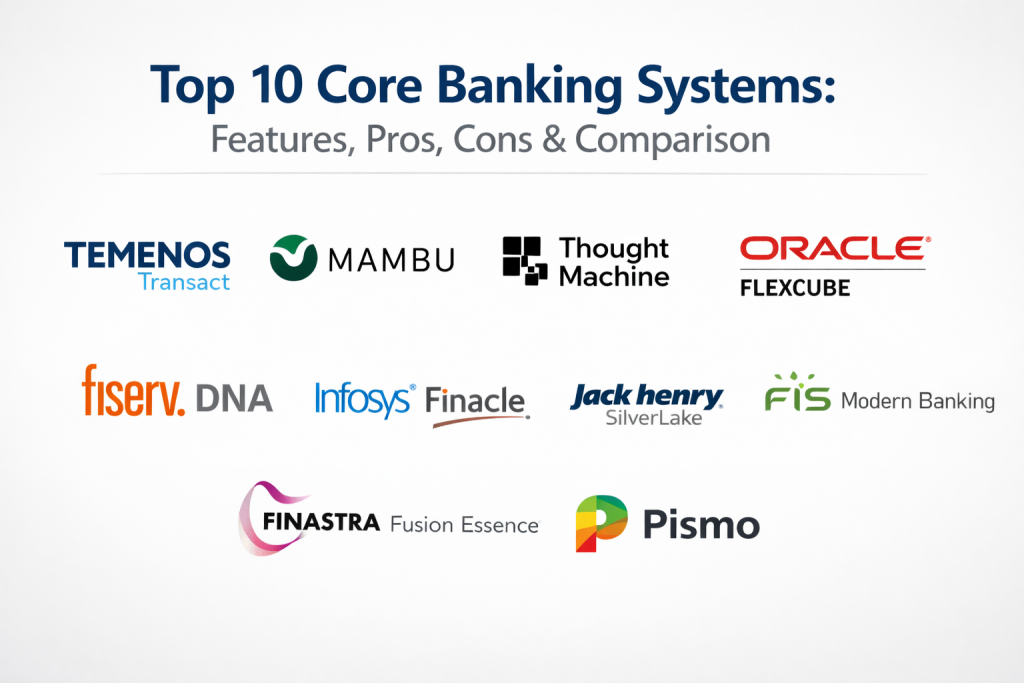
Top 10 Core Banking Systems Tools
1.Temenos Transact
A globally recognized powerhouse in core banking, offering a massive breadth of functionality that serves thousands of financial institutions across all tiers.
Key Features
- Cloud-Native Design: Fully optimized for AWS, Azure, and Google Cloud.
- Multi-Country Framework: Built-in localization for over 150 countries.
- Extensible Product Engine: Visual tools to create complex interest and fee structures.
- Real-Time Core: Eliminates the need for traditional end-of-day batch processing.
- Integrated Analytics: Real-time data visualization directly from the core ledger.
Pros
- Unmatched functional depth covering every imaginable banking product.
- High scalability for the world’s largest financial institutions.
Cons
- Implementation can be exceptionally long and costly.
- The sheer number of modules can make the system feel overwhelming for smaller banks.
Platforms / Deployment
- Cloud / Self-hosted / Hybrid
Security & Compliance
- ISO 27001
- SOC 1 & 2
- GDPR Compliant
Integrations & Ecosystem
Temenos utilizes the “Temenos Exchange” to provide hundreds of pre-built integrations.
- Salesforce
- Bloomberg
- Plaid
- Various payment rails
Support & Community
Extensive global support network with a dedicated learning community and professional certification paths.
2.Mambu
A cloud-native, “composable” core banking engine that has become the preferred choice for digital-first neobanks and fintech pioneers.
Key Features
- SaaS-Only Model: Continuous updates without the need for manual upgrades.
- API-First Architecture: Every single action within the system can be triggered via REST APIs.
- Flexible Data Models: Allows users to define custom fields for any financial object.
- Lean Core: Focuses on the ledger and logic, leaving the UI to the engagement layer.
- Process Orchestrator: Tools to build custom workflows and logic between APIs.
Pros
- Extremely fast speed to market for new digital brands.
- Highly cost-effective for institutions that want to pay-as-they-grow.
Cons
- Requires an external engagement layer or digital banking platform for the UI.
- May lack some of the extremely niche legacy features found in older cores.
Platforms / Deployment
- Cloud
Security & Compliance
- ISO 27001
- SOC 2 Type II
- PCI DSS
Integrations & Ecosystem
Known for its “composable” philosophy, making it easy to plug in best-of-breed partners.
- Backbase
- Amazon Web Services
- Google Cloud
- Marqeta
Support & Community
Highly technical developer-focused support with comprehensive online documentation.
3.Thought Machine
Built from the ground up to be cloud-native, Thought Machine uses “Smart Contracts” to define banking products, offering unprecedented flexibility.
Key Features
- Vault Core: A single, unified ledger capable of running any type of bank.
- Smart Contracts: Python-based logic to define precisely how products behave.
- Real-Time Ledger: Instant updates for both the bank and the customer.
- High-Availability: Designed to be always-on with no maintenance downtime.
- Universal Product Engine: One engine for credit cards, mortgages, and savings.
Pros
- The Smart Contract approach allows for infinite product customization.
- Clean, modern codebase that is easy for developers to manage.
Cons
- Requires internal Python expertise to build and maintain products.
- Still gaining the massive global footprint of older incumbents.
Platforms / Deployment
- Cloud (AWS, GCP, Azure)
Security & Compliance
- ISO 27001
- SOC 2
- Not publicly stated (specific regional certs)
Integrations & Ecosystem
Focuses on a “best-of-breed” integration strategy via a robust API gateway.
- Form3
- Mastercard
- Various CRM providers
Support & Community
Offers high-touch engineering support and a growing ecosystem of implementation partners.
4.Oracle FLEXCUBE
A venerable name in the industry, Oracle’s core banking solution offers deep functionality with the backing of one of the world’s largest tech companies.
Key Features
- Componentized Architecture: Allows banks to upgrade specific modules without a full overhaul.
- Machine Learning Integration: Built-in AI for credit scoring and offer personalization.
- Global Operations: Strong support for multi-branch and multi-legal entity structures.
- Blockchain Ready: Modules available for distributed ledger experiments.
- Treasury Management: Advanced tools for corporate and institutional banking.
Pros
- Deep reliability and performance on Oracle’s optimized hardware/software stack.
- Broad global support and a massive pool of trained consultants.
Cons
- Can be very expensive when including database and infrastructure licenses.
- Older versions can be difficult to move to the cloud.
Platforms / Deployment
- Cloud / Self-hosted / Hybrid
Security & Compliance
- ISO 27001
- SOC 1 & 2
- HIPAA (N/A)
Integrations & Ecosystem
Deeply integrated with the wider Oracle ecosystem and various third-party financial tools.
- Oracle ERP
- Salesforce
- Various global payment gateways
Support & Community
Enterprise-grade support with a global presence and massive user groups.
5.FIS Modern Banking Platform
A cloud-native, component-based core designed for large-scale digital transformation in established Tier 1 and Tier 2 banks.
Key Features
- Cloud-First Design: Built specifically for the high-performance requirements of modern cloud.
- Modular Services: Components for deposits, lending, and cards can be used independently.
- Real-Time Processing: Full support for instant payments and real-time balances.
- Advanced Security: Built-in threat intelligence and automated compliance.
- Developer Portal: Comprehensive tools for bank developers to extend the core.
Pros
- Backed by one of the largest financial technology firms in the world.
- Designed specifically to bridge the gap between legacy and modern banking.
Cons
- Pricing is geared toward larger institutions.
- Implementation projects are typically very large in scale.
Platforms / Deployment
- Cloud / Hybrid
Security & Compliance
- SOC 1, 2, & 3
- ISO 27001
- FFIEC Compliant
Integrations & Ecosystem
Leverages the FIS “Code Connect” API marketplace for vast connectivity.
- Zelle
- Worldpay
- Various core-agnostic fintechs
Support & Community
Global enterprise support with dedicated account management and 24/7 technical assistance.
6.Fiserv DNA
Known for its modern, “person-centric” data model, DNA is a leading choice for credit unions and banks in North America.
Key Features
- Person-Centric Design: Organizes data around the customer, not just the account.
- Open Architecture: Allows banks to add custom apps and features via “DNAapps.”
- Unified Real-Time Core: Handles retail and commercial banking in one database.
- Automated Workflow: Built-in tools to streamline back-office tasks.
- CRM Integration: Strong native connectivity with customer management tools.
Pros
- Excellent for banks that want a 360-degree view of the customer.
- Very strong user community and shared app marketplace.
Cons
- Primarily focused on the North American regulatory environment.
- The interface for back-office staff can require extensive training.
Platforms / Deployment
- Cloud / Self-hosted
Security & Compliance
- SOC 2 Type II
- FFIEC Compliant
- Not publicly stated (specific ISOs)
Integrations & Ecosystem
Deeply integrated with the massive Fiserv suite of peripheral services.
- CheckFree (Bill Pay)
- Zelle
- Various document management tools
Support & Community
Known for its active user groups and extensive educational resources for bank staff.
7.Infosys Finacle
A digital-first core banking solution that has gained significant ground globally, particularly in Asia, the Middle East, and Africa.
Key Features
- Agile Architecture: Supports a wide range of deployment models.
- Blockchain Framework: One of the first cores to offer native DLT support.
- Open APIs: Over 500 standard APIs for rapid third-party integration.
- Customer Insights: AI-driven tools to predict customer needs and churn.
- Scalable Lending: End-to-end automation for both retail and corporate loans.
Pros
- Highly competitive pricing compared to some Western counterparts.
- Strong focus on innovation and emerging technology like blockchain.
Cons
- Documentation can sometimes be inconsistent across different modules.
- Implementation partners can vary in quality by region.
Platforms / Deployment
- Cloud / Self-hosted / Hybrid
Security & Compliance
- ISO 27001
- SOC 2
- GDPR Compliant
Integrations & Ecosystem
Strong ecosystem of fintech partners through the “Finacle App Center.”
- Microsoft Azure
- Google Cloud
- Various regional payment rails
Support & Community
Global support footprint with a strong emphasis on training and certification.
8.Jack Henry SilverLake
A comprehensive core banking system designed specifically for commercial banks, focusing on operational efficiency and customer service.
Key Features
- Integrated Treasury: Advanced tools for business and corporate clients.
- Open Integration: Allows for easy connectivity with non-Jack Henry products.
- Enterprise Workflow: Automates complex tasks across different bank departments.
- Digital Toolkit: Tools for banks to build their own custom digital experiences.
- Robust Reporting: Hundreds of standard reports for management and compliance.
Pros
- Specifically tuned for the needs of U.S. commercial banking.
- Exceptional customer service reputation and vendor stability.
Cons
- Limited international presence outside of North America.
- Can feel less “modern” in its UI than newer neobank cores.
Platforms / Deployment
- Cloud / Self-hosted
Security & Compliance
- SOC 2 Type II
- FFIEC Compliant
- Not publicly stated (specific ISOs)
Integrations & Ecosystem
Part of the Jack Henry “OpenAnywhere” initiative to encourage third-party connections.
- Centrix (Risk Management)
- Banno (Digital Engagement)
- Various credit bureaus
Support & Community
Widely cited as having some of the best customer support in the industry.
9.Finastra Fusion Essence
Finastra offers a modern, cloud-first core banking solution that emphasizes “Open Banking” and speed to market.
Key Features
- SaaS Delivery: Lowers the barrier to entry for smaller banks.
- Pre-Integrated Modules: High-speed deployment for common banking tasks.
- Advanced Analytics: Built-in dashboards for business intelligence.
- User-Centric UI: Modern interface for both customers and bank staff.
- Regulatory-as-a-Service: Automated updates for local compliance rules.
Pros
- Excellent for banks wanting to transition to a SaaS model quickly.
- Strong focus on a clean, modern user experience for staff.
Cons
- Deep customization can be more restrictive than a “headless” API core.
- Still migrating some older legacy features to the new architecture.
Platforms / Deployment
- Cloud / Hybrid
Security & Compliance
- ISO 27001
- SOC 1 & 2
- GDPR Compliant
Integrations & Ecosystem
Centered around the “FusionFabric.cloud” open innovation platform.
- Microsoft Azure
- Various fintech startups
- Global payment networks
Support & Community
Provides a range of support tiers and an active online developer portal.
10.Pismo
A cloud-native, microservices-based platform that has recently seen massive adoption by global financial giants for its modern architectural approach.
Key Features
- Microservices Architecture: Every function is a discrete service that can scale independently.
- Global Ledger: Designed to handle massive scale across multiple regions.
- Card Issuing: Integrated core banking and card processing on one platform.
- Low-Latency APIs: Built for high-speed, real-time financial applications.
- Multi-Tenant SaaS: Ensures all customers are always on the latest version.
Pros
- Incredible technical agility and scalability for the digital era.
- Simplifies the tech stack by combining core and issuing features.
Cons
- Newer to the enterprise space than established giants.
- Requires a highly technical team to manage the API-driven environment.
Platforms / Deployment
- Cloud (AWS, GCP)
Security & Compliance
- PCI DSS
- SOC 2 Type II
- ISO 27001
Integrations & Ecosystem
Being API-first, it is designed to be the central hub of a wide fintech ecosystem.
- Various KYC providers
- Global payment schemes
- Cloud infrastructure providers
Support & Community
Provides high-level technical support focused on helping engineers build on the platform.
Comparison Table
| Tool Name | Best For | Platform(s) Supported | Deployment | Standout Feature | Public Rating |
|---|---|---|---|---|---|
| Temenos Transact | Global Tier 1 Banks | Web, Windows | Cloud / Hybrid | Global Localization | 4.4/5 |
| Mambu | Neobanks & Fintechs | Web (Admin) | Cloud | API-First Engine | 4.5/5 |
| Thought Machine | Custom Product Logic | Web (Admin) | Cloud | Smart Contracts | 4.6/5 |
| Oracle FLEXCUBE | Enterprise Reliability | Web, Windows | Cloud / Hybrid | Componentized Architecture | 4.1/5 |
| FIS Modern Banking | Large Digital Shifts | Web | Cloud / Hybrid | Modular Services | 4.0/5 |
| Fiserv DNA | U.S. Credit Unions | Windows, Web | Cloud / Self-hosted | Person-Centric Design | 4.3/5 |
| Infosys Finacle | Asian/African Markets | Web, Windows | Cloud / Hybrid | Blockchain Framework | 4.2/5 |
| Jack Henry SilverLake | U.S. Commercial Banks | Windows, Web | Cloud / Self-hosted | Treasury Management | 4.4/5 |
| Finastra Fusion Essence | SaaS-First Banks | Web | Cloud / Hybrid | FusionFabric.cloud | 4.1/5 |
| Pismo | High-Volume Digital | Web (API) | Cloud | Microservices Scale | 4.7/5 |
Evaluation & Scoring of Core Banking Systems
| Tool Name | Core (25%) | Ease (15%) | Integrations (15%) | Security (10%) | Performance (10%) | Support (10%) | Value (15%) | Weighted Total |
|---|---|---|---|---|---|---|---|---|
| Temenos Transact | 10 | 5 | 9 | 9 | 9 | 8 | 7 | 8.20 |
| Mambu | 8 | 8 | 10 | 9 | 9 | 8 | 8 | 8.55 |
| Thought Machine | 9 | 7 | 9 | 9 | 9 | 8 | 8 | 8.40 |
| Oracle FLEXCUBE | 9 | 6 | 8 | 9 | 9 | 8 | 7 | 7.95 |
| FIS Modern Banking | 9 | 7 | 9 | 9 | 8 | 8 | 7 | 8.10 |
| Fiserv DNA | 8 | 7 | 8 | 9 | 8 | 9 | 8 | 8.05 |
| Infosys Finacle | 9 | 7 | 8 | 9 | 8 | 7 | 8 | 8.05 |
| Jack Henry SilverLake | 8 | 7 | 8 | 9 | 8 | 10 | 8 | 8.15 |
| Finastra Fusion Essence | 8 | 8 | 9 | 9 | 8 | 8 | 8 | 8.25 |
| Pismo | 8 | 7 | 10 | 9 | 10 | 8 | 9 | 8.65 |
Interpreting the Scores:
- Scores reflect the tool’s effectiveness in a technology environment.
- Weighted Total calculates the score based on the specific importance of each category (e.g., Core features have 2.5x the weight of Security).
- Performance scores are based on documented transaction processing benchmarks.
Which Core Banking Systems Tool Is Right for You?
Solo / Freelancer
Individual consultants or freelancers do not implement core banking systems. However, if you are a freelancer looking for a “Fintech-as-a-Service” partner, look for platforms powered by Mambu or Pismo, as they typically provide the fastest API response times for building your own tools.
SMB
Small and community banks often struggle with high IT costs. Finastra Fusion Essence and Jack Henry offer hosted models that reduce the need for an internal server farm, making them more manageable for smaller teams.
Mid-Market
Regional banks looking to modernize without a “big bang” migration should consider FIS Modern Banking or Fiserv DNA. These allow for modular upgrades, so you can modernize your deposit engine before moving on to lending.
Enterprise
For global giants operating in dozens of countries, Temenos Transact and Oracle FLEXCUBE remain the gold standard due to their immense regulatory depth and multi-currency capabilities.
Budget vs Premium
Mambu and Pismo offer more flexible “pay-as-you-go” pricing models that can be budget-friendly for startups. Temenos and FIS represent premium, high-investment solutions for established leaders.
Feature Depth vs Ease of Use
If you need every possible feature under the sun, Temenos is the choice. If you want a system that is easy for your modern IT team to understand and manage via code, Thought Machine or Mambu are superior.
Integrations & Scalability
Pismo and Thought Machine are designed for the “API-first” era, offering the best integration potential for a modern tech stack. For sheer vertical scalability, Oracle and FIS have proven histories with the world’s largest transaction volumes.
Security & Compliance Needs
While all tools on this list are highly secure, FIS and Jack Henry have particularly strong reputations for meeting the rigorous standards of U.S. federal regulators (FFIEC).
Frequently Asked Questions (FAQs)
What is the average time to implement a new core banking system?
Implementation can take anywhere from 6 months for a small digital bank to over 3 years for a major global institution. The timeline depends heavily on the complexity of data migration.
Can I run a new core banking system alongside my old one?
Yes, this is called “Co-existence.” Many banks launch new digital products on a modern core like Mambu while slowly migrating their legacy accounts from an old mainframe core.
What is the most common mistake during core migration?
The most common mistake is attempting a “Big Bang” migration where everything changes at once. This often leads to data loss or downtime; a modular approach is much safer.
Are these systems secure enough for the cloud?
Modern cloud-native cores are often more secure than on-premise systems because they benefit from the multi-billion dollar security investments of providers like AWS and Microsoft.
Do I need a team of developers to manage these tools?
For API-first systems like Pismo or Mambu, yes, you need a strong technical team. For “turnkey” systems like Jack Henry, you can rely more on the vendor for technical management.
How much does a core banking system cost?
Pricing is usually based on a combination of implementation fees (millions of dollars) and recurring fees based on the number of accounts or transaction volume.
What is “API-First” core banking?
It means the system was built as a series of APIs from day one, rather than having APIs “bolted on” to an old system later. This makes integration much faster and more reliable.
Can these systems handle cryptocurrency?
Many modern cores now offer sub-ledgers for digital assets, though the bank must still handle the actual custodial and regulatory requirements of crypto separately.
What is a “ledger” in core banking?
The ledger is the final record of all debits and credits. It ensures that the sum of all accounts always matches the bank’s total assets and liabilities.
What happens if the core banking system goes down?
If the core fails, the bank cannot process transactions, ATMs stop working, and mobile apps show incorrect balances. High availability and “always-on” architecture are critical for this reason.
Conclusion
Choosing a core banking system is the most significant technology decision a financial institution will ever make. In and beyond, the winners will be the institutions that move away from rigid legacy architectures and toward flexible, cloud-native, and API-driven cores. Whether you are a neobank launching in weeks or a global giant modernizing over years, the right choice depends on your internal technical capability and your long-term product vision. Start by auditing your existing data, identifying your most critical product needs, and running a pilot with a vendor that aligns with your architectural goals.

Best Cardiac Hospitals Near You
Discover top heart hospitals, cardiology centers & cardiac care services by city.
Advanced Heart Care • Trusted Hospitals • Expert Teams
View Best Hospitals