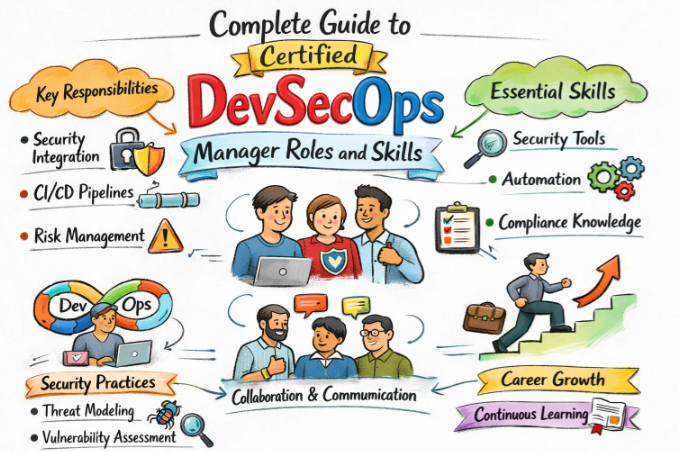
As software delivery moves faster than ever, the role of a manager has shifted from simply overseeing tasks to architecting a culture of safety and reliability. This guide outlines the path to becoming a Certified DevSecOps Manager, a role that combines high-level strategy with deep technical governance.
Success in this field is about seeing the “big picture.” To do that, you need more than just security tools; you need a system-wide view. Integrating concepts from the Master in Observability Engineering Certifications Program into your leadership style ensures that your security measures are not just present, but effective and measurable.
Master Table of Professional Certifications
This matrix helps you identify the right track for your career stage. Each path is designed to build the specialized skills required for modern operational excellence.
| Track | Level | Who it’s for | Prerequisites | Skills covered | Recommended order |
| DevOps | Associate | Junior Engineers | Basic Scripting | CI/CD, Linux, Docker | 1 |
| DevOps | Expert | Senior Engineers | 2+ Years Experience | IaC, Orchestration, Scaling | 2 |
| DevSecOps | Master | Team Leads & Managers | 3-5 Years Experience | Governance, Risk, Strategy | 3 |
| SRE | Specialist | Reliability Engineers | Coding & Systems | SLOs, Incident Response | 2 |
| AIOps/MLOps | Specialist | ML & Data Leads | Python, Cloud | Model Pipelines, Auto-tuning | 3 |
| DataOps | Specialist | Data Architects | SQL, Big Data | Data Pipeline Integrity | 3 |
| FinOps | Specialist | Cloud Managers | Financial Basics | Unit Economics, Optimization | 2 |
| Observability | Master | Architects / Leads | Deep Telemetry | Tracing, Metrics, Analysis | 4 |
Deep Dive: Certified DevSecOps Manager
The Certified DevSecOps Manager (CDOM) is a master-level credential for those who want to move beyond technical implementation and lead the organizational shift toward secure delivery.
What it is
The Certified DevSecOps Manager is a leadership-focused certification that addresses the challenges of managing secure software lifecycles at scale. It focuses on the “Shift-Left” philosophy from a management perspective—ensuring that security isn’t just a technical hurdle, but a core part of the business strategy. This program teaches you how to automate compliance, manage risk across multiple teams, and foster a culture of shared responsibility. Much like the Master in Observability Engineering Certifications Program gives you a lens into system performance, the CDOM gives you a lens into the security health of your entire organization.
Who should take it
This certification is designed for those ready to step into a high-impact leadership role:
- Engineering Managers responsible for multiple development squads.
- Senior DevOps Engineers transitioning into formal management or director roles.
- Security Leads who need to integrate deeply with modern agile and cloud teams.
- CTOs and Architects who need a framework for long-term secure engineering.
Skills you’ll gain
This program transitions you from a technical contributor to a strategic visionary who understands how security impacts the bottom line.
You will learn to lead with influence, not just authority. This means building systems that empower developers rather than blocking them.
- Strategic Security Leadership: Learning to lead the cultural transformation required for true DevSecOps.
- Automated Compliance Governance: Turning regulatory requirements into “Policy as Code” that runs automatically in your pipelines.
- Enterprise Risk Management: Identifying, prioritizing, and mitigating threats based on their actual business impact.
- Security Orchestration Strategy: Choosing the right mix of tools (SAST, DAST, IAST) and ensuring they integrate seamlessly without slowing down releases.
- Data-Driven Security: Using metrics and observability to prove the ROI of your security initiatives to senior leadership.
Real-world projects you should be able to do after it
The focus here is on delivering tangible value to your organization through large-scale security initiatives.
You will be able to manage complex systems that protect your company’s assets while maintaining high velocity.
- Building a Global DevSecOps Roadmap: Creating a multi-year strategy that aligns secure engineering with the company’s product growth.
- Implementing Continuous Auditing: Designing a system that makes your teams “always audit-ready,” eliminating the manual stress of compliance reviews.
- Orchestrating Vulnerability Management: Establishing a cross-functional process for identifying and patching security flaws across hundreds of applications.
- Cloud Security Cost Optimization: Performing a FinOps-style audit of your security tools to ensure the business is getting the best value for its investment.
Preparation Plan (7 / 30 / 60 Days)
- 7–14 Days (The Expert Sprint): For seasoned leaders. Focus purely on the exam format and the specific governance frameworks (like ISO/NIST) mentioned in the curriculum. Spend 3 hours a day on mock assessments.
- 30 Days (The Career Pivot): The standard track. Spend the first two weeks on technical tool integration. Spend the last two weeks focusing on the “Manager” modules: risk assessment, team leadership, and compliance.
- 60 Days (The Foundation Builder): Recommended if you are moving from a non-security background. Spend the first month mastering the technical basics of DevSecOps. Spend the second month mastering management theory and the practical capstone projects.
Common Mistakes
Avoiding these errors is what separates a technician from a true manager.
- Focusing on Tools Over People: Tools are easy to buy; culture is hard to build. A manager’s primary job is to fix the culture that allows security bugs to exist.
- Ignoring the Developer Experience: If you build a secure gate that takes 20 minutes to run, developers will hate it. You must learn to build “invisible” security.
- Managing Without Data: Without deep telemetry and observability, you are just guessing. This is why many successful leaders also pursue a Master in Observability Engineering.
- Failing to Align with Business Goals: Security doesn’t exist in a vacuum. If your security strategy stops the business from shipping features, the strategy will fail.
Best Next Certification After This
Once you have mastered the CDOM, look toward broadening your executive impact.
- Leadership Path: Advanced Security Leadership for those aiming for CISO roles.
- Cross-Track: FinOps Practitioner (to master the economics of the cloud and security spend).
- Strategic Focus: Master in Observability Engineering (to gain a total, 360-degree view of your technical infrastructure).
Choose Your Path
Every leader’s journey is unique. Identify your ultimate career goal and follow the roadmap that leads you there.
- DevOps Path: Concentrates on improving the velocity and efficiency of the software delivery process.
- DevSecOps Path: Focuses on the integration of automated security into every phase of the application lifecycle.
- SRE Path: Prioritizes the stability, scalability, and performance of large-scale systems.
- AIOps/MLOps Path: Explores the use of artificial intelligence to manage and predict system behavior automatically.
- DataOps Path: Streamlines the secure and reliable delivery of data for business intelligence and analytics.
- FinOps Path: Manages the financial efficiency of cloud resources to ensure maximum business value.
Role → Recommended Certifications Mapping
Use this table to align your current role with your long-term career aspirations.
| If your role is… | Your next strategic step is… | Priority Level |
| DevOps Engineer | SRE Expert $\rightarrow$ CKA | High |
| SRE | Master in Observability Engineering | Critical |
| Platform Engineer | Certified DevSecOps Manager | Strategic |
| Cloud Engineer | FinOps Practitioner $\rightarrow$ Cloud Architect | High |
| Security Engineer | Certified DevSecOps Manager | Career-Defining |
| Data Engineer | DataOps Specialist $\rightarrow$ MLOps | High |
| FinOps Practitioner | FinOps Expert $\rightarrow$ Cloud Economics | High |
| Engineering Manager | Certified DevSecOps Manager $\rightarrow$ Observability (M) | Executive |
Top Institutions for Training & Certification
To pass a master-level exam like the CDOM, you need training that understands the global engineering landscape.
- DevOpsSchool: A premier global institution known for its high-intensity, hands-on labs. They don’t just teach the exam; they teach you how to handle real-world production crises.
- Cotocus: They specialize in corporate-level transformations, helping entire departments transition into a unified DevSecOps culture through practical, tool-focused workshops.
- Scmgalaxy: A technical powerhouse that provides some of the deepest documentation and community support in the industry for automation and orchestration.
- BestDevOps: They offer a more personalized approach to mentoring, helping individuals plan their career jumps and master the soft skills required for leadership.
- Devsecopsschool: The official home for the CDOM certification, offering a curriculum that is always updated to reflect the latest security threats and exam standards.
- Sreschool: The go-to source for those wanting to master the art of reliability engineering, SLOs, and incident response.
- Aiopsschool: Providing cutting-edge training for the next generation of operations, focusing on integrating AI into your monitoring and deployment workflows.
- Dataopsschool: The dedicated Choice for data professionals who want to apply DevOps principles to the world of big data and analytics.
- Finopsschool: The central hub for learning cloud financial management and cost optimization strategies for engineering leaders.
General Career FAQs
- Which track should I pick if I want to move into management? The DevSecOps track (specifically CDOM) is the most direct path to modern engineering leadership because it covers culture, risk, and governance.
- How long do these certifications take? Most professionals can complete a master-level certification in 30 to 60 days of dedicated study.
- Are these certifications recognized in India? Yes, the Indian market has a massive demand for certified managers, particularly in the tech hubs like Bangalore, Hyderabad, and Pune.
- Do I need an MBA to be a successful manager? Not anymore. In modern tech companies, specialized master certifications like the CDOM are often valued more than a general business degree.
- What is the “ROI” of getting certified? Beyond a salary increase, it gives you a “seat at the table” during strategic planning because you speak the language of both engineering and business.
- Can I self-study for these exams? You can, but for a management level, formal training is highly recommended to understand the complex case studies and scenarios.
- Why is Observability so important? Because you cannot lead what you cannot see. The Master in Observability Engineering provides the evidence you need to back up your leadership decisions.
- Is it better to be a generalist or a specialist? Start as a specialist (DevOps or Security) and move toward being a “strategic generalist” as you enter management (CDOM).
- Are the exams proctored? Yes, to maintain the value of the credential, master-level exams are typically proctored online.
- How often should I update my skills? Usually every 2–3 years, as the technology and security threats evolve rapidly.
- Do I need to be a coding expert? You need to be “code-literate”—you must be able to understand script logic even if you aren’t writing code every day.
- What is the first step I should take? Identify your goal role, check the “Role Mapping” table above, and start with the corresponding certification.
Certified DevSecOps Manager (CDOM) FAQs
- How does the CDOM differ from a general security cert like CISSP? The CISSP is broad and often legacy-focused. The CDOM is specifically built for the high-speed, automated, cloud-native world of DevOps.
- Is there a practical component to the training? Yes. About 50% of the program is focused on hands-on project work, such as building and securing actual delivery pipelines.
- What are the prerequisites for the CDOM? A background in development, operations, or security is required, as this is a master-level management program.
- Can I take the exam online? Yes, official providers like devsecopsschool.com offer secure online examination options.
- How does this certification help with SOC2 or ISO audits? It teaches you how to automate the evidence collection, making the audit process much faster and less painful for your engineers.
- Is the CDOM valid globally? Yes, the principles taught are vendor-neutral and are recognized by major tech firms worldwide.
- What happens if I fail the exam? Most programs offer a retake option after a short cooling-off period to allow for more study.
- Why is devsecopsschool.com the best provider? Because they specialize in this specific domain and their curriculum is designed by practitioners who are active in the industry.
Conclusion
The path to becoming a Certified DevSecOps Manager is a journey that changes how you see the entire engineering ecosystem. It moves you from the engine room to the bridge of the ship, where you are responsible for both the safety and the speed of the vessel. By mastering the balance between innovation and security, you become an indispensable asset in the global engineering market. This guide has provided you with the technical requirements, the preparation strategies, and the visionary paths available to you. Whether you choose to double down on the technicalities of SRE or the economics of FinOps, remember that the foundation of all modern leadership is visibility. Engaging with programs like the Master in Observability Engineering Certifications Program will ensure that you are never managing in the dark. Now is the time to invest in your growth, choose your specialization, and lead your organization into a more secure and reliable future. The evolution of your career starts with the decision to master these disciplines today.

Best Cardiac Hospitals Near You
Discover top heart hospitals, cardiology centers & cardiac care services by city.
Advanced Heart Care • Trusted Hospitals • Expert Teams
View Best Hospitals