Introduction
Grant management software is a specialized category of digital solutions designed to handle the complex lifecycle of grantmaking and grantseeking. For funders, these platforms provide an end-to-end framework to announce opportunities, track applications, manage the review process, and monitor the impact of awarded funds. For recipients, they offer a centralized repository to discover funding, manage deadlines, and submit compliance reports. These tools replace fragmented systems like spreadsheets and scattered emails with a unified “source of truth.”
In the current landscape, grant management has shifted from a back-office administrative task to a strategic driver of social impact. As we move through the mid-2020s, the integration of AI for automated vetting and real-time impact reporting has made these tools essential for transparency. Whether for private foundations, government agencies, or research universities, grant management software ensures that every dollar is tracked, every regulation is met, and every outcome is measurable.
Real-World Use Cases
- Philanthropic Grantmaking: Private foundations managing the full cycle from initial call-for-proposals to multi-year impact tracking and disbursement.
- Government Funding Programs: Federal, state, and local agencies distributing public funds while maintaining strict adherence to regulatory compliance and audit trails.
- University Research Management: Academic institutions tracking faculty grant applications, managing internal approvals, and monitoring research expenditures.
- Corporate CSR Programs: Corporations managing community investment grants and employee matching programs as part of their social responsibility initiatives.
- Scholarship & Fellowship Administration: Educational organizations handling high-volume applications and multi-stage review processes for student awards.
Evaluation Criteria for Buyers
- Workflow Configuration: The ability to tailor the application and review steps to match your organization’s unique internal processes.
- Compliance & Audit Trails: Robust logging of all actions and automated checks to ensure alignment with regulations like Uniform Guidance or GDPR.
- Applicant Experience: The ease with which external users can create accounts, save progress, and submit documentation without technical support.
- Reviewer Portal: The quality of the interface where internal or external judges score applications and provide feedback.
- Reporting & Impact Analytics: The depth of built-in tools for creating visual dashboards and funder-specific impact reports.
- Finance & Accounting Integration: How well the software connects with existing ERP or accounting systems to track disbursements and expenditures.
- Security & Data Privacy: High-level protections including encryption, Multi-Factor Authentication (MFA), and SOC 2 compliance.
Best for: Grantmaking foundations, government agencies, universities, and corporate CSR teams looking to automate high-volume application cycles and improve transparency.
Not ideal for: Small organizations only managing a single, simple grant per year who may find the cost and setup of a dedicated platform unnecessary compared to basic task management tools.
Key Trends in Grant Management Software
- AI-Powered Vetting: Platforms are now using AI to automatically screen applicants for eligibility based on IRS status, geographic location, or mission alignment.
- Impact-First Reporting: A major shift toward capturing qualitative outcomes and “storytelling” data alongside traditional financial metrics.
- Automated Compliance Alerts: Systems that warn administrators when a grantee’s spending pattern creates a risk of non-compliance with grant restrictions.
- OpenUSD for Data Portability: Increased adoption of industry-standard data formats to allow easier transfer of grant history between different software ecosystems.
- Equitable Grantmaking Tools: Features such as anonymized reviews and bias-detection algorithms to ensure fairer selection processes.
- Real-Time Financial Sync: Deep, bi-directional integration with accounting software that allows for instant updates on fund availability and payment status.
- Mobile-First Applicant Portals: A focus on making the application process fully accessible via smartphones for grassroots organizations with limited hardware.
- Generative Narrative Support: AI tools that help grantseekers draft initial responses and help grantmakers summarize complex project reports.
How We Selected These Tools
Our selection of the top ten grant management tools is based on a rigorous evaluation of the current philanthropic and public sector software market. We focused on platforms that provide full-cycle coverage—from pre-award discovery to post-award closeout. Our methodology prioritized software with high reliability, established security postures (such as FedRAMP or SOC 2), and strong user feedback from administrators and applicants. We balanced the list to include enterprise suites for large foundations, specialized compliance-forward tools for the public sector, and user-friendly options for small-to-mid-sized nonprofits.
Top 10 Grant Management Software Tools
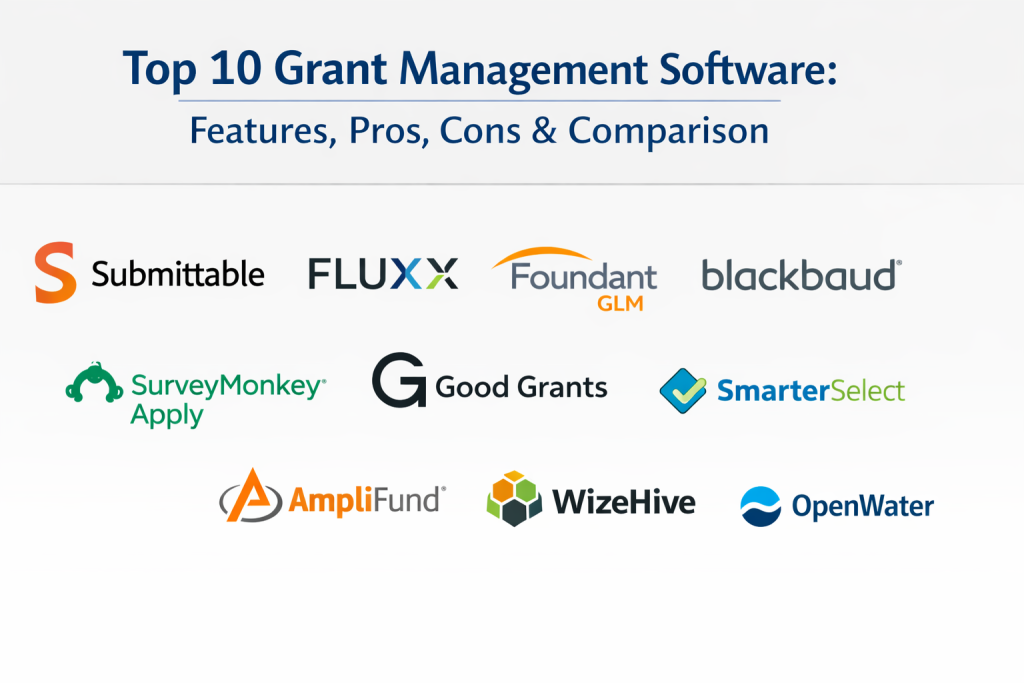
1. Submittable
Submittable is widely recognized for its exceptional user experience and high-volume intake capabilities. It is a versatile tool used by everyone from local governments to major corporations for managing grants, awards, and relief funds.
Key Features
- Dynamic Form Builder: A drag-and-drop interface for creating complex, branch-logic application forms.
- Reviewer Collaboration: A centralized portal for judges to score and comment on submissions in real-time.
- Automated Workflows: Set up triggers to move applications through stages and send automatic notifications.
- Impact Reporting: Visual dashboards that aggregate data from custom form fields to show program success.
- Funds Distribution: Built-in tools for securely disbursing payments to awardees.
Pros
- Highest-rated interface for applicant and reviewer ease of use.
- Rapid deployment—many programs can go live in a matter of days.
Cons
- Post-award financial monitoring depth is lighter than specialized enterprise suites.
- Advanced analytics features often require higher-tier plans.
Platforms / Deployment
Web — Cloud
Security & Compliance
SOC 2 Type II, HIPAA, and GDPR compliant.
Integrations & Ecosystem
Submittable offers a robust API and integrates with common CRM and finance tools to ensure data flows smoothly into downstream systems.
Support & Community
Excellent official documentation and a strong reputation for responsive customer support during high-volume periods.
2. Fluxx
Fluxx is an enterprise-grade platform built specifically for sophisticated grantmakers. It is known for its highly configurable dashboards and its ability to manage complex, multi-layered grantmaking programs.
Key Features
- Configurable Dashboards: Tailored views for every role, from program officers to board members.
- Automated Reminders: Dynamic routing and bulk actions to keep the grant lifecycle on schedule.
- Compliance Integration: Native vetting via SAM.gov, Candid, and LexisNexis.
- Audit Trails: Comprehensive logs of every change and interaction for full regulatory transparency.
- Ad-Hoc Reporting: Powerful internal tools for creating complex, multi-criteria data reports.
Pros
- Extremely powerful for organizations with highly unique or complex workflows.
- Strong focus on security with FedRAMP-compliant cloud hosting options.
Cons
- Steep learning curve for administrators due to the depth of configuration options.
- Higher total cost of ownership compared to more basic intake tools.
Platforms / Deployment
Web — Cloud
Security & Compliance
FedRAMP, SSO/MFA, and role-based access control (RBAC).
Integrations & Ecosystem
Fluxx features native integrations with major philanthropic databases and can connect to enterprise ERP systems for deep financial tracking.
Support & Community
Provides extensive live training and a professional user community focused on large-scale philanthropy.
3. Foundant (GLM)
Foundant’s Grant Lifecycle Manager (GLM) is a balanced tool designed to simplify the grantmaking process for community foundations and mid-market grantmakers. It focuses on accessibility and efficiency.
Key Features
- Full Lifecycle Tracking: Manages everything from the initial letter of intent (LOI) to the final report.
- Reviewer Portal: A simplified interface for board members and external reviewers to evaluate grants.
- Automatic Follow-ups: Automatically prompts grantees for required reports and documentation.
- Ecosystem Alignment: Seamlessly integrates with Foundant’s specialized accounting software for foundations.
- Custom Letter Templates: Create and automate the delivery of award and decline letters.
Pros
- Excellent balance between powerful features and ease of use.
- Highly regarded customer service and onboarding experience.
Cons
- Not as many native integrations for organizations outside the Foundant ecosystem.
- The UI can feel more traditional compared to “slicker” modern web apps.
Platforms / Deployment
Web — Cloud
Security & Compliance
Standard SOC 2 compliance and encrypted data storage.
Integrations & Ecosystem
Designed to work perfectly with Foundant’s suite of products for grantseekers and foundation accountants.
Support & Community
Strong community focus with active user groups and a high-touch support model.
4. Blackbaud Grantmaking
Blackbaud is a titan in the nonprofit sector, and its grantmaking tool is built to integrate with its massive suite of fundraising and accounting products. It is best for organizations already using the Blackbaud ecosystem.
Key Features
- Database Centralization: Moves data directly from applications into the core relationship management system.
- Visual Dashboards: Stunning visual summaries of impact and funding trends.
- SKY View Interface: A modern web interface designed for faster navigation and data entry.
- Fund Accounting Integration: Native sync with Blackbaud’s financial management tools.
- Custom Reporting: A robust library of pre-built and custom reports for stakeholders.
Pros
- Ideal for large organizations that need a “single pane of glass” for donors and grantees.
- Very robust database capabilities for managing long-term relationships.
Cons
- High complexity and a steep learning curve for new users.
- Pricing is on the higher end and may be inconsistent between client types.
Platforms / Deployment
Web — Cloud
Security & Compliance
Standard enterprise security including identity management and SOC 2.
Integrations & Ecosystem
Superior integration within the Blackbaud suite (Raiser’s Edge, Financial Edge) but fewer external options.
Support & Community
Very knowledgeable customer support but often requires frequent contact due to software complexity.
5. SmarterSelect
SmarterSelect is an intuitive tool focused on scholarship and grant management for program leads who want to avoid “application chaos.” It is known for its rapid setup and flat-rate pricing model.
Key Features
- Unlimited Programs: A single price allows for an unlimited number of grant and scholarship programs.
- Rapid Setup: Many organizations can stand up their first program in less than 24 hours.
- Applicant Tracking: Centralized view of all candidate progress and document submissions.
- Reviewer Scoring: A simple portal for evaluators to score applications fairly and consistently.
- Customizable Templates: Pre-designed layouts to get new applications running quickly.
Pros
- Extremely cost-effective for organizations running many small programs.
- Designed for non-technical users with no coding required.
Cons
- Lacks the deep post-award financial tracking found in enterprise suites.
- Analytics are basic compared to high-end BI integrations.
Platforms / Deployment
Web — Cloud
Security & Compliance
Audit management and compliance tracking for internal policies.
Integrations & Ecosystem
Supports standard data import/export and basic CRM integrations.
Support & Community
High-rated for ease of setup and basic support; excellent for small foundation teams.
6. SurveyMonkey Apply
SurveyMonkey Apply (formerly FluidReview) leverages the familiar survey technology of its parent company to provide a streamlined application and review platform.
Key Features
- Automated Notifications: Keeps applicants and reviewers on track with scheduled reminders.
- Multi-Stage Workflows: Configure complex review cycles with multiple rounds of judging.
- Collaboration Tools: Allows team members to share notes and media files within the app.
- AI-Powered Analysis: Use integrated tools to highlight trends and sentiment in applications.
- Customizable Branding: Add logos and brand colors to ensure a professional applicant experience.
Pros
- Very intuitive for those already familiar with the SurveyMonkey ecosystem.
- Faster innovation cycle with regular updates and new AI features.
Cons
- Can become expensive as you move into higher tiers with more features.
- Some advanced configurations require a deeper technical understanding.
Platforms / Deployment
Web — Cloud
Security & Compliance
SOC 2 Type II and GDPR compliant.
Integrations & Ecosystem
Strongest set of native integrations for a mid-market tool, connecting easily to major CRM platforms.
Support & Community
Highly rated for customer support and comprehensive documentation.
7. Good Grants
Good Grants is a modern, impact-focused platform that prioritizes fairness and transparency in the selection process. It is used by foundations and government bodies globally.
Key Features
- Anonymized Reviews: Features to reduce unconscious bias during the evaluation process.
- Audit Trails: Fully traceable decision-making history for every application.
- Impact Documentation: Tools specifically designed to capture societal impact data.
- Real-Time Reporting: Live dashboards for monitoring program health and diversity.
- International Support: Multiple language and currency options for global programs.
Pros
- Strongest focus on ethical grantmaking and reducing bias.
- Clean, modern interface that everyone from applicants to board members enjoys.
Cons
- May lack some of the deepest “financial-first” accounting features of older suites.
- High customization can lead to administrative “sprawl” if not managed.
Platforms / Deployment
Web — Cloud
Security & Compliance
Secure data management with a focus on privacy and transparency.
Integrations & Ecosystem
Offers a modern API and standard integrations for standard nonprofit tech stacks.
Support & Community
Highly active in promoting “good grantmaking” practices and bias reduction training.
8. AmpliFund
AmpliFund (part of the Euna family) is a compliance-forward tool designed primarily for the public sector. it focuses heavily on the strict requirements of federal and state grant management.
Key Features
- Compliance Workflows: Built-in safeguards to ensure adherence to Uniform Guidance (2 CFR 200).
- Performance Tracking: Correlates financial spend directly with programmatic outcomes.
- Grantee Portals: Dedicated spaces for awardees to submit required documentation and reports.
- Disbursement Tracking: Detailed management of payment schedules and fund availability.
- Enterprise Security: Designed for the high-security needs of government agencies.
Pros
- The best choice for organizations managing government funds with high audit risk.
- Exceptionally strong post-award monitoring and financial oversight.
Cons
- The interface is more technical and “form-heavy” than applicant-centric tools.
- Implementation can be a significant undertaking for smaller teams.
Platforms / Deployment
Web — Cloud
Security & Compliance
SOC 2, HIPAA, and specialized public sector security standards.
Integrations & Ecosystem
Deeply integrated into the Euna ecosystem for public sector financial management.
Support & Community
Professional support with deep expertise in government regulatory requirements.
9. WizeHive (Zengine)
WizeHive’s Zengine is a highly flexible platform that can be configured for grants, scholarships, and awards. It is known for its powerful automation and mid-market adaptability.
Key Features
- Workflow Designer: Highly configurable steps for unique program requirements.
- Review Operations: Supports high-volume review processes with custom scoring rubrics.
- Data Import/Export: Flexible tools for moving data in and out of the platform.
- Applicant Portal: A clean gateway for users to update info and track progress.
- Automated Responses: Saves hours of manual follow-up with intelligent messaging.
Pros
- Highly suitable for organizations managing multiple types of programs in one place.
- Strong configuration depth without needing a fully custom build.
Cons
- Configuration depth can lead to administrative complexity if not carefully governed.
- Advanced analytics may require external business intelligence tools.
Platforms / Deployment
Web — Cloud
Security & Compliance
Standard SOC 2 and encrypted remote access.
Integrations & Ecosystem
Varies; primarily focused on CRM exports and email workflows.
Support & Community
Strong mid-market presence with reliable support for established programs.
10. OpenWater
OpenWater is a versatile tool designed for “application and review” programs of all kinds. It excels in environments that require multi-stage evaluation and complex scoring.
Key Features
- Multi-Stage Cycles: Supports several rounds of judging and refinement.
- Form Builder: Flexible tools for collecting both data and high-resolution media files.
- Reviewer Management: Features to assign reviewers based on expertise or workload.
- Built-in Payments: Securely collect application or membership fees.
- Reporting Dashboards: Real-time visibility into submission volume and judge progress.
Pros
- Faster to stand up than a full enterprise grantmaking suite.
- Excellent for programs that involve high-touch evaluation and scoring.
Cons
- Post-award lifecycle management (disbursement/monitoring) is lighter than competitors.
- Advanced reporting can require more manual setup.
Platforms / Deployment
Web — Cloud
Security & Compliance
Standard enterprise security features and role-based access.
Integrations & Ecosystem
Integrates well with association management systems and modern web tools.
Support & Community
Active user base and solid documentation for program administrators.
Comparison Table (Top 10)
| Tool Name | Best For | Platform(s) Supported | Deployment | Standout Feature | Public Rating |
| 1. Submittable | High-volume & Ease of Use | Web | Cloud | Applicant Experience | 4.8/5 |
| 2. Fluxx | Complex Foundations | Web | Cloud | Configurable Dashboards | 4.4/5 |
| 3. Foundant (GLM) | Structured Lifecycle | Web | Cloud | Lifecycle Balance | 4.6/5 |
| 4. Blackbaud | Large Ecosystems | Web | Cloud | Relationship Database | 4.0/5 |
| 5. SmarterSelect | Scholarships & Small Orgs | Web | Cloud | 24hr Quick Setup | 4.4/5 |
| 6. SurveyMonkey Apply | Innovative UX/AI | Web | Cloud | AI Analysis Tools | 4.5/5 |
| 7. Good Grants | Fair & Ethical Selection | Web | Cloud | Bias Reduction Features | 4.7/5 |
| 8. AmpliFund | Public Sector Compliance | Web | Cloud | 2 CFR 200 Alignment | 4.3/5 |
| 9. WizeHive | Multi-Program Management | Web | Cloud | Workflow Automation | 4.4/5 |
| 10. OpenWater | Awards & Simple Grants | Web | Cloud | Multi-Stage Review | 4.5/5 |
Evaluation & Scoring of Grant Management Software
| Tool Name | Core (25%) | Ease (15%) | Integrations (15%) | Security (10%) | Perf (10%) | Support (10%) | Value (15%) | Total |
| 1. Submittable | 9 | 10 | 8 | 9 | 9 | 9 | 7 | 8.7 |
| 2. Fluxx | 10 | 4 | 9 | 10 | 9 | 8 | 6 | 8.1 |
| 3. Foundant | 8 | 8 | 7 | 9 | 8 | 10 | 8 | 8.1 |
| 4. Blackbaud | 10 | 3 | 7 | 9 | 9 | 8 | 5 | 7.4 |
| 5. SmarterSelect | 7 | 9 | 6 | 8 | 8 | 8 | 10 | 7.8 |
| 6. SurveyMonkey | 8 | 9 | 8 | 9 | 9 | 8 | 7 | 8.2 |
| 7. Good Grants | 9 | 9 | 7 | 9 | 8 | 9 | 7 | 8.3 |
| 8. AmpliFund | 10 | 5 | 8 | 10 | 8 | 8 | 7 | 8.1 |
| 9. WizeHive | 8 | 7 | 8 | 9 | 8 | 8 | 8 | 7.8 |
| 10. OpenWater | 7 | 8 | 7 | 9 | 8 | 8 | 8 | 7.6 |
The scoring reflects a balance of technical capability and usability. High “Core” scores identify tools capable of managing complex, high-risk financial cycles. High “Ease” scores represent tools that require minimal staff training, while high “Value” scores indicate pricing models that are favorable for growing nonprofits or small foundations.
Which Grant Management Software Tool Is Right for You?
Solo / Freelancer
For consultants or individuals managing small scholarship programs, SmarterSelect or OpenWater are ideal. They offer the fastest setup times and straightforward pricing that doesn’t require a large organizational budget.
SMB
Small-to-mid-sized nonprofits and local foundations should look at Submittable or Foundant. These tools provide a professional experience for applicants while giving administrators the automation they need to avoid burnout.
Mid-Market
Organizations running multiple grant programs across different focus areas will find WizeHive or Good Grants to be the best fit. These platforms offer the flexibility to handle diverse workflows without the extreme overhead of an enterprise suite.
Enterprise
Large foundations with global reach and massive endowments should consider Fluxx or Blackbaud. These platforms are designed to handle the scale and complexity of relationship-based grantmaking at the highest levels.
Budget vs Premium
SmarterSelect is the clear winner for budget-conscious organizations needing unlimited program capacity. Fluxx and AmpliFund are premium solutions that justify their cost through advanced compliance features and deep configuration power.
Feature Depth vs Ease of Use
If you need deep compliance and audit tools, AmpliFund is the choice, but it requires more training. If you prioritize a “zero-training” experience for your board and applicants, Submittable is the superior option.
Integrations & Scalability
For organizations already using the Microsoft or Salesforce ecosystems, Azure-integrated tools or Submittable (via API) offer the best scalability. For those in the Blackbaud ecosystem, staying with Blackbaud Grantmaking is the most efficient path.
Security & Compliance Needs
Government agencies and those managing public funds must prioritize AmpliFund or Fluxx for their specialized focus on federal regulations and high-level security certifications.
Frequently Asked Questions (FAQs)
1. Is grant management software different from a CRM?
Yes. While a CRM tracks donor relationships, grant management software is specifically designed for the intake, review, and compliance tracking of awarded funds.
2. Can these tools help me find new grants?
Most of these tools are for managing grants you already have or are offering. However, some tools like Instrumentl or Foundant for Grantseekers are specifically designed for grant discovery.
3. Is it hard to migrate our old spreadsheets into these systems?
Most modern platforms like Submittable or WizeHive offer bulk data import tools, though some “cleanup” of your old data is usually required first.
4. Can reviewers use these systems on their phones?
Yes, most modern tools like Good Grants and SurveyMonkey Apply feature responsive designs that allow reviewers to score applications on tablets or mobile devices.
5. How much does grant management software cost?
Pricing varies wildly. Some tools start at a few thousand dollars per year, while enterprise suites for large foundations can cost tens of thousands annually.
6. Does the software handle the actual payment of funds?
Some platforms like Submittable have built-in payment tools, while others integrate with your accounting software to trigger the disbursement.
7. Is our data safe in the cloud?
Platforms with SOC 2 Type II or FedRAMP compliance offer industry-standard security. Always check a tool’s “Trust Center” for their specific security certifications.
8. How long does it take to get a new system running?
Simple tools like SmarterSelect can be ready in 24 hours, while complex enterprise implementations like Fluxx can take several months of configuration.
9. Can we use these tools for scholarships too?
Absolutely. Many of these tools, particularly OpenWater and SmarterSelect, are designed to handle both grants and scholarship programs seamlessly.
10. What is the most important feature to look for?
The most important feature is usually workflow flexibility—the software must be able to adapt to how your specific team already works, not the other way around.
Conclusion
The move toward specialized grant management software is a critical step for any organization looking to maximize its social impact while maintaining strict accountability. As the philanthropic landscape becomes more data-driven and transparency-focused, the ability to centralize applications, automate reviews, and track real-world outcomes is no longer optional. By choosing a platform that balances technical depth with ease of use, you ensure that your team can spend less time on paperwork and more time on the transformative work your funding supports. I recommend shortlisting three tools—one intake-focused like Submittable, one lifecycle-focused like Foundant, and one compliance-focused like AmpliFund. Run a small “pilot” review cycle with a mock application to see which workflow feels most natural for your team.

Best Cardiac Hospitals Near You
Discover top heart hospitals, cardiology centers & cardiac care services by city.
Advanced Heart Care • Trusted Hospitals • Expert Teams
View Best Hospitals