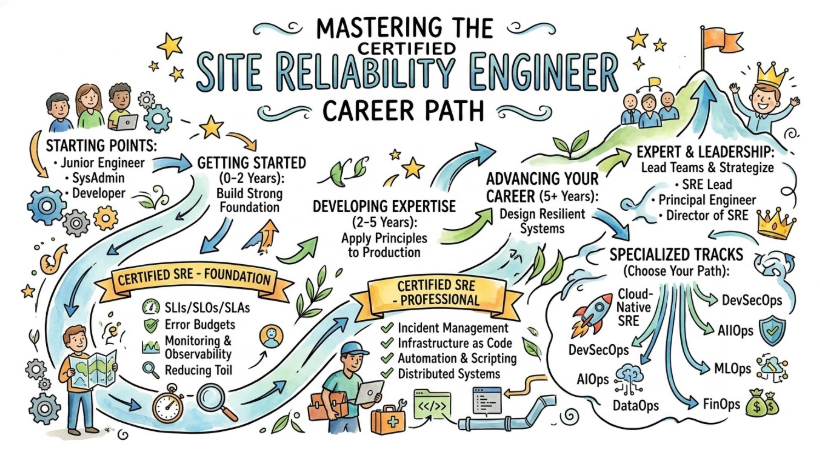
The Certified Site Reliability Engineer program is a professional validation designed for those who manage the intersection of operations and software engineering. This guide is for system administrators moving toward automation, developers shifting into infrastructure, and managers overseeing complex cloud environments. In the current landscape of platform engineering and cloud-native architectures, understanding how to maintain high availability while shipping code rapidly is a critical career differentiator. This guide helps professionals evaluate the certification’s depth and make informed decisions about their technical growth. For those looking to excel, the Certified Site Reliability Engineer provides a structured roadmap to mastering production environments.
What is the Certified Site Reliability Engineer?
The Certified Site Reliability Engineer represents a standard of excellence in maintaining large-scale, distributed systems. It exists to bridge the gap between traditional operations and modern software practices by focusing on reliability as a primary feature. Unlike theoretical courses, this certification emphasizes real-world applications such as error budgets, service level objectives, and toil reduction. It aligns with modern enterprise practices where uptime is directly tied to business revenue and customer satisfaction.
Who Should Pursue Certified Site Reliability Engineer?
This certification is ideally suited for DevOps engineers, systems administrators, and cloud architects who want to formalize their reliability skills. Beginners in the infrastructure space will find it provides a solid foundation, while experienced seniors can use it to validate their expertise in incident management and automation. It is highly relevant for professionals in India and across the global market where tech-driven enterprises are scaling rapidly. Engineering managers also benefit from this path to better lead teams through digital transformation journeys.
Why Certified Site Reliability Engineer is Valuable and Beyond
The demand for reliability expertise continues to grow as organizations move away from legacy data centers toward complex microservices. This certification offers long-term career longevity because the principles of SRE—such as monitoring, alerting, and automation—are independent of specific tool versions. Professionals who hold this credential demonstrate a commitment to operational excellence that enterprises value during hiring and promotions. It provides a significant return on investment by positioning the engineer as a high-value asset capable of preventing costly outages.
Certified Site Reliability Engineer Certification Overview
The program is delivered via the official training portal and hosted on the main website. It utilizes a practical assessment approach rather than rote memorization, ensuring that candidates can actually perform the tasks required in a production setting. The certification is structured into logical levels that allow for a progressive learning experience, starting from core concepts and moving toward advanced architectural strategies. Ownership of the program is maintained by industry experts who keep the curriculum updated with the latest infrastructure trends.
Certified Site Reliability Engineer Certification Tracks & Levels
The certification is organized into foundation, professional, and advanced tiers to accommodate different career stages. Specialization tracks allow engineers to focus on specific domains like automation, incident response, or cloud-specific SRE practices. These levels are designed to align with typical career progression, taking a junior engineer through the steps needed to become a principal or lead SRE. By completing these tracks, professionals can demonstrate a clear growth trajectory to current or future employers.
Complete Certified Site Reliability Engineer Certification Table
| Track | Level | Who it’s for | Prerequisites | Skills Covered | Recommended Order |
| Core SRE | Foundation | Junior Engineers | Basic Linux/Cloud | SLIs/SLOs, Toil, Monitoring | 1 |
| Operations | Professional | DevOps Engineers | Foundation Level | Incident Management, IAC | 2 |
| Architecture | Advanced | Lead Engineers | 5+ Years Experience | Distributed Systems, Scalability | 3 |
| Specialization | Expert | SRE Leads | Advanced Level | Chaos Engineering, Post-mortems | 4 |
Detailed Guide for Each Certified Site Reliability Engineer Certification
Certified Site Reliability Engineer – Foundation
What it is
This certification validates a fundamental understanding of the SRE mindset and the core metrics used to measure system health. It serves as the entry point for anyone looking to transition from traditional IT roles into modern site reliability.
Who should take it
It is suitable for junior developers, system admins, and fresh graduates who want to understand how production systems are managed. It is also a great starting point for managers who need to speak the language of their technical teams.
Skills you’ll gain
- Understanding the difference between DevOps and SRE.
- Defining Service Level Indicators and Objectives.
- Implementing basic monitoring and alerting strategies.
- Identifying and reducing manual toil through automation.
Real-world projects you should be able to do
- Create a dashboard that visualizes the “Four Golden Signals” of monitoring.
- Write a basic script to automate a repetitive manual deployment task.
- Draft a sample Service Level Agreement for a mock internal application.
Preparation plan
- 7–14 days: Focus on understanding the vocabulary and core SRE pillars.
- 30 days: Engage with practical labs and set up basic monitoring tools.
- 60 days: Review case studies of major outages and how SRE principles could have prevented them.
Common mistakes
- Focusing too much on specific tools rather than the underlying SRE principles.
- Underestimating the importance of the cultural shift required for SRE.
- Ignoring the mathematical logic behind error budgets.
Best next certification after this
- Same-track option: Certified Site Reliability Engineer – Professional
- Cross-track option: Certified DevOps Professional
- Leadership option: Technical Team Lead Certification
Choose Your Learning Path
DevOps Path
The DevOps path focuses on the seamless integration of development and operations through continuous delivery. Engineers following this route prioritize automation and the software development lifecycle to increase velocity. It is ideal for those who enjoy building pipelines and improving developer experience. This path eventually leads to roles like Platform Engineer or Lead DevOps Architect.
DevSecOps Path
This path integrates security into Every stage of the development and operations process. It emphasizes shift-left security, automated vulnerability scanning, and compliance as code. Professionals here are responsible for ensuring that speed does not come at the cost of safety. It is a high-demand area for industries like finance and healthcare where data protection is paramount.
SRE Path
The SRE path is dedicated to system availability, performance, and latency. It involves writing code to manage infrastructure and handling incident response for large-scale applications. Engineers on this path focus on making systems more resilient and scalable through engineering practices. It is the gold standard for those who want to work at the core of massive cloud infrastructures.
AIOps Path
AIOps leverages machine learning and big data to automate IT operations and incident detection. This path is for engineers who want to use data-driven insights to predict and resolve issues before they impact users. It requires a blend of traditional operations knowledge and data science concepts. As systems become more complex, AIOps is becoming essential for managing modern scale.
MLOps Path
MLOps focuses on the operationalization of machine learning models in production. It bridges the gap between data scientists and infrastructure engineers to ensure models are deployed and monitored effectively. This path involves managing data pipelines, model versioning, and specialized compute resources like GPUs. It is a critical role for any organization building AI-driven products.
DataOps Path
DataOps applies DevOps and SRE principles to data management and analytics. The goal is to improve the quality and cycle time of data analytics by automating the data pipeline. Professionals in this space work on data orchestration, testing, and continuous integration for data workflows. It is perfect for those who want to combine infrastructure skills with a passion for data.
FinOps Path
FinOps focuses on the financial management of cloud resources to ensure cost-efficiency. It involves bringing accountability to cloud spend and optimizing resource utilization across the organization. This path is increasingly important as companies look to maximize their cloud investment while minimizing waste. It requires a mix of technical understanding and financial literacy.
Role → Recommended Certified Site Reliability Engineer Certifications
| Role | Recommended Certifications |
| DevOps Engineer | Foundation, Professional SRE |
| SRE | Foundation, Professional, Advanced SRE |
| Platform Engineer | Foundation, Infrastructure Automation |
| Cloud Engineer | Foundation, Cloud Reliability Specialist |
| Security Engineer | Foundation, DevSecOps Integration |
| Data Engineer | Foundation, DataOps Specialist |
| FinOps Practitioner | Foundation, Cloud Cost Management |
| Engineering Manager | Foundation, SRE Leadership |
Next Certifications to Take After Certified Site Reliability Engineer
Same Track Progression
Advancing within the SRE track involves moving toward deep specialization in areas like chaos engineering or performance tuning. This progression ensures you remain an expert in the evolving field of reliability. Senior certifications validate your ability to lead large-scale architectural changes. Deepening your expertise here makes you a candidate for Principal SRE positions.
Cross-Track Expansion
Broadening your skills into areas like DevSecOps or FinOps makes you a multi-dimensional engineer. Understanding how reliability interacts with security and cost provides a more holistic view of the business. This cross-training is highly valued in smaller startups and large enterprises alike. It allows you to pivot your career as market demands shift over time.
Leadership & Management Track
For those looking to move away from hands-on keyboard work, the leadership track is the natural next step. This involves certifications in engineering management and technical leadership. You will focus on building high-performing teams and aligning technical strategy with business goals. It is the path toward becoming a Director of Engineering or a CTO.
Training & Certification Support Providers for Certified Site Reliability Engineer
DevOpsSchool
DevOpsSchool provides comprehensive training programs that cover the entire spectrum of modern software delivery. Their courses are designed by industry veterans who bring real-world scenarios into the classroom. They offer a blend of self-paced learning and instructor-led sessions to suit different schedules. Students gain access to a wide range of tools and platforms to practice their skills.
Cotocus
Cotocus focuses on delivering high-impact technical training for enterprise teams and individual professionals. Their approach is centered on hands-on labs and project-based learning to ensure practical competence. They have a strong reputation for helping candidates clear professional certifications on their first attempt. Their curriculum is constantly updated to reflect the latest changes in the cloud ecosystem.
Scmgalaxy
Scmgalaxy is a well-known community and training hub for software configuration management and DevOps. They offer a wealth of resources, including blogs, tutorials, and specialized certification bootcamps. Their focus is on building a strong foundation in version control, CI/CD, and automation. Many professionals look to them for guidance on navigating complex career paths in infrastructure.
BestDevOps
BestDevOps offers targeted training programs for engineers looking to specialize in high-growth areas like SRE and AIOps. Their courses are known for being concise, practical, and directly aligned with certification exam objectives. They provide a supportive learning environment with access to mentors who have extensive field experience. It is an excellent choice for busy professionals seeking efficient upskilling.
devsecopsschool.com
This platform is dedicated to the integration of security within the DevOps lifecycle. They provide specialized tracks for security engineers and developers who want to master automated security testing. Their training covers everything from static analysis to container security and compliance. It is the primary resource for those aiming to become experts in secure software delivery.
sreschool.com
Sreschool.com is the primary authority for SRE-specific training and certification preparation. Their programs are built around the core pillars of site reliability engineering as defined by industry leaders. They offer detailed modules on error budgets, incident response, and distributed systems. For anyone serious about a career in reliability, this is the foundational resource to trust.
aiopsschool.com
Aiopsschool.com focuses on the future of operations through the lens of artificial intelligence and machine learning. Their training helps engineers transition from manual monitoring to automated, data-driven observability. They cover the implementation of AI models to manage IT infrastructure at scale. It is a cutting-edge platform for those looking to stay ahead of the technology curve.
dataopsschool.com
Dataopsschool.com addresses the growing need for reliability and automation in data engineering. Their curriculum applies proven DevOps practices to the data lifecycle, ensuring high-quality data delivery. Students learn about data orchestration, quality testing, and pipeline automation. It is an essential stop for data professionals who want to adopt an engineering mindset.
finopsschool.com
Finopsschool.com provides the specialized knowledge required to manage and optimize cloud spending. Their courses teach the cultural and technical shifts needed to bring financial accountability to cloud-native teams. They cover cost allocation, optimization strategies, and the use of financial tools in a cloud environment. It is the go-to resource for mastering the business side of the cloud.
Frequently Asked Questions
- How difficult is the Certified Site Reliability Engineer exam?
The exam is moderately challenging as it requires a mix of theoretical knowledge and the ability to apply SRE principles to practical scenarios. Candidates with some background in Linux and cloud will find it manageable with 30 days of study. - How much time is needed to prepare for the foundation level?
Most professionals can prepare for the foundation level in 2 to 4 weeks depending on their existing experience. It involves understanding the core concepts and the SRE mindset. - Are there any prerequisites for taking this certification?
There are no hard prerequisites for the foundation level, though a basic understanding of software development and IT operations is highly recommended. - What is the return on investment for this certification?
The ROI is significant, as SREs are among the highest-paid professionals in the technology sector. It also provides long-term career stability in an increasingly cloud-dependent world. - In what sequence should I take these certifications?
It is best to start with the Foundation level, followed by the Professional track, and finally the Advanced or Expert specializations as you gain more years of experience. - Does this certification expire?
Like many professional credentials, it is recommended to renew or advance your certification every two to three years to stay current with technology shifts. - Is this certification recognized globally?
Yes, the principles taught in this program are based on industry-standard practices used by major tech companies worldwide. - Can a project manager benefit from this certification?
Absolutely, as it helps managers understand the technical constraints and goals of their engineering teams, leading to better project outcomes. - How does SRE differ from traditional DevOps?
SRE is often described as a specific implementation of DevOps, focusing more on the engineering aspects of reliability and production management. - Are there hands-on labs included in the training?
Most authorized training providers include hands-on labs to ensure you can implement the concepts in a real environment. - What is the format of the certification exam?
The exam typically consists of multiple-choice questions and scenario-based problems that test your decision-making skills. - How does this help with a job search in India?
With the massive growth of global capability centers in India, there is a high demand for certified professionals who can manage global-scale infrastructure.
FAQs on Certified Site Reliability Engineer
- What specific SRE tools will I learn about during this certification?
While the focus is on principles, you will likely encounter tools for monitoring, CI/CD, and infrastructure as code, which are essential for any SRE role. - Does this certification cover cloud-specific reliability like AWS or Azure?
The certification is designed to be cloud-agnostic, meaning the principles apply whether you are using AWS, Azure, Google Cloud, or on-premise servers. - How does the Certified Site Reliability Engineer help in reducing system downtime?
By teaching you how to implement proper monitoring and incident response, you can detect and resolve issues much faster, directly reducing downtime. - Will I learn about Chaos Engineering in this program?
Yes, basic chaos engineering concepts are introduced at the foundation level, with deeper practical applications covered in the advanced tracks. - How does this program address the concept of toil?
It provides a framework for identifying manual, repetitive tasks and teaches the automation strategies necessary to eliminate them from your daily workflow. - Is there a focus on post-mortem documentation?
Yes, learning how to conduct blameless post-mortems is a core part of the curriculum, as it is vital for continuous improvement. - Does the certification cover container orchestration like Kubernetes?
Kubernetes is a major part of modern SRE work, and the certification covers how to manage reliability within containerized environments. - How does this certification support my transition from a developer to an SRE?
It provides the operational context and systems-thinking mindset that developers often lack when first moving into infrastructure roles.
Conclusion : Is Certified Site Reliability Engineer Worth It?
Investing in a certification like this is a strategic move for any engineer who wants to remain relevant in a shifting industry. The Certified Site Reliability Engineer is not just a badge; it represents a commitment to a specific way of thinking about software and systems. In my experience, the engineers who thrive are those who understand that reliability is not an afterthought but a core feature of the product. This program provides the structure and the validation needed to move into high-impact roles. If you are looking for a clear path to professional growth in the cloud-native era, this is a sound and practical choice. Focus on the principles, do the labs, and the career rewards will naturally follow.

Best Cardiac Hospitals Near You
Discover top heart hospitals, cardiology centers & cardiac care services by city.
Advanced Heart Care • Trusted Hospitals • Expert Teams
View Best Hospitals