Introduction
Capital project management software is a specialized category of enterprise tools designed to oversee large-scale, high-expenditure projects—typically involving the construction, expansion, or renovation of physical assets like infrastructure, factories, or corporate campuses. Unlike standard project management software, these platforms are engineered to handle the financial complexity and long-term timelines inherent in capital investments. They provide a unified command center for managing multi-year budgets, complex supply chains, regulatory compliance, and cross-functional coordination between owners, contractors, and engineers.
In the current global landscape, these tools are indispensable for organizations aiming to achieve sustainability goals and operational efficiency. With the rise of smart infrastructure and the pressure to reduce carbon footprints, capital project software now integrates advanced data analytics and real-time monitoring to ensure that every dollar spent translates into a resilient, future-ready asset. Whether it is a government-funded bridge or a private energy plant, the ability to visualize the entire project lifecycle—from feasibility to decommission—is what separates successful investments from costly failures.
Best for: Large enterprise organizations, government agencies, construction firms, and institutional owners (like hospitals or universities) managing high-value, long-term asset development and infrastructure projects.
Not ideal for: Small service-based businesses, creative agencies, or teams managing short-term operational tasks that do not involve significant physical asset construction or long-term financial depreciation.
Key Trends in Capital Project Management Software
- Generative AI for Risk Forecasting: Systems are now utilizing historical data to predict potential schedule delays and budget overruns before they occur, allowing for proactive mitigation.
- Sustainability and Carbon Tracking: New modules are being integrated to monitor the environmental impact of materials and construction methods, helping firms meet strict ESG (Environmental, Social, and Governance) targets.
- Digital Twin Integration: Modern software increasingly connects to 3D digital replicas of physical assets, enabling real-time performance monitoring and predictive maintenance during the construction phase.
- BIM-Centric Workflows: Building Information Modeling (BIM) is no longer a separate function; it is now deeply embedded in project management platforms to provide a 4D view of time and 5D view of cost.
- Mobile-First Field Collaboration: A shift toward robust mobile applications allows field teams to update progress, report safety incidents, and access blueprints instantly, reducing the gap between the site and the office.
- Blockchain for Contract Integrity: Some high-end platforms are exploring distributed ledger technology to ensure transparent and immutable records for complex multi-party contracts and payments.
- Automated Regulatory Compliance: Integrated legal and compliance engines automatically track changes in local building codes and environmental regulations to ensure the project remains within legal boundaries.
- Real-Time Cash Flow Analytics: Enhanced financial modules provide minute-by-minute visibility into expenditures against the capital budget, preventing the common “black hole” of project spending.
How We Selected These Tools
- Capital Program Scalability: We focused on tools capable of managing portfolios worth billions, rather than just individual tasks.
- Financial Management Depth: Priority was given to software with robust cost-control, job-costing, and capital-budgeting capabilities.
- Lifecycle Coverage: We looked for solutions that manage the project from the initial planning and funding stage through to operations and maintenance.
- Enterprise Security Posture: Only tools with high-level security features and established compliance records for industrial and government use were considered.
- Interoperability: The selection includes tools that integrate seamlessly with ERP systems, CAD software, and financial platforms.
- Industry Mindshare: We prioritized software that is currently the standard for global infrastructure and commercial development.
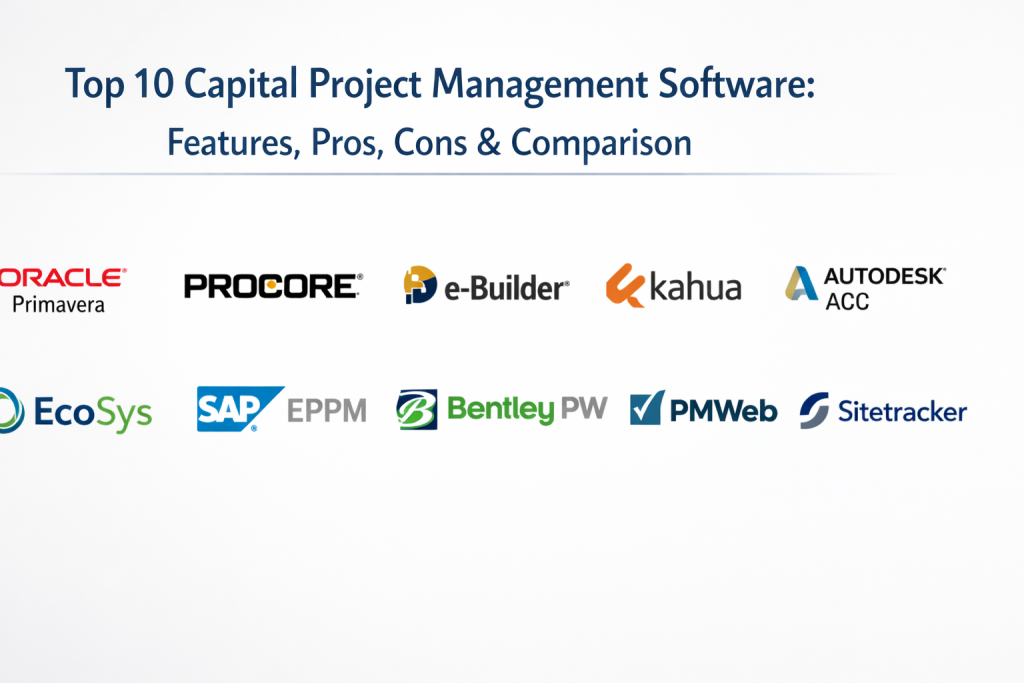
Top 10 Capital Project Management Software Tools
1. Oracle Primavera Cloud
This platform is widely considered the industry benchmark for complex, high-stakes project scheduling and portfolio management. It is designed for enterprise-level organizations that require deep analytical power and integrated risk management.
Key Features
- Integrated CPM (Critical Path Method) scheduling for massive project timelines.
- Advanced risk management using Monte Carlo simulations for schedule and cost.
- Portfolio management tools for prioritizing capital investments across a company.
- Built-in resource leveling to optimize labor and equipment across multiple sites.
- Real-time “Health Checks” to identify schedule delays before they impact the critical path.
Pros
- Unrivaled power for managing thousands of activities in a single project.
- Strong reporting capabilities that satisfy both executive and technical needs.
Cons
- Requires specialized training to utilize the full depth of the software.
- Can be more expensive than general-purpose project management tools.
Platforms / Deployment
Windows / Web / iOS / Android
Cloud
Security & Compliance
Standard identity protection and secure cloud licensing.
SOC 2 / ISO 27001 compliant.
Integrations & Ecosystem
Deeply integrated with the Oracle ecosystem (Unifier, Aconex) and major ERP systems. It supports complex data exports for external audit and analysis.
Support & Community
A global network of certified trainers and a massive user base in the construction and engineering sectors.
2. Procore
Procore is a dominant cloud-based platform known for its focus on collaboration and ease of use in the field. It bridges the gap between the owner, the general contractor, and the subcontractors.
Key Features
- Unified platform for project management, quality, safety, and financial tracking.
- Robust mobile app that works offline for site inspections and daily logs.
- Standardized RFI and Submittal workflows to keep communication organized.
- Owner-specific dashboards for high-level visibility into project health.
- Integrated drawing management with automatic version control.
Pros
- Extremely high user adoption rate due to its intuitive interface.
- Massive marketplace of third-party integrations (over 400 apps).
Cons
- Scheduling tools are not as deep as those found in Oracle Primavera.
- Pricing scales with project value, which can be high for massive capital programs.
Platforms / Deployment
Web / iOS / Android
Cloud
Security & Compliance
Enterprise-grade identity management and audit logs.
ISO 27001 compliant.
Integrations & Ecosystem
Offers one of the largest integration ecosystems in the industry, connecting with accounting software, CRM, and BIM tools.
Support & Community
Extensive online training through Procore Academy and 24/7 customer support.
3. e-Builder (by Trimble)
Designed specifically for capital project owners, e-Builder focuses on reducing risk and improving visibility across the entire project lifecycle, from planning to operations.
Key Features
- Owner-centric workflows for managing funding and approvals.
- Detailed cost management and job costing for capital budget control.
- Document management with automated retention policies and audit trails.
- Standardized reporting for public and private sector compliance.
- Integrated BIM viewing for design review and coordination.
Pros
- Strongest focus on the specific needs of project owners and program managers.
- Excellent for managing complex regulatory and funding requirements.
Cons
- The interface can feel more technical and less “modern” than Procore.
- Implementation can take longer due to the depth of customization.
Platforms / Deployment
Web / iOS / Android
Cloud
Security & Compliance
High-level security tailored for government and healthcare sectors.
Not publicly stated.
Integrations & Ecosystem
Strong ties to the Trimble ecosystem and common ERP platforms like SAP and Oracle.
Support & Community
Professional implementation services and a dedicated community for capital program owners.
4. Kahua
Kahua offers a flexible, app-based platform that allows organizations to customize their project management environment to match their unique business processes.
Key Features
- Modular “App” architecture allowing users to add or remove features as needed.
- Dedicated portals for different stakeholders (Owners, GC, Subcontractors).
- Robust cost management and change order tracking.
- Automated workflow engine for complex approval cycles.
- Integrated document and communication management.
Pros
- Highly customizable through its unique platform-as-a-service model.
- Easier to adapt to company-specific policies than rigid off-the-shelf software.
Cons
- Customization requires a clear strategy and internal expertise to manage.
- Smaller marketplace of third-party integrations compared to industry giants.
Platforms / Deployment
Web / Windows / iOS / Android
Cloud
Security & Compliance
Standard identity protection and secure cloud licensing.
SOC 2 compliant.
Integrations & Ecosystem
Strong API capabilities and a growing list of pre-built integrations with major financial systems.
Support & Community
Growing professional community and active support for enterprise clients.
5. Autodesk Construction Cloud
Building on the legacy of BIM 360 and PlanGrid, this suite provides a seamless data flow from design through construction, making it ideal for BIM-heavy capital projects.
Key Features
- Deep integration with Revit and other design software for 3D coordination.
- Centralized document management as a “single source of truth.”
- Advanced quantity takeoff and estimating tools.
- Integrated quality and safety management for field teams.
- Predictive analytics to identify project risks during the construction phase.
Pros
- The best choice for teams that are already centered on the Autodesk design suite.
- Excellent 3D visualization and coordination capabilities.
Cons
- The financial and cost-control modules are still evolving to match pure capital software.
- Navigating the multiple tools in the “Cloud” can be complex for new users.
Platforms / Deployment
Web / iOS / Android
Cloud
Security & Compliance
Enterprise-grade identity protection and secure cloud licensing.
ISO 27001 / SOC 2 compliant.
Integrations & Ecosystem
Naturally connects with all Autodesk design products and a wide range of industry-standard plugins.
Support & Community
Backed by the massive Autodesk global network and comprehensive learning resources.
6. EcoSys (by Hexagon)
EcoSys is a powerful platform focused on “Project Controls,” specializing in the financial management and performance measurement of large-scale industrial projects.
Key Features
- Comprehensive capital planning and budgeting tools.
- In-depth progress measurement and performance analysis.
- Integrated cost, schedule, and resource management.
- Enterprise-wide reporting for visibility across thousands of projects.
- Flexible “what-if” scenario planning for budget changes.
Pros
- Widely considered the leader in pure project controls and financial accuracy.
- Unrivaled for managing projects in the energy, oil, and gas industries.
Cons
- Very technical interface designed for professional project controllers.
- Requires a significant investment in implementation and training.
Platforms / Deployment
Web / Windows
Local / Hybrid / Cloud
Security & Compliance
High-level security protocols for sensitive industrial projects.
Not publicly stated.
Integrations & Ecosystem
Integrates deeply with scheduling tools like Primavera and major ERP systems like SAP.
Support & Community
Professional support for enterprise clients and deep industry expertise in project controls.
7. SAP Enterprise Project Portfolio Management (EPPM)
For organizations that run on SAP, this module extends their ERP power into the project world, ensuring that capital spending and financial records are perfectly synced.
Key Features
- Direct link between project tasks and company financial records.
- Comprehensive resource planning across the entire enterprise.
- Automated procurement and contract management within the SAP ecosystem.
- Portfolio optimization based on financial constraints and business goals.
- Robust compliance and audit tracking for global organizations.
Pros
- Eliminates the “financial silo” between project management and corporate accounting.
- Standardized processes for global organizations with complex legal structures.
Cons
- The interface is traditional and can feel less agile than modern cloud startups.
- Requires an existing SAP environment to be truly effective.
Platforms / Deployment
Web / Windows / iOS / Android
Local / Hybrid / Cloud
Security & Compliance
Highest level of corporate security and global regulatory compliance.
ISO 27001 / SOC 2 compliant.
Integrations & Ecosystem
Natively integrated with the entire SAP business suite.
Support & Community
Massive global support network and specialized consultants for every industry.
8. Bentley Systems ProjectWise
ProjectWise is a collaborative platform specifically designed for infrastructure projects like roads, rail, and water systems where engineering data is at the center of the project.
Key Features
- Advanced engineering document management and workflow automation.
- Deep integration with geospatial data and mapping systems.
- Real-time collaboration on engineering models across global offices.
- Standardized workflows for design review and approvals.
- Lifecycle management for large-scale infrastructure assets.
Pros
- The standard for massive civil engineering and public infrastructure projects.
- Excellent management of large, complex engineering datasets.
Cons
- Focused heavily on the design and engineering phase rather than financial construction management.
- Interface is geared toward engineers rather than general project managers.
Platforms / Deployment
Web / Windows / iOS
Hybrid / Cloud
Security & Compliance
High-level security for government and infrastructure data.
Not publicly stated.
Integrations & Ecosystem
Deeply integrated with Bentley’s engineering software and major CAD platforms.
Support & Community
Specialized professional support and a strong presence in the global engineering community.
9. PMWeb
PMWeb is a comprehensive capital project management solution that is often favored by government agencies and large institutional owners for its “all-in-one” approach.
Key Features
- Visual workflow engine for managing every stage of the project lifecycle.
- Robust cost management and financial reporting.
- Integrated facilities management to transition assets to operations.
- Detailed procurement and bid management modules.
- Comprehensive document control and project communications.
Pros
- Provides a true “single platform” solution without needing many external add-ons.
- Excellent for managing the transition from construction to facility operation.
Cons
- The software can feel complex due to the sheer number of features.
- Modernization of the mobile interface has been slower than some competitors.
Platforms / Deployment
Web / Windows
Local / Hybrid / Cloud
Security & Compliance
Standard identity protection and secure cloud licensing.
Not publicly stated.
Integrations & Ecosystem
Good integration with major ERP and scheduling software.
Support & Community
Dedicated professional support for institutional and government clients.
10. Sitetracker
Sitetracker is specialized for “High-Volume” capital projects, such as telecommunications rollout or renewable energy infrastructure, where thousands of small sites must be managed as one program.
Key Features
- Templates for high-volume, repeatable project workflows.
- Integrated AI to predict site completion dates and identify bottlenecks.
- Field tools for capturing site photos and status updates instantly.
- Automated reporting for managing thousands of assets simultaneously.
- Integrated financial tracking for high-volume procurement.
Pros
- The only tool on this list optimized for managing thousands of similar project sites.
- Extremely efficient for telecommunications and renewable energy rollouts.
Cons
- Not designed for a single, massive complex project like a nuclear plant or high-rise.
- Requires a shift in thinking from traditional “CPM” scheduling to “High-Volume” management.
Platforms / Deployment
Web / iOS / Android
Cloud
Security & Compliance
Built on the Salesforce platform, offering high-level enterprise security.
ISO 27001 / SOC 2 compliant.
Integrations & Ecosystem
Deeply integrated with Salesforce and a wide variety of field service and ERP tools.
Support & Community
Active community in the telecommunications and utility sectors.
Comparison Table
| Tool Name | Best For | Platform(s) Supported | Deployment | Standout Feature | Public Rating |
| 1. Oracle Primavera | Global Scheduling | Win, Web, iOS, Android | Cloud | Monte Carlo Risk | N/A |
| 2. Procore | Field Collaboration | Web, iOS, Android | Cloud | App Marketplace | N/A |
| 3. e-Builder | Capital Owners | Web, iOS, Android | Cloud | Funding Workflows | N/A |
| 4. Kahua | Custom Workflows | Win, Web, iOS, Android | Cloud | App-Based Platform | N/A |
| 5. Autodesk ACC | BIM Integration | Web, iOS, Android | Cloud | 3D Coordination | N/A |
| 6. EcoSys | Project Controls | Web, Windows | Hybrid/Cloud | Financial Accuracy | N/A |
| 7. SAP EPPM | ERP Integration | Win, Web, iOS, Android | Hybrid/Cloud | Financial Sync | N/A |
| 8. Bentley PW | Infrastructure Eng. | Win, Web, iOS | Hybrid/Cloud | Engineering Data | N/A |
| 9. PMWeb | Institutional Owners | Web, Windows | Hybrid/Cloud | Asset Transition | N/A |
| 10. Sitetracker | High-Volume Sites | Web, iOS, Android | Cloud | Repeatable Workflows | N/A |
Evaluation & Scoring
| Tool Name | Core (25%) | Ease (15%) | Integrations (15%) | Security (10%) | Perf (10%) | Support (10%) | Value (15%) | Total |
| 1. Oracle Primavera | 10 | 4 | 9 | 9 | 10 | 9 | 6 | 8.15 |
| 2. Procore | 8 | 10 | 10 | 9 | 9 | 10 | 7 | 8.80 |
| 3. e-Builder | 9 | 7 | 8 | 9 | 8 | 8 | 8 | 8.15 |
| 4. Kahua | 8 | 8 | 8 | 8 | 8 | 8 | 8 | 8.00 |
| 5. Autodesk ACC | 8 | 8 | 9 | 9 | 9 | 8 | 7 | 8.20 |
| 6. EcoSys | 10 | 3 | 8 | 9 | 10 | 8 | 6 | 7.55 |
| 7. SAP EPPM | 9 | 5 | 10 | 10 | 9 | 9 | 6 | 8.15 |
| 8. Bentley PW | 9 | 5 | 8 | 9 | 9 | 8 | 7 | 7.75 |
| 9. PMWeb | 9 | 6 | 8 | 8 | 8 | 8 | 8 | 7.85 |
| 10. Sitetracker | 7 | 9 | 9 | 9 | 9 | 8 | 9 | 8.25 |
The scoring model highlights the diversity of this category. Procore leads in “Total” primarily due to its extreme ease of use and massive ecosystem, which is critical for large, multi-party construction projects. However, for specialized industrial work, EcoSys and Primavera remain the dominant forces in “Core Features” and “Performance,” despite their steeper learning curves. Organizations should weigh the “Ease of Use” score heavily if they have a distributed workforce with varying technical skills, whereas “Core Features” and “Security” should be the focus for high-stakes infrastructure or government work.
Which Capital Project Management Software Tool Is Right for You?
Solo / Freelancer
Individual consultants or project managers working on smaller capital works should prioritize Procore or Kahua for their ease of use and accessibility. These tools allow a single user to project a high level of professional organization without needing a massive internal IT infrastructure.
SMB
Small and medium businesses in the construction sector are often best served by Procore. Its vast marketplace allows them to add only the features they need, keeping costs manageable while ensuring they remain compatible with the standards used by larger general contractors.
Mid-Market
Growing firms with multiple ongoing capital projects should look at e-Builder or Autodesk Construction Cloud. These platforms provide the necessary balance of sophisticated project controls and modern collaboration, allowing for sustainable growth without losing control of project costs.
Enterprise
For global organizations and massive industrial projects, Oracle Primavera Cloud or EcoSys are the primary choices. Their ability to handle deep financial analysis, complex risk modeling, and massive schedules across multiple continents makes them indispensable for the largest capital programs on Earth.
Budget vs Premium
Choosing a “Budget” option often means utilizing a more generic project management tool and customizing it, while “Premium” solutions like SAP EPPM or Oracle come with a higher price tag but offer deep, specialized functionality that can save millions in potential project overruns.
Feature Depth vs Ease of Use
If your team is composed of highly technical project controllers, the depth of EcoSys or Houdini (for specialized visualizations) is worth the effort. For a broader workforce, the ease of Procore will lead to higher data accuracy and better overall compliance.
Integrations & Scalability
If your project data must feed into a corporate ERP system for financial reporting, SAP EPPM or Oracle provide the most secure and reliable data bridges. For firms looking for extreme flexibility, Kahua offers a scalable platform that grows with the organization.
Security & Compliance Needs
For projects in the public sector, healthcare, or aerospace, choosing a tool with established ISO 27001 and SOC 2 compliance, such as SAP or Procore, is essential to protect sensitive intellectual property and meet government audit requirements.
Frequently Asked Questions (FAQs)
1. How does capital project software differ from regular project management software?
Capital software is built to manage long-term assets with complex financial tracking, funding sources, and depreciation, whereas regular project management often focuses on short-term tasks and team collaboration.
2. Is it possible to manage a capital project with just Excel?
While many firms start with Excel, it lacks the audit trails, real-time collaboration, and complex risk-modeling capabilities needed to prevent multi-million dollar overruns in professional environments.
3. Do these tools support sustainable building practices?
Yes, modern platforms are increasingly adding modules to track material origins, carbon footprints, and energy efficiency targets to help firms meet global sustainability standards.
4. What is the typical implementation time for these platforms?
Implementation can range from a few weeks for simpler cloud-based tools like Procore to several months for deeply integrated enterprise systems like SAP or EcoSys.
5. How do these tools handle risk management?
They use advanced statistical methods, such as Monte Carlo simulations, to analyze how small delays in individual tasks might impact the final completion date and total budget.
6. Can field workers use these tools without an internet connection?
Most leading platforms, like Procore and e-Builder, have mobile apps that allow users to input data offline and sync it automatically once they return to a connected area.
7. Are these tools compatible with BIM (Building Information Modeling)?
Yes, software like Autodesk Construction Cloud and ProjectWise is built specifically to integrate 3D design models into the project management and scheduling workflow.
8. Why is “Owner Visibility” so important in capital projects?
Since owners are the ultimate source of funding and the eventual operators of the asset, they need real-time data to make informed decisions about project scope and financial changes.
9. Can these tools help with public sector audit requirements?
Absolutely. Specialized tools like PMWeb and e-Builder are designed with robust audit trails and standardized reporting to satisfy strict government transparency and compliance rules.
10. Do I need a dedicated administrator for these systems?
For large enterprise deployments, having a dedicated system administrator or “Power User” is highly recommended to ensure data consistency and to manage user permissions and updates.
Conclusion
Navigating the complexities of capital projects requires more than just a schedule; it requires a robust, data-driven foundation that bridges the gap between financial planning and field execution. The selection of a project management platform is a strategic decision that impacts every stage of an asset’s lifecycle, from the first dollar invested to the final day of operation. Whether you prioritize the collaborative ease of a cloud-native platform or the analytical depth of an enterprise project control suite, the goal remains the same: to deliver high-value assets on time and within budget. By carefully evaluating your organization’s specific needs for scalability, integration, and security, you can choose a tool that not only manages a project but secures a legacy of successful capital investment.

Best Cardiac Hospitals Near You
Discover top heart hospitals, cardiology centers & cardiac care services by city.
Advanced Heart Care • Trusted Hospitals • Expert Teams
View Best Hospitals