Introduction
Public Safety Dispatch systems, commonly known as Computer-Aided Dispatch (CAD), are mission-critical software platforms used by emergency communications centers to manage the lifecycle of an incident. These systems serve as the central nervous system for first responders, enabling call-takers to intake emergency data, prioritize incidents, and deploy law enforcement, fire, or EMS units with precision. Modern CAD solutions integrate geographical information systems (GIS), automatic vehicle location (AVL), and real-time data sharing to ensure that the right resources reach the right location in the shortest possible time.
In the current landscape, CAD systems have evolved from simple digital logs into highly intelligent hubs that process high-speed data from smartphones, connected vehicles, and IoT sensors. With the transition to Next-Generation 911 (NG911) standards, these platforms are now capable of handling multimedia inputs such as live video feeds and text-to-911, providing dispatchers and responders with unprecedented situational awareness before they even arrive on the scene.
Best for: Municipal emergency communication centers, multi-agency regional dispatch hubs, and large-scale public safety departments requiring high-availability tools for coordinated incident response.
Not ideal for: Private security firms with limited patrol areas, small organizations with low call volumes that do not require complex multi-agency routing, or departments without the infrastructure to support high-end GIS integration.
Key Trends in Public Safety Dispatch Systems
- Next-Generation 911 (NG911) Integration: Modern systems are designed to accept and process rich data beyond voice, including photos, videos, and real-time location data from mobile devices.
- Cloud-Native Resilience: A shift toward cloud-based architectures ensures that dispatch operations can remain functional even if a physical dispatch center is compromised by natural or man-made disasters.
- AI-Driven Dispatch Assistance: Artificial intelligence is being utilized to analyze call patterns, suggest the nearest available units, and even transcribe emergency calls in real-time to reduce dispatcher cognitive load.
- Universal Interoperability: Increasing focus on breaking down jurisdictional data silos, allowing neighboring agencies to view each other’s unit status and incident data during mutual aid events.
- Mobile-First Responder Tools: CAD functionality is being extended directly to hand-held devices and vehicle tablets, giving field units the same level of situational awareness as the dispatch center.
- Augmented Reality (AR) Mapping: Integration of 3D building floor plans and subterranean utility maps into the CAD interface to guide responders in complex environments.
- Cybersecurity and Encryption: Enhanced focus on protecting mission-critical data through end-to-end encryption and multi-factor authentication to prevent ransomware attacks on emergency infrastructure.
- Predictive Analytics for Resource Allocation: Using historical incident data to predict high-call-volume areas and pre-position emergency units for faster response times.
How We Selected These Tools
- Production Stability and Uptime: We prioritized systems known for high availability and “five-nines” reliability, as system failure is not an option in public safety.
- NG911 Readiness: Selection was based on the software’s ability to handle modern data types and integrate with next-generation telephony standards.
- Multi-Agency Support: We looked for tools that excel at coordinating responses across police, fire, and EMS disciplines simultaneously.
- GIS and Mapping Sophistication: Each tool was evaluated on the accuracy and real-time nature of its mapping and vehicle tracking capabilities.
- User Interface and Ergonomics: Priority was given to software that minimizes the number of clicks required to dispatch a unit, reducing the critical “call-to-dispatch” time.
- Ecosystem Extensibility: We evaluated how well these tools integrate with Records Management Systems (RMS), jail management, and mobile data computers.
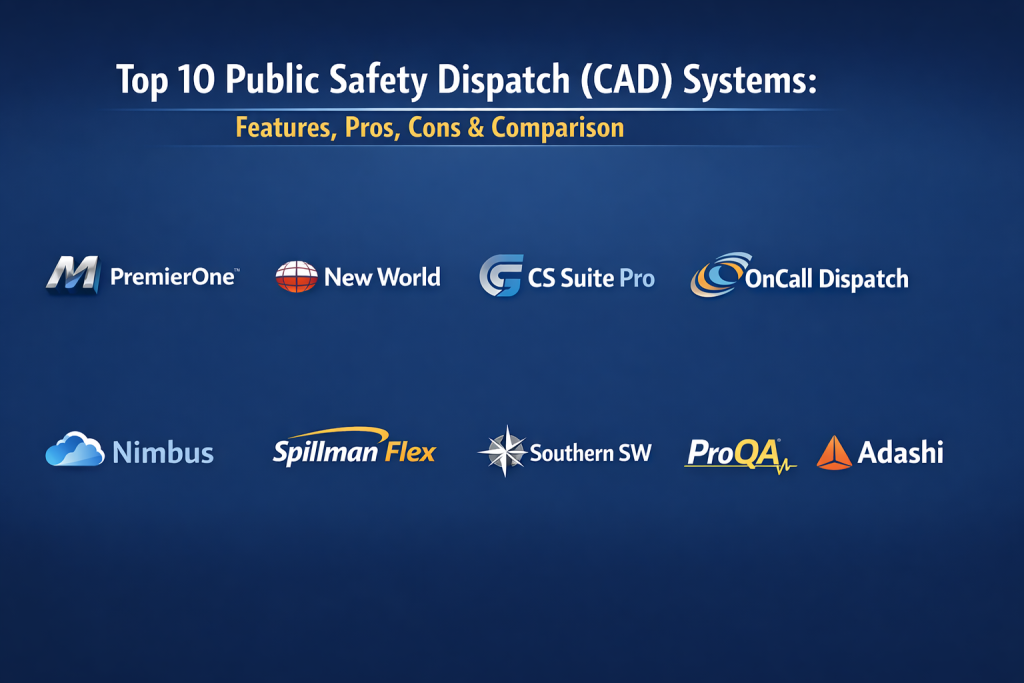
Top 10 Public Safety Dispatch (CAD) Systems
1. Motorola Solutions PremierOne CAD
A market-leading platform built for high-volume agencies that require a unified view of incidents and resources. It excels at correlating voice, data, and video to enhance decision-making under pressure.
Key Features
- Integrated GIS intelligence for pinpoint caller and unit location.
- Real-time video streaming directly into the CAD map interface.
- Advanced work-assist area for uninterrupted dispatcher workflows.
- Seamless radio messaging and unit status updates.
- Highly configurable business rules for multi-agency autonomy.
Pros
- Unrivaled reliability for large-scale, complex metropolitan operations.
- Deep integration with the broader Motorola ecosystem (radios, body cams).
Cons
- Implementation can be complex and time-consuming.
- High total cost of ownership compared to smaller-tier solutions.
Platforms / Deployment
Windows
Local / Hybrid
Security & Compliance
Enterprise identity management with CJIS-compliant data handling.
Not publicly stated.
Integrations & Ecosystem
PremierOne serves as a central hub for the Motorola CommandCentral suite, integrating with RMS, evidence management, and mobile data terminals.
Support & Community
Extensive training programs and a global network of specialized technical support engineers available 24/7.
2. Tyler Technologies New World CAD
Known for its robust GIS integration and ease of use, this system is a favorite for agencies looking to streamline dispatch and records into a single, cohesive workflow.
Key Features
- Embedded Esri GIS for high-accuracy mapping and routing.
- Dynamic response plans that provide real-time updates as calls evolve.
- Automated unit recommendations based on proximity and resource type.
- Integrated RapidSOS technology for instant mobile caller location.
- Scalable architecture for small towns to large regional hubs.
Pros
- Strongest GIS-centric approach in the mid-to-large market.
- Excellent data continuity between dispatch and records management.
Cons
- User interface can feel dense for agencies used to simpler tools.
- Hardware requirements for local servers can be substantial.
Platforms / Deployment
Windows
Local / Hybrid
Security & Compliance
Built-in security protocols aligned with federal public safety standards.
Not publicly stated.
Integrations & Ecosystem
Strongest when paired with the Tyler New World RMS and municipal ERP software for comprehensive administrative oversight.
Support & Community
Active user groups and comprehensive online learning resources provided through Tyler University.
3. CentralSquare Public Safety Suite Pro
A comprehensive, all-in-one solution designed for speed and interoperability. It is built to resolve data silos and ensure that dispatchers have all necessary information on a single screen.
Key Features
- Plug-and-play architecture combining 911, CAD, and RMS.
- Real-time situational awareness dashboards for supervisors.
- Advanced interoperability for joint responses across jurisdictions.
- Mobile lifeline features that keep field responders connected.
- Cloud-ready deployment models for disaster resilience.
Pros
- Fast deployment timelines for agencies moving away from legacy systems.
- High level of customizability for local dispatch workflows.
Cons
- Some advanced features may require additional licensing modules.
- Updates can occasionally slow down local network performance.
Platforms / Deployment
Windows
Cloud / Hybrid
Security & Compliance
Secure, reliable technology with a focus on mitigating cyber threats.
Not publicly stated.
Integrations & Ecosystem
Integrates widely across the CentralSquare portfolio and supports numerous third-party telephony and radio vendors.
Support & Community
Responsive customer service with a strong focus on community safety and staff satisfaction.
4. Hexagon OnCall Dispatch
This software emphasizes mobility and role-based workflows, providing a consistent experience whether an artist is in the control room or in the field.
Key Features
- Task-oriented user interface designed to reduce cognitive load.
- Native device capabilities like GPS and speech-to-text.
- Connected and disconnected operation modes for mobile units.
- Advanced spatial analysis and incident playback for post-event review.
- Browser-based clients for simplified deployment and maintenance.
Pros
- Superior mobility and field-based reporting capabilities.
- Excellent analytics engine for assessing agency performance.
Cons
- The transition to browser-based interfaces may require staff retraining.
- Initial configuration of the analytics data warehouse is technical.
Platforms / Deployment
Web / Windows / Android / iOS
Cloud / Local
Security & Compliance
Role-based access controls and centralized administration tools.
Not publicly stated.
Integrations & Ecosystem
Designed to unite disparate data stores into clear business themes through its open API and data warehouse.
Support & Community
Global presence with extensive documentation and professional managed services.
5. Mark43 CAD
A cloud-native platform that prioritizes human-in-the-loop automation. It is built for agencies that want modern, intuitive design without the burden of maintaining local servers.
Key Features
- Intelligent plan builder that generates response plans from policy rules.
- Automated response engine with clear dispatcher checkpoints.
- Transparent, auditable logic for all unit recommendations.
- Predictive impact modeling for large-scale events.
- Always-on resilience with high uptime guarantees.
Pros
- Modern, intuitive UX that significantly reduces training time.
- Zero IT burden due to the cloud-native, auto-updating architecture.
Cons
- Internet dependency requires robust agency-wide connectivity.
- May lack some legacy features found in older on-premise systems.
Platforms / Deployment
Web / Windows
Cloud-Native
Security & Compliance
DoD-level security with full CJIS and SOC 2 compliance.
SOC 2 / CJIS Compliant.
Integrations & Ecosystem
Open and integrated by design, connecting easily with maps, sensors, and mobile devices.
Support & Community
High-touch customer support with a focus on modernizing public safety operations.
6. RapidDeploy Nimbus
This system is a revolutionary cloud-aided dispatch solution that brings Tier 1 features to agencies of all sizes through an affordable subscription model.
Key Features
- Cloud-hosted system that can be deployed in days rather than years.
- Deep integration with RapidSOS for precision caller location.
- Native AI features for workflow automation and data analysis.
- Full-function mobile app for responders on Apple and Android.
- Unlimited map layers with real-time weather and traffic data.
Pros
- Extremely fast deployment and frequent, non-disruptive updates.
- Highly affordable for smaller agencies with limited budgets.
Cons
- Newer platform with a smaller long-term install base than legacy giants.
- Focuses primarily on the cloud, which may not suit all agency policies.
Platforms / Deployment
Web / Android / iOS
Cloud-Native
Security & Compliance
Runs on government-grade cloud platforms with Level 5 DoD compliance.
Level 5 DoD / CJIS Compliant.
Integrations & Ecosystem
Built on an open platform that integrates leading real-time solutions from multiple spheres including CCTV and weather.
Support & Community
Professional project management and support provided in partnership with major telecommunications providers.
7. Spillman Flex CAD (by Motorola Solutions)
A premier choice for agencies seeking a comprehensive, all-in-one public safety ecosystem. It is famous for its single-source database that eliminates redundant data entry.
Key Features
- Single-source database shared across CAD, RMS, and Jail.
- Advanced AVL mapping with drag-and-drop unit routing.
- Customizable visual and audible status alerts for dispatchers.
- Multi-jurisdictional data sharing that maintains local autonomy.
- Comprehensive reporting tools for administrative oversight.
Pros
- Unparalleled operational efficiency through unified data entry.
- Superior stability for mission-critical command centers.
Cons
- Workflows can be non-intuitive for users transitioning from simpler apps.
- Documentation can be complex due to the sheer depth of the system.
Platforms / Deployment
Windows
Local / Hybrid
Security & Compliance
High-level data security with comprehensive audit trails.
Not publicly stated.
Integrations & Ecosystem
Functions as an integrated hub, resolving data silos between dispatchers and field units.
Support & Community
Strong user community and accolades for innovation in public safety technology.
8. Southern Software CAD
An extensive dispatching tool that focuses on structured call-for-service handling and real-time tracking for multiple jurisdictions.
Key Features
- Multi-geo lookup that searches addresses, landmarks, and intersections simultaneously.
- Automatic call guide and pre-arrival instruction display.
- Integrated audit trails documenting every action from call to follow-up.
- Support for mouse or command-line operation for major functions.
- Centralized hub for interfacing with RMS and mapping.
Pros
- Very organized and transparent method for assigning units.
- Excellent for agencies requiring detailed chronological audit records.
Cons
- Implementation can be slowed by extensive system updates.
- Performance can lag under extreme, high-volume loads.
Platforms / Deployment
Windows
Cloud / Local
Security & Compliance
Centralized authentication and secure audit platforms.
Not publicly stated.
Integrations & Ecosystem
Integrates with popular pre-arrival instruction software and federal database query tools.
Support & Community
Strong reputation for user-friendly formats and accessible technical assistance.
9. Priority Dispatch ProQA
While often used as a plugin, ProQA is a vital dispatch decision support system that provides scripted interrogations to ensure consistent emergency response.
Key Features
- Scripted caller interrogations to quickly identify chief complaints.
- Intelligent analysis of call data to determine the correct dispatch code.
- Specialized tools for strokes, CPR tracking, and sinking vehicles.
- Echo Dispatch features for immediate unit deployment during high-acuity calls.
- Integrated Quality Assurance (QA) tools for performance tracking.
Pros
- Significantly reduces human error and ensures protocol compliance.
- Provides dispatchers with life-saving instructions to give callers.
Cons
- Primarily a protocol system, requiring integration with a primary CAD.
- Rigid scripts may feel restrictive to highly experienced dispatchers.
Platforms / Deployment
Windows / Web
Local / Cloud
Security & Compliance
Standards-based protocols developed by international medical academies.
Not publicly stated.
Integrations & Ecosystem
Integrates with almost every major CAD system on this list to provide decision support.
Support & Community
Extensive training, certification, and quarterly software updates.
10. Adashi Systems CAD
A specialized tool that focuses on tactical response and incident management, particularly favored by fire and EMS agencies for personnel accountability.
Key Features
- Incident command tools for assigning resources and tracking personnel.
- Real-time collaboration through map-based annotation.
- Integration with What3Words for precise location in remote areas.
- Personnel Accountability Report (PAR) checks and air monitoring.
- Hazard predictions and modeling for tactical fire response.
Pros
- Unmatched for on-scene tactical management and firefighter safety.
- Excellent map-based interface for managing complex emergency scenes.
Cons
- May be less focused on administrative law enforcement tasks than others.
- Customer support is primarily managed via email.
Platforms / Deployment
Windows / Web
Local / Hybrid
Security & Compliance
Tactical-level data security with real-time collaboration protocols.
Not publicly stated.
Comparison Table
| Tool Name | Best For | Platform(s) Supported | Deployment | Standout Feature | Public Rating |
| 1. PremierOne | Large Metro Agencies | Windows | Hybrid | Real-Time Video | N/A |
| 2. New World | GIS-Centric Hubs | Windows | Hybrid | Esri Integration | N/A |
| 3. CS Suite Pro | All-in-One Ops | Windows | Cloud | Plug-and-Play | N/A |
| 4. OnCall Dispatch | Mobility/Field | Web, Win, Mobile | Cloud/Local | Role-Based UX | N/A |
| 5. Mark43 | Cloud Innovation | Web, Windows | Cloud | AI Response Plans | N/A |
| 6. Nimbus | Small-Mid Agencies | Web, Mobile | Cloud | Rapid Deployment | N/A |
| 7. Spillman Flex | Data Continuity | Windows | Hybrid | Shared Database | N/A |
| 8. Southern SW | Audit/Tracking | Windows | Cloud/Local | Multi-Geo Lookup | N/A |
| 9. ProQA | Decision Support | Windows, Web | Local/Cloud | Scripted Protocols | N/A |
| 10. Adashi | Tactical/Fire | Windows, Web | Local/Hybrid | PAR Tracking | N/A |
Evaluation & Scoring
| Tool Name | Core (25%) | Ease (15%) | Integrations (15%) | Security (10%) | Perf (10%) | Support (10%) | Value (15%) | Total |
| 1. PremierOne | 10 | 5 | 10 | 9 | 10 | 9 | 6 | 8.50 |
| 2. New World | 9 | 7 | 9 | 8 | 9 | 8 | 7 | 8.20 |
| 3. CS Suite Pro | 8 | 8 | 9 | 8 | 8 | 8 | 8 | 8.15 |
| 4. OnCall | 9 | 8 | 8 | 8 | 9 | 8 | 8 | 8.45 |
| 5. Mark43 | 8 | 9 | 9 | 10 | 8 | 9 | 8 | 8.60 |
| 6. Nimbus | 7 | 9 | 8 | 9 | 9 | 7 | 10 | 8.30 |
| 7. Spillman Flex | 10 | 6 | 9 | 8 | 9 | 8 | 6 | 8.05 |
| 8. Southern SW | 7 | 7 | 7 | 8 | 8 | 8 | 9 | 7.55 |
| 9. ProQA | 8 | 7 | 10 | 7 | 9 | 9 | 8 | 8.30 |
| 10. Adashi | 8 | 8 | 7 | 7 | 9 | 6 | 7 | 7.50 |
The evaluation scores highlight the varying strengths of the current market. Mark43 and RapidDeploy Nimbus lead in areas of ease of use and modern cloud security, making them ideal for agencies looking to modernize quickly. Established systems like PremierOne and Spillman Flex maintain high scores for core features and performance, reflecting their history of handling high-stress production environments. ProQA stands out for its unique role in integration and protocol-driven support, which is critical for reducing agency liability.
Which Public Safety Dispatch (CAD) System Tool Is Right for You?
Solo / Freelancer
Not applicable. These systems are designed for organizational use and require agency-level infrastructure and personnel.
SMB
Small to medium agencies should prioritize tools like RapidDeploy Nimbus or CentralSquare Suite Pro. These offer rapid deployment and lower hardware costs, allowing smaller teams to benefit from enterprise-level features without the need for massive local server rooms.
Mid-Market
Agencies serving moderate-sized counties or cities will find Tyler Technologies New World or Hexagon OnCall Dispatch to be the best balance between depth and manageability. These tools offer strong GIS capabilities and mobile tools that are essential for growing departments.
Enterprise
For major metropolitan hubs or regional dispatch centers, Motorola PremierOne and Spillman Flex are the benchmarks. These systems are built to scale infinitely and handle the extreme data throughput required for thousands of simultaneous units across multiple disciplines.
Budget vs Premium
Agencies on a strict budget should look toward subscription-based cloud models like Nimbus, which avoid large upfront capital expenditures. Premium agencies with complex local requirements will benefit from the deep feature sets and dedicated on-site support of the Motorola or Tyler Technologies suites.
Feature Depth vs Ease of Use
Mark43 and OnCall Dispatch lead the way in providing a modern, simplified user experience that is easy for new dispatchers to learn. Conversely, Houdini-level depth in tactical planning is found in Adashi Systems, which is indispensable for specialized fire and rescue operations.
Integrations & Scalability
If your primary need is for your CAD to “talk” to everything else in the city, CentralSquare and Hexagon offer some of the most interoperable frameworks. For agencies looking to stay within one ecosystem, the Motorola/Spillman portfolio provides the most seamless end-to-end data flow.
Security & Compliance Needs
For high-security requirements, Mark43 offers a significant advantage with its SOC 2 and CJIS-compliant cloud-native architecture, ensuring that software is always patched against the latest threats without local intervention.
Frequently Asked Questions (FAQs)
1. What is the primary function of a CAD system?
A CAD system acts as the central hub for emergency response, allowing dispatchers to log calls, track the status of responders, and send units to incidents using real-time data.
2. How does NG911 affect CAD software?
Next-Generation 911 allows CAD systems to receive multimedia data like video and photos, providing better situational awareness than traditional voice-only calls.
3. Is cloud-based CAD safe for emergency services?
Yes, modern cloud CAD systems use government-grade security and are often more resilient than local servers during disasters because they are hosted across multiple geographic regions.
4. What is AVL in a dispatch context?
Automatic Vehicle Location (AVL) uses GPS to track the real-time position of emergency vehicles on the dispatcher’s map, ensuring the closest unit is sent to a call.
5. Can different agencies use the same CAD system?
Yes, most modern CAD systems support multi-agency configurations where police, fire, and EMS share a single platform while maintaining their own unique rules and data.
6. How long does a CAD implementation take?
Depending on the size of the agency and whether it is a cloud or local deployment, implementation can take anywhere from a few months to over a year.
7. Why is GIS important in dispatching?
Geographical Information Systems (GIS) provide the mapping data that allows dispatchers to verify addresses, see unit locations, and identify landmarks for faster routing.
8. What is a “unit recommendation”?
This is a CAD feature that automatically suggests which specific fire truck, ambulance, or patrol car should respond based on proximity, equipment, and current status.
9. Can CAD systems integrate with radio hardware?
Yes, high-end CAD systems integrate with radio consoles so dispatchers can see who is talking and send text alerts directly to a responder’s radio screen.
10. Do these systems include reporting and analytics?
Most CAD systems include robust reporting tools that allow agencies to analyze response times, call volume trends, and staff performance for administrative review.
Conclusion
Selecting a Public Safety Dispatch system is a long-term commitment that directly impacts the safety of both the community and first responders. The ideal system must balance immediate responsiveness with the long-term scalability required to handle the evolving data types of the next decade. Whether an agency chooses a cloud-native innovator or a legacy on-premise powerhouse, the goal remains the same: reducing the seconds that save lives. Leaders should focus on tools that prioritize interoperability, GIS accuracy, and user ergonomics to ensure their dispatchers can operate at peak efficiency during the most critical moments of an emergency.

Best Cardiac Hospitals Near You
Discover top heart hospitals, cardiology centers & cardiac care services by city.
Advanced Heart Care • Trusted Hospitals • Expert Teams
View Best Hospitals