Introduction
Unmanned Aerial Vehicle (UAV) fleet management platforms are centralized software ecosystems designed to coordinate, monitor, and govern multiple drones, pilots, and missions simultaneously. These platforms serve as the “mission control” for organizations, moving beyond simple flight control to provide a holistic view of hardware health, airspace compliance, and data lifecycle management. By integrating live telemetry with regulatory databases and maintenance logs, these tools ensure that every takeoff is safe, legal, and efficient.
Landscape, the importance of these platforms has surged as organizations transition from experimental drone use to scaled, autonomous operations. The rise of Beyond Visual Line of Sight (BVLOS) missions and “drone-in-a-box” technology requires sophisticated remote oversight that manual spreadsheets simply cannot provide. Whether it is a utility company inspecting thousands of miles of power lines or a public safety agency coordinating a search-and-rescue effort, a robust fleet platform is the invisible infrastructure that makes complex aerial operations possible.
Real-World Use Cases
- Infrastructure Inspection: Automating the monitoring of cell towers, wind turbines, and bridges to identify structural anomalies without risking human climbers.
- Public Safety and Emergency Response: Providing real-time situational awareness to first responders during active fires, natural disasters, or missing person searches.
- Precision Agriculture: Managing fleets of multi-spectral drones to monitor crop health, optimize irrigation, and apply fertilizers with surgical precision.
- Logistics and Delivery: Orchestrating autonomous delivery drones in urban environments, ensuring deconfliction and safe landing zone management.
- Construction Site Monitoring: Tracking project progress through automated daily maps and 3D models to compare “as-built” data against “as-designed” plans.
Evaluation Criteria for Buyers
- Multi-Vendor Support: Does the platform support hardware from different manufacturers like DJI, Skydio, and Autel?
- Airspace Awareness: Does it provide real-time LAANC authorizations and NOTAM alerts for legal compliance?
- Hardware Health Tracking: Can it monitor battery cycle counts, motor life, and sensor calibration across the entire fleet?
- Live Streaming Latency: How effectively can it broadcast low-latency video to remote stakeholders?
- Regulatory Reporting: Does it automatically generate the flight logs required by civil aviation authorities?
- Integration Depth: Can it push data into existing enterprise systems like ERP or GIS platforms?
- Security Protocols: Does it offer role-based access control and encrypted data storage?
- Autonomous Mission Support: Can it handle the scheduling and remote execution of automated docking stations?
Best for: Corporate drone program managers, government agencies, large-scale industrial inspection firms, and logistics providers who need to scale their aerial operations safely and predictably.
Not ideal for: Recreational hobbyists, individual photographers, or small businesses operating a single drone for occasional marketing shots.
Key Trends in UAV Fleet Management Platforms
- Agentic AI Decision Support: Systems are moving from simple reporting to acting as digital co-pilots that can predict hardware failure or suggest the best pilot for a specific mission based on past performance.
- BVLOS Enabling Technologies: Integration with Remote ID and advanced deconfliction algorithms is becoming standard to support flights where the pilot cannot see the aircraft.
- Remote Operations Centers (ROC): A shift toward centralized command rooms where a single operator oversees multiple autonomous drones across different geographic regions.
- Sustainability and Battery Analytics: Advanced tracking of battery “state of health” to maximize lifecycle and reduce the environmental impact of lithium-ion waste.
- 5G/LTE Connectivity: The transition to cellular-linked drones allows for infinite control range and high-bandwidth data transmission directly to the cloud.
- Edge Computing Integration: Platforms are increasingly processing flight data on the drone itself to provide instant alerts for anomalies rather than waiting for post-flight analysis.
- Standardized Data Sovereignty: Increased demand for local hosting and offline-capable modes to ensure sensitive industrial data never leaves a specific jurisdiction.
- Predictive Maintenance Models: Using historical telemetry to forecast when a motor or propeller is likely to fail before it actually happens during a mission.
How We Selected These Tools
- Market Penetration and Proven Track Record: We prioritized platforms used by Fortune 500 companies and national public safety agencies.
- Technological Versatility: Each tool was evaluated on its ability to handle different mission types, from high-speed mapping to long-endurance surveillance.
- Security and Compliance Maturity: Preference was given to platforms with established security frameworks and transparent data handling practices.
- Hardware Agnostic Capabilities: We looked for tools that prevent vendor lock-in by supporting a wide variety of UAV hardware.
- Innovation in Automation: Priority was given to software leading the charge in remote “drone-in-a-box” management and AI-driven analytics.
- Ecosystem Integration: We evaluated how easily these tools connect to the broader software world, including GIS and asset management suites.
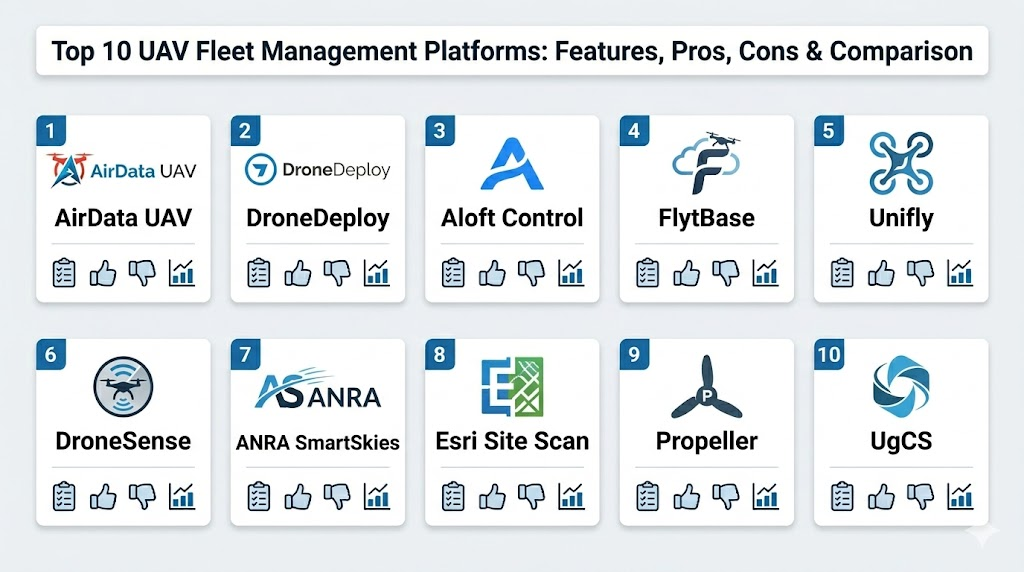
Top 10 UAV Fleet Management Platforms
1. AirData UAV
This platform is widely recognized for its deep focus on hardware health and preventative maintenance. It transforms raw flight logs into detailed analytics that help managers extend the life of their equipment and ensure pilot accountability.
Key Features
- Automatic flight log syncing from major drone brands including DJI and Autel.
- Comprehensive battery management tracking every cycle and cell health indicator.
- Predictive maintenance alerts based on actual flight time and motor stress.
- Detailed pilot performance scoring and safety trend reporting.
- Easy-to-use compliance reporting for regulatory audits.
Pros
- The best-in-class tool for tracking the “wear and tear” of a drone fleet.
- Hardware agnostic, allowing for a mixed fleet of various manufacturers.
Cons
- Lacks real-time mission planning features found in other platforms.
- The interface is data-heavy and may take time to navigate for new users.
Platforms / Deployment
Web / iOS / Android
Cloud
Security & Compliance
Role-based access control and secure data encryption.
Not publicly stated.
Integrations & Ecosystem
Integrates with major pilot apps and provides a robust API for exporting flight data to external business intelligence tools.
Support & Community
Extensive documentation and a large community of professional users who share best practices for fleet maintenance.
2. DroneDeploy
A powerhouse in the mapping and inspection space, this platform combines flight planning with high-end cloud processing to turn drone data into actionable maps and 3D models.
Key Features
- Unified flight planning and automated mission execution from a mobile device.
- High-speed cloud processing for orthomosaics and 3D point clouds.
- Fleet-wide compliance dashboards tracking pilots and hardware.
- Advanced 3D inspection tools for measuring volume and distance.
- Built-in collaboration tools for sharing maps across large teams.
Pros
- Provides an end-to-end workflow from flight to final data analysis.
- Extremely intuitive interface that lowers the barrier to entry for new teams.
Cons
- Subscription costs are among the highest in the industry.
- Real-time flight control is less specialized than platforms focused on public safety.
Platforms / Deployment
Web / iOS / Android
Cloud
Security & Compliance
SOC 2 Type II compliant with enterprise-grade SSO.
ISO 27001 certified.
Integrations & Ecosystem
Strongest app market in the industry with direct connections to Procore, John Deere, and Autodesk.
Support & Community
Professional onboarding and dedicated account managers for enterprise clients, supported by a very active user forum.
3. Aloft Air Control
Formerly known as Kittyhawk, this platform is the industry leader for airspace compliance and LAANC authorizations. It focuses on the “operation” side of drones, ensuring every flight is legal and documented.
Key Features
- One-tap LAANC authorizations for near-instant access to controlled airspace.
- Centralized fleet and pilot management with digital documentation.
- Dynamic airspace maps including NOTAMs and weather alerts.
- Custom checklists and risk assessments for standardized safety.
- Detailed incident reporting and audit logs for regulatory compliance.
Pros
- The fastest and most reliable platform for airspace authorizations.
- Clean, professional interface that simplifies complex regulatory requirements.
Cons
- Data processing and mapping features are limited compared to specialized tools.
- Advanced features are locked behind an enterprise subscription.
Platforms / Deployment
Web / iOS / Android
Cloud
Security & Compliance
SOC 2 Type II and secure data handling protocols.
Not publicly stated.
Integrations & Ecosystem
Provides a robust API and integrates with hardware-specific flight apps to capture logs automatically.
Support & Community
Excellent technical support and a massive community of pilots who rely on the platform for daily airspace checks.
4. FlytBase
This platform is built for the future of autonomous flight, specializing in the remote management of “drone-in-a-box” systems and BVLOS operations over cellular networks.
Key Features
- Remote command and control over 4G/5G/LTE networks with low latency.
- Integration with various docking stations for fully autonomous missions.
- Precision landing and automated charging station management.
- Multi-user dashboards for remote operation centers.
- API-first architecture for building custom autonomous workflows.
Pros
- The premier choice for teams deploying autonomous, remote-controlled drones.
- Highly extensible, allowing for the integration of custom AI models.
Cons
- Requires a higher level of technical maturity to set up and manage.
- Best suited for specific industrial sites rather than ad hoc mobile flights.
Platforms / Deployment
Web
Cloud / Hybrid
Security & Compliance
End-to-end encryption for remote command links.
Not publicly stated.
Integrations & Ecosystem
Works with a wide range of enterprise drones and hardware docks, supported by a rich developer SDK.
Support & Community
Direct engineering support and technical consulting for large-scale autonomous deployments.
5. Unifly
A specialized platform that focuses on Unmanned Traffic Management (UTM) and the safe integration of drones into the national airspace alongside manned aircraft.
Key Features
- Strategic deconfliction tools for large-scale drone operations.
- Real-time visualization of manned and unmanned air traffic.
- Automated flight authorization and regulatory validation workflows.
- Support for multi-national fleet operations under different aviation bodies.
- Management of temporary flight restrictions and geofencing.
Pros
- Unmatched capability for large-scale airspace coordination and safety.
- Trusted by national aviation authorities for managing drone traffic.
Cons
- Focused heavily on the “traffic” side rather than data processing or mapping.
- Interface is more technical and geared toward safety managers.
Platforms / Deployment
Web
Cloud
Security & Compliance
Regulatory-grade audit logs and high-level encryption.
Not publicly stated.
Integrations & Ecosystem
Connects directly with air traffic control systems and regulatory databases globally.
Support & Community
Structured enterprise support with a focus on regulatory compliance and aviation safety.
6. DroneSense
The leading choice for public safety agencies, this platform provides a standardized flight interface and real-time situational awareness for police, fire, and emergency services.
Key Features
- Hardware-agnostic flight control app with a consistent user interface.
- Live streaming of multiple drone feeds to a central command center.
- Incident management tools for tracking missions in real-time.
- Detailed pilot and aircraft logging for public record requests.
- Secure, role-based access for multiple agencies during mutual aid.
Pros
- Purpose-built for the high-pressure environment of public safety.
- Standardizes the pilot experience across different drone brands.
Cons
- Primarily focused on the public sector; fewer features for commercial mapping.
- Higher entry cost compared to general-purpose fleet managers.
Platforms / Deployment
Web / iOS / Android
Cloud
Security & Compliance
CJIS-aligned data handling and secure mission communications.
Not publicly stated.
Integrations & Ecosystem
Integrates with common public safety dispatch and incident management software.
Support & Community
24/7 support for critical missions and an active community of first responder pilots.
7. ANRA Technologies (SmartSkies)
A sophisticated platform providing end-to-end mission orchestration for both UAVs and Urban Air Mobility (UAM), focusing on complex delivery and transport fleets.
Key Features
- Advanced UTM integration for large-scale airspace coordination.
- Automated mission planning for autonomous delivery fleets.
- Real-time deconfliction and separation management.
- Multi-platform support for drones and larger autonomous aircraft.
- Detailed compliance and operational dashboards for global fleets.
Pros
- One of the few platforms ready for the future of passenger and cargo drones.
- Highly specialized in the technical aspects of airspace separation.
Cons
- Complexity may be excessive for teams doing simple visual inspections.
- Smaller community compared to the more mainstream mapping platforms.
Platforms / Deployment
Web
Cloud / Hybrid
Security & Compliance
Enterprise encryption and adherence to international UTM standards.
Not publicly stated.
Integrations & Ecosystem
Deeply integrated with international regulatory frameworks and aviation systems.
Support & Community
Professional onboarding for large-scale logistics and transport enterprises.
8. Esri Site Scan for ArcGIS
The premier choice for organizations already using the Esri ecosystem, providing a seamless bridge between drone capture and professional GIS analysis.
Key Features
- Direct integration with ArcGIS Online and ArcGIS Pro.
- Automated mission planning tailored for complex 3D structures.
- Comprehensive fleet and pilot management for GIS departments.
- High-accuracy data processing into standard GIS layers.
- Fleet-wide usage and compliance reporting for large organizations.
Pros
- The best workflow for teams that need to turn drone data into maps.
- Leverages the world-class security and scaling of the Esri platform.
Cons
- Requires an existing investment in the ArcGIS ecosystem to realize full value.
- Focused heavily on mapping; less specialized for real-time tactical use.
Platforms / Deployment
Web / iOS
Cloud
Security & Compliance
FedRAMP authorized and SOC 2 compliant.
ISO 27001 certified.
Integrations & Ecosystem
Naturally integrated with the entire suite of Esri products and many CAD systems.
Support & Community
Global user conferences, massive training resources, and high-tier enterprise support.
9. Propeller
Specifically designed for the heavy civil construction and mining industries, this platform focuses on high-accuracy earthwork measurements and site progress.
Key Features
- Specialized workflow for earthwork volume calculations and comparisons.
- Integration with high-accuracy ground control points (AeroPoints).
- Visual site timelines for tracking progress over weeks and months.
- Fleet management focused on surveying equipment and pilot records.
- Simple cloud sharing for site managers and stakeholders.
Pros
- The absolute leader for accuracy in construction and mining.
- Simplifies the complex math of volume measurements for non-engineers.
Cons
- Very niche focus; not suitable for general surveillance or filmmaking.
- Hardware-agnostic but works best when using their proprietary ground control.
Platforms / Deployment
Web
Cloud
Security & Compliance
Secure cloud storage and data access controls.
Not publicly stated.
Integrations & Ecosystem
Connects with major civil engineering software and site management platforms.
Support & Community
Dedicated customer success teams and proactive data processing support.
10. UgCS (Universal Ground Control Software)
A professional mission planning tool that stands out for its deep support of diverse hardware and specialized sensors like LiDAR and Ground Penetrating Radar.
Key Features
- Advanced 3D mission planning with terrain following.
- Support for a vast range of drones including custom-built systems.
- Offline maps and mission planning for remote, disconnected areas.
- Multi-drone mission management from a single control station.
- Customizable telemetry and video streaming for industrial use.
Pros
- The most powerful tool for complex, sensor-heavy industrial missions.
- Allows for total data sovereignty through local software deployment.
Cons
- Steepest learning curve of any mission planning software.
- Requires a powerful computer to run the 3D planning environment.
Platforms / Deployment
Windows / macOS / Linux
Local / Self-hosted
Security & Compliance
Supports complete “air-gapped” operations for total data security.
Not publicly stated.
Integrations & Ecosystem
Excellent support for industrial sensors and custom hardware integrations via SDK.
Support & Community
Highly technical community and responsive support for industrial and research users.
Comparison Table
| Tool Name | Best For | Platform(s) Supported | Deployment | Standout Feature | Public Rating |
| 1. AirData UAV | Fleet Health | Web, iOS, Android | Cloud | Maintenance Alerts | N/A |
| 2. DroneDeploy | Enterprise Mapping | Web, iOS, Android | Cloud | Cloud 3D Processing | N/A |
| 3. Aloft Control | Airspace Access | Web, iOS, Android | Cloud | LAANC Integration | N/A |
| 4. FlytBase | Autonomous Docks | Web | Hybrid | Remote Command | N/A |
| 5. Unifly | Traffic Management | Web | Cloud | Air Traffic Sync | N/A |
| 6. DroneSense | Public Safety | Web, iOS, Android | Cloud | Multi-Drone Live Feed | N/A |
| 7. ANRA SmartSkies | Drone Delivery | Web | Hybrid | UTM Deconfliction | N/A |
| 8. Esri Site Scan | GIS Professionals | Web, iOS | Cloud | ArcGIS Native Sync | N/A |
| 9. Propeller | Construction | Web | Cloud | Earthwork Metrics | N/A |
| 10. UgCS | Industrial Sensors | Windows, macOS, Linux | Local | Terrain Following | N/A |
Evaluation & Scoring
| Tool Name | Core (25%) | Ease (15%) | Integrations (15%) | Security (10%) | Perf (10%) | Support (10%) | Value (15%) | Total |
| 1. AirData UAV | 8 | 7 | 8 | 8 | 9 | 8 | 9 | 8.10 |
| 2. DroneDeploy | 10 | 9 | 10 | 10 | 9 | 9 | 6 | 9.05 |
| 3. Aloft Control | 7 | 10 | 8 | 9 | 8 | 9 | 8 | 8.30 |
| 4. FlytBase | 9 | 5 | 9 | 8 | 10 | 8 | 7 | 8.20 |
| 5. Unifly | 9 | 6 | 9 | 8 | 9 | 8 | 6 | 7.75 |
| 6. DroneSense | 9 | 8 | 8 | 9 | 10 | 9 | 6 | 8.45 |
| 7. ANRA SmartSkies | 9 | 4 | 9 | 8 | 9 | 8 | 7 | 7.70 |
| 8. Esri Site Scan | 10 | 8 | 10 | 10 | 9 | 10 | 6 | 9.10 |
| 9. Propeller | 8 | 8 | 9 | 8 | 9 | 9 | 6 | 8.05 |
| 10. UgCS | 10 | 3 | 8 | 10 | 10 | 8 | 7 | 8.00 |
The scoring provided is a comparative evaluation of how these platforms perform within their intended professional environments. High-scoring platforms like Esri Site Scan and DroneDeploy earn their position through exceptional ease of use and deep enterprise integrations, which are critical for scaling operations. Meanwhile, specialized tools like UgCS may have lower ease-of-use scores but are technically superior for complex industrial sensors. The weighted total represents the overall balance of the platform’s reliability, support network, and professional utility.
Which UAV Fleet Management Platform Tool Is Right for You?
Solo / Freelancer
If you are an individual operator, your primary concern is likely simple compliance and hardware tracking. Aloft Air Control is the perfect entry point for managing your airspace authorizations for free, while AirData UAV offers an affordable way to track your drone’s health and flight logs automatically.
SMB
Small businesses focusing on mapping and surveying will find the best value in DroneDeploy. It offers a polished interface that allows a small team to produce professional results quickly without requiring a deep technical background in photogrammetry.
Mid-Market
For companies with growing fleets, DroneSense (for public safety) or Propeller (for construction) are ideal. These tools offer the specific situational awareness or measurement metrics needed for their respective industries while providing the scaling necessary for multiple pilots.
Enterprise
Large corporations with complex requirements should look toward Esri Site Scan or ANRA Technologies. These platforms provide the highest levels of security, automation, and data integration required to manage hundreds of aircraft across diverse global locations.
Budget vs Premium
- Budget: Aloft and AirData offer low-cost or free tiers that handle the essential “must-haves” of drone management.
- Premium: DroneDeploy and Esri Site Scan represent a significant investment but provide massive time savings through automation.
Feature Depth vs Ease of Use
- Feature Depth: UgCS provides incredible control over every flight parameter but requires professional training to master.
- Ease of Use: DroneDeploy and Aloft are designed to be used by anyone with minimal instruction.
Integrations & Scalability
If your goal is to make drone data a core part of your company’s digital strategy, Esri Site Scan is the clear winner due to its native connection to the ArcGIS ecosystem. For those building custom autonomous solutions, FlytBase offers the best developer foundation.
Security & Compliance Needs
For organizations with high security requirements, particularly those in government or critical infrastructure, Esri and Aloft offer the most robust and transparent security certifications (SOC 2, ISO). UgCS is also a strong contender for those needing completely air-gapped, offline security.
Frequently Asked Questions (FAQs)
1. What exactly is a UAV fleet management platform?
It is a centralized software system used to oversee multiple drones and pilots, tracking everything from mission planning and live telemetry to hardware maintenance and regulatory compliance.
2. Can I manage different brands of drones on the same platform?
Yes, several platforms like AirData, Aloft, and DroneSense are hardware-agnostic and allow you to manage DJI, Skydio, Autel, and other brands in a single dashboard.
3. Do these platforms help with FAA or local regulatory audits?
Most professional platforms automatically generate the flight logs, pilot records, and maintenance reports required by aviation authorities, making audits much simpler and more accurate.
4. How does real-time situational awareness work?
The software streams live telemetry and video from the drone over the internet (via 4G/5G or satellite) to a central dashboard where managers can watch the mission unfold in real-time.
5. What is LAANC and why does my fleet platform need it?
LAANC is a system that provides automated airspace authorizations in near real-time. Having it integrated into your fleet platform allows pilots to get legal permission to fly in controlled airspace quickly.
6. Can these tools track the health of my drone’s batteries?
Advanced platforms like AirData track every charging cycle, voltage levels, and temperature history, providing alerts when a battery is becoming unsafe or reaching the end of its life.
7. Is it possible to fly drones remotely using these platforms?
Yes, platforms like FlytBase and DroneSense offer remote command and control features, allowing a pilot in a centralized office to operate a drone located miles away.
8. Do I need to buy a specific drone to use these software tools?
While some tools are optimized for certain brands, most enterprise platforms are designed to work with the most popular commercial drones currently on the market.
9. How do these platforms handle data security?
Enterprise platforms typically use high-level encryption for data in transit and at rest, along with role-based access controls to ensure only authorized personnel can view sensitive mission data.
10. Is it difficult to switch from manual tracking to a fleet platform?
Most platforms offer data import tools to bring in your historical flight logs, and the transition usually pays for itself quickly through reduced administrative time and improved safety.
Conclusion
Managing a modern UAV fleet requires a shift from reactive flying to proactive operational management. The right platform serves as the foundation for this transition, ensuring that safety, compliance, and data quality are never compromised as you scale. Whether your priority is the high-accuracy mapping of construction sites, the tactical oversight of public safety missions, or the complete autonomy of remote docking stations, there is a specialized tool designed for your needs. By centralizing your pilots, hardware, and missions into a single digital record, you not only mitigate risk but also unlock the full potential of aerial intelligence for your organization.

Best Cardiac Hospitals Near You
Discover top heart hospitals, cardiology centers & cardiac care services by city.
Advanced Heart Care • Trusted Hospitals • Expert Teams
View Best Hospitals