Introduction
Carbon accounting platforms have become essential tools for modern enterprises as they shift from voluntary environmental pledges to mandatory regulatory compliance. These digital solutions automate the complex process of collecting, calculating, and reporting greenhouse gas emissions across a company’s entire value chain. By integrating directly with enterprise resource planning systems and utility providers, these platforms transform fragmented raw data into an auditable “carbon ledger.” In the current landscape, this process is no longer just about environmental stewardship; it is a fundamental requirement for financial transparency, investor relations, and long-term risk management.
As we move deeper into an era of strict climate disclosure, the ability to manage emissions with the same rigor as financial capital is a competitive necessity. Businesses are now expected to provide granular data on their direct operations, energy consumption, and—most importantly—the carbon footprint of their global supply chains. A robust carbon accounting platform provides the methodology and traceability required to meet international standards while identifying operational inefficiencies that, when corrected, can lead to significant cost savings.
Best for: Multinational corporations, financial institutions, and mid-to-large-scale manufacturers who need to comply with mandatory disclosure laws and manage complex supply chain emissions.
Not ideal for: Micro-businesses with very simple operational footprints or organizations that are only looking for a one-time, high-level estimate rather than a continuous, auditable management system.
Key Trends in Carbon Accounting Platforms
- AI-Driven Data Categorization: Machine learning is now used to automatically map thousands of line items from spend data to the correct emission factors, drastically reducing manual entry errors.
- Real-Time Supply Chain Visibility: New tools allow for “primary data” collection directly from suppliers, moving away from industry averages to actual, recorded emissions.
- Integration with Financial Systems: Carbon data is increasingly being treated like financial data, leading to direct API integrations with ERPs and accounting software.
- Regulatory Automation: Platforms now offer “one-click” reporting for major frameworks like the CSRD in Europe and climate disclosure rules in North America and Asia.
- Predictive Decarbonization Modeling: Advanced scenario planning allows companies to simulate the financial and environmental impact of switching suppliers or energy sources.
- Product-Level Carbon Footprinting: Beyond corporate-level reporting, there is a massive shift toward calculating the specific carbon intensity of individual products.
- Audit-Ready Traceability: Every data point is now backed by a digital paper trail, ensuring that external auditors can verify the methodology and sources used.
- Convergence of ESG and Carbon: Platforms are expanding to include broader environmental and social metrics, creating a unified “sustainability control tower.”
How We Selected These Tools
- Methodological Rigor: We prioritized platforms that strictly adhere to the Greenhouse Gas Protocol and other international accounting standards.
- Enterprise Integration Capabilities: Selection was based on how well the software connects with existing business infrastructure like SAP, Oracle, and Microsoft systems.
- Scope 3 Management: Special weight was given to tools that excel in the difficult task of calculating and verifying indirect supply chain emissions.
- User Interface and Adoption: We evaluated how easily non-expert teams can navigate the software and generate actionable insights.
- Regulatory Alignment: Each tool was checked for its ability to generate reports that meet the latest global mandatory disclosure requirements.
- Scalability and Performance: The list includes platforms capable of handling massive datasets from thousands of global facilities and vendors.
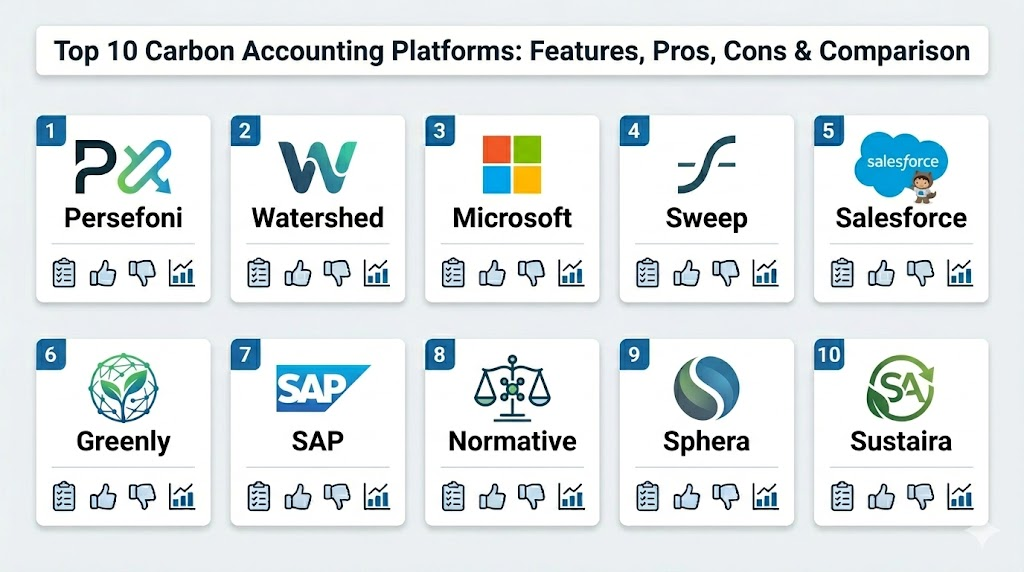
Top 10 Carbon Accounting Platforms
1. Persefoni
This platform is widely recognized as a leader for its high-performance calculation engine and deep focus on financial-grade reporting. It is specifically built for large enterprises and financial institutions that require absolute precision and auditability.
Key Features
- GHG Protocol-aligned calculation engine with over 100,000 emission factors.
- Advanced Scope 3 module for granular supply chain and financed emissions tracking.
- AI-powered data ingestion that identifies anomalies and fills data gaps.
- Comprehensive reporting templates for CSRD, TCFD, and SEC requirements.
- Internal carbon pricing tools to aid in strategic financial planning.
Pros
- The most robust platform for meeting complex financial and regulatory audits.
- Strong ecosystem of partners including major global consulting and audit firms.
Cons
- The high level of detail may be more than what smaller companies require.
- Premium pricing reflects its position as an enterprise-grade solution.
Platforms / Deployment
Web / Cloud
Cloud
Security & Compliance
SOC 2 Type II, ISO 27001, and GDPR compliant with SSO and MFA.
SOC 2, ISO 27001
Integrations & Ecosystem
It integrates seamlessly with major ERPs and financial platforms, serving as the connective tissue between sustainability and finance departments.
Support & Community
Professional support includes dedicated account managers and access to a sustainability advisory board of industry experts.
2. Watershed
Known for its high-velocity deployment and focus on actionable reduction, this platform combines powerful software with deep climate expertise to help companies move from measurement to actual carbon removal.
Key Features
- Real-time dashboards that visualize emissions across every department.
- Watershed Marketplace for purchasing high-quality carbon removals and clean energy.
- Customizable emission factors for unique industrial processes.
- Automated supplier engagement tools to gather primary data.
- Science-based target setting and progress tracking.
Pros
- Excellent user interface that makes complex climate data easy to understand.
- Focuses heavily on driving actual emissions reductions, not just reporting.
Cons
- Requires active engagement from internal teams to get the most value.
- Some advanced features are geared specifically toward very large organizations.
Platforms / Deployment
Web / Cloud
Cloud
Security & Compliance
Enterprise-grade security with audit-ready data trails.
Not publicly stated.
Integrations & Ecosystem
Integrates with over 100 software systems, including AWS, Google Cloud, and major financial tools.
Support & Community
Provides access to in-house climate scientists and a robust library of learning materials for sustainability leads.
3. Microsoft Sustainability Manager
Part of the Microsoft Cloud for Sustainability, this tool leverages the familiar Microsoft ecosystem to centralize environmental data and provide a unified view of an organization’s impact.
Key Features
- Direct integration with Microsoft 365 and Azure data lakes.
- Automated data connectors for water, waste, and carbon metrics.
- Advanced analytics and visualization through Power BI.
- Standardized data models that ensure consistency across global operations.
- Copilot AI integration for natural language queries and reporting.
Pros
- Easiest implementation for companies already standardized on the Microsoft stack.
- Highly scalable and benefits from Microsoft’s massive global infrastructure.
Cons
- Can feel complex for users who are not familiar with the broader Microsoft environment.
- Native carbon accounting depth sometimes lags behind specialized, purpose-built tools.
Platforms / Deployment
Web / Windows / Cloud
Cloud
Security & Compliance
Backed by the full security and compliance suite of the Microsoft Cloud.
ISO, SOC 1/2/3, GDPR
Integrations & Ecosystem
Offers the widest range of pre-built connectors for enterprise software and IoT sensors.
Support & Community
Global support network with extensive documentation and a massive community of third-party implementation partners.
4. Sweep
A collaborative data platform designed to help organizations manage their climate and ESG goals as a team. It focuses on decentralizing data collection, making every department head responsible for their own footprint.
Key Features
- Collaborative workspace that assigns tasks and data ownership to specific teams.
- Advanced scenario modeling for testing different reduction strategies.
- Deep supply chain mapping using a massive library of industrial data.
- Built-in compliance modules for EU and global reporting standards.
- Intuitive “campaign” feature for managing supplier data requests.
Pros
- The best platform for fostering a culture of sustainability across a large organization.
- Highly visual and interactive dashboards that improve stakeholder engagement.
Cons
- The collaborative approach requires strong internal governance to be effective.
- Setup can be time-consuming due to the high level of customization available.
Platforms / Deployment
Web / Cloud
Cloud
Security & Compliance
B Corp certified with high standards for data privacy and security.
Not publicly stated.
Integrations & Ecosystem
Strong partnerships with major global consultancies and integrations with standard business productivity tools.
Support & Community
Excellent onboarding and a professional community focused on collaborative climate action.
5. Salesforce Net Zero Cloud
Built directly on the Salesforce platform, this tool provides a comprehensive view of environmental impact by leveraging the data already stored in a company’s CRM and business systems.
Key Features
- Unified executive dashboards for tracking carbon, water, and waste.
- Tableau integration for high-level data visualization and storytelling.
- Net Zero Marketplace for purchasing verified carbon credits.
- Automated supplier portal for streamlined Scope 3 data collection.
- Built-in tools for calculating the impact of business travel and employee commuting.
Pros
- Provides a seamless experience for existing Salesforce users.
- Excellent for communicating sustainability progress to board-level stakeholders.
Cons
- Can be expensive if the organization is not already invested in the Salesforce ecosystem.
- May require significant customization to handle niche industrial emissions.
Platforms / Deployment
Web / Cloud
Cloud
Security & Compliance
Standard Salesforce enterprise security, including SSO and encryption.
Not publicly stated.
Integrations & Ecosystem
Leverages the massive AppExchange ecosystem for additional sustainability add-ons.
Support & Community
Backed by Salesforce’s global support network and the Trailhead learning platform.
6. Greenly
This platform focuses on making carbon accounting accessible and intuitive, particularly for mid-market companies and those just beginning their sustainability journey.
Key Features
- EcoPilot AI for automated categorization and expert-level advice.
- Life Cycle Assessment (LCA) tools for individual products.
- Engagement modules for educating and involving employees.
- Sector-specific templates tailored to the needs of different industries.
- Real-time bank and spend-based synchronization.
Pros
- Fastest setup time for companies needing a quick and reliable baseline.
- User-friendly interface that does not require a background in climate science.
Cons
- May lack some of the deeper “financed emissions” features needed by major banks.
- Reporting flexibility is slightly more limited than the high-end enterprise tools.
Platforms / Deployment
Web / Cloud
Cloud
Security & Compliance
GDPR compliant with secure data processing and hosting.
Not publicly stated.
Integrations & Ecosystem
Connects easily to common SMB tools like Shopify, Slack, and standard accounting software.
Support & Community
Active community and personalized coaching for sustainability leads.
7. SAP Sustainability Control Tower
For organizations running on SAP, this tool integrates sustainability metrics directly into the core ERP, providing a “green ledger” alongside the traditional financial one.
Key Features
- Direct integration with SAP S/4HANA for real-time operational data.
- Standardized ESG data models based on global reporting frameworks.
- Advanced audit trails for tracking every emission back to its source.
- Deep integration with supply chain and procurement modules.
- Automated sustainability reporting for annual and quarterly disclosures.
Pros
- The most powerful option for deep operational integration in large industrial firms.
- Eliminates data silos by keeping environmental metrics within the core ERP.
Cons
- Implementation can be a major IT project requiring significant resources.
- Only viable for organizations already using SAP as their primary business system.
Platforms / Deployment
Web / Cloud
Cloud / Hybrid
Security & Compliance
Enterprise-grade security compliant with global industrial and financial standards.
Not publicly stated.
Integrations & Ecosystem
Unrivaled integration within the SAP world and a global network of implementation partners.
Support & Community
Extensive corporate support and a professional community of SAP sustainability experts.
8. Normative
A specialized platform with a strong scientific foundation, focusing on providing highly accurate Scope 3 data and helping companies avoid the risks of greenwashing.
Key Features
- Science-based calculation engine that prioritizes data accuracy.
- Deep supply chain scanning to identify hidden carbon hotspots.
- Audit-ready reports that meet the most stringent regulatory requirements.
- Tools for setting and tracking Net Zero targets aligned with the latest standards.
- Customized reduction roadmaps based on a company’s unique footprint.
Pros
- Excellent for companies that face high levels of public and regulatory scrutiny.
- Provides some of the most reliable and defensible carbon data in the industry.
Cons
- The interface is more technical and data-heavy than some competitors.
- Requires a clean initial data set to reach its full potential.
Platforms / Deployment
Web / Cloud
Cloud
Security & Compliance
Strong focus on data integrity and secure audit trails for third-party verification.
Not publicly stated.
Integrations & Ecosystem
Strong connections to the European sustainability ecosystem and major global consultancies.
Support & Community
Provides access to top-tier climate experts and a professional user community.
9. Sphera
A veteran in the environmental, health, and safety (EHS) space, Sphera offers a comprehensive platform that combines carbon accounting with risk management and regulatory compliance.
Key Features
- Integrated EHS and sustainability management in a single platform.
- World-class database of life cycle assessment (LCA) data.
- Sophisticated tools for managing hazardous materials and waste alongside carbon.
- Deep experience in highly regulated heavy industries like chemicals and oil.
- Automated compliance reporting for global industrial regulations.
Pros
- The most experienced provider for heavy industrial and manufacturing sectors.
- Offers a much broader range of environmental risk tools beyond just carbon.
Cons
- The user interface can feel more industrial and less “modern” than newer startups.
- Implementation can be complex due to the sheer depth of the software.
Platforms / Deployment
Web / Cloud / Windows
Local / Cloud
Security & Compliance
Compliant with the strictest global industrial and government security standards.
ISO 27001, SOC 2
Integrations & Ecosystem
Deeply integrated with industrial systems and specialized EHS data sources.
Support & Community
A massive global presence with decades of experience in environmental consulting and support.
10. Sustaira
A modular, low-code platform that allows companies to build and customize their sustainability journey, providing a highly flexible approach to carbon and ESG management.
Key Features
- Low-code platform that allows for rapid customization of features.
- Modular design so companies only pay for the features they currently need.
- Strong focus on social and governance metrics alongside environmental ones.
- Templates for specific industries like construction and logistics.
- Collaborative tools for managing sustainability initiatives across teams.
Pros
- The most flexible and customizable platform on the list.
- Ideal for organizations that have unique reporting requirements not met by standard tools.
Cons
- High levels of customization may require more internal technical oversight.
- Newer in the market compared to established giants like SAP or Sphera.
Platforms / Deployment
Web / Cloud
Cloud / Private Cloud
Security & Compliance
Offers a private cloud option for companies with extreme data privacy needs.
Not publicly stated.
Integrations & Ecosystem
Built on a low-code foundation that makes connecting to any API relatively straightforward.
Support & Community
Responsive support and a growing community of developers and sustainability leads.
Comparison Table
| Tool Name | Best For | Platform(s) Supported | Deployment | Standout Feature | Public Rating |
| 1. Persefoni | Financial Institutions | Web, Cloud | Cloud | Audit-Grade Engine | N/A |
| 2. Watershed | Reduction Action | Web, Cloud | Cloud | Supply Chain Portal | N/A |
| 3. Microsoft | Microsoft Ecosystem | Web, Windows | Cloud | Power BI Integration | N/A |
| 4. Sweep | Team Collaboration | Web, Cloud | Cloud | Task Ownership | N/A |
| 5. Salesforce | CRM Users | Web, Cloud | Cloud | Tableau Dashboards | N/A |
| 6. Greenly | Mid-Market / SMB | Web, Cloud | Cloud | EcoPilot AI | N/A |
| 7. SAP | SAP-Led Enterprises | Web, Cloud | Hybrid | ERP-Level Integration | N/A |
| 8. Normative | Scientific Accuracy | Web, Cloud | Cloud | Scope 3 Scanning | N/A |
| 9. Sphera | Heavy Industry | Web, Cloud, Win | Hybrid | EHS & LCA Database | N/A |
| 10. Sustaira | Custom Flexibility | Web, Cloud | Private Cloud | Low-Code Modular | N/A |
Evaluation & Scoring
| Tool Name | Core (25%) | Ease (15%) | Integrations (15%) | Security (10%) | Perf (10%) | Support (10%) | Value (15%) | Total |
| 1. Persefoni | 10 | 6 | 10 | 10 | 9 | 9 | 6 | 8.60 |
| 2. Watershed | 9 | 8 | 9 | 8 | 9 | 9 | 7 | 8.45 |
| 3. Microsoft | 8 | 7 | 10 | 10 | 9 | 8 | 8 | 8.45 |
| 4. Sweep | 8 | 9 | 8 | 8 | 8 | 8 | 7 | 7.85 |
| 5. Salesforce | 8 | 8 | 9 | 9 | 8 | 9 | 7 | 8.15 |
| 6. Greenly | 7 | 10 | 8 | 7 | 8 | 8 | 10 | 8.15 |
| 7. SAP | 10 | 4 | 10 | 10 | 10 | 9 | 5 | 8.15 |
| 8. Normative | 9 | 6 | 7 | 8 | 9 | 8 | 7 | 7.60 |
| 9. Sphera | 10 | 5 | 8 | 10 | 9 | 9 | 6 | 8.05 |
| 10. Sustaira | 7 | 8 | 9 | 9 | 7 | 8 | 8 | 7.90 |
The scoring above is designed to reflect the strengths and trade-offs of each platform in a competitive corporate environment. Tools like SAP and Persefoni score perfectly in core methodology and security because they are built for the highest levels of professional scrutiny. However, they may score lower on ease of use due to their complexity. Conversely, platforms like Greenly provide incredible value and accessibility for companies that do not have dedicated sustainability teams. The weighted total provides a balanced view of how these tools compare as complete business solutions.
Which Carbon Accounting Software Tool Is Right for You?
Solo / Freelancer
For consultants working in the sustainability space, Greenly or Sustaira provide the most approachable entry points. These tools allow you to quickly baseline a client’s emissions without needing a massive technical implementation.
SMB
Small to medium businesses should prioritize Greenly or Watershed. These platforms offer the best balance of ease of use and automated data collection, allowing small teams to achieve compliance without hiring a full-time climate expert.
Mid-Market
Growing companies should look at Watershed or Sweep. These platforms provide the scalability needed as the company expands its operations and supply chain complexity while maintaining a focus on collaborative data management.
Enterprise
Large global organizations should consider Persefoni, SAP, or Microsoft. These tools offer the enterprise-grade security, integration depth, and methodological rigor required to handle thousands of data points and pass international financial audits.
Budget vs Premium
If the primary goal is rapid, cost-effective baseline reporting, Greenly offers excellent value. For organizations where a reporting error could lead to significant legal or financial risk, the premium investment in Persefoni or SAP is justified.
Feature Depth vs Ease of Use
Sphera and Houdini-style logic in specialized tools offer incredible depth for industrial processes but require significant training. Sweep and Watershed prioritize a modern user experience that encourages high adoption across all departments.
Integrations & Scalability
SAP and Microsoft lead the pack here. If your data is already living in these ecosystems, the “cost” of connecting your carbon accounting is significantly lower, and the system’s ability to scale with your data volume is virtually infinite.
Security & Compliance Needs
For highly regulated sectors like finance, defense, or healthcare, Persefoni or the private cloud options of Sustaira provide the highest levels of data sovereignty and audit-readiness.
Frequently Asked Questions (FAQs)
1. What exactly is carbon accounting?
It is the process of measuring the amount of greenhouse gases emitted by an organization. This data is then converted into “CO2 equivalents” so that different types of gases can be tracked as a single, standardized metric.
2. What is the difference between Scope 1, 2, and 3 emissions?
Scope 1 are direct emissions from sources you own. Scope 2 are indirect emissions from electricity or heat you buy. Scope 3 are all other indirect emissions in your value chain, including suppliers and product use.
3. Why can’t I just use a spreadsheet for carbon accounting?
Spreadsheets are prone to manual error, lack an audit trail, and cannot easily integrate with live data sources. Professional software ensures that your methodology is consistent and traceable for external auditors.
4. How long does it take to implement a carbon accounting platform?
For a simple setup, it can take a few weeks. For a global enterprise integrating multiple ERP systems and thousands of suppliers, the process can take several months to a year.
5. Do these platforms help with the new CSRD regulations?
Yes, most top-tier platforms have built-in templates specifically designed to meet the Corporate Sustainability Reporting Directive and other emerging global mandates.
6. Is the data in these platforms auditable?
Professional platforms provide a “locked” data trail, meaning every calculation and source is recorded and can be verified by a third-party auditor, similar to financial accounting.
7. Can these tools help me reduce my emissions, or just track them?
Most modern platforms now include “decarbonization” modules that suggest reduction strategies, such as switching to renewable energy or selecting more efficient shipping routes.
8. How do these tools get data from my suppliers?
Leading platforms provide “supplier portals” where vendors can securely upload their own data or use automated forms to report their emissions directly into your system.
9. Are these platforms expensive?
Pricing is typically based on the size of the organization and the number of facilities or suppliers being tracked. It can range from a few thousand dollars per year to six-figure enterprise contracts.
10. Do I need to be a climate scientist to use this software?
No, the goal of these platforms is to automate the complex science and math behind the scenes, allowing business leaders and finance teams to manage carbon as a standard business metric.
Conclusion
Implementing a carbon accounting platform is a strategic move that transitions a business from making climate promises to delivering measurable results. The right tool acts as a single source of truth, aligning environmental performance with financial accountability and regulatory requirements. As global standards tighten, the distinction between “good” and “great” platforms will lie in their ability to provide high-integrity, primary data from across the entire value chain. Organizations should begin by assessing their current data maturity and regulatory exposure, then select a platform that can scale alongside their sustainability ambitions while providing the auditability required in a modern corporate environment.

Best Cardiac Hospitals Near You
Discover top heart hospitals, cardiology centers & cardiac care services by city.
Advanced Heart Care • Trusted Hospitals • Expert Teams
View Best Hospitals