Introduction
Sustainability data platforms have become the central nervous system for modern organizations navigating the transition to a low-carbon economy. These digital ecosystems are designed to aggregate, validate, and report on a vast array of Environmental, Social, and Governance (ESG) metrics. In an era where “greenwashing” carries significant legal and financial risk, these platforms provide the “single source of truth” necessary for audit-ready disclosures. They transform fragmented data—from utility bills and supply chain invoices to HR diversity metrics—into actionable insights that drive corporate strategy and investor confidence.
As we operate in a global landscape defined by mandatory climate disclosures and tightening carbon border adjustments, the role of these platforms has shifted from elective reporting to mission-critical infrastructure. Buyers now prioritize automated data ingestion and AI-driven anomaly detection to manage the sheer volume of information required by frameworks like the CSRD and ISSB. A robust platform doesn’t just record history; it uses predictive modeling to forecast emissions trajectories and identify physical climate risks to assets, ensuring long-term business resilience.
Best for: Chief Sustainability Officers, CFOs, and risk managers at mid-to-large enterprises who must satisfy rigorous regulatory requirements and investor demands for transparent, high-fidelity ESG data.
Not ideal for: Small businesses with minimal reporting needs, or organizations looking for a simple carbon calculator without the need for integrated governance, audit trails, or multi-framework mapping.
Key Trends in Sustainability Data Platforms
- Agentic AI for Data Validation: Autonomous AI agents are now used to reconcile millions of data entries, flagging inconsistencies in energy units or identifying missing supplier responses in real-time.
- Double Materiality Automation: Platforms are integrating specialized workflows to assess both the financial impact of sustainability on the company and the company’s impact on society and the environment.
- Scope 3 Primary Data Collection: The focus has shifted from using industry averages to direct supplier engagement through integrated portals that capture actual activity-based emissions data.
- Financial-Grade Audit Trails: Every data point now requires a digital “paper trail” that links back to the original evidence, allowing external auditors to verify reports with the same rigor as financial statements.
- Real-Time Digital Twins: Large industrial firms are connecting IoT sensors directly to sustainability platforms to create real-time digital replicas of their carbon footprint across global facilities.
- Nature and Biodiversity Metrics: Following new global standards, platforms are expanding beyond carbon to track land use, water stress, and biodiversity impact across the value chain.
- Interoperable Ecosystems: Integration between sustainability platforms and core ERP systems has become a standard requirement to ensure sustainability metrics are embedded into daily business operations.
- Predictive Scenario Modeling: Companies are moving from reactive reporting to using AI-driven “what-if” scenarios to evaluate the cost and impact of different decarbonization pathways.
How We Selected These Tools
- Regulatory Specialization: We prioritized platforms that provide structured, native support for evolving global mandates like the CSRD, ESRS, and SEC climate rules.
- Data Architecture Integrity: Each selected tool was evaluated on its ability to maintain high-integrity audit trails and provide a “single source of truth” for all ESG data.
- Carbon Accounting Depth: We looked for platforms that offer sophisticated Scope 1, 2, and 3 calculations aligned with the GHG Protocol.
- Supplier Enablement: Priority was given to software that offers robust portals and tools for gathering primary data from the supply chain.
- Market Momentum: The selection reflects the platforms currently favored by Fortune 500 companies and major financial institutions for their reliability and scale.
- Innovation in AI: We evaluated how effectively each tool incorporates machine learning for data cleaning, anomaly detection, and predictive analytics.
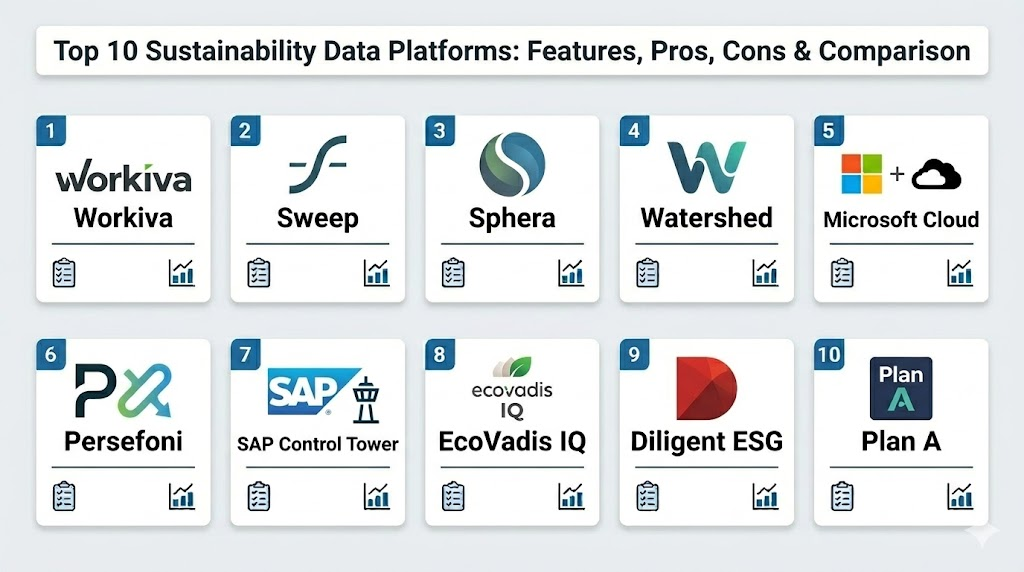
Top 10 Sustainability Data Platforms
1. Workiva Sustainability
Workiva is an enterprise-grade platform that unites financial reporting, GRC (Governance, Risk, and Compliance), and ESG data. It is highly favored by regulated organizations for its superior collaboration tools and audit readiness.
Key Features
- Centralized ESG data management with automated collection workflows.
- Built-in reporting templates aligned with major global frameworks.
- Advanced data validation and traceability for external assurance.
- Collaborative dashboards that allow finance and sustainability teams to work together.
- Integrated XBRL tagging for digital regulatory filings.
Pros
- Exceptional for audit trails and version control.
- Strongest choice for companies that already use Workiva for financial reporting.
Cons
- Can be complex for organizations without a dedicated reporting team.
- Implementation requires significant time to map complex organizational structures.
Platforms / Deployment
Web / Cloud
Hybrid
Security & Compliance
SSO/SAML, MFA, and SOC 2 Type II compliant.
ISO 27001 and GDPR compliant.
Integrations & Ecosystem
Integrates deeply with over 60 data sources, including SAP, Oracle, and Salesforce. It connects financial and non-financial data seamlessly to ensure consistency across all corporate disclosures.
Support & Community
High-touch enterprise support with dedicated account managers and a robust user community focused on regulatory compliance.
2. Sweep
Sweep is a leading carbon-first platform that has expanded into a comprehensive ESG management suite. It focuses on empowering large organizations to manage their climate transition through detailed data and scenario analysis.
Key Features
- Automated emissions calculations across Scope 1, 2, and 3.
- Specialized supply chain module for direct supplier engagement and primary data collection.
- Decarbonization roadmap tools to set and track science-based targets.
- AI-powered anomaly detection for rapid data validation.
- Real-time dashboards for monitoring progress against climate goals.
Pros
- Very intuitive interface that encourages adoption across different departments.
- Strongest feature set for active carbon reduction planning.
Cons
- Broader social and governance features are still evolving compared to carbon tools.
- Enterprise pricing can be a hurdle for mid-market firms.
Platforms / Deployment
Web / Cloud
Cloud
Security & Compliance
B Corp certified and SOC 2 compliant.
Not publicly stated.
Integrations & Ecosystem
Supports a wide range of API integrations for automated data ingestion from utility providers, ERPs, and travel management systems.
Support & Community
Excellent onboarding assistance and a growing community of climate-conscious enterprise leaders.
3. Sphera
Sphera offers a sophisticated corporate sustainability solution part of a broader EHS (Environment, Health, and Safety) platform. It is particularly strong for industrial organizations that need deep lifecycle analysis.
Key Features
- Advanced Scope 3 accounting with a massive library of emission factors.
- Integration across environmental, product stewardship, and sustainability modules.
- Audit-proof carbon management with full data transparency.
- Scenario modeling for complex industrial sustainability initiatives.
- Support for global regulatory frameworks and custom KPIs.
Pros
- Unmatched depth for industrial and manufacturing-specific data.
- High scalability for global enterprises with thousands of facilities.
Cons
- The platform’s complexity can lead to longer implementation cycles.
- User interface may feel more technical than modern SaaS competitors.
Platforms / Deployment
Web / Windows
Cloud / Hybrid
Security & Compliance
Enterprise-grade security with support for global compliance standards.
Not publicly stated.
Integrations & Ecosystem
Strongest in connecting with operational data from factory floors and supply chain management systems.
Support & Community
Global presence with extensive technical support and consulting services for complex deployments.
4. Watershed
Watershed is an enterprise sustainability platform designed for high-growth and established companies aiming for deep decarbonization. It combines software with a dedicated climate advisory team.
Key Features
- Financial-grade carbon accounting with full traceability of every number.
- AI-enabled gap analysis to identify missing data in the supply chain.
- Comprehensive ESG disclosure tools for ESRS and TCFD reporting.
- Marketplace for high-integrity carbon credits and removal projects.
- Policy and document management to store audit evidence centrally.
Pros
- Rapid data ingestion and excellent visualization of climate risk.
- High-quality climate advice included as part of the platform experience.
Cons
- Primarily focused on climate and carbon, with less depth in social metrics.
- Pricing is positioned at the premium end of the market.
Platforms / Deployment
Web / Cloud
Cloud
Security & Compliance
Built for highly regulated industries with robust data encryption.
Not publicly stated.
Integrations & Ecosystem
Offers over 60 pre-built integrations to ingest data from cloud providers, financial systems, and logistics partners.
Support & Community
Focused on high-touch partnership and helping companies navigate the complexities of science-based targets.
5. Microsoft Cloud for Sustainability
Microsoft’s solution leverages the power of the Azure ecosystem to provide a scalable data platform that unifies disparate sustainability data streams.
Key Features
- Integration with IoT and satellite data for real-time environmental monitoring.
- AI-powered insights through the Microsoft Sustainability Manager.
- Deep integration with the Microsoft 365 and Power BI ecosystem.
- Automated data connectors for carbon, water, and waste tracking.
- Comprehensive framework mapping for global reporting standards.
Pros
- Best choice for organizations already deeply embedded in the Microsoft stack.
- Excellent for real-time data visualization and large-scale data processing.
Cons
- Can require significant internal IT resources to configure properly.
- Some users find the interface less “sustainability-native” than specialized startups.
Platforms / Deployment
Web / Azure
Cloud
Security & Compliance
Benefits from Microsoft’s global security and compliance certifications (SOC, ISO, HIPAA).
Fully GDPR compliant.
Integrations & Ecosystem
Native integration with the entire Microsoft ecosystem and a massive library of third-party connectors.
Support & Community
Backed by Microsoft’s global support network and an extensive partner ecosystem for implementation.
6. Persefoni
Persefoni is an AI-powered carbon accounting platform that focuses on making climate data as reliable as financial data. It is a top choice for the investment community and private markets.
Key Features
- Automated calculation engine for Scope 1, 2, and 3 emissions.
- AI-driven “data-to-factor” matching to ensure calculation accuracy.
- Robust partnership with global accounting firms for audit readiness.
- Climate risk and scenario analysis tools for portfolio management.
- Support for the Partnership for Carbon Accounting Financials (PCAF) standards.
Pros
- Specifically designed to meet the rigorous standards of CFOs and auditors.
- Exceptional for financial institutions managing financed emissions.
Cons
- Very focused on carbon; less breadth in social and governance indicators.
- The interface is highly professional but can be dense with technical data.
Platforms / Deployment
Web / Cloud
Cloud
Security & Compliance
High-level data security focused on the needs of financial institutions.
Not publicly stated.
Integrations & Ecosystem
Strongest integrations are with financial management and investment tracking software.
Support & Community
Provides significant resources for understanding carbon accounting standards and regulatory changes.
7. SAP Sustainability Control Tower
SAP’s solution embeds sustainability metrics directly into the core of the business, allowing companies to record and act on ESG data within their existing ERP environment.
Key Features
- Autonomous carbon accounting through advanced AI integration.
- Real-time visibility into ESG performance across all business units.
- Direct connection to operational data in SAP S/4HANA.
- Integrated scenario modeling for supply chain and procurement decisions.
- Automated reporting for major global sustainability frameworks.
Pros
- Eliminates the need for manual data entry by pulling directly from the ERP.
- Best for large enterprises that need to manage sustainability at a granular level.
Cons
- Primarily effective for organizations already using the SAP ecosystem.
- Implementation can be complex and requires a high level of ERP expertise.
Platforms / Deployment
Web / Cloud
Cloud / Hybrid
Security & Compliance
Standard SAP enterprise security and data privacy controls.
Not publicly stated.
Integrations & Ecosystem
Fully integrated with the SAP Business Network and other enterprise applications.
Support & Community
Extensive global support network and professional services for enterprise implementation.
8. EcoVadis IQ
EcoVadis is specialized in supply chain sustainability ratings and data. It provides the largest global network for assessing and managing supplier ESG performance.
Key Features
- Comprehensive supplier ESG risk scoring and benchmarking.
- Evidence-based assessments across environment, labor, and ethics.
- Direct supplier engagement through a global assessment platform.
- Monitoring and alerts for supply chain sustainability risks.
- Integration of sustainability ratings into procurement workflows.
Pros
- The undisputed leader for managing and scoring third-party ESG risk.
- Massive database of pre-rated suppliers accelerates supply chain transparency.
Cons
- Not a complete internal ESG reporting platform; focused on external parties.
- Scoring is based on evidence provided by suppliers, which requires validation.
Platforms / Deployment
Web / Cloud
Cloud
Security & Compliance
ISO 27001 certified and GDPR compliant.
Not publicly stated.
Integrations & Ecosystem
Integrates with major procurement platforms like SAP Ariba, Coupa, and Oracle.
Support & Community
Global support in multiple languages to assist suppliers during the assessment process.
9. Diligent ESG
Diligent ESG is part of a broader governance platform, focusing on board-level oversight and the integration of ESG data into corporate risk management.
Key Features
- Board-level dashboards for monitoring ESG risks and opportunities.
- Automated data aggregation from across the organization.
- Integration of ESG metrics into internal audit and risk registers.
- Compliance tracking for a wide range of global regulations.
- Secure collaboration tools for executive and board oversight.
Pros
- Best for connecting sustainability data to high-level corporate governance.
- Excellent for organizations that already use Diligent for board management.
Cons
- Carbon accounting depth is not as technical as climate-native platforms.
- Less focused on operational-level sustainability management.
Platforms / Deployment
Web / Cloud
Cloud
Security & Compliance
Enterprise-grade security used by boards of directors worldwide.
Not publicly stated.
Integrations & Ecosystem
Strongest in its connection to governance, risk, and compliance (GRC) tools.
Support & Community
Highly professional support focused on the needs of executives and corporate boards.
10. Plan A
Plan A is an action-oriented sustainability platform that emphasizes decarbonization planning alongside comprehensive ESG data management.
Key Features
- AI-driven decarbonization roadmaps with specific reduction actions.
- Automated ESG data tracking and reporting for CSRD and other frameworks.
- Real-time monitoring of emissions trajectory vs targets.
- Tools for calculating and managing the impact of specific sustainability projects.
- Supplier engagement and value-chain data integration.
Pros
- Excellent user experience with a focus on taking “action” rather than just reporting.
- Very strong for companies looking to move quickly on their net-zero goals.
Cons
- May not have the same level of EHS depth as older legacy platforms.
- Pricing is competitive but scales quickly with increased data complexity.
Platforms / Deployment
Web / Cloud
Cloud
Security & Compliance
TÜV Rheinland certified for carbon accounting methodology.
Not publicly stated.
Integrations & Ecosystem
A growing library of API connectors for financial and operational data ingestion.
Support & Community
Proactive customer success team focused on helpings firms achieve measurable reductions.
Comparison Table
| Tool Name | Best For | Platform(s) Supported | Deployment | Standout Feature | Public Rating |
| 1. Workiva | Regulated Reporting | Web | Hybrid | Audit-Ready Workflows | N/A |
| 2. Sweep | Decarbonization | Web | Cloud | Climate Action Tools | N/A |
| 3. Sphera | Industrial Assets | Web, Windows | Hybrid | Lifecycle Analysis | N/A |
| 4. Watershed | Carbon Accounting | Web | Cloud | Financial-Grade Data | N/A |
| 5. Microsoft Cloud | Real-Time Monitoring | Web | Cloud | Azure/IoT Integration | N/A |
| 6. Persefoni | Financial Sector | Web | Cloud | Finance-Grade Carbon | N/A |
| 7. SAP Control Tower | SAP ERP Users | Web | Hybrid | Autonomous Accounting | N/A |
| 8. EcoVadis IQ | Supply Chain Risk | Web | Cloud | Supplier ESG Ratings | N/A |
| 9. Diligent ESG | Board Governance | Web | Cloud | Executive Dashboards | N/A |
| 10. Plan A | Action Planning | Web | Cloud | Net-Zero Roadmaps | N/A |
Evaluation & Scoring
| Tool Name | Core (25%) | Ease (15%) | Integrations (15%) | Security (10%) | Perf (10%) | Support (10%) | Value (15%) | Total |
| 1. Workiva | 10 | 5 | 9 | 10 | 9 | 9 | 6 | 8.45 |
| 2. Sweep | 9 | 9 | 8 | 8 | 9 | 8 | 8 | 8.55 |
| 3. Sphera | 10 | 4 | 8 | 9 | 9 | 8 | 6 | 7.80 |
| 4. Watershed | 9 | 8 | 9 | 9 | 9 | 9 | 7 | 8.55 |
| 5. Microsoft Cloud | 8 | 6 | 10 | 10 | 10 | 8 | 7 | 8.15 |
| 6. Persefoni | 9 | 7 | 8 | 9 | 9 | 8 | 7 | 7.95 |
| 7. SAP Control Tower | 9 | 5 | 10 | 9 | 9 | 8 | 7 | 8.10 |
| 8. EcoVadis IQ | 7 | 8 | 9 | 8 | 9 | 8 | 9 | 8.00 |
| 9. Diligent ESG | 7 | 8 | 7 | 10 | 8 | 9 | 7 | 7.80 |
| 10. Plan A | 8 | 9 | 7 | 8 | 8 | 8 | 9 | 8.10 |
The evaluation scores represent how effectively each platform meets the demands of a professional enterprise sustainability program. High total scores from platforms like Sweep and Watershed reflect their success in combining deep technical carbon data with a modern, accessible user experience. Workiva continues to lead in “Core” and “Security” due to its long history in regulated financial disclosures. For organizations with deep ERP ties, SAP and Microsoft offer high “Integrations” scores, which offsets their slightly higher learning curves.
Which Sustainability Data Platform Tool Is Right for You?
Solo / Freelancer
While these enterprise platforms are often too robust for a single freelancer, Blender or specialized open-source carbon calculators are often better. However, if you are a consultant managing data for others, Plan A or Sweep offer the most user-friendly entry points for managing multiple client datasets.
SMB
Small and medium businesses should prioritize speed and value. Greenly or Plan A are excellent choices because they offer automated data ingestion that reduces the need for a large internal sustainability team. These tools focus on getting you to a baseline report as quickly as possible.
Mid-Market
For companies that are beginning to face mandatory regulations but don’t have a massive IT budget, Sweep and Watershed offer the best balance of feature depth and ease of use. They provide the necessary audit trails without the extreme complexity of a full ERP-integrated solution.
Enterprise
Large, global organizations must prioritize scalability and security. Workiva, SAP, and Microsoft Cloud for Sustainability are the top contenders here. These platforms can handle millions of data points across hundreds of entities while ensuring that the data is ready for high-stakes investor disclosures.
Budget vs Premium
- Budget-Friendly: Plan A and Greenly offer competitive SaaS pricing with high automation.
- Premium Enterprise: Workiva and Sphera are higher-cost investments but provide unrivaled depth for complex regulatory and industrial needs.
Feature Depth vs Ease of Use
- Feature Depth: Houdini-level complexity in sustainability is found in Sphera and Houdini, offering total control over every emission factor.
- Ease of Use: Sweep and Watershed have set the standard for modern, intuitive interfaces that non-technical managers can easily navigate.
Integrations & Scalability
If your primary goal is to “set it and forget it” by connecting to your existing systems, SAP Sustainability Control Tower and Microsoft Cloud are the clear leaders. They are designed to scale infinitely alongside your existing cloud infrastructure.
Security & Compliance Needs
For companies in the banking or highly regulated sectors, Workiva and Diligent ESG provide the highest levels of security certification and specialized tools for board-level oversight, ensuring that sustainability data is never a vulnerability.
Frequently Asked Questions (FAQs)
1. What is the difference between carbon accounting and ESG software?
Carbon accounting focuses specifically on tracking and reducing greenhouse gas emissions. ESG software is broader, covering environmental metrics as well as social factors like diversity and governance structures.
2. Is these tools’ data ready for an official financial audit?
Leading platforms like Workiva and Watershed are built with “audit readiness” in mind, providing the digital evidence and traceability required by professional accounting firms for limited and reasonable assurance.
3. How long does it take to implement a sustainability data platform?
A basic setup can take 2-3 months, but a full enterprise implementation that involves connecting to multiple internal systems and global facilities typically takes 6-12 months.
4. Can these platforms help with Scope 3 emissions?
Yes, most top-tier platforms now include specialized modules for gathering data from suppliers, though the quality of the data often depends on the supplier’s own maturity and willingness to engage.
5. Do I need to be a climate scientist to use these tools?
No, modern platforms use AI and automated mapping to handle the complex science behind emission factors, allowing business managers to focus on strategy and reporting.
6. Will these tools automatically keep up with new regulations?
The best SaaS platforms provide regular updates to their framework libraries, ensuring that your reports remain compliant with the latest changes from bodies like the CSRD and SEC.
7. Can I export data for my annual report directly from the platform?
Yes, these tools are designed to generate high-quality, pre-formatted reports that can be used for annual disclosures, investor presentations, and public sustainability websites.
8. What is a “Single Source of Truth” in sustainability?
It refers to a centralized database where all sustainability data is stored and validated, ensuring that every department in the company is using the same numbers for their various reports.
9. How do these tools handle data from different global regions?
Enterprise platforms are built to handle multiple currencies, units of measure, and regional regulatory requirements, consolidating them into a single, consistent global report.
10. What is the role of AI in these platforms?
AI is used to automate data entry, flag anomalies (like a sudden spike in water use), match activity data to the correct emission factors, and model future carbon reduction scenarios.
Conclusion
Selecting the right sustainability data platform is a critical step in future-proofing your organization against the rising tide of climate regulation and investor scrutiny. The market has matured, offering specialized solutions that range from carbon-first action planning to board-level governance and deep ERP integration. By centralizing your ESG data, you move beyond simple compliance and into a space where sustainability insights drive real financial value and operational efficiency. The global landscape defined by mandatory climate disclosures and tightening carbon border adjustments, the role of these platforms has shifted from elective reporting to mission-critical infrastructure. The key to success lies in choosing a platform that matches your team’s technical maturity and can scale as your reporting requirements evolve.

Best Cardiac Hospitals Near You
Discover top heart hospitals, cardiology centers & cardiac care services by city.
Advanced Heart Care • Trusted Hospitals • Expert Teams
View Best Hospitals