Introduction
The Certified Site Reliability Professional serves as a definitive benchmark for engineers looking to master the art of maintaining high-availability systems. This guide is crafted for software engineers and systems professionals who want to transition from traditional operations to a modern, code-centric reliability model. By focusing on the intersection of software engineering and systems administration, this certification provides a structured roadmap for navigating the complexities of distributed systems.
Managed through SREschool, the program bridges the gap between theoretical DevOps concepts and practical, production-grade reliability engineering. As the industry moves toward autonomous systems and cloud-native architectures, having a validated credential helps professionals stand out in a competitive global market. This guide will help you understand how this certification can pivot your career toward high-impact roles in platform engineering and reliability management.
Making informed career decisions requires a clear understanding of what a certification validates and how it translates to daily tasks. Throughout this document, we explore the depth of the curriculum, the intensity of the assessments, and the long-term ROI for engineers in India and across the world. Whether you are a junior developer or a technical leader, this guide provides the clarity needed to plan your learning journey effectively.
What is the Certified Site Reliability Professional?
The Certified Site Reliability Professional is a professional designation that validates an individual’s ability to apply software engineering principles to solve infrastructure and operational problems. Unlike traditional certifications that focus on a specific vendor’s toolset, this program focuses on the core tenets of SRE, such as toil reduction, error budgets, and horizontal scalability. It represents a shift from “keeping the lights on” to “engineering the system to keep its own lights on.”
This certification exists to standardize the skill sets required for modern production environments where manual intervention is no longer sustainable. It emphasizes real-world scenarios, including incident response, root cause analysis, and the automation of repetitive operational tasks. By achieving this status, an engineer proves they can build resilient systems that handle failures gracefully without human intervention.
The learning objectives align with modern enterprise practices where speed of delivery must be balanced with system stability. Organizations today require engineers who can speak the language of both developers and operations teams while maintaining a laser focus on the end-user experience. This program ensures that graduates are prepared to implement observability, handle large-scale migrations, and manage complex microservices architectures efficiently.
Who Should Pursue Certified Site Reliability Professional?
Software engineers who find themselves spending more time on infrastructure and deployments than on feature development are prime candidates for this certification. It provides the necessary framework to transition into formal SRE or Platform Engineering roles where coding skills are applied to system reliability. This path is particularly beneficial for those who enjoy troubleshooting deep-level system issues and building automated self-healing mechanisms.
DevOps engineers and cloud architects can use the Certified Site Reliability Professional to refine their approach to system stability and performance tuning. While DevOps focuses on the culture of collaboration and delivery, SRE provides the specific implementation details and metrics to measure that success. Professionals in security and data roles also benefit, as reliability is the foundational layer upon which security and data integrity are built.
Engineering managers and technical leaders should pursue this knowledge to better understand how to build and scale reliability teams within their organizations. Understanding concepts like Error Budgets and Service Level Objectives (SLOs) allows managers to make data-driven decisions about feature velocity versus stability. In India’s booming tech landscape and the global SaaS market, these skills are highly sought after by top-tier product companies and service providers alike.
Why Certified Site Reliability Professional is Valuable in Beyond
The demand for high-system availability has never been higher, as even minutes of downtime can result in millions of dollars in lost revenue and damaged brand reputation. Enterprises are moving away from reactive firefighting and toward proactive reliability engineering, making this certification a long-term asset. It ensures that professionals remain relevant even as specific cloud providers or CI/CD tools evolve, because the underlying principles of reliability remain constant.
Longevity in a technical career depends on mastering fundamental concepts rather than just learning the latest “hot” tool. The Certified Site Reliability Professional teaches the “why” behind system failures and the “how” of building resilience, which are skills that do not expire. As more companies adopt hybrid and multi-cloud strategies, engineers who can maintain consistency across diverse environments will continue to command premium salaries.
Investing time in this certification provides a significant return by opening doors to specialized roles that offer better work-life balance through reduced on-call stress. By mastering automation and toil reduction, engineers can move away from manual, repetitive tasks and focus on high-value architectural improvements. This shift not only enhances career satisfaction but also makes an individual indispensable to any organization running production workloads at scale.
Certified Site Reliability Professional Certification Overview
The program is delivered via the official SREschool.com platform and is designed to cater to various career stages through a modular learning approach. It is hosted on SREschool.com, providing a centralized environment for learning materials, practice labs, and the final assessment. The certification is structured to be practical, requiring candidates to demonstrate their knowledge through hands-on scenarios rather than simple multiple-choice questions.
Ownership of the certification remains with a body of industry experts who ensure the curriculum is updated to reflect current industry trends and technologies. The assessment approach focuses on the ability to diagnose system bottlenecks, implement monitoring solutions, and write automation scripts. This ensures that the credential carries weight in the industry, as it proves actual competence in a production-like environment.
The structure is divided into distinct tracks that allow learners to specialize in areas that most interest them while maintaining a core understanding of SRE principles. Each level of the certification builds upon the previous one, ensuring a logical progression of skills and responsibilities. This practical framework makes it easy for employers to understand the exact capabilities of a certified professional at any given level.
Certified Site Reliability Professional Certification Tracks & Levels
The certification is structured into three primary levels: Foundation, Professional, and Advanced, ensuring that learners have a clear path from novice to expert. The Foundation level focuses on core concepts like Linux internals, networking, and the basic philosophy of SRE. It is designed to get someone up to speed with the vocabulary and fundamental tools required for entry-level reliability roles.
The Professional level dives deeper into the technical implementation of SRE practices, including observability, container orchestration, and incident management. This track is meant for engineers who are already working in production environments and need to refine their ability to build and scale resilient systems. It covers the middle ground where most SRE work occurs, focusing on automation and performance optimization.
The Advanced level is for seasoned professionals looking to lead SRE teams or architect large-scale reliability strategies for entire organizations. This track includes specialization options for specific domains such as FinOps (financial optimization) or AIOps (applying machine learning to operations). These levels align with typical career progression from Junior SRE to Senior SRE and eventually to Principal Engineer or SRE Manager.
Complete Certified Site Reliability Professional Certification Table
| Track | Level | Who it’s for | Prerequisites | Skills Covered | Recommended Order |
| Core SRE | Foundation | Junior Engineers, Students | Basic Programming | Linux, Git, SRE Terms | 1 |
| Production SRE | Professional | Mid-level Engineers | Foundation Cert | SLOs, Monitoring, K8s | 2 |
| Strategic SRE | Advanced | Senior Engineers, Leads | Professional Cert | Chaos Eng, Scaling | 3 |
| SRE Special | Specialized | Cloud Architects | Professional Cert | Multi-cloud, DR | 4 |
| Reliability Lead | Leadership | Managers, Tech Leads | Professional Cert | Team Building, Budgets | 5 |
Detailed Guide for Each Certified Site Reliability Professional Certification
Certified Site Reliability Professional – Foundation
What it is
This entry-level certification validates a foundational understanding of the SRE philosophy and the basic technical tools required for modern operations. It ensures the candidate understands the difference between traditional SysAdmin roles and the SRE approach.
Who should take it
Aspiring SREs, recent graduates, or software developers who want to understand how their code behaves in production. It is also suitable for technical recruiters who need to understand SRE terminology.
Skills you’ll gain
- Understanding of the SRE mindset and the “Golden Signals” of monitoring.
- Proficiency in basic Linux command-line operations and shell scripting.
- Knowledge of version control using Git in a collaborative environment.
- Familiarity with the concepts of Service Level Indicators (SLIs) and SLOs.
Real-world projects you should be able to do
- Set up a basic monitoring dashboard for a web application.
- Automate a simple backup script using Bash or Python.
- Participate in a basic incident post-mortem discussion.
Preparation plan
- 7-14 days: Review official documentation and memorize key SRE terminology.
- 30 days: Complete hands-on labs for Linux basics and Git workflows.
- 60 days: Engage in community forums and take multiple practice assessments.
Common mistakes
- Focusing too much on specific tools rather than the underlying SRE principles.
- Underestimating the importance of Linux file system knowledge.
Best next certification after this
- Same-track option: Certified Site Reliability Professional – Professional
- Cross-track option: Certified Cloud Practitioner
- Leadership option: Project Management Professional (PMP)
Certified Site Reliability Professional – Professional
What it is
The Professional level validates the ability to implement and manage SRE practices in a live production environment. It focuses on the technical “how-to” of maintaining system health and optimizing performance.
Who should take it
Engineers with 2+ years of experience in DevOps or SRE roles who are responsible for maintaining high-availability applications. It is for those who want to master observability and automation.
Skills you’ll gain
- Advanced observability using Prometheus, Grafana, and distributed tracing.
- Managing containerized workloads using Kubernetes and service meshes.
- Implementing and managing Error Budgets to balance speed and stability.
- Automating complex infrastructure using Terraform or Ansible.
Real-world projects you should be able to do
- Design and implement a complete CI/CD pipeline with integrated health checks.
- Configure auto-scaling policies based on custom application metrics.
- Conduct a simulated chaos engineering experiment to test system resilience.
Preparation plan
- 7-14 days: Intensive study of observability patterns and metric collection.
- 30 days: Hands-on configuration of Kubernetes clusters and monitoring stacks.
- 60 days: Work through real-world incident scenarios and troubleshooting labs.
Common mistakes
- Neglecting the cultural aspect of SRE, such as blameless post-mortems.
- Over-complicating monitoring setups with too many low-value alerts.
Best next certification after this
- Same-track option: Certified Site Reliability Professional – Advanced
- Cross-track option: Certified DevSecOps Professional
- Leadership option: Certified SRE Manager
Certified Site Reliability Professional – Advanced
What it is
This is the highest level of technical certification, focusing on large-scale system architecture and strategic reliability planning. It validates an expert’s ability to handle global-scale traffic and complex distributed failures.
Who should take it
Principal engineers, SRE architects, and technical leaders who are responsible for the reliability of massive, multi-region infrastructures. It requires deep prior experience.
Skills you’ll gain
- Designing global traffic management and load balancing strategies.
- Advanced chaos engineering and disaster recovery planning.
- Architecting self-healing systems using AI and machine learning (AIOps).
- Optimizing cloud costs without sacrificing system performance (FinOps).
Real-world projects you should be able to do
- Design a multi-region failover strategy with zero data loss.
- Build an automated incident response system that triggers remediation scripts.
- Perform a deep-dive performance audit of a global microservices architecture.
Preparation plan
- 7-14 days: Reviewing advanced architectural patterns and case studies.
- 30 days: Participating in high-level architectural design challenges.
- 60 days: Documenting and presenting a complex reliability strategy for a distributed system.
Common mistakes
- Assuming that what works at a small scale will work at a global scale.
- Ignoring the financial implications of high-availability architectures.
Best next certification after this
- Same-track option: Specialized tracks in AIOps or FinOps
- Cross-track option: Certified Solutions Architect Professional
- Leadership option: Chief Technology Officer (CTO) Program
Choose Your Learning Path
DevOps Path
The DevOps path focuses on the seamless integration of development and operations to improve deployment frequency. Engineers on this path will use the Certified Site Reliability Professional to add a layer of production discipline to their automation skills. It is ideal for those who want to ensure that faster delivery does not come at the cost of system stability. Mastery of CI/CD and infrastructure as code is central to this particular journey.
DevSecOps Path
The DevSecOps path integrates security into the heart of the reliability and delivery process. By combining SRE principles with security automation, professionals can build systems that are both resilient to failures and resistant to attacks. This path is crucial for engineers working in regulated industries like finance or healthcare. It teaches how to implement security checks as part of the standard reliability metrics.
SRE Path
The pure SRE path is for those dedicated to the specific discipline of reliability engineering as defined by industry leaders. It focuses heavily on metrics, toil reduction, and the software engineering approach to operations. This path leads to roles specifically titled “Site Reliability Engineer” within major technology organizations. It is the most direct application of the Certified Site Reliability Professional curriculum to a job role.
AIOps Path
The AIOps path focuses on using artificial intelligence and machine learning to automate and enhance IT operations. Professionals on this path learn how to use data-driven insights to predict failures before they occur and automate root cause analysis. This represents the future of SRE, where human intervention is minimized through intelligent system monitoring. It requires a strong grasp of both reliability principles and data science basics.
MLOps Path
The MLOps path is designed for engineers who manage the production lifecycle of machine learning models. Reliability in this context includes monitoring for model drift and ensuring that data pipelines are as robust as the applications they feed. The Certified Site Reliability Professional provides the framework for applying SRE discipline to the often-unpredictable world of machine learning. It ensures that AI models remain performant and reliable in production environments.
DataOps Path
The DataOps path applies the principles of SRE to data engineering and data pipeline management. It focuses on the reliability of data flows, ensuring that high-quality data is available to the business at all times. Professionals learn how to treat data pipelines as production systems, implementing monitoring and automated recovery for data tasks. This is essential for organizations that rely on real-time data for critical decision-making.
FinOps Path
The FinOps path focuses on the financial management of cloud resources, ensuring that reliability is achieved in a cost-effective manner. It teaches engineers how to balance the desire for infinite redundancy with the reality of cloud budgets. By mastering this path, SREs can demonstrate the direct business value of their technical decisions through cost savings. It is a critical skill for senior leadership roles in cloud-first companies.
Role → Recommended Certified Site Reliability Professional Certifications
| Role | Recommended Certifications |
| DevOps Engineer | Foundation, Professional |
| SRE | Foundation, Professional, Advanced |
| Platform Engineer | Professional, Advanced |
| Cloud Engineer | Foundation, Professional |
| Security Engineer | Professional (Security Specialization) |
| Data Engineer | Foundation, DataOps Specialization |
| FinOps Practitioner | Professional, FinOps Specialization |
| Engineering Manager | Foundation, Leadership Track |
Next Certifications to Take After Certified Site Reliability Professional
Same Track Progression
Deep specialization within the SRE track involves moving from the Professional to the Advanced level. This allows an engineer to transition from managing individual services to overseeing the reliability of entire platforms. The goal here is to become a domain expert who can mentor others and set the technical direction for the organization. Deepening your knowledge in Chaos Engineering or Performance Tuning is a natural extension of this path.
Cross-Track Expansion
Broadening your skills across different tracks like DevSecOps or DataOps makes you a more versatile “T-shaped” professional. For example, an SRE with deep security knowledge is incredibly valuable for building compliant infrastructure in the cloud. Similarly, understanding the nuances of MLOps allows an SRE to support the growing number of AI-driven applications. This expansion helps in moving toward Architect-level roles that require a broad technical overview.
Leadership & Management Track
For those looking to move away from individual contributor roles, the leadership track offers a path into management. This involves learning how to build SRE teams, manage departmental budgets, and align reliability goals with business objectives. Certifications in ITIL, PMP, or specialized SRE management programs are excellent follow-ups. This transition is ideal for experienced engineers who want to influence the culture and strategy of an organization.
Training & Certification Support Providers for Certified Site Reliability Professional
DevOpsSchool
DevOpsSchool is a prominent training provider that offers comprehensive courses designed to prepare students for various reliability and automation certifications. They provide a blend of theoretical knowledge and intensive hands-on labs that simulate real-world production environments. Their curriculum is often updated to include the latest tools and best practices used by top-tier tech companies globally. Students benefit from mentorship by industry veterans who bring years of practical experience to the classroom. The platform is well-regarded for its focus on career transition and helping professionals land high-paying roles in the DevOps and SRE ecosystem.
Cotocus
Cotocus specializes in providing high-end technical training for modern engineering roles, focusing heavily on cloud-native technologies and SRE principles. They offer tailored programs that cater to both individual learners and corporate teams looking to upskill their workforce. Their approach is highly practical, ensuring that every participant gains direct experience with the tools they will use in their daily jobs. Cotocus is known for its rigorous assessment processes and high standards of instruction, making it a preferred choice for serious professionals. Their training modules often cover complex topics like service mesh, advanced observability, and multi-cloud architecture.
Scmgalaxy
Scmgalaxy is a widely recognized community and training hub that has been supporting software configuration management and DevOps professionals for over a decade. They offer a vast repository of resources, tutorials, and certification preparation courses that are accessible to engineers at all levels. Their training programs for SRE and related fields are designed to be affordable while maintaining high educational quality. Scmgalaxy emphasizes the importance of community learning and provides platforms for engineers to share their experiences and solutions. This collaborative environment helps students stay informed about the latest industry trends and job market requirements.
BestDevOps
BestDevOps focuses on delivering top-tier educational content specifically for those aiming for excellence in the DevOps and SRE domains. They provide structured learning paths that guide students through the complexities of modern software delivery and system reliability. Their instructors are typically active practitioners who understand the current challenges faced by engineering teams in fast-paced environments. BestDevOps is praised for its clear communication style and its ability to break down complex technical concepts into manageable learning modules. Their certification support is geared toward ensuring that candidates not only pass the exams but also excel in their roles.
devsecopsschool.com
Devsecopsschool.com is a specialized platform dedicated to the integration of security into the DevOps and SRE lifecycles. They offer unique training programs that bridge the gap between traditional security practices and modern automated workflows. Their courses are essential for professionals who want to master the art of building secure, resilient systems from the ground up. By focusing on security as a core component of reliability, they prepare students for the increasingly critical role of DevSecOps Engineer. The platform provides hands-on labs that focus on automated security testing, vulnerability management, and compliance as code.
sreschool.com
Sreschool.com is the primary authority and hosting site for the Certified Site Reliability Professional program, offering the most direct path to certification. The platform is built by SREs for SREs, ensuring that the content is highly relevant to the actual work performed in production environments. They provide a comprehensive suite of learning materials, including video tutorials, technical documentation, and interactive lab environments. Because they manage the certification itself, their training is perfectly aligned with the assessment objectives and requirements. Professionals who use this platform get the most authentic and up-to-date information regarding SRE standards and practices.
aiopsschool.com
Aiopsschool.com is at the forefront of the emerging AIOps field, providing specialized training on the application of AI and ML to IT operations. Their programs teach SREs how to handle the massive amounts of data generated by modern systems using intelligent automation. This training is crucial for those looking to stay ahead of the curve as systems become too complex for manual management. The platform covers topics such as anomaly detection, automated incident correlation, and predictive maintenance. By learning these skills, engineers can significantly reduce mean time to resolution (MTTR) and improve overall system health through data-driven insights.
dataopsschool.com
Dataopsschool.com focuses on the intersection of data engineering and operational excellence, offering a dedicated path for DataOps professionals. Their curriculum applies the rigorous principles of SRE to data pipelines and big data infrastructure. This ensures that data-driven organizations can rely on their data assets as much as they rely on their applications. The training includes modules on data quality monitoring, pipeline automation, and managing large-scale data platforms in the cloud. As data becomes the lifeblood of modern business, the skills taught here are becoming indispensable for maintaining a competitive edge.
finopsschool.com
Finopsschool.com addresses the critical need for financial accountability in the world of cloud computing and reliability engineering. Their training programs teach engineers and managers how to optimize cloud spending without compromising on performance or stability. This involves understanding complex cloud billing models, implementing cost-allocation tags, and automating the shutdown of unused resources. FinOps is a vital skill for senior SREs who need to justify infrastructure costs to business stakeholders. The platform provides the framework for creating a culture of cost-awareness within engineering teams, leading to more sustainable and profitable cloud operations.
Frequently Asked Questions (General)
- How difficult is the Certified Site Reliability Professional exam?
The exam is designed to be challenging but fair, focusing on practical application rather than rote memorization. Candidates with hands-on experience in Linux and basic automation usually find it manageable. - What is the recommended study time for the Foundation level?
Most professionals spend about 30 to 45 days preparing for the Foundation level, depending on their existing technical background. This allows for a deep dive into the core concepts and labs. - Do I need to be a programmer to pass this certification?
While you don’t need to be a software architect, a basic understanding of programming logic and shell scripting is essential. SRE is fundamentally about using code to manage systems. - What is the Return on Investment (ROI) for this certification?
Many graduates report significant salary increases and access to more senior roles within 6 to 12 months of certification. It also increases job security in a tech-heavy market. - Can I skip the Foundation level if I have experience?
It is generally recommended to follow the sequence to ensure no gaps in foundational SRE philosophy, but experienced professionals can often move through the first level quickly. - Are there any annual fees to maintain the certification?
Typically, there is a renewal process every few years to ensure your skills remain current with evolving technology. Check the official site for specific renewal terms. - How does this certification compare to vendor-specific ones like AWS or Google Cloud?
This certification is vendor-neutral, focusing on the core principles of SRE that apply across any cloud or on-premise environment. It complements vendor-specific certs perfectly. - What kind of jobs can I get after becoming a Certified Site Reliability Professional?
Common titles include SRE, DevOps Engineer, Platform Engineer, Systems Engineer, and Infrastructure Architect. - Is the exam conducted online or at a center?
The assessment is typically conducted online through a proctored environment on the official platform, offering flexibility for global candidates. - What happens if I fail the exam?
There is usually a cooling-off period before you can retake the assessment. It is recommended to review the areas where you scored low before attempting it again. - Are there practice exams available?
Yes, the official platform and support providers usually offer practice assessments that mirror the format and difficulty of the real exam. - Is this certification recognized globally?
Yes, the principles taught are based on industry standards used by major global tech firms, making the credential valuable anywhere in the world.
FAQs on Certified Site Reliability Professional
- What specific SRE tools are covered in the curriculum?
The program covers a range of industry-standard tools including Prometheus for monitoring, Grafana for visualization, Kubernetes for orchestration, and Terraform for infrastructure as code. - Does the certification focus more on Google’s SRE model or Netflix’s model?
It takes a balanced approach, incorporating the best practices from various industry leaders to provide a comprehensive view of modern reliability engineering. - How much weight is given to incident management?
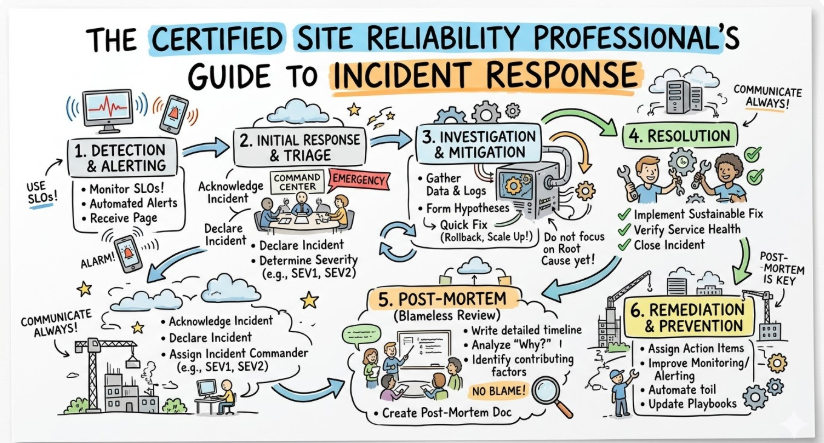
Incident management is a core pillar of the Professional and Advanced levels, covering everything from initial response to blameless post-mortem documentation. - Is Chaos Engineering part of the mandatory curriculum?
Chaos Engineering is introduced at the Professional level and becomes a major focus at the Advanced level, where it is used for testing system resilience. - Does the certification cover cloud-specific reliability features?
While the principles are neutral, the labs often use popular cloud environments to demonstrate how to implement SRE concepts in real-world settings. - How are Service Level Objectives (SLOs) assessed in the exam?
Candidates are often asked to define appropriate SLIs and calculate Error Budgets for a given application scenario to prove they understand the math of reliability. - Can this certification help me move from a SysAdmin to an SRE role?
Yes, it is specifically designed to provide the software engineering and automation skills that traditional SysAdmins need to make that career transition. - Is there a focus on legacy systems or only modern microservices?
While the focus is on modern architectures, the principles of reliability engineering are also applied to maintaining and migrating legacy systems.
Final Thoughts: Is Certified Site Reliability Professional Worth It?
As a mentor with over two decades in the industry, I have seen many certifications come and go. The reason the Certified Site Reliability Professional stands out is its focus on the “engineering” part of systems engineering. It doesn’t just teach you how to use a tool; it teaches you how to think about systems, failures, and human error in a way that makes you a more effective professional.
If you are looking for a way to future-proof your career and move into roles that are both technically challenging and highly rewarded, this is a solid investment. It provides a structured path in an often-confusing field, giving you the confidence to lead production efforts at any scale. The certification is worth it not just for the paper, but for the rigorous mental framework it instills in every successful candidate.

Best Cardiac Hospitals Near You
Discover top heart hospitals, cardiology centers & cardiac care services by city.
Advanced Heart Care • Trusted Hospitals • Expert Teams
View Best Hospitals