Introduction
In the complex world of enterprise DevOps, transformation success is defined by measurable business outcomes rather than just technical implementation. To move beyond industry hype and deliver genuine value, consultants must utilize rigorous, data-driven frameworks to track performance and process alignment. By mastering the right DevOps KPIs, you ensure transparency and continuous improvement throughout the engagement. To deepen your expertise in these critical delivery models, professional resources like DevOpsSchool offer essential guidance on aligning technical execution with strategic business impact.
Why KPIs Matter for DevOps Consultants
Accountability is the cornerstone of professional consulting. Clients engage consultants to solve problems, mitigate risks, and accelerate delivery. Without KPIs, a consulting engagement risks becoming a “black box” where value is assumed rather than proven.
KPIs serve as the common language between the engineering team and the C-suite. They provide the objective data needed to:
- Validate Investment: Demonstrate that the consulting spend is yielding measurable improvements in speed and stability.
- Prioritize Efforts: Identify which areas of the software development lifecycle (SDLC) are providing the highest return on investment.
- Mitigate Project Risk: Use early warning signs in metrics to pivot strategies before a project fails.
- Ensure Alignment: Keep the development, operations, and business stakeholders aligned on the same definitions of “done” and “successful.”
For a consultant, KPIs are not just data points; they are the narrative of the engagement’s success.
Difference Between Engineering KPIs and Consulting KPIs
While engineering teams focus on granular metrics to manage daily workflows, consultants must view DevOps through a strategic lens.
Engineering KPIs are often tactical—focused on individual build times, test coverage percentages, or CPU utilization. While these are necessary for the health of the system, they often fail to capture the “big picture” value that stakeholders require.
Consulting KPIs, by contrast, are outcome-based. They bridge the gap between technical output and business value. A consultant does not just report that “deployment frequency increased by 20%.” Instead, they report that “increased deployment frequency has reduced our time-to-market for critical features, directly supporting the quarterly revenue goal.”
- Engineering Metrics: Focus on how things are built.
- Consulting Metrics: Focus on why the business is performing better and what the future state looks like.
Core Categories of DevOps Consulting KPIs
To provide comprehensive value, consultants should categorize their metrics. This structure ensures that no aspect of the transformation is overlooked.
| KPI Category | Purpose | Key Focus Area |
| Delivery KPIs | Measure velocity and flow. | Speed of value delivery to the end user. |
| Reliability KPIs | Measure system health. | Stability, uptime, and user experience. |
| Security KPIs | Measure risk posture. | Compliance, vulnerability management. |
| Business KPIs | Measure commercial impact. | ROI, cost reduction, market competitiveness. |
| Client Satisfaction | Measure engagement quality. | Stakeholder trust, requirement clarity. |
Delivery Performance KPIs
Delivery performance is the heartbeat of DevOps. These metrics indicate how effectively an organization can move code from development to production.
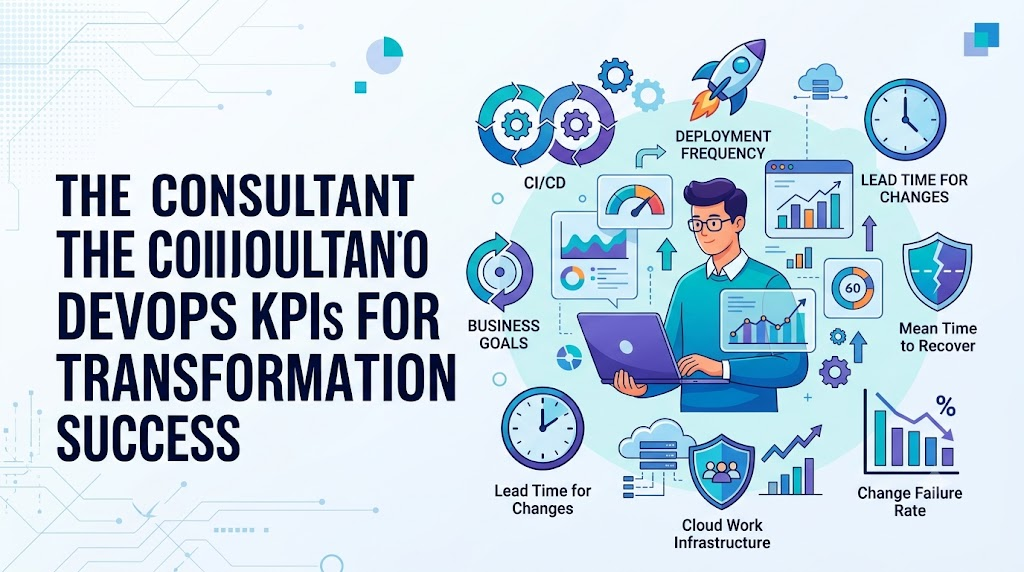
- Deployment Frequency: How often the organization can deploy to production. High-performing teams deploy on-demand.
- Lead Time for Changes: The duration from code commit to code running in production. This is the primary indicator of process efficiency.
- Release Success Rate: The percentage of releases that reach production without requiring an emergency rollback.
- Change Failure Rate: The percentage of deployments that result in degraded service or service failure.
Consulting Scenario: In a banking engagement, we found that long lead times were caused by manual compliance gates. By tracking “Lead Time for Changes” as a primary KPI, we secured executive buy-in to automate the compliance audit trail, reducing deployment time from weeks to hours.
Reliability & Stability KPIs
Technical agility is useless if the system is constantly down. These metrics ensure that the consultant is building a sustainable, resilient architecture.
- System Uptime: The availability of services, usually measured against a Service Level Agreement (SLA).
- Incident Frequency: How often the system experiences production issues.
- Mean Time to Recovery (MTTR): The average time taken to restore service after an incident. This is perhaps the most critical indicator of SRE effectiveness.
- Error Rate Trends: Monitoring the volume of application errors to identify systemic issues before they become outages.
Consulting Scenario: A retail client suffered from “deployment anxiety.” By focusing on MTTR as a core KPI, we implemented better observability and automated rollback strategies, giving the team the confidence to release features daily rather than monthly.
CI/CD Pipeline KPIs
The pipeline is the factory floor of DevOps. If the factory is slow or broken, the output will always be poor.
- Pipeline Success Rate: The percentage of pipeline runs that complete successfully without manual intervention.
- Build Duration: The time taken for the CI/CD pipeline to complete the build, test, and package phases.
- Deployment Automation Coverage: The percentage of the environment that is managed via Infrastructure-as-Code (IaC) rather than manual configuration.
- Rollback Frequency: How often a deployment needs to be reverted. High frequency suggests poor testing or bad code quality.
DevSecOps & Compliance KPIs
Security cannot be an afterthought. In modern consulting, the “Consultant” must also be a “Security Advisor.”
- Vulnerability Detection Rate: How quickly security flaws are identified during the build phase.
- Security Remediation Time: The average time taken to fix identified vulnerabilities.
- Compliance Coverage: Percentage of the environment that adheres to regulatory standards (e.g., PCI-DSS, HIPAA).
- Policy Violation Rate: Tracking how often infrastructure deployments violate predefined security policies.
Client Satisfaction & Engagement KPIs
Soft metrics are just as important as hard data. A project that succeeds technically but leaves the client feeling unheard or unsupported is a consulting failure.
- Stakeholder Satisfaction Score: Regular qualitative surveys to measure confidence in the transformation process.
- Requirement Clarity Index: Measuring how often scope changes due to misunderstanding technical capabilities.
- Delivery Alignment Score: Assessing how well the technical team’s output matches the business requirements defined at the start.
- Feedback Cycle Time: How long it takes for a stakeholder request to be incorporated into the development backlog.
Real-World Example: Consulting Without KPI Tracking
Consider a large enterprise undergoing a cloud migration. Without a defined KPI model, the consulting engagement became a series of “tasks” rather than a “transformation.”
- The Issue: The engineering team focused on “number of instances migrated.” The business stakeholders, however, cared about “application performance” and “cloud cost efficiency.”
- The Result: The consultants were seen as effective because they moved servers, but the business felt the engagement was a failure because costs skyrocketed and performance remained sluggish.
- The Outcome: The lack of alignment on shared KPIs led to project cancellation and damaged the reputation of the consulting firm.
Real-World Example: KPI-Driven DevOps Consulting Success
Contrast this with an engagement where we established a “Transformation Scorecard” on day one.
- The Approach: We defined a set of KPIs that combined technical delivery (MTTR) with business goals (reduced cost per transaction).
- The Execution: Monthly stakeholder reviews focused exclusively on these metrics. When cost-efficiency dipped, we shifted resources to focus on auto-scaling optimizations.
- The Outcome: The client gained visibility into exactly what they were paying for. Trust was absolute because data, not intuition, drove every decision. The project was extended based on the proven ROI.
Common Mistakes DevOps Consultants Make
- Tracking Vanity Metrics: Counting commits or lines of code. These tell you nothing about value.
- Ignoring Business Outcomes: Building the “perfect” architecture that doesn’t actually solve the business problem.
- Over-focusing on Tools: Thinking the installation of a tool is a metric for success.
- Lack of Baselines: Failing to measure the “before” state, making it impossible to calculate improvement.
- Inconsistent Reporting: Changing metrics mid-stream, which destroys credibility.
Best Practices for KPI-Driven DevOps Consulting
- Define KPIs Early: Agree on the metrics before a single line of code is written.
- Align with Business Goals: Ensure every technical KPI can be traced back to a business objective.
- Automate Measurement: Do not rely on manual spreadsheets. Build dashboards that pull data directly from Jira, Jenkins, or cloud monitoring tools.
- Review Regularly: Treat KPIs as a live discussion with stakeholders, not a static report.
- Focus on Improvement Trends: Look at the delta over time. Is the trend line moving in the right direction?
Role of DevOpsSchool in Consulting Skill Development
Success in DevOps consulting requires a deep understanding of not just the tools, but the methodologies, frameworks, and cultural shifts necessary for transformation. Professionals seeking to refine their expertise often turn to ecosystems like DevOpsSchool.
Exposure to structured learning models helps consultants understand how to map CI/CD best practices to real-world enterprise constraints. By learning to integrate industry-aligned delivery models, consultants can better articulate the ROI of their recommendations, ensuring that their technical expertise is always paired with strong business acumen.
Industries Where DevOps Consulting KPIs Matter Most
- Banking & Finance: High regulatory pressure makes Compliance and Security KPIs non-negotiable.
- Healthcare: Reliability and uptime are matters of patient safety, making MTTR and Uptime critical.
- SaaS: Delivery speed is a competitive advantage, making Lead Time for Changes and Deployment Frequency the primary focus.
- E-Commerce: Scalability and stability during peak traffic periods are the main drivers for Reliability KPIs.
- Telecom: Managing massive infrastructure complexity requires high-level CI/CD pipeline and automation metrics.
Future of KPI-Driven DevOps Consulting
The future of consulting lies in predictive analytics. We are moving toward a model where AI-powered dashboards will not just report what happened in the last sprint, but predict potential failures in the next one. Automated KPI dashboards will provide real-time visibility, allowing consultants to act as “performance coaches” rather than just implementers. The shift will be from reactive reporting to proactive optimization.
FAQs
- What KPIs should DevOps consultants track?Focus on a mix of Delivery (lead time, frequency), Reliability (uptime, MTTR), and Business (ROI, cost) metrics.
- Why are KPIs important in consulting?They provide objective proof of success, ensure alignment with business goals, and build trust with stakeholders.
- What is a good DevOps success metric?Any metric that indicates improvement in business value, such as a reduction in lead time to market or an increase in release stability.
- How do you measure DevOps transformation?By benchmarking the current state against a set of industry-standard DevOps KPIs and tracking the trend of improvement over time.
- What is MTTR?Mean Time to Recovery. It measures how quickly a system can be restored after a failure.
- What is deployment frequency?The number of successful deployments to production over a specific period.
- How do consultants report progress?Through regular, data-driven reviews that highlight KPI trends and relate them back to agreed-upon business objectives.
- What are DevOps consulting KPIs?These are the specific performance indicators used to manage and evaluate the effectiveness of a DevOps consulting engagement.
- Should I track vanity metrics?No. Avoid metrics like “number of commits” or “number of open tickets” as they do not reflect true business value.
- How do I align KPIs with business goals?Ask the client, “What business outcome does this technical change support?” then build a metric around that outcome.
- What if the data isn’t available?It is part of the consultant’s job to implement the instrumentation needed to capture the necessary data.
- How often should KPIs be reviewed?Ideally, during every sprint review or monthly steering committee meeting.
- Are CI/CD metrics enough?No. CI/CD metrics only cover the delivery aspect; you must also track stability, security, and business impact.
- What is a Change Failure Rate?The percentage of releases that cause a production issue, requiring a rollback or hotfix.
- Does DevOps consulting need to be automated?Yes, the measurement of the transformation itself should be as automated as the DevOps process it aims to improve.
Final Thoughts
Consulting success is not about the tools you implement or the lines of code you refactor; it is about the measurable impact you leave behind. By anchoring your engagements in clear, data-driven KPIs, you create transparency, foster trust, and demonstrate the tangible value of the DevOps philosophy. Technical delivery is the baseline, but continuous improvement—measured and reported with precision—is what defines a top-tier consultant. Keep your focus on the outcomes that matter to the business, and let the data tell the story of your success.

Best Cardiac Hospitals Near You
Discover top heart hospitals, cardiology centers & cardiac care services by city.
Advanced Heart Care • Trusted Hospitals • Expert Teams
View Best Hospitals