Introduction
When software delivery slows down or production incidents pile up despite modern tooling, organizations often bring in an external perspective to diagnose root causes. An experienced DevOps consultant evaluates much more than whether a pipeline simply builds and deploys; they comprehensively review automation completeness, security controls, test quality, infrastructure consistency, deployment strategies, observability, and developer experience. By examining how code travels from a developer laptop to production, consultants help engineering teams eliminate manual bottlenecks, secure their delivery lifecycle, and ensure that pipelines are repeatable, scalable, and closely aligned with overall business goals. Organizations seeking to benchmark their practices often reference resources and training programs from DevOpsSchool, knowing that every assessment remains custom-tailored to the specific architecture, risk profile, and technology stack of the enterprise.
What Does A DevOps Consultant Review in a Pipeline?
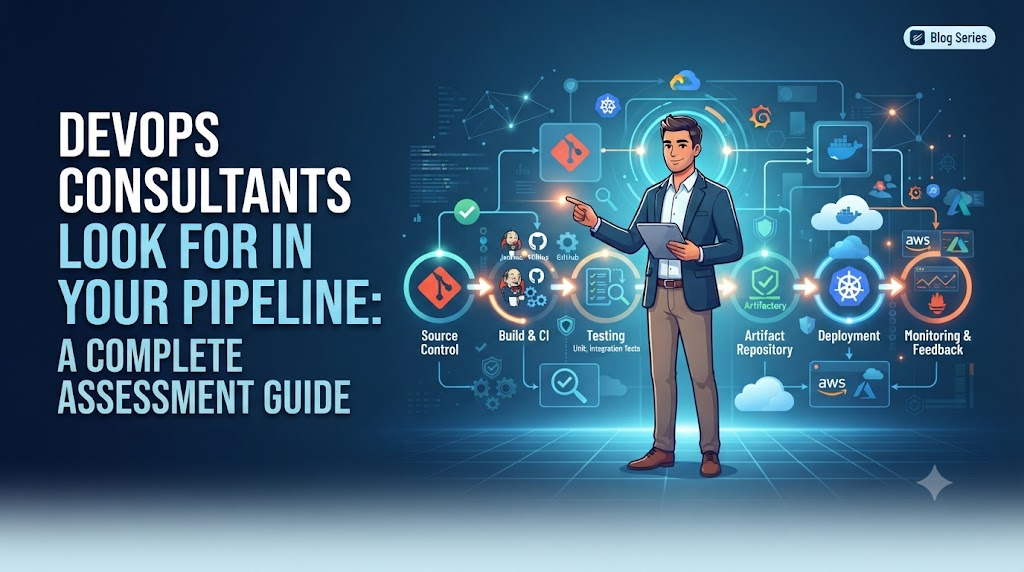
A comprehensive pipeline assessment covers the entire software delivery lifecycle rather than just the central CI/CD execution tool. Consultants examine how code is written, reviewed, tested, secured, packaged, deployed, monitored, and operated in production. Reviewing only the CI/CD server provides a very narrow picture of delivery health.
The evaluation process typically spans several core operational areas:
- Source control management and branching strategies.
- Automated build processes and dependency handling.
- Test execution quality, coverage, and reliability.
- CI/CD orchestration and environment promotion workflows.
- Security integration, including static analysis and secret management.
- Infrastructure provisioning and version control practices.
- Deployment automation and release mechanics.
- Observability, logging, metrics, and tracing instrumentation.
- Operational reliability and incident recovery procedures.
- Governance, compliance, and auditability controls.
By evaluating these interconnected domains, consultants identify where friction occurs, where risks accumulate, and where engineering effort will yield the highest return on investment.
Why Pipeline Assessment Matters
Many organizations operate with pipelines that grew organically over years, accumulating technical debt, brittle scripts, and manual workarounds. Over time, these hidden inefficiencies degrade both engineering output and business agility.
Unchecked pipeline weaknesses often manifest as severe operational symptoms:
- Delivery bottlenecks caused by manual approvals, waiting queues, or slow builds.
- Unreliable manual processes that lead to human error during critical releases.
- High deployment risk due to inadequate testing or missing rollback mechanisms.
- Security gaps, such as hardcoded secrets or unpatched container dependencies.
- Reliability issues caused by inconsistent configuration across environments.
- Poor visibility that makes troubleshooting production incidents difficult.
- Inflated cloud and CI/CD infrastructure costs from idle resources.
- Low developer productivity and frustration with slow feedback loops.
When pipelines are slow, brittle, or opaque, developers spend more time fighting tooling than writing features. Addressing these structural issues helps organizations release software safely, reduce operational toil, and respond faster to market demands.
Pipeline Assessment Overview
The following table summarizes the primary areas evaluated during a comprehensive pipeline review and outlines the typical risks associated with each domain.
| Assessment Area | What Consultants Look For | Typical Risk |
| Source Control | Clean branching workflows, strict code reviews, protected branches | Unauthorized changes, unreviewed code merging to production |
| Build | Automated compilation, consistent packaging, secure dependency handling | Non-reproducible builds, supply chain vulnerabilities |
| Testing | Automated unit, integration, and end-to-end tests with quality gates | Bugs reaching production, slow feedback cycles |
| CI/CD | Reliable orchestrators, reusable workflows, clean environment promotion | Fragile pipelines, hardcoded environment configurations |
| Security | Automated SAST, DAST, container scanning, and secret management | Data breaches, compliance violations, leaked credentials |
| Infrastructure | Version-controlled Infrastructure as Code, automated provisioning | Configuration drift, manual environment discrepancies |
| Deployment | Automated zero-downtime releases, clear rollback mechanisms | Extended outages during failed production releases |
| Observability | Comprehensive logs, metrics, traces, and actionable alerts | Blind spots during incidents, slow mean time to resolution |
| Reliability | Defined incident response, regular failure testing, robust backups | Extended downtime, catastrophic data loss |
| Governance | Standardized templates, clear ownership, audit trails | Shadow IT, unmaintained pipelines, regulatory non-compliance |
Source Control and Code Management
Source control is the foundation of any reliable software delivery pipeline. Consultants examine how teams manage code repositories, structure branches, conduct reviews, and protect critical branches from accidental or malicious modification.
Reviewing this area involves looking at specific engineering practices:
- Git workflows that match team size and release frequency, such as Trunk-Based Development or GitFlow.
- Pull request standards, mandatory peer reviews, and automated status checks before merging.
- Branch protection rules that prevent direct pushes to main or production branches.
- Commit message hygiene, repository structure, and clear code ownership files.
- Semantic versioning practices and clean release tagging.
Consultants frequently identify warning signs such as long-lived feature branches that merge infrequently, missing code reviews, or lack of branch protections. These practices increase merge conflict overhead and allow low-quality code to enter shared environments unchecked.
CI Pipeline Design
A Continuous Integration pipeline is responsible for turning raw source code into validated, reproducible artifacts. Consultants evaluate how efficiently and reliably code is compiled, tested, and packaged upon every commit.
Key aspects of CI pipeline design include:
- Build automation that runs consistently regardless of developer operating system.
- Trigger configuration that avoids redundant runs while ensuring rapid feedback.
- Efficient dependency management, caching strategies, and secure artifact repositories.
- Pipeline execution duration and optimization to keep feedback loops short.
- Modular, reusable pipeline components rather than duplicated script blocks across projects.
Maintainable CI pipelines treat pipeline definitions as code, storing them alongside application source code. Consultants look for clear separation between build steps and deployment steps, ensuring that built artifacts are immutable and ready for promotion across multiple environments.
Testing and Quality Gates
Having an automated test suite does not automatically guarantee pipeline quality. Consultants evaluate the depth, distribution, reliability, and execution speed of tests embedded within the delivery workflow.
A robust testing strategy encompasses multiple layers:
- Unit tests that validate isolated business logic quickly.
- Integration tests that confirm database and external API interactions work correctly.
- End-to-end and regression tests that verify user journeys across integrated systems.
- Static Application Security Testing and code quality linters.
- Automated quality gates that block promotions when test thresholds are missed.
Consultants pay close attention to flaky tests—tests that fail intermittently without code changes. Flaky tests erode developer trust and lead teams to bypass automated gates. Minimizing execution time and ensuring deterministic test results are critical goals during an assessment.
Deployment Automation
Deploying software should be a routine, automated operational event rather than a high-stress ritual. Consultants examine how code moves from staging environments into production and how changes are managed.
Key deployment criteria include:
- Fully automated deployments across all non-production and production environments.
- Consistent environment promotion models ensuring identical artifact deployment.
- Clear rollback mechanisms and automated health checks during deployment windows.
- Adoption of safe release strategies tailored to application architecture.
Deployment strategies vary based on business criticality. Rolling updates replace instances incrementally, blue-green deployments switch traffic between parallel environments instantly, and canary releases route a small percentage of traffic to new versions to validate behavior. Consultants help teams choose the right strategy to minimize downtime and blast radius.
Infrastructure as Code
Manual infrastructure provisioning introduces environment drift, undocumented configuration changes, and severe recovery delays. Consultants evaluate how infrastructure is defined, tested, versioned, and applied.
Core Infrastructure as Code evaluation points include:
- Use of declarative provisioning tools such as Terraform, OpenTofu, or cloud-native templates.
- Complete version control for all network, compute, storage, and IAM definitions.
- Reproducible environment creation from scratch without manual intervention.
- Automated scanning of infrastructure code for security misconfigurations.
- Elimination of manual console changes through strict role-based access controls.
When infrastructure is treated as software, teams can spin up exact replicas of production for testing or disaster recovery in minutes rather than days.
Cloud and Environment Management
Organizations typically operate multiple environments, including development, testing, staging, and production. Consultants review how these environments are managed, secured, and isolated from one another.
Important cloud management considerations include:
- Ensuring staging environments closely mirror production to catch environment-specific bugs early.
- Cloud resource management, networking segmentation, and least-privilege IAM policies.
- Cost visibility, resource tagging strategies, and identification of orphaned cloud assets.
- Configuration management separation using environment-specific variables or secrets managers.
Consultants examine whether teams have clear visibility into cloud spending and whether resource utilization aligns with actual business demand.
DevSecOps and Pipeline Security
Security cannot be bolted on at the end of the development lifecycle; it must be embedded directly into the pipeline. Consultants review how security controls are integrated into daily engineering workflows.
A secure pipeline implementation includes:
- Centralized, encrypted secrets management rather than plain-text configuration files.
- Software Composition Analysis to scan third-party dependencies for known vulnerabilities.
- Container image scanning for operating system-level vulnerabilities.
- Infrastructure as Code security linters running on every pull request.
- Strict pipeline execution permissions and signed artifact verification.
Integrating security checks early allows developers to catch vulnerabilities when they are inexpensive and easy to fix, rather than discovering them during a pre-release audit.
Container and Kubernetes Pipelines
When organizations containerize applications and deploy to Kubernetes, pipeline complexity shifts. Consultants review how container images are built, scanned, registered, and deployed.
Key Kubernetes pipeline review elements include:
- Multi-stage Docker builds that keep final image sizes minimal and secure.
- Use of trusted, minimal base images and mandatory registry scanning policies.
- Management of Kubernetes manifests using templating tools like Helm or Kustomixing.
- Implementation of Role-Based Access Control, network policies, and admission controllers.
- Artifact signing to guarantee provenance and integrity before cluster deployment.
Poorly structured container pipelines can introduce vulnerabilities through bloated base images or overly permissive cluster access rights.
Observability and Monitoring
A pipeline is incomplete if the team cannot observe the health of the application after deployment. Consultants evaluate logging, metrics, tracing, and alerting mechanisms across the delivery stack.
Effective observability practices cover:
- Structured, centralized application and infrastructure logging.
- Core performance metrics capturing CPU, memory, latency, and error rates.
- Distributed tracing for microservices architectures to pinpoint latency bottlenecks.
- Actionable, tiered alerting that wakes engineers only for genuine actionable issues.
- Pipeline telemetry tracking build durations, failure rates, and deployment frequencies.
Teams must be able to quickly answer what changed, when it changed, and how it impacted users immediately following a deployment.
Reliability and Incident Management
Operational reliability is closely tied to pipeline maturity. Consultants evaluate how well an organization handles failures, recovers from incidents, and tests system resilience.
Key reliability indicators include:
- Defined incident response workflows and post-mortem review cultures.
- Rapid recovery processes supported by automated rollbacks and robust backups.
- Regular disaster recovery testing and chaos engineering practices.
- Tracking key reliability metrics such as Mean Time to Recovery and Change Failure Rate.
High-performing pipelines empower teams to recover quickly by making rollbacks as simple as promoting a previous immutable artifact version.
Pipeline Performance and Developer Experience
If a pipeline takes hours to run or fails unpredictably, developers will circumvent it or lose momentum. Consultants evaluate developer experience by measuring pipeline efficiency and usability.
Crucial performance and experience indicators include:
- Total pipeline execution time and queue waiting times.
- Clarity of failure messages and fast feedback loops for developers.
- Self-service capabilities enabling developers to provision environments without ticketing bottlenecks.
- Low maintenance overhead for maintaining pipeline definitions.
Improving developer experience directly correlates with higher code quality, faster delivery velocity, and improved job satisfaction.
Pipeline Governance and Standardization
As organizations scale, managing dozens of disparate pipelines across different teams becomes difficult. Consultants evaluate how organizations balance governance with engineering autonomy.
Standardization strategies involve:
- Shared, reusable pipeline templates and workflows maintained by platform engineering teams.
- Consistent change management integration without unnecessary manual bureaucracy.
- Clear audit trails proving compliance with internal policies and regulatory standards.
- Defined pipeline ownership models ensuring every repository has a responsible team.
Governance should empower teams with secure, pre-approved building blocks rather than slowing them down with rigid administrative gates.
Cost and Resource Efficiency
CI/CD infrastructure and cloud build agents consume significant resources. Consultants examine whether build environments and cloud deployments are optimized for cost without compromising performance.
Cost optimization reviews focus on:
- Right-sizing CI/CD build agents and autoscaling runners based on actual load.
- Identifying idle test environments and scheduling automated shutdowns outside business hours.
- Eliminating redundant test suites and optimizing artifact retention policies.
- Balancing build speed with compute costs by utilizing appropriate runner instance types.
Controlling pipeline resource waste helps organizations maintain sustainable cloud budgets as their engineering headcount grows.
What Consultants Look for in Pipeline Failures
Failures happen in every engineering organization, but how a pipeline reacts to failure reveals a lot about maturity. Consultants analyze historical pipeline failure data to find systemic weaknesses.
Common investigative areas include:
- Failure frequency and whether specific stages fail more often than others.
- Patterns in flaky builds, infrastructure timeouts, or intermittent test failures.
- Root cause analysis thoroughness and remediation tracking.
- Clarity of error reporting and effectiveness of automated recovery routines.
Recurring pipeline failures indicate deeper architectural or process problems that require systematic attention rather than temporary band-aids.
DevOps Pipeline Maturity Assessment
Maturity models help organizations understand their current operational standing and plan incremental improvements. Maturity is contextual and should be measured against specific business goals rather than treated as a universal ranking.
| Level | Pipeline Characteristics |
| Level 1 – Manual | Deployments require manual script execution, builds happen on local machines, testing is ad-hoc, and documentation is sparse. |
| Level 2 – Partially Automated | Builds and unit tests run automatically in CI, but deployments to staging and production involve manual approvals and manual steps. |
| Level 3 – Automated | End-to-end CI/CD pipelines automate testing, security scans, infrastructure provisioning, and deployments to staging environments. |
| Level 4 – Optimized | Automated deployments utilize canary or blue-green strategies, comprehensive observability is active, and rollbacks are fully automated. |
| Level 5 – Continuously Improved | Pipelines feature advanced feedback loops, self-service developer platforms, automated chaos testing, and continuous cost optimization. |
Red Flags Consultants Commonly Identify
During assessments, consultants frequently encounter recurring anti-patterns that hinder delivery performance. Recognizing these warning signs is the first step toward remediation.
- Manual deployments: Relying on human execution for production releases increases error rates and stress.
- Hardcoded secrets: Storing passwords, API tokens, or database credentials directly in repository code.
- No rollback strategy: Having no automated way to revert a failed release quickly.
- Absence of automated testing: Relying entirely on manual QA cycles before releases.
- Long pipeline duration: Waiting hours for build and test results destroys developer focus.
- Frequent unexplained failures: Ignoring intermittent test or build failures as normal behavior.
- Production drift: Making manual changes directly on production servers outside version control.
- Inconsistent environments: Differences between development and production that hide critical bugs.
- Excessive permissions: Granting overly broad cloud or pipeline access rights to users and services.
- Tool sprawl: Adopting disconnected tools without a cohesive integration strategy.
Real-World Pipeline Assessment Example
Scenario
A growing software company providing logistics management software experiences frequent production outages, slow release cycles, and growing tension between development and operations teams. Leadership engages a DevOps consultant to review their software delivery pipeline.
Initial Environment
The organization uses a monolithic application architecture. Code is stored in GitHub, but builds are triggered manually on a shared Jenkins server. Testing consists primarily of manual QA checks taking up to five days. Infrastructure is provisioned manually using cloud console clicks, and deployments require remote desktop access to production servers.
Consultant Assessment
The consultant reviews the end-to-end workflow, interviewing developers, QA engineers, and system administrators. They evaluate the codebase, Jenkins configurations, cloud IAM roles, and historical incident records.
Major Risks
- High blast radius due to manual production deployments without automated rollbacks.
- Zero infrastructure version control leading to configuration drift across environments.
- Complete lack of automated regression testing, causing frequent post-release bugs.
- Hardcoded database credentials stored in configuration files within the repository.
Recommended Improvements
- Implement Terraform to bring all cloud infrastructure under version control.
- Introduce automated unit and integration test suites into a modernized CI pipeline.
- Migrate secrets out of source control and into a centralized secrets manager.
- Establish an automated staging deployment workflow with zero-downtime rolling updates.
Expected Engineering Improvements
Implementing these priorities helps the organization achieve faster feedback loops, reduced deployment stress, improved security posture, and significantly lower mean time to recovery during incidents.
DevOps Consultant Pipeline Checklist
- Source control is properly managed with branching strategies and pull requests.
- Code reviews are established and enforced before merging.
- Builds are automated and triggered on every code commit.
- Automated unit, integration, and security tests run within the pipeline.
- Dependencies are scanned regularly for known vulnerabilities.
- Secrets are managed securely outside of source code repositories.
- Infrastructure is defined, version controlled, and provisioned via code.
- Deployments are fully automated across all environments.
- Clear rollback procedures exist for failed deployments.
- Environments are consistent between staging and production.
- Monitoring, logging, and observability tools are active and configured.
- Pipeline failures are tracked, measured, and analyzed for root causes.
- Access control follows the principle of least privilege.
- Pipeline documentation and ownership are clearly defined.
Questions to Ask Before a DevOps Pipeline Assessment
| Question | Why It Matters |
| What is our current architecture and technology stack? | Determines tool compatibility and scaling requirements. |
| How frequently do we successfully deploy to production? | Establishes baseline delivery velocity and agility. |
| What is our average pipeline execution time and failure rate? | Identifies developer feedback bottlenecks. |
| Where do manual steps currently slow down our release process? | Pinpoints areas for immediate automation. |
| How are secrets and sensitive credentials managed? | Highlights critical security vulnerabilities. |
| Is our infrastructure managed via code or manual configuration? | Measures risk of environment drift. |
| What observability tools do we use during incidents? | Evaluates mean time to resolution capabilities. |
| Who owns and maintains our CI/CD pipelines? | Clarifies organizational accountability and governance. |
| What are our primary business priorities for the next quarter? | Aligns technical improvements with business goals. |
| What technical debt causes the most friction for our engineers? | Reveals internal pain points affecting morale and speed. |
How to Prepare Your Pipeline for a DevOps Consultant
Preparing for an assessment ensures that the consulting engagement is efficient and focused on high-value outcomes. Organizations should approach the review with transparency and openness.
Practical preparation steps include:
- Documenting the current end-to-end pipeline workflow from commit to production.
- Identifying known pain points, bottlenecks, and frequent failure areas honestly.
- Collecting pipeline metrics such as build duration, deployment frequency, and lead time.
- Preparing up-to-date architecture and network diagrams.
- Reviewing access controls and preparing inventory lists of tools and repositories.
- Gathering historical incident reports and post-mortem documentation.
- Clarifying business objectives and delivery targets with leadership stakeholders.
Organizations should avoid hiding problems or artificially cleaning up pipelines before an assessment. Consultants gain the most value when they observe real, unvarnished operational challenges.
How DevOps Consultants Prioritize Recommendations
A consultant typically uncovers dozens of potential improvements during an assessment. Attempting to fix everything at once leads to organizational fatigue and confusion. Consultants prioritize recommendations based on a structured evaluation matrix.
| Priority | Example Issue | Recommended Action |
| High | Hardcoded database passwords in code repository | Immediately rotate credentials and move secrets to a secure manager. |
| High | No automated rollback for production deployments | Implement immutable artifacts and automated deployment rollbacks. |
| Medium | Slow test execution blocking PR merges | Optimize test suites, parallelize execution, and remove flaky tests. |
| Medium | Manual infrastructure provisioning via console | Introduce Terraform scripts for non-production environments. |
| Low | Inconsistent commit message formatting | Establish team guidelines and optional linting checks. |
Consultants focus on high-impact, low-effort changes first to build momentum, followed by foundational architectural improvements that secure long-term stability.
DevOps Learning Roadmap
DevOps Fundamentals
       ↓
Git & Source Control
       ↓
CI/CD
       ↓
Testing Automation
       ↓
Cloud
       ↓
Infrastructure as Code
       ↓
Containers
       ↓
Kubernetes
       ↓
DevSecOps
       ↓
Observability
       ↓
Reliability Engineering
       ↓
DevOps Consulting & Optimization
Understanding pipeline assessments requires a solid grasp of foundational DevOps concepts and continuous practice across the delivery lifecycle. Engineers begin by mastering version control and CI/CD basics, progressing through cloud infrastructure, security, observability, and advanced platform engineering principles.
Career Value of Understanding Pipeline Assessments
| Role | Pipeline Assessment Skills |
| DevOps Engineers | Identifies inefficiencies and strengthens daily automation practices. |
| SREs | Improves system reliability, incident recovery, and observability standards. |
| Platform Engineers | Designs better internal developer platforms and reusable templates. |
| Cloud Engineers | Ensures secure, cost-effective, and reproducible infrastructure design. |
| DevOps Consultants | Provides structured diagnostic frameworks for client evaluations. |
| Engineering Managers | Aligns technical delivery improvements with business goals. |
| Technical Architects | Evaluates enterprise scalability, security posture, and risk. |
Experienced engineers benefit greatly from learning how to evaluate pipelines rather than just building them. Developing diagnostic skills enables technical leaders to diagnose complex delivery bottlenecks, mentor junior staff, and guide strategic technology investments.
Frequently Asked Questions (12 Questions)
What does a DevOps consultant look for in a pipeline?
Consultants examine automation completeness, test reliability, security controls, deployment strategies, infrastructure consistency, observability, governance, and overall developer experience from code commit to production.
Why do consultants assess CI/CD pipelines?
Assessments identify delivery bottlenecks, security vulnerabilities, manual toil, and reliability risks that slow down software delivery and impact business performance.
What makes a good DevOps pipeline?
A strong pipeline is fast, reliable, secure, fully automated, easy to maintain, and provides rapid feedback to developers while ensuring safe production releases.
How do consultants evaluate pipeline security?
They check for hardcoded secrets, automated dependency scanning, static code analysis, container image vulnerabilities, and strict access permission boundaries.
What do consultants check in CI/CD testing?
They evaluate test coverage, test suite execution speed, environment reliability, presence of quality gates, and the elimination of flaky tests.
Why is Infrastructure as Code important?
Infrastructure as Code ensures environments are reproducible, version-controlled, and free from manual configuration drift or undocumented changes.
How do consultants evaluate deployment strategies?
They assess whether teams use safe release methods like rolling, blue-green, or canary deployments paired with automated health checks and rapid rollbacks.
What pipeline metrics should organizations track?
Key metrics include deployment frequency, lead time for changes, mean time to recovery, and change failure rate.
How do consultants identify pipeline bottlenecks?
They analyze build queues, test execution durations, manual approval steps, and historical failure data to find where work stops moving.
What are common DevOps pipeline red flags?
Manual deployments, hardcoded credentials, missing rollbacks, long build times, unmonitored environments, and lack of automated tests are primary warning signs.
How can an organization prepare for a DevOps assessment?
Organizations should document current workflows, gather metrics, prepare architecture diagrams, list known pain points, and approach the review with transparency.
How can engineers learn to evaluate DevOps pipelines?
Engineers can study CI/CD best practices, participate in platform engineering communities, review real-world case studies, and practice auditing software delivery workflows.
Final Thoughts
A DevOps consultant evaluates much more than whether an automated script successfully moves code from one environment to another. They look at how people, processes, and technology interact across the entire software delivery lifecycle. A mature pipeline should be reliable, secure, repeatable, observable, maintainable, efficient, and closely aligned with the organization’s engineering and business needs. Building such a pipeline requires continuous refinement, collaboration, and a commitment to operational excellence.

Best Cardiac Hospitals Near You
Discover top heart hospitals, cardiology centers & cardiac care services by city.
Advanced Heart Care • Trusted Hospitals • Expert Teams
View Best Hospitals