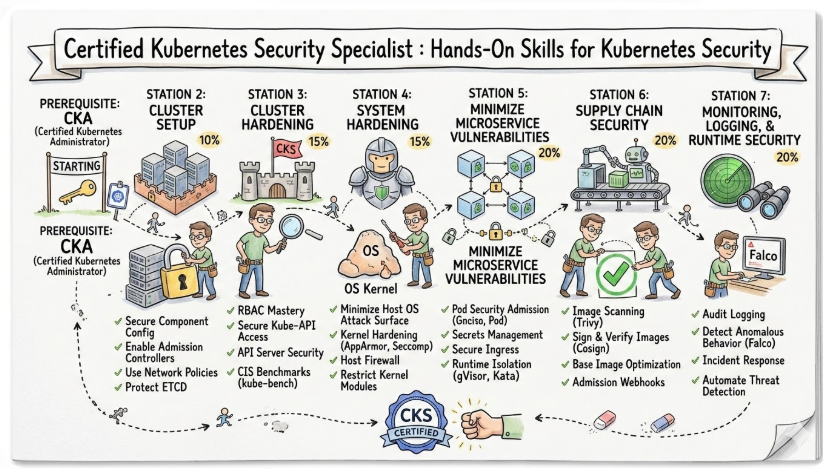
In today’s cloud-native world, “infrastructure” is no longer a static collection of servers; it is a dynamic, code-driven ecosystem. As we move more critical workloads into containers, the role of the engineer has shifted from simply “making things work” to “making things resilient against attack.” Security is no longer a separate department—it is a core engineering requirement.
The Certified Kubernetes Security Specialist (CKS) is the gold standard for this new reality. It is a performance-based validation that you possess the hands-on skills to defend a Kubernetes cluster across its entire lifecycle. This guide provides a high-level, practical overview of the CKS journey and how it transforms your career trajectory in a security-conscious market.
Navigating the Kubernetes Certification Landscape
Success in the CKS requires a solid foundation. You cannot secure what you do not understand. The CKS sits at the peak of a specialized learning path designed by the Cloud Native Computing Foundation (CNCF).
Kubernetes Certification Comparison
| Certification | Level | Core Focus | Required Prerequisite | Target Audience |
| CKAD | Intermediate | App Deployment & Design | None | Developers |
| CKA | Intermediate | Cluster Admin & Ops | None | SREs / Admins |
| CKS | Advanced | Security Hardening | Active CKA | DevSecOps / Security |
Deep Dive: Certified Kubernetes Security Specialist (CKS)
The CKS is not a traditional exam. It is a 120-minute battle in a live terminal. You are given a series of real-world security challenges and must use your technical expertise to harden the cluster under pressure.
What it is
The CKS validates an engineer’s ability to secure container-based applications and Kubernetes platforms during the build, deployment, and runtime phases. It covers everything from securing the underlying host to implementing automated scanning in the CI/CD pipeline.
Who should take it
- Security Engineers looking to master the nuances of container orchestration security.
- DevOps & DevSecOps Professionals aiming to build automated security guardrails.
- Platform Engineers responsible for delivering hardened, production-ready clusters.
- Engineering Managers who need to understand the technical risks facing their modern infrastructure.
Skills you’ll gain
Preparing for the CKS fundamentally changes your approach to engineering. You begin to see every configuration choice through a security lens.
- Cluster Hardening: Securing the control plane, managing RBAC with the principle of least privilege, and protecting sensitive data at rest.
- System Hardening: Reducing the attack surface of the host OS and using Linux kernel security modules like AppArmor and Seccomp.
- Supply Chain Security: Implementing image scanning (e.g., Trivy), verifying image signatures, and using Admission Controllers to block untrusted workloads.
- Microservice Security: Isolating pods using NetworkPolicies and ensuring encrypted, authenticated communication between services.
- Runtime Threat Detection: Monitoring live clusters with tools like Falco to detect unauthorized file access or suspicious process executions.
Real-World Projects After CKS
Once you earn your CKS, you are equipped to lead high-stakes security projects within your organization:
- Implementing CIS Benchmarks: You can audit an existing cluster and apply the configurations required to meet global security standards.
- Policy-as-Code Implementation: Using tools like OPA Gatekeeper to ensure that security standards are enforced automatically at the API level.
- Building Secure CI/CD Pipelines: You can design workflows that automatically block the deployment of images containing critical vulnerabilities.
- Zero-Trust Network Design: You can architect a cluster where no service is trusted by default, and all pod communication is strictly controlled.
The Preparation Blueprint
- 7–14 Days (The Expert): For those already using Falco and Trivy. Focus on the exam environment and speed-running common YAML configurations.
- 30 Days (The Professional): The ideal path for CKA holders. Spend two weeks on the theory of each security domain and two weeks on intensive lab repetition.
- 60 Days (The Transition): Recommended for those moving from a traditional development background. Spend the first month mastering Linux security fundamentals before diving into Kubernetes.
Common Pitfalls
- The “CKA Gap”: Many fail because they’ve forgotten basic cluster troubleshooting. If you can’t fix a broken node quickly, you won’t have time to apply security patches.
- Documentation Over-reliance: You have access to official docs, but the time limit is tight. If you have to look up “how to write a NetworkPolicy,” you will likely run out of time.
- Ignoring the Host: CKS is 20% Linux security. If you focus only on Kubernetes objects and ignore the host OS (syscalls, profiles), you will struggle to pass.
Choose Your Path: 6 Career Evolution Tracks
The CKS is a versatile asset that serves as a gateway to several high-growth specialized roles.
- DevOps Path: Focus on the balance between speed and safety, building secure delivery engines.
- DevSecOps Path: The most direct career evolution. Become the subject matter expert on “shifting left” and automated compliance.
- SRE Path: Focus on “Secure Reliability,” ensuring that hardening measures do not impact the uptime or performance of the system.
- AIOps/MLOps Path: Securing the massive data pipelines and high-performance clusters used for AI training.
- DataOps Path: Focus on data privacy and encryption, ensuring that data-intensive applications remain secure.
- FinOps Path: Managing the financial cost of security logging and monitoring to prevent cloud spend from spiraling.
Role → Recommended Certification Mapping
| Current Role | Core Credential | The Next Strategic Step |
| DevOps Engineer | CKA / CKAD | CKS (To advance to Lead/Architect) |
| SRE | CKA | CKS / Prometheus (PCA) |
| Platform Engineer | CKA | CKS / HashiCorp Terraform |
| Security Engineer | CKS | CCSP / CISSP (for management track) |
| Data Engineer | CKAD | Databricks / Kafka Certifications |
| Engineering Manager | CKA | CKS (To effectively manage risk) |
Top Training & Mentorship Institutions
Clearing a performance-based exam requires hands-on labs and expert-led guidance. Here are the leading institutions providing specialized Kubernetes support:
- DevOpsSchool: A premier training provider known for its lab-intensive CKS bootcamps. They focus on real-world scenarios to ensure you are ready for both the exam and daily production demands.
- Cotocus: Specializes in corporate training and cloud-native consulting, providing deep insights into securing large-scale production environments.
- Scmgalaxy: A massive community platform offering mock tests, specialized tutorials, and resources that help candidates build the speed required for the CKS.
- BestDevOps: Known for their expert-led bootcamps, they provide a structured approach to mastering the complex security tools found in the CKS curriculum.
- DevSecOpsSchool: The primary destination for security-focused engineers, offering courses that integrate CKS concepts into the broader DevSecOps lifecycle.
- SRESchool: Focuses on the intersection of uptime and security, helping engineers build clusters that are both resilient and hardened.
- AIOpsSchool: Tailored for the next generation of engineers who are securing AI and ML workloads on Kubernetes.
- DataOpsSchool: Bridges the gap between data engineering and infrastructure security, focusing on data isolation and storage encryption.
- FinOpsSchool: Teaches the financial governance of cloud-native systems, ensuring your security investments are as cost-effective as they are strong.
FAQ: CKS Career & Strategy
1. Is CKS worth it in 2026?
Absolutely. As cyber threats become more sophisticated, “Security-Aware Kubernetes Engineers” are among the most sought-after and highest-paid professionals in the global market.
2. Can I skip CKA and go straight to CKS?
No. A valid CKA is a mandatory prerequisite. You can take the exam, but the certification will not be granted until you have an active CKA status.
3. What is the passing score?
You need 67% or higher on the performance-based tasks within the 120-minute window.
4. How long is the CKS valid?
It is valid for 2 years, ensuring that certified professionals stay up-to-date with the latest Kubernetes versions.
5. What is the biggest challenge of the exam?
Time management. You have roughly 15-20 complex tasks to complete in 2 hours. Speed and accuracy are equally important.
6. Do I need to learn Falco and AppArmor?
Yes, these are central to the CKS curriculum. You must be able to write and apply basic security profiles and rules.
7. Does the exam offer a free retake?
Most official vouchers, including those from partners like DevOpsSchool, include one free retake if you fail the first attempt.
8. Can I use external notes?
No. You are only allowed access to a single browser tab for official documentation (Kubernetes.io, Falco.org, etc.).
9. What is the best way to practice?
Repetitive, hands-on labs. You should be able to write a NetworkPolicy or an RBAC Role from memory without looking at documentation.
10. Why should I take CKS over other security certs?
CKS is performance-based. It proves you can actually implement security configurations in a real environment, not just answer multiple-choice questions about them.
11. Does it help with remote jobs abroad?
Absolutely. CNCF certifications are the gold standard globally, making them a “technical passport” for engineers in India and elsewhere.
12. Is it useful for Managers?
Yes. It provides the technical depth needed to assess risk and make informed decisions about your team’s security roadmap.
FAQ: Certified Kubernetes Application Developer (CKAD)
1. Is CKAD only for developers?
While developer-focused, it’s a great “first step” for anyone who wants to master the basics of how containers run in a cluster.
2. How long does it take to prepare for CKAD?
For an experienced software engineer, 2 to 4 weeks of focused practice on the CLI is usually sufficient.
3. What is the value of CKAD in the market?
It proves you are a “Full-Stack Cloud Developer” who can package, deploy, and monitor their own services independently.
4. Is the CKAD exam also performance-based?
Yes. Like CKA and CKS, it is conducted in a live terminal environment.
5. Does CKAD cover security?
It covers basic application security (Secrets, ConfigMaps, ServiceAccounts), but for deep-dive hardening, you need the CKS.
6. Can I use documentation during the CKAD?
Yes, you have access to the official Kubernetes documentation during the exam.
7. What are the common topics for CKAD?
Expect a focus on Pod Design, Multi-container pods, CronJobs, and basic application-level troubleshooting.
8. How many years is CKAD valid?
It is valid for 3 years from the date of passing.
Post-CKS Evolution: What’s Next?
According to industry trends from GurukulGalaxy, a specialist’s education is never truly complete. Once you have cleared the CKS, consider these three paths to maintain your competitive edge:
- Vertical Specialization: Prometheus Certified Associate (PCA). You cannot defend what you cannot see. Mastering observability is the natural technical successor to security.
- Horizontal Expansion: HashiCorp Certified: Terraform Associate. Security starts with the infrastructure. Learn to provision your hardened clusters using Infrastructure as Code (IaC).
- Strategic Leadership: Certified Cloud Security Professional (CCSP). For those moving toward Architect or CISO paths, the CCSP provides the high-level governance needed to manage risk across an entire organization.
Conclusion
The journey to becoming a Certified Kubernetes Security Specialist is one of the most transformative paths a technical professional can take. It represents a shift from being a “user” of technology to being its “guardian.” In an era where a single misconfigured S3 bucket or an exposed API server can lead to catastrophic data breaches, the skills validated by the CKS are not just “nice to have”—they are a survival requirement. By committing to this certification, you aren’t just earning a digital badge; you are joining an elite group of professionals capable of defending the infrastructure that powers our digital civilization. The path is challenging, the exam is fast-paced, but the technical confidence and career trajectory you gain are unparalleled. Whether you are an engineer in India or working globally, the CKS is your passport to the future of secure, cloud-native engineering.

Best Cardiac Hospitals Near You
Discover top heart hospitals, cardiology centers & cardiac care services by city.
Advanced Heart Care • Trusted Hospitals • Expert Teams
View Best Hospitals