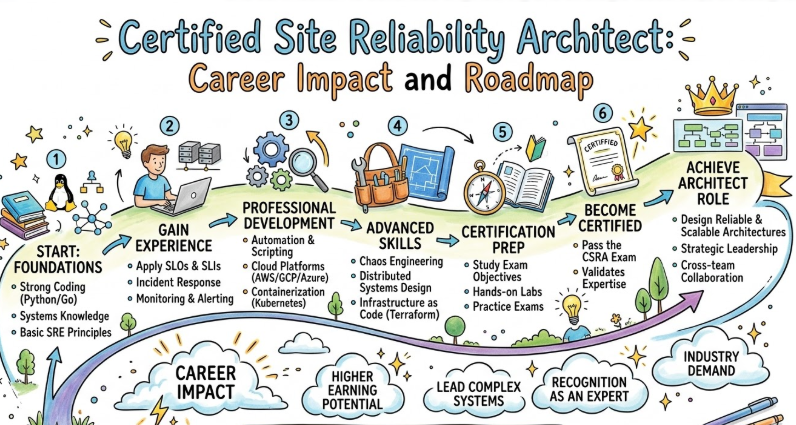
The path to infrastructure mastery requires more than just knowing how to write code or configure a server. As organizations scale, the need for individuals who can bridge the gap between software engineering and systems operations has never been more critical. This guide is designed for engineers and technical managers looking to navigate the complex landscape of reliability engineering. Whether you are deeply entrenched in cloud-native environments or moving toward platform engineering, understanding the role of a Certified Site Reliability Architect is essential for making informed career decisions. By the end of this article, you will have a clear, experience-driven perspective on how this certification can serve as a catalyst for your professional growth at SREschool.
What is the Certified Site Reliability Architect?
The Certified Site Reliability Architect represents the pinnacle of operational excellence and system design. Unlike traditional certifications that focus on theoretical memorization, this program exists to validate an engineer’s ability to design, build, and maintain massive-scale distributed systems. It emphasizes a production-focused mindset, where the goal is not just “uptime,” but the creation of resilient architectures that can self-heal and scale predictably.
In modern engineering workflows, the Site Reliability Architect is the bridge between product requirements and system stability. This certification aligns with enterprise practices by shifting the focus toward observability, error budgets, and toil reduction. It treats operations as a software problem, ensuring that as your infrastructure grows in complexity, it remains manageable and cost-effective.
Who Should Pursue Certified Site Reliability Architect?
This path is specifically tailored for mid-to-senior level professionals who are responsible for the heartbeat of digital services. Systems Engineers, DevOps practitioners, and Cloud Architects will find the most immediate value here, as it provides the formal framework needed to manage complex production environments. However, it is not limited to those roles; Security and Data engineers also benefit by learning how to ensure their specific pipelines are as reliable as the core infrastructure.
For engineering managers and technical leaders, particularly those in the Indian and global tech hubs, this certification provides the vocabulary and strategic insight needed to lead high-performing SRE teams. Whether you are a beginner looking to understand the “why” behind the “how,” or an experienced veteran looking to formalize decades of hard-won knowledge, this architect-level focus provides a clear trajectory for career advancement.
Why Certified Site Reliability Architect is Valuable and Beyond
The demand for high-availability systems is not a trend; it is a permanent requirement of the digital economy. As enterprises move away from simple cloud migration toward sophisticated cloud-native ecosystems, the ability to architect for reliability becomes a primary competitive advantage. This certification ensures that your skills remain relevant even as specific tools and vendors change, focusing on the core principles of distributed systems.
Investing time in this certification offers a significant return on career investment by positioning you as a specialist in a high-demand, low-supply talent pool. Companies are no longer just looking for people who can “run” a system; they are looking for architects who can ensure that systems never fail in the first place. This longevity is what makes the Certified Site Reliability Architect a foundational pillar for any long-term engineering career.
Certified Site Reliability Architect Certification Overview
The program is delivered through a structured curriculum that emphasizes practical application over passive learning. It is hosted on a platform dedicated to the craft of reliability, focusing on how SRE principles apply to real-world business constraints. The assessment approach is designed to test your architectural decision-making skills, asking you to solve problems that mirror the challenges faced in production environments today.
The certification is structured into logical tiers, allowing professionals to progress at a pace that matches their current responsibilities. It is owned and maintained by industry practitioners, ensuring that the content remains fresh and aligned with the latest developments in the field. Rather than just a badge, it serves as a comprehensive validation of your ability to handle the pressures of enterprise-grade infrastructure.
Certified Site Reliability Architect Certification Tracks & Levels
The certification journey is divided into levels that reflect the natural progression of an engineer’s career. The Foundation level introduces the core concepts of SRE, such as SLIs, SLOs, and the cultural shifts required to implement them. As you move toward the Professional and Advanced levels, the focus shifts toward complex system design, cross-team collaboration, and the automation of entire infrastructure lifecycles.
Specialization tracks allow you to align your learning with your specific domain, whether that be DevOps, FinOps, or DevSecOps. This modular approach ensures that while you gain a broad understanding of reliability, you also develop deep expertise in the areas most relevant to your daily work. This alignment between certification levels and career progression makes it easier for employers to recognize your specific value contribution.
Complete Certified Site Reliability Architect Certification Table
| Track | Level | Who it’s for | Prerequisites | Skills Covered | Recommended Order |
| SRE Core | Foundation | Junior Engineers/DevOps | Basic Linux & Cloud | SLOs, SLIs, Toil, Monitoring | 1 |
| Architecture | Professional | Senior SREs/SysAdmins | 3+ Years Experience | Dist. Systems, Scalability | 2 |
| Platform | Advanced | Principal Engineers | Lead Architect Exp. | Control Planes, Automation | 3 |
| Governance | Leadership | Engineering Managers | Management Exp. | SRE Culture, Budgeting | 4 |
Detailed Guide for Each Certified Site Reliability Architect Certification
What it is
This certification validates a fundamental understanding of Site Reliability Engineering principles and their application in modern software delivery. It ensures the candidate can distinguish between traditional operations and the SRE model.
Who should take it
This is ideal for software developers, system administrators, and junior DevOps engineers who want to build a solid foundation in reliability practices before moving into architectural roles.
Skills you’ll gain
- Mastery of Service Level Objectives (SLOs) and Error Budgets.
- Understanding the cultural shift from “blame” to “post-mortem.”
- Ability to identify and eliminate operational toil through automation.
- Proficiency in basic observability and monitoring strategies.
Real-world projects you should be able to do
- Design an SLO framework for a microservices-based application.
- Conduct a blameless post-mortem for a simulated production outage.
- Automate a repetitive manual task using Python or Bash.
Preparation plan
- 7–14 Days: Focus on the “SRE Book” fundamentals and core terminology.
- 30 Days: Implement basic monitoring and alerting on a small lab environment.
- 60 Days: Deep dive into case studies and practice defining SLOs for complex scenarios.
Common mistakes
- Focusing too much on specific tools rather than underlying principles.
- Underestimating the importance of the cultural and organizational aspects of SRE.
- Failing to understand the mathematical relationship between SLOs and error budgets.
Best next certification after this
- Same-track option: Certified Site Reliability Architect – Professional
- Cross-track option: Certified DevSecOps Professional
- Leadership option: Engineering Management Foundation
Choose Your Learning Path
DevOps Path
The DevOps path focuses on the seamless integration of development and operations. It emphasizes CI/CD pipelines, infrastructure as code, and breaking down silos. For a Site Reliability Architect, this means ensuring that reliability is baked into the code from the very first commit. You will learn how to build automated gates that prevent unreliable code from ever reaching production environments.
DevSecOps Path
In this path, security is treated as a critical component of reliability. A system cannot be reliable if it is not secure. This track focuses on integrating security scanning, compliance auditing, and vulnerability management into the SRE workflow. You will learn how to architect systems that are resilient not just to traffic spikes, but also to malicious attacks and data breaches.
SRE Path
The pure SRE path is for those who want to specialize in the “software engineering approach to operations.” It focuses heavily on distributed systems, performance tuning, and incident response. This is the heart of the Architect role, where you spend your time designing systems that can handle petabytes of data and millions of concurrent users without breaking.
AIOps Path
AIOps introduces artificial intelligence and machine learning to the world of operations. This path is for engineers who want to use data-driven insights to predict outages before they happen. You will learn how to implement automated remediation and intelligent alerting systems that reduce the cognitive load on human operators by filtering out the noise.
MLOps Path
As machine learning models become core components of business applications, ensuring their reliability is paramount. The MLOps path focuses on the lifecycle of ML models, from training to deployment and monitoring. You will learn how to architect pipelines that ensure model performance doesn’t drift and that the underlying infrastructure can support heavy computational loads.
DataOps Path
DataOps is about the reliability of data pipelines. In this path, you apply SRE principles to data engineering, ensuring that data is accurate, available, and delivered on time. This is crucial for organizations that rely on real-time analytics for decision-making. You will learn how to build resilient data architectures that can handle varying schemas and massive volumes.
FinOps Path
FinOps brings financial accountability to the variable spend model of the cloud. This path teaches architects how to design systems that are not just reliable, but also cost-efficient. You will learn how to map architectural choices to business value, ensuring that your high-availability designs don’t break the company’s budget.
Role → Recommended Certifications
| Role | Recommended Certifications |
| DevOps Engineer | Certified Site Reliability Engineer – Foundation |
| SRE | Certified Site Reliability Architect – Professional |
| Platform Engineer | Certified Site Reliability Architect – Advanced |
| Cloud Engineer | Certified Cloud Reliability Specialist |
| Security Engineer | Certified DevSecOps Practitioner |
| Data Engineer | Certified DataOps Professional |
| FinOps Practitioner | Certified FinOps Architect |
| Engineering Manager | SRE Leadership & Culture Certification |
Next Certifications to Take After Certified Site Reliability Architect
Same Track Progression
Once you have mastered the architectural level, the next step is deep specialization. This involves moving into niche areas such as Kernel-level performance tuning, advanced eBPF monitoring, or designing global-scale multi-cloud control planes. Deep specialization makes you the “go-to” person for the most difficult technical challenges an organization faces.
Cross-Track Expansion
Broadening your skills into adjacent domains like DevSecOps or FinOps allows you to become a “T-Shaped” professional. By understanding how security and cost impact reliability, you can make better architectural decisions that benefit the entire business. This expansion is essential for those who want to move into Principal or Staff Engineer roles.
Leadership & Management Track
For those who enjoy mentoring and strategy more than hands-on keyboard work, the leadership track is the natural next step. This involves moving from managing systems to managing people and processes. You will learn how to build SRE organizations, define department-wide reliability goals, and advocate for technical debt reduction at the executive level.
Training & Certification Support Providers
DevOpsSchool
This provider offers extensive resources for those looking to master the entire DevOps ecosystem. Their programs are known for being hands-on and focused on the practical application of tools like Kubernetes, Terraform, and Jenkins. They provide a robust support system for students, including live sessions and community forums where practitioners share real-world experiences and troubleshooting tips.
Cotocus
Cotocus focuses on specialized training for cloud-native technologies and site reliability. They provide tailored learning paths that help engineers transition from traditional IT roles into modern SRE and DevOps positions. Their curriculum is designed to be lean and high-impact, making it a popular choice for busy professionals looking to upskill quickly without sacrificing depth of knowledge.
Scmgalaxy
As a long-standing community and training hub, Scmgalaxy provides a wealth of information on software configuration management and continuous integration. They offer a deep dive into the technical aspects of the delivery pipeline, ensuring that architects understand the mechanics of how code moves from a developer’s machine to a production server reliably and consistently.
BestDevOps
This platform curates high-quality content specifically for the DevOps community. They focus on the latest trends and best practices in the industry, offering certifications that are recognized for their rigor. Their approach is to provide a comprehensive view of the lifecycle, helping engineers understand where SRE fits into the broader picture of modern software development.
devsecopsschool.com
This site is the premier destination for those looking to integrate security into their SRE and DevOps workflows. They provide deep technical training on automated security testing, container security, and compliance as code. Their programs are essential for any architect who wants to ensure their reliable systems are also hardened against modern threats.
sreschool.com
This is the primary authority on Site Reliability Engineering education. The platform focuses exclusively on the SRE discipline, providing the most detailed and comprehensive training available for the Certified Site Reliability Architect. Their content is developed by practitioners who have managed some of the largest infrastructures in the world, providing unmatched insight into the craft.
aiopsschool.com
As AI continues to transform operations, this provider helps engineers stay ahead of the curve. They focus on the intersection of data science and systems engineering, teaching students how to build and deploy AIOps solutions. Their training is critical for architects who want to move toward proactive and predictive infrastructure management.
dataopsschool.com
This provider addresses the unique challenges of data reliability. They apply SRE principles to the data lifecycle, offering certifications that validate a professional’s ability to manage complex data pipelines. This is an essential resource for architects working in data-heavy environments where uptime is measured by data quality and availability.
finopsschool.com
Focusing on the financial side of cloud engineering, this site provides the tools and knowledge needed to master cloud economics. They teach architects how to build systems that are financially sustainable, providing a critical link between engineering decisions and business outcomes. Their certifications are highly valued by organizations looking to optimize their cloud spend.
Frequently Asked Questions (General)
- How difficult is the Certified Site Reliability Architect exam?
The exam is designed to be challenging and requires a deep understanding of architectural principles and real-world experience. - How much time does it take to prepare?
Depending on your background, most professionals spend between 30 to 90 days in dedicated study and lab work. - Are there any mandatory prerequisites?
While not always mandatory, a solid foundation in Linux, networking, and at least one cloud provider is highly recommended. - What is the return on investment (ROI) for this certification?
Certified architects often see significant salary increases and gain access to high-level roles at top-tier technology companies. - In what order should I take the certifications?
It is usually best to start with the Foundation level to ensure a common vocabulary before moving to the Architect level. - How does this certification differ from a vendor-specific one like AWS or Azure?
This certification focuses on the methodology and principles of SRE, which are applicable regardless of the specific cloud provider used. - Is there a practical component to the assessment?
Yes, the program emphasizes your ability to solve architectural problems and make decisions based on production scenarios. - How often do I need to recertify?
Typically, recertification is required every two to three years to ensure your skills stay current with evolving industry standards. - Can this certification help me move into a management role?
Absolutely, as it demonstrates a high-level strategic understanding of how systems and teams work together to ensure reliability. - Is the content applicable to on-premise environments?
While many examples are cloud-native, the core principles of SRE apply to any environment where high availability is required. - Do I need to be a programmer to succeed in this path?
A working knowledge of programming (like Python or Go) is essential, as SRE is fundamentally a software engineering approach to operations. - Are there community resources available for study?
Yes, there are numerous forums, study groups, and community-led sessions hosted by the support providers mentioned above.
FAQs on Certified Site Reliability Architect
- What specifically does a Site Reliability Architect do daily?
They design the frameworks for monitoring, incident response, and capacity planning across multiple teams and services. - How does an Architect handle error budgets?
They define the acceptable level of failure and work with product teams to balance new feature velocity with system stability. - What is the focus of the “Architect” level versus the “Engineer” level?
Engineers focus on implementing and maintaining specific systems, while Architects focus on the high-level design and integration of all systems. - Does the certification cover container orchestration like Kubernetes?
Yes, Kubernetes is a core component of modern SRE architecture and is covered extensively in the professional tracks. - How are SLIs and SLOs treated in the exam?
You will be expected to define meaningful metrics and set realistic targets based on specific business requirements. - Is automation a major part of the curriculum?
Automation is the backbone of SRE; the certification validates your ability to replace manual operations with software-driven solutions. - How does the certification address incident management?
It focuses on the architectural choices that make incidents easier to detect, mitigate, and resolve quickly. - What role does observability play in the Architect’s toolkit?
Observability is a primary focus, ensuring that you can gain deep insights into system behavior through logs, metrics, and traces.
Final Thoughts: Is Certified Site Reliability Architect Worth It?
When you reach a certain point in your career, the ability to build a server is no longer enough. You must be able to design the system that builds the server, monitors it, and heals it when it fails. The Certified Site Reliability Architect is not just a title; it is a mindset that prioritizes long-term stability and efficiency over short-term fixes.
In my experience, the engineers who thrive in the next decade will be those who can speak the language of both developers and business leaders. This certification provides that bridge. It is an honest investment in your future, requiring hard work and a commitment to excellence. If you are ready to move beyond the “how” and start defining the “why” of your infrastructure, then this is the right path for you.

Best Cardiac Hospitals Near You
Discover top heart hospitals, cardiology centers & cardiac care services by city.
Advanced Heart Care • Trusted Hospitals • Expert Teams
View Best Hospitals