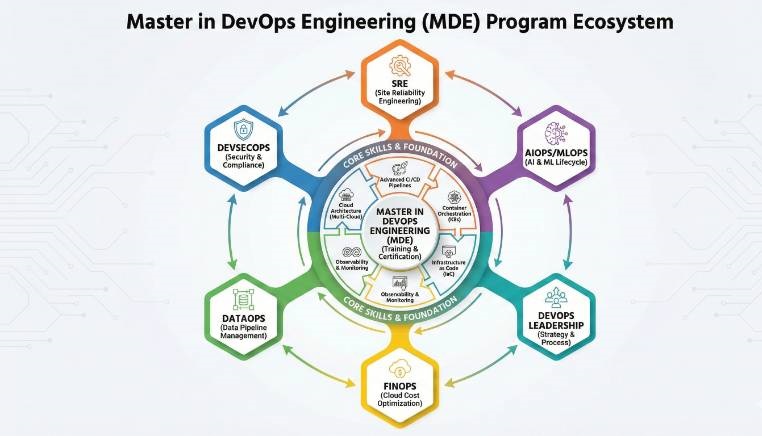
The technology landscape moves at a staggering pace. Consequently, many engineers find themselves stuck in a cycle of learning isolated tools without understanding the broader architecture. After seeing the industry evolve over two decades, I have realized that true success comes from mastering the entire ecosystem. Therefore, this guide focuses on the Master in DevOps Engineering (MDE) program. This certification is specifically designed to transform working professionals into technical leaders.
The Rising Demand for Master Engineers
Initially, the industry focused on simple automation. However, modern companies now require engineers who can handle complex, multi-cloud environments. For this reason, a standard certification is often not enough. Employers actively seek professionals with a “Master” designation because it proves a deep understanding of the software delivery lifecycle. Furthermore, this program bridges the gap between development and operations in a way that creates immediate business value.
Deep Dive into the MDE Certification
What it is
The Master in DevOps Engineering (MDE) is a comprehensive training and certification program. It integrates advanced automation, cloud architecture, and leadership principles. Consequently, it serves as a complete toolkit for modern engineering. This program is offered by DevOpsSchool.
Who should take it
Working software engineers should take this course to expand their career horizons. Additionally, infrastructure managers will find it useful for leading technical teams. Specifically, if you have experience in Linux or basic coding, this is the perfect next step for your growth. Furthermore, it is ideal for professionals in India and across the globe who want to reach the expert level.
Skills you’ll gain
- Advanced CI/CD: You will learn to build pipelines that handle global traffic.
- Kubernetes Mastery: You will gain the ability to manage container clusters at scale.
- Infrastructure as Code: Specifically, you will master tools like Terraform and Ansible.
- Security Integration: You will learn how to shift security left in the delivery process.
- Observability: Consequently, you will be able to monitor system health using advanced stacks.
- Cloud Strategy: You will gain deep knowledge of AWS, Azure, and GCP architectures.
Real-world projects you should be able to do
- Multi-Cloud Migration: You will be able to move applications between clouds seamlessly.
- Automated Security Gates: Furthermore, you can build systems that block vulnerable code automatically.
- Self-Healing Infrastructure: Specifically, you will design systems that fix themselves when they fail.
- Cost Optimization: Therefore, you will be able to reduce company cloud bills by significant margins.
Preparation Plans for Every Schedule
The 14-Day Sprint
If you are already an expert, you can prepare in two weeks. To begin with, spend the first five days reviewing Kubernetes and Docker. Subsequently, spend the next five days on Terraform and Cloud security. Finally, use the last four days for practice exams and architectural review.
The 30-Day Professional Plan
For most working engineers, a month is the best timeframe. During the first week, focus entirely on CI/CD and Git workflows. In the second week, shift your focus to container orchestration. Furthermore, use the third week to master Infrastructure as Code. Finally, use the fourth week to study SRE and FinOps principles.
The 60-Day Foundation Path
If you are new to the “Ops” side, take two months. Specifically, use the first month to build a strong foundation in Linux and Cloud basics. Consequently, use the second month to dive deep into the MDE curriculum. In addition, make sure to complete at least three hands-on projects during this period.
Common Mistakes to Avoid
- Ignoring the Theory: Many people focus only on tools. However, you must understand the “why” behind the process.
- Skipping Labs: You cannot learn DevOps just by reading. Therefore, ensure you spend hours in the terminal.
- Neglecting Security: Many engineers treat security as an afterthought. Instead, you should integrate it from day one.
- Poor Documentation: Specifically, failing to document your code is a major mistake in professional environments.
Best next certification after this
- Same Track: Focus on a Certified Kubernetes Security Specialist (CKS) to deepen your niche.
- Cross-Track: Alternatively, look into DataOps or MLOps to expand your reach.
- Leadership: Furthermore, consider a PMP or an executive leadership program if you want to move into management.
Master Certification Comparison Table
| Certification Name | Track | Level | Who it’s for | Prerequisites | Skills Covered | Recommended Order |
| Master in DevOps Engineering (MDE) | Core DevOps | Expert | Senior Engineers / Managers | Linux, SDLC knowledge | CI/CD, K8s, IaC, Security, SRE | Capstone Level |
Choose Your Specialized Path
Once you master the core, you must decide on a specialization. Each path offers unique challenges and rewards. Specifically, you can choose from these six directions:
- DevOps: The most versatile path focusing on end-to-end delivery and automation.
- DevSecOps: A path for those who want to specialize in automated security and compliance.
- SRE (Site Reliability Engineering): Focuses on system uptime and performance at massive scale.
- AIOps/MLOps: The future of tech, focusing on managing AI models and data flows.
- DataOps: Specifically designed for engineers who want to streamline data analytics pipelines.
- FinOps: A growing field focused on cloud cost management and financial accountability.
Mapping Your Role to Certifications
Depending on your current job, you should prioritize different learning areas. Specifically, follow this mapping to maximize your career impact:
| Role | Target Focus | Recommended Path |
| DevOps Engineer | Automation | MDE + Kubernetes Focus |
| SRE | Reliability | MDE + Observability Focus |
| Platform Engineer | Internal Tools | MDE + Infrastructure as Code |
| Cloud Engineer | Infrastructure | MDE + Cloud Architect Cert |
| Security Engineer | Compliance | MDE + DevSecOps Specialization |
| Data Engineer | Data Flow | MDE + DataOps Focus |
| FinOps Practitioner | Cloud Cost | MDE + FinOps Foundation |
| Engineering Manager | Strategy | MDE + Leadership Training |
Top Institutions for MDE Training
Choosing the right training partner is essential. Specifically, these institutions are known for their high-quality MDE programs:
DevOpsSchool
This institution is a global leader in DevOps education. Furthermore, they provide extensive hands-on labs and real-world project support. Consequently, their certification is highly respected by major IT firms.
Cotocus
They specialize in cloud-native technologies and containerization. In addition, their trainers are active industry professionals. Therefore, you get practical insights that you won’t find in textbooks.
Scmgalaxy
This organization focus on configuration management and CI/CD tools. Specifically, they offer a vast library of resources for engineers. Because of this, they are a great choice for those who want to dive deep into tool integration.
BestDevOps
They offer structured bootcamps that focus on career transitions. Furthermore, their curriculum is updated regularly to match industry needs. Consequently, many students find jobs quickly after completing their programs.
DevSecOpsSchool
As the name suggests, they are the experts in security integration. In addition, they teach you how to protect your pipelines from modern threats. Therefore, this is the best place for aspiring security engineers.
SRESchool
Specifically focused on reliability, this school teaches you how to keep systems running 24/7. Consequently, you learn about error budgets and incident management. This is ideal for those targeting SRE roles at top tech firms.
AIOpsSchool
They focus on the intersection of AI and operations. Specifically, you will learn how to use machine learning to predict system failures. For this reason, it is perfect for forward-thinking engineers.
DataOpsSchool
This institution bridges the gap between data science and DevOps. Furthermore, they teach you how to manage data pipelines with the same speed as software pipelines. Consequently, you become a vital asset to any data-driven company.
FinOpsSchool
Specifically focused on the financial side of the cloud, they teach you how to save money. In fact, many companies hire FinOps experts just to manage their AWS or Azure bills. Therefore, this is a highly lucrative niche.
General FAQs for Software Engineers
1. Is the MDE certification difficult for a beginner?
Yes, it is designed for those with some experience. However, if you follow a 60-day plan, you can definitely succeed.
2. How long does the certification stay valid?
Usually, it remains valid for two to three years. Consequently, you should keep learning to stay current with new tools.
3. Does the MDE help with global job opportunities?
Absolutely. Because the curriculum is standardized, companies in the US, Europe, and India all recognize its value.
4. What is the average salary increase after getting certified?
Many engineers report a 30% to 50% increase in their compensation. Specifically, this happens when moving into senior architect roles.
5. Do I need to know how to code?
Yes, you should know at least one scripting language. For instance, Python or Bash are essential for automation tasks.
6. Can I take the exam online?
Most providers offer online proctored exams. Therefore, you can get certified from the comfort of your home.
7. Is there a prerequisite for the MDE?
Typically, you should understand the basics of Linux and the software development lifecycle. Consequently, this ensures you can follow the advanced modules.
8. What is the difference between DevOps and SRE?
DevOps focuses on the speed of delivery. On the other hand, SRE focuses on the stability of the system after it goes live.
9. Should I learn Docker before Kubernetes?
Yes, because Kubernetes is used to manage Docker containers. Specifically, you must understand the container before you can orchestrate it.
10. Is the MDE better than a specific cloud certification?
The MDE is more broad and focuses on process. Therefore, it is often more valuable for long-term career growth than a single-provider cert.
11. How much time should I dedicate daily for study?
Specifically, aim for at least two hours of focused study. Furthermore, make sure to include hands-on lab time in every session.
12. Will this certification help me move into management?
Yes, it provides the technical authority needed to lead engineering teams. Consequently, many MDE holders become Engineering Managers.
Specific FAQs on Master in DevOps Engineering (MDE)
1. What makes the MDE different from other certifications?
The MDE is unique because it combines multiple disciplines into one program. Specifically, it covers DevOps, Security, and SRE in a single track.
2. Who provides the official MDE certification?
The official provider is DevOpsSchool. They are the primary body that governs the curriculum and standards.
3. Is there a project requirement for the MDE?
Yes, you must complete a capstone project to prove your skills. Consequently, this project serves as a portfolio for your future employers.
4. Does the MDE cover multi-cloud strategies?
Indeed, it teaches you how to work across AWS, Azure, and GCP. Therefore, you are not locked into one specific vendor.
5. Are there any discounts available for the training?
Providers often offer early-bird discounts or corporate packages. Specifically, check the official website for the latest offers.
6. What kind of support do I get during the training?
You typically get access to expert mentors and a community forum. Furthermore, you get lifetime access to the updated course materials.
7. How are the exams structured?
The exams usually include a mix of multiple-choice questions and hands-on laboratory tasks. Specifically, this tests both your knowledge and your practical ability.
8. Where can I find more information about the syllabus?
You can find all the details at the official URL: Master in DevOps Engineering (MDE).
Conclusion
In summary, the Master in DevOps Engineering (MDE) is the ultimate credential for the modern era. Specifically, it empowers you to handle the complexities of today’s tech world with confidence. By choosing a structured training path, you ensure that your skills remain relevant for years to come. Consequently, you will not only improve your career prospects but also drive significant value for your organization.

Best Cardiac Hospitals Near You
Discover top heart hospitals, cardiology centers & cardiac care services by city.
Advanced Heart Care • Trusted Hospitals • Expert Teams
View Best Hospitals