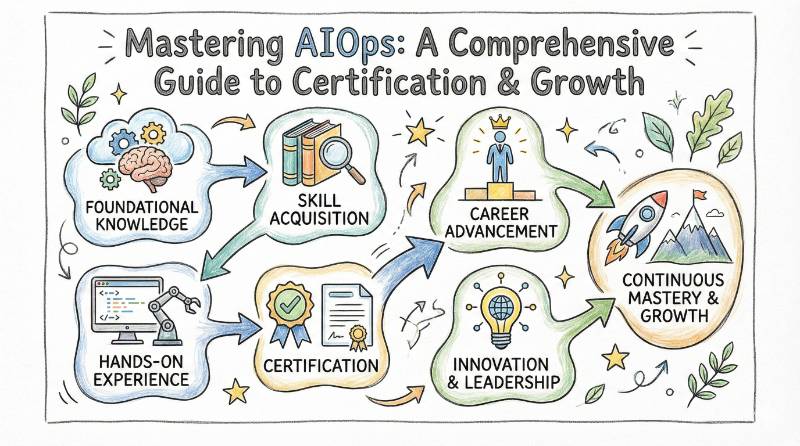
The digital world has reached a tipping point where the sheer volume of data produced by modern infrastructure has surpassed the human capacity to manage it. Having watched the industry evolve from the early days of physical servers to the hyper-scale cloud environments of today, it is clear that manual intervention is no longer a viable long-term strategy. This is where AIOps (Artificial Intelligence for IT Operations) enters the frame.
AIOps is not just a buzzword; it is a fundamental shift in how we approach stability, scalability, and security. By integrating machine learning and big data, IT operations are moving from a reactive “break-fix” model to a proactive, predictive state. For software engineers, SREs, and engineering managers, mastering AIOps is the key to staying relevant in an increasingly automated world.
This master guide will walk you through everything you need to know about the AIOps Certification Training Course and how to navigate the certifications that will define your career trajectory.
The Landscape of AIOps Certifications
Before diving into the technical details, it is important to understand where these certifications sit in your professional development. These programs are designed to bridge the gap between traditional operations and data-driven intelligence.
AIOps Certification Master Table
| Track | Level | Who it’s for | Prerequisites | Skills Covered | Recommended Order |
| Core AIOps | Foundation | Engineers, Leads | Basic Linux/Cloud | Event Correlation, ML Basics | 1 |
| AIOps Professional | Advanced | SREs, Architects | AIOCP Foundation | Predictive Analytics, Anomaly Detection | 2 |
| MLOps Integration | Specialized | Data Engineers | Python, DevOps exp | Model Deployment, CI/CD for ML | 3 |
| Strategic AIOps | Leadership | Managers, CTOs | 5+ years exp | ROI, Governance, Ethics in AI | 4 |
Detailed Guide: AIOps Certification Training Course | AIOps
The AIOps Certified Professional (AIOCP) is the primary certification for those looking to master the art of intelligent operations. It focuses on using data science to solve operational headaches.
What it is
The AIOps Certification Training Course is a professional-grade program that teaches you how to apply AI and Machine Learning to IT operations. It focuses on collecting data from various sources, analyzing it using ML models, and automating the response to incidents.
Who should take it
- Software Engineers who want to build applications that monitor themselves.
- Site Reliability Engineers (SREs) looking to reduce alert fatigue and automate root cause analysis.
- DevOps Engineers aiming to incorporate AI into their delivery pipelines.
- Engineering Managers who need to lead teams through the transformation of automated operations.
Skills you’ll gain
- Data Aggregation: Learning how to ingest high-velocity logs and metrics from distributed systems.
- Noise Reduction: Using ML algorithms to filter out irrelevant alerts and focus on real issues.
- Predictive Maintenance: Forecasting system failures based on historical patterns before they impact users.
- Automated Remediation: Building scripts that use AI triggers to fix common system errors without human intervention.
- Observability Mastery: Moving beyond basic monitoring to deep, context-aware system visibility.
Real-world projects you should be able to do
- Predictive Disk Failure System: Create a model that predicts hardware failure 48 hours in advance with 90% accuracy.
- Smart Alerting Engine: Build an engine that groups 1,000 daily alerts into 5 actionable “incident clusters.”
- Self-Healing Microservices: Design a Kubernetes-based system that automatically restarts or scales based on AI-detected traffic anomalies.
Preparation Plan
- 14 Days: Focus on the “Four Pillars of AIOps”—Data Ingestion, Analysis, Pattern Recognition, and Automation.
- 30 Days: Hands-on labs with tools like Prometheus, ELK, and Python-based ML libraries. This is where you practice building your first models.
- 60 Days: Full project implementation and simulation of real-world “incident storms” to see how your AI models react under pressure.
Common Mistakes
- Expecting Magic: AI cannot fix a broken process. Fix your manual workflows before you try to automate them with AI.
- Ignoring Data Quality: If your logs are messy, your AI results will be wrong. Clean data is the foundation of AIOps.
- Lack of Domain Context: Relying purely on algorithms without understanding the underlying application logic.
Best next certification after this
- MLOps Certified Professional: To learn how to manage the lifecycle of the models you’ve just learned to build.
Choose Your Path: 6 Specialized Learning Paths
Every engineer has a different starting point. Here are the six most common ways to integrate AIOps into your career:
- The DevOps Path: Use AI to optimize your CI/CD pipelines. Predict which code changes are most likely to fail based on historical data.
- The DevSecOps Path: Focus on “AI-Driven Security.” Use machine learning to detect zero-day threats and unusual user behavior that static rules might miss.
- The SRE Path: This is the most popular path. It focuses on using AIOps to achieve “Zero-Toil” operations and maintaining 99.99% availability with minimal human touch.
- The AIOps/MLOps Path: Become the bridge between Data Science and Operations. You build the infrastructure that hosts and monitors AI models.
- The DataOps Path: Ensure that the data feeding the AI is high quality, secure, and delivered in real-time.
- The FinOps Path: Use AI to predict cloud costs and automatically shut down wasteful resources based on usage patterns.
Role → Recommended Certifications
| Current Role | Recommended Certification Path |
| DevOps Engineer | AIOps Certified Professional → Master in DevOps |
| SRE | AIOps Foundation → Site Reliability Engineering Professional |
| Platform Engineer | Certified Kubernetes Administrator → AIOps Professional |
| Cloud Engineer | AWS/Azure/GCP Solutions Architect → AIOps Specialist |
| Security Engineer | DevSecOps Certified Professional → AIOps for Security |
| Data Engineer | DataOps Certified Professional → ML Engineering |
| FinOps Practitioner | FinOps Certified Professional → AI-Driven Cost Management |
| Engineering Manager | Certified DevOps Manager → AIOps Strategy & Governance |
Top Institutions for AIOps Training and Certification
Choosing the right institution is as important as the certification itself. Here are the top providers that help you prepare for the AIOps Certification Training Course | AIOps (CDE):
- DevOpsSchool: This is the leading global provider for AIOps certification. They offer deep-dive, mentor-led programs that focus on the practical application of AI in real-world IT environments. Their curriculum is updated constantly to match industry shifts.
- Cotocus: Known for its highly technical workshops, Cotocus provides specialized training for engineers who want to go deep into the coding and algorithmic side of AIOps. They focus on enterprise-level cloud integrations.
- Scmgalaxy: A massive community-driven platform that offers extensive resources, documentation, and training modules for AIOps. It is an excellent choice for those who value community support and peer-to-peer learning.
- BestDevOps: This institution offers a streamlined path for beginners. Their training is designed to take you from a basic understanding of operations to a professional AIOps level through structured, easy-to-follow modules.
- DevSecOpsSchool: If your goal is to apply AI specifically to the world of security, this is the place to go. They focus on “AIOps for Security,” teaching you how to build automated threat-hunting systems.
- Sreschool: Dedicated entirely to the discipline of Site Reliability Engineering. Their AIOps training focuses on reliability metrics, SLIs/SLOs, and how AI can help maintain them.
- AIOpsSchool: A niche institution that focuses exclusively on AI in operations. Their specialized curriculum covers everything from basic statistics to advanced neural networks used in system monitoring.
- DataOpsSchool: Focuses on the “Data” part of AIOps. They teach you how to build the pipelines that ensure your AI models have the right data at the right time.
- FinOpsSchool: Specializes in the financial side of cloud operations. Their training shows you how to use AIOps to manage cloud budgets and optimize spending automatically.
Next Certifications to Take
Once you have completed your AIOps training, you should look to expand your expertise into adjacent areas.
- Same Track (Expertise): MLOps Certified Professional. This allows you to manage the entire lifecycle of Machine Learning models, from training to deployment and monitoring.
- Cross-Track (Broadening): DevSecOps Certified Professional. Security is the next major frontier for AI. Learning how to secure your AI-driven operations is a massive career advantage.
- Leadership (Management): Certified DevOps Manager. If you want to lead teams, this certification teaches you the strategic side of automation, including budgeting, team building, and ROI.
FAQs about AIOps Certification Training Course
1. Is AIOps just for large companies? No. While large companies benefit most from noise reduction, small teams use AIOps to “punch above their weight” by automating tasks that would otherwise require more staff.
2. Do I need to be a mathematician to learn AIOps? Not at all. You need to understand the concepts of how models work, but modern tools and libraries handle most of the complex math for you.
3. How does AIOps impact job security? It enhances it. AIOps doesn’t replace engineers; it replaces “toil.” By learning AIOps, you move from doing repetitive tasks to designing intelligent systems.
4. What is the average salary hike after getting AIOps certified? Globally, professionals with AIOps skills often see a 20% to 35% increase in compensation compared to standard DevOps roles.
5. Can I transition from a traditional Ops role to AIOps? Yes. In fact, people with traditional Ops experience make the best AIOps engineers because they understand the problems the AI is trying to solve.
6. Which cloud provider is best for AIOps? All major providers (AWS, Azure, GCP) have AIOps-related services, but the skills you learn in this certification are designed to be cloud-agnostic.
7. How long is the certification valid? Most professional certifications in this space are valid for 2-3 years, after which a refresher or a higher-level exam is recommended.
8. Is Python mandatory for AIOps? While not strictly mandatory for every tool, Python is the language of AI. Having basic Python skills will make your AIOps journey much easier.
9. Does AIOps replace monitoring? No, it enhances it. Monitoring tells you what is wrong; AIOps tells you why it happened and often fixes it for you.
10. What is the biggest challenge in implementing AIOps? Cultural resistance and poor data quality are the two biggest hurdles. Training helps you navigate both.
11. How do managers benefit from this certification? Managers learn how to set realistic expectations for AI projects and how to measure the success of an AIOps implementation.
12. Is there a sequence to these certifications? Start with AIOps Foundation, then move to Professional, and finally look at specialized tracks like MLOps or Security.
FAQs: AIOps Certification Training Course | AIOps
1. How difficult is the AIOCP exam? It is moderately difficult. It requires a mix of theoretical knowledge and hands-on capability. If you complete the labs, you will be well-prepared.
2. How much time should I dedicate daily to the course? For a 30-day plan, 1 to 2 hours of daily study is usually enough for most working professionals.
3. Are there any prerequisites for the AIOps Training? Basic knowledge of Linux, networking, and at least one year of experience in an IT operations or development role is recommended.
4. Is the course available online or in person? Most providers, including DevOpsSchool, offer both live instructor-led online sessions and self-paced learning options.
5. Does the certification provide lifetime access to materials? Most reputable institutions provide lifetime access to the course content and the community forums for ongoing support.
6. Will this course help me clear interviews? Yes. The course includes real-world projects and mock interviews that specifically target the types of questions asked by top-tier tech companies.
7. Can I take this course if I am a manager? Yes, there are specific modules within the course designed for leadership, focusing on strategy, ROI, and team structure.
8. What happens if I fail the exam? Most providers offer at least one retake option within a certain timeframe. Be sure to review your weak areas before attempting the second time.
Conclusion
The journey toward an AIOps-driven career is one of the most rewarding paths an IT professional can take today. We are moving away from the era of manual monitoring and entering a time where “intelligent automation” is the standard. By pursuing the AIOps Certification Training Course, you are not just adding a badge to your profile; you are gaining the ability to lead the next generation of IT operations.
Whether you are a software engineer looking to innovate or a manager looking to optimize, the tools and methodologies within AIOps will give you the edge you need. The future of IT is self-healing, predictive, and intelligent. It is time for you to be the one who builds it.

Best Cardiac Hospitals Near You
Discover top heart hospitals, cardiology centers & cardiac care services by city.
Advanced Heart Care • Trusted Hospitals • Expert Teams
View Best Hospitals