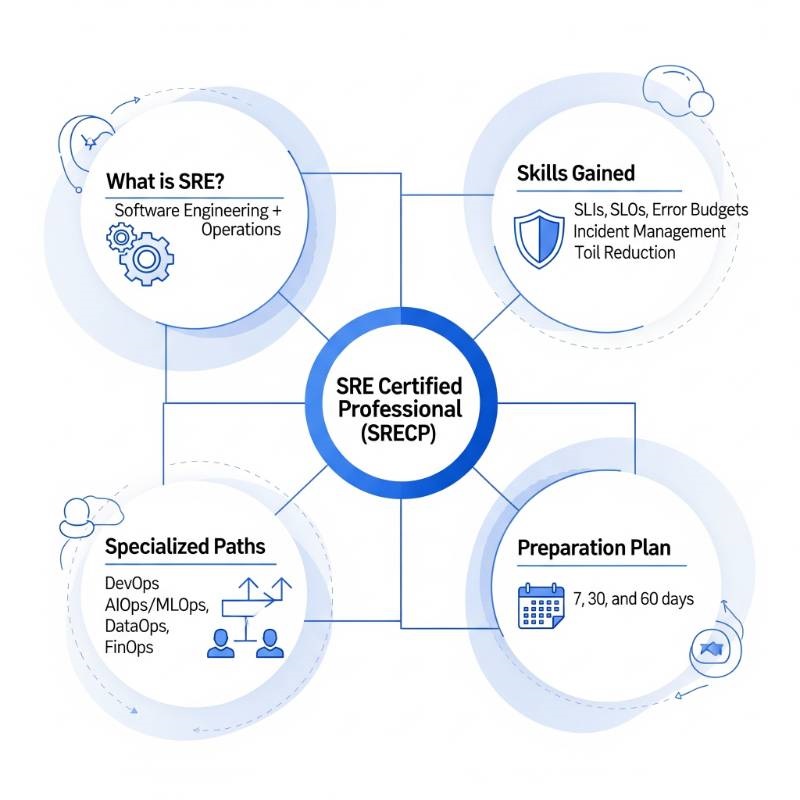
In the modern digital economy, a system’s reliability is directly tied to a company’s success. As software environments become more complex, the traditional gap between development and operations has created bottlenecks that only specialized engineering can solve. This is where Site Reliability Engineering (SRE) becomes essential. SRE is not just a job title; it is a data-driven discipline that treats operations as a software problem, allowing organizations to scale rapidly without sacrificing stability. For engineers and managers aiming to lead in this space, the SRE Certified Professional (SRECP) program offers a structured roadmap to mastering high-availability systems. This guide will walk you through everything you need to know about the certification, from the core skills you will gain to the career paths that open up once you become a certified expert.
What is Site Reliability Engineering (SRE)?
Site Reliability Engineering is a discipline that incorporates aspects of software engineering and applies them to infrastructure and operations problems. The main goal is to create scalable and highly reliable software systems. Instead of traditional “operations,” SRE teams use software as a tool to manage systems, solve problems, and automate operational tasks.
For a working engineer, SRE is the next logical step after DevOps. While DevOps is a philosophy, SRE is a specific way to implement that philosophy using data, code, and engineering principles.
Detailed Look: SRE Certified Professional (SREC-P)
The SRE Certified Professional (SRECP) is a specialized certification aimed at practitioners who want to master the art of system reliability. It moves beyond basic monitoring and dives into service level management, incident response, and automation.
What it is
The SRECP is an intensive program focused on the practical application of SRE principles. It covers how to balance the need for new features with the absolute requirement for system stability using Error Budgets and SLIs/SLOs.
Who should take it
This certification is ideal for Software Engineers, DevOps Engineers, System Administrators, and Engineering Managers who are responsible for the uptime and performance of large-scale applications.
Skills you’ll gain
- Mastery over SLIs (Service Level Indicators) and SLOs (Service Level Objectives).
- Ability to manage and utilize Error Budgets to drive product decisions.
- Hands-on experience with incident management and post-mortem analysis.
- Advanced automation skills for toil reduction.
- Understanding of distributed system architectures.
Real-world projects you should be able to do after it
- Automated Incident Response: Build a system that automatically alerts and triggers self-healing scripts for common outages.
- SLO Dashboarding: Create a real-time visualization of system health against agreed-upon reliability targets.
- Toil Audit and Elimination: Identify manual, repetitive tasks in an organization and replace them with automated software solutions.
Preparation plan
- 7–14 days: Best for experienced SREs. Focus on the SRECP exam syllabus, specifically the terminology and specific framework used by DevOpsSchool.
- 30 days: The standard path for DevOps Engineers. Spend 1 hour daily on core SRE concepts (Error Budgets, SLIs) and 1 hour on practical labs.
- 60 days: Recommended for beginners or those transitioning from pure dev/ops roles. Start with the Google SRE handbook, followed by the SRECP course modules and mock exams.
Common mistakes
- Ignoring the “Engineering” in SRE: Treating SRE like a traditional Ops role instead of using code to solve problems.
- Poor SLO Definition: Setting targets that are too high (100% is impossible) or too low (meaningless to the user).
- Neglecting Post-Mortems: Failing to treat failures as learning opportunities.
Best next certification after this
Once you have mastered the SRECP, the best next step is AIOps Certified Professional to learn how to use Artificial Intelligence to automate reliability even further.
Choose Your Path: 6 Specialized Learning Paths
Modern engineering is diverse. Depending on your career goals, you can choose a path that suits your interests. Each of these paths integrates with the SRE mindset of reliability and automation.
- The DevOps Path: Focuses on the CI/CD pipeline, culture, and the tools required to move code from a laptop to production as fast as possible.
- The DevSecOps Path: Integrates security into every step of the DevOps process. It ensures that being fast doesn’t mean being vulnerable.
- The SRE Path: The core path for those dedicated to high availability, scalability, and “operations as a software problem.”
- The AIOps/MLOps Path: Focuses on managing the lifecycle of Machine Learning models and using AI to manage complex IT environments.
- The DataOps Path: Streamlines the delivery of data for analytics and business intelligence, ensuring data pipelines are reliable and scalable.
- The FinOps Path: A cultural practice where everyone takes responsibility for their cloud costs, supported by a central best-practices group.
Role → Recommended Certifications Mapping
To help you decide which certification fits your current job or your next promotion, refer to this mapping:
| Current Role | Recommended Certification(s) |
| DevOps Engineer | SRE Certified Professional, DevSecOps Certified Professional |
| SRE | AIOps Certified Professional, Kubernetes Administrator |
| Platform Engineer | Terraform Certified Associate, SRE Certified Professional |
| Cloud Engineer | AWS/Azure Solutions Architect, FinOps Practitioner |
| Security Engineer | DevSecOps Certified Professional, CISSP |
| Data Engineer | DataOps Certified Professional, Big Data Specialty |
| FinOps Practitioner | FinOps Certified Practitioner, Cloud Cost Management |
| Engineering Manager | DevOps Leader, SRE Certified Professional (for technical oversight) |
The Master Certification Table
This table provides a bird’s-eye view of the certification landscape for software engineers and operations professionals.
| Track | Level | Who it’s for | Prerequisites | Skills Covered | Recommended Order |
| SRE | Professional | Engineers/Managers | Basic DevOps knowledge | SLOs, Error Budgets, Automation | SRECP -> AIOps |
| DevOps | Foundation | Beginners | None | CI/CD, Culture, Tools | DevOps Foundation -> Professional |
| DevSecOps | Professional | Security/DevOps | DevOps knowledge | Pipeline Security, Compliance | DevOps -> DevSecOps |
| FinOps | Associate | Finance/Cloud Eng | Cloud Basics | Cloud Billing, Cost Optimization | Cloud Practitioner -> FinOps |
| MLOps | Professional | Data Scientists | Python, DevOps | Model Deployment, Monitoring | DevOps -> MLOps |
Top Institutions for SRE Training & Certification
Selecting the right training partner is crucial for passing the exam and gaining actual skills. Here are the top institutions providing help for the SRE Certified Professional (SRECP):
1. DevOpsSchool
As the primary provider for the SRECP certification, DevOpsSchool is a global leader in high-end technical training. They offer an advanced 69-hour curriculum that covers everything from observability with Prometheus to container orchestration with Kubernetes. Their programs are specifically designed for working professionals, offering live instructor-led sessions and lifetime access to their Learning Management System (LMS).
2. Cotocus
Cotocus is highly regarded for its boutique, high-touch training approach. They specialize in enterprise-level upskilling, focusing on architectural patterns and “Day 2” operations. Their SRE training is ideal for senior engineers who need to understand how to design fault-tolerant systems and implement complex chaos engineering experiments in production environments.
3. Scmgalaxy
Scmgalaxy is more than just a training center; it is a massive community hub for DevOps and SRE practitioners. They provide a wealth of open-source resources, community support, and specialized training programs. Their focus is often on the practical “how-to” of SRE, making them a go-to for engineers who learn best through community-driven documentation and peer support.
4. BestDevOps
BestDevOps focuses on delivering fast-paced, high-impact training for corporate teams. Their SRE programs are built around the concept of “accelerated learning,” where teams can move from zero to certified in a matter of weeks. They are an excellent choice for organizations looking to standardize SRE practices across their entire engineering department quickly.
5. DevSecOpsSchool
As the name suggests, this institution bridges the gap between reliability and security. They provide SRE training that emphasizes the “Security” aspect of site reliability, teaching engineers how to build systems that are not only up and running but also resilient to modern cyber threats.
6. Sreschool
Sreschool is a dedicated platform entirely focused on the Site Reliability Engineering domain. They offer niche courses that dive deep into specific SRE sub-pillars, such as Incident Management, Observability, and Toil Reduction. This is the ideal place for a practitioner who wants to specialize deeply in one specific area of the SRE spectrum.
7. Aioopsschool
aiopsschool supports learning for operations automation and intelligence. It fits teams dealing with alert fatigue and looking for smarter monitoring and triage practices.
8. Dataopsschool
dataopsschool supports DataOps thinking: pipeline discipline, quality checks, governance, and reliability for data systems. It is useful for data engineering teams that want predictable and auditable pipelines.
9. Finopsschool
finopsschool supports FinOps learning: cost visibility, governance habits, and optimization workflows. It fits cloud teams and managers who want controlled cloud spend without blocking innovation.
Growth Paths: What to Take Next?
After completing your SRE Certified Professional certification, you shouldn’t stop learning. Here are three directions you can take based on your career goals:
- Same Track (Deepening Expertise): Move toward AIOps Certified Professional. This allows you to apply artificial intelligence and machine learning to the data generated by your SRE practices, enabling predictive scaling and automated root cause analysis.
- Cross-Track (Broadening Skills): Consider the DevSecOps Certified Professional. A “Secure SRE” is one of the most valuable roles in the market today. Knowing how to keep a system reliable and secure is a massive career booster.
- Leadership Path: If you want to move into management, the DevOps Leader or Certified SRE Manager certifications are essential. These focus on team building, culture change, and high-level strategy rather than just technical implementation.
General FAQs for Software Engineers
- How difficult is the SRECP exam? It is moderately difficult. It requires both theoretical knowledge of SRE principles and practical understanding of how to implement them.
- How much time does it take to get certified? Most working professionals can complete the training and pass the exam within 30 to 45 days.
- Are there any prerequisites? While there are no hard prerequisites, having a basic understanding of Linux, Cloud, and DevOps concepts is highly recommended.
- Should I do DevOps or SRE first? It is usually better to understand DevOps principles first, as SRE is a specific way to implement DevOps at scale.
- What is the value of SRECP in the global market? SRE is one of the highest-paying roles in tech today. This certification validates your skills to top employers like Google, Amazon, and Microsoft.
- Does this certification help in career growth? Yes. It moves you from “Engine Room” tasks to “Architectural” tasks, often leading to Senior or Lead Engineer roles.
- Is the SRECP certification recognized in India? Absolutely. DevOpsSchool has a strong presence in India, and their certifications are well-regarded by major IT hubs in Bangalore, Pune, and Hyderabad.
- Can a manager take this course? Yes. It is highly beneficial for managers to understand the metrics (SLOs/SLIs) their teams should be using to measure success.
- What is the passing score? Usually, a score of 70% or higher is required to earn the certification.
- Do I get a certificate and a badge? Yes, successful candidates receive a digital certificate and a badge they can display on LinkedIn.
- Is there a renewal process? Most professional certifications require a refresh every 2–3 years to ensure you stay updated with new technologies.
- What if I fail the first attempt? Most providers, including DevOpsSchool, offer a retake policy. Check the specific terms during registration.
FAQs: SRE Certified Professional (SRECP) Focus
- What is the main focus of SRECP? The core focus is reliability, scalability, and using software engineering to solve operational problems.
- Will I learn specific tools like Prometheus or Grafana? Yes, the training includes hands-on labs with industry-standard monitoring and observability tools.
- How does SRECP differ from a standard Cloud certification? Cloud certifications focus on how to use a provider (like AWS). SRECP focuses on how to run systems reliably, regardless of where they are hosted.
- Is coding required for SRECP? A basic understanding of scripting (Python/Bash) is necessary as automation is a key pillar of SRE.
- Does the course cover incident management? Yes, it covers the entire lifecycle of an incident, from detection to the blameless post-mortem.
- Are there mock exams available? Yes, DevOpsSchool and Sreschool provide mock tests to help you prepare for the format of the actual exam.
- Can I take the exam online? Yes, the SRECP exam is typically offered as a proctored online exam.
- Who is the certifying body? The certification is provided and validated by DevOpsSchool, a leader in the DevOps education space.
Conclusion
Mastering the balance between rapid innovation and rock-solid reliability is the hallmark of a senior engineering leader. Earning the SRE Certified Professional (SRECP) certification is a significant milestone that proves you possess the technical depth and the strategic mindset required to manage global-scale infrastructure. By shifting your focus from manual “toil” to automated, self-healing systems, you increase your value to any organization and future-proof your career in an increasingly automated world. Whether you are an engineer in India or a manager leading a global team, the principles of Error Budgets, SLOs, and blameless culture will transform how you approach software delivery. Now is the time to move beyond traditional operations and embrace the engineering standards that power the world’s most successful tech giants.

Best Cardiac Hospitals Near You
Discover top heart hospitals, cardiology centers & cardiac care services by city.
Advanced Heart Care • Trusted Hospitals • Expert Teams
View Best Hospitals