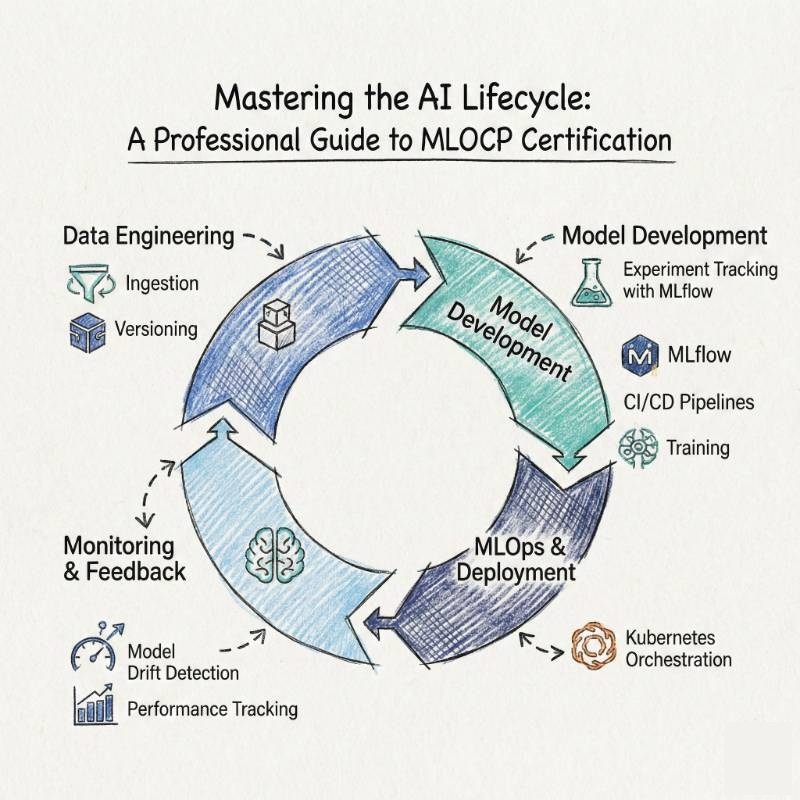
Machine Learning has moved past the “experimental” phase. Today, the real value lies in how we take those models and make them work reliably at scale. As someone who has watched the industry shift from manual deployments to fully automated AI pipelines, I can tell you that the gap between a “model that works on my laptop” and a “model that works in production” is huge.
If you are a software engineer or an engineering manager, you are likely feeling the pressure to bridge this gap. The MLOps Certified Professional (MLOCP) is the most structured way to gain that expertise. This guide will break down why this certification is the gold standard for the modern technical career.
Why MLOps Matters Now
Traditionally, software development (DevOps) and data science lived in separate worlds. DevOps was about speed and reliability; Data Science was about research and accuracy. MLOps (Machine Learning Operations) is the bridge. It applies the rigor of DevOps—Continuous Integration (CI) and Continuous Delivery (CD)—to Machine Learning, adding a third critical pillar: Continuous Training (CT).
By becoming a certified expert, you prove you can manage the “hidden technical debt” of ML systems, such as model drift, data silos, and manual deployment bottlenecks.
Deep Dive: MLOps Certified Professional (MLOCP)
The MLOCP program is a professional-level credential that validates your ability to build, deploy, and scale ML models in a cloud-native environment. It moves beyond the math of AI and focuses on the engineering excellence required to keep AI systems alive.
What it is
The MLOps Certified Professional (MLOCP) is a comprehensive certification provided by DevOpsSchool. It covers the end-to-end ML lifecycle, focusing on the integration of data engineering, model development, and automated operations. It is designed to turn technical professionals into architects of automated AI factories.
Who should take it
- Software Engineers looking to transition into the high-growth AI/ML field.
- DevOps/SRE Professionals tasked with managing ML infrastructure and GPUs.
- Data Engineers who want to automate data pipelines and feature engineering.
- Engineering Managers who need to lead AI teams and understand the MLOps ROI.
Skills you’ll gain
- Infrastructure Automation: Building scalable ML labs using Terraform and Ansible.
- Container Orchestration: Deploying ML workloads at scale using Docker and Kubernetes.
- Experiment Tracking: Managing model versions and parameters with MLflow and DVC.
- CI/CD/CT Pipelines: Automating the build, test, and retraining cycles for models.
- Observability: Setting up specialized monitoring for model decay and data drift.
- Scalable Serving: Deploying models as high-performance microservices.
Real-world projects you should be able to do
- Automated Retraining Loop: A system that detects performance drops and triggers a new training job automatically.
- Enterprise Feature Store: A centralized hub for features used across multiple models.
- Multi-Cloud ML Pipeline: A portable pipeline that runs seamlessly across AWS, Azure, or GCP.
- A/B Testing for AI: A traffic-routing system to compare “Challenger” vs. “Champion” models in real-time.
Preparation plan
- 7–14 Days (The Expert Sprint): Focus on tool-specific configurations (MLflow, K8s) and exam patterns. Best for those already in DevOps roles.
- 30 Days (The Standard Path): Dedicate 2 hours daily. Two weeks on infrastructure (Docker/K8s) and two weeks on MLOps specific tools and CT pipelines.
- 60 Days (The Beginner Path): Spend the first month on Linux, Git, and Python basics before moving into the core MLOps curriculum.
Common mistakes
- Math vs. Engineering: Spending too much time on algorithm theory and not enough on deployment scripts.
- Static Data Fallacy: Forgetting that data changes over time; always version your datasets.
- Manual Deployment: If you are “clicking” to deploy a model, you aren’t doing MLOps. Everything must be code.
Best next certification after this
Once you have conquered MLOps, the natural progression is AIOps Certified Professional (AIOCP) to manage entire IT stacks with AI, or a Certified DevOps Architect role for high-level leadership.
Professional Certification Comparison
| Track | Level | Who it’s for | Prerequisites | Skills Covered | Recommended Order |
| MLOps | Professional | Engineers/Managers | Python, Basic ML | Docker, MLflow, CT | 1st (AI Focus) |
| DevOps | Professional | Devs, Admins | Linux, Git | Jenkins, Ansible | 1st (General) |
| SRE | Professional | Ops Engineers | DevOps Basics | SLIs/SLOs, Reliability | 2nd |
| DevSecOps | Professional | Security Pros | DevOps Knowledge | Vault, Security Scans | 2nd |
| AIOps | Professional | SREs, ML Eng | MLOps Knowledge | AI for IT Ops | 3rd |
| DataOps | Professional | Data Engineers | SQL, Python | Data Pipelines | 2nd |
| FinOps | Professional | Managers, Arch | Cloud Knowledge | Cost Optimization | 2nd |
Choose Your Path: 6 Learning Roads
Identify your goal and follow the specific “Road” to mastery:
1. The DevOps Path
The foundation of modern engineering. You focus on the speed and safety of the software delivery pipeline.
2. The DevSecOps Path
For those who want to integrate security into the heart of the automation process.
3. The SRE Path
Focuses on the scalability and high availability of systems using software engineering principles.
4. The AIOps/MLOps Path
The most future-proof path. You manage AI lifecycles and use AI to optimize IT operations.
5. The DataOps Path
Ensures the quality and speed of data flow from source to consumption.
6. The FinOps Path
The intersection of finance and cloud operations, focusing on maximizing cloud value and cost efficiency.
Role-Based Certification Mapping
| Current/Target Role | Recommended Certification Journey |
| DevOps Engineer | DevOps Professional → SRE Professional → DevOps Architect |
| SRE | SRE Certified Professional → Master in Observability |
| Platform Engineer | Terraform Associate → MLOps Certified Professional |
| Cloud Engineer | Cloud Solutions Architect → Certified DevOps Professional |
| Security Engineer | DevSecOps Certified Professional → Kubernetes Security (CKS) |
| Data Engineer | DataOps Certified Professional → MLOps Certified Professional |
| FinOps Practitioner | FinOps Professional → Cloud Cost Architect |
| Engineering Manager | Certified DevOps Manager → MLOps for Leaders |
Top Institutions for MLOCP Training
Success in the MLOps Certified Professional (MLOCP) exam requires more than just reading; it requires hands-on practice. These institutions are the leaders in providing that environment.
- DevOpsSchool: The primary authority for MLOps training. They offer a deep-dive curriculum with lifetime access to their LMS and a 100% hands-on approach. Their labs simulate real-world production environments, making them the top choice for serious candidates.
- Cotocus: Known for their high-level technical consulting. They provide specialized workshops for teams looking to master complex tools like Kubernetes and MLflow within an MLOps framework.
- Scmgalaxy: A veteran in the community, providing extensive resources and certification support. They focus on the entire Software Configuration Management lifecycle, ensuring a holistic learning experience.
- BestDevOps: Offers highly flexible training modes with a strong focus on interview preparation and mock exams to ensure job readiness in the global market.
- AiOpsSchool: Focuses specifically on the intersection of AI and Operations. They are experts in MLOps and AIOps tracks.
- DataOpsSchool: The go-to place for data engineering and DataOps certifications. They help you master data pipelines and quality.
- FinOpsSchool: Specializes in cloud cost management and financial operations. Ideal for managers looking to optimize cloud spend.
Next Certifications to Take
After completing your MLOCP, stay ahead of the curve with these options:
- Same Track: AIOps Certified Professional (AIOCP)Learn to use the ML models you’ve built to predict and prevent IT outages.
- Cross-Track: SRE Certified Professional (SRECP)Combine MLOps with reliability engineering to ensure your models are always available.
- Leadership: Certified DevOps ManagerTransition into strategic leadership, focusing on culture, ROI, and scaling departments.
FAQs: Navigating Your MLOps Career Path
1. How difficult is it to transition from DevOps to MLOps?
The transition is logical but requires a mindset shift. While you already understand CI/CD, you must now learn to treat “data” as a first-class citizen alongside code. The difficulty is moderate; the challenge lies in understanding model versioning and the non-deterministic nature of Machine Learning.
2. How much time should a working manager dedicate to this certification?
For managers, the focus is on architectural oversight. A 30-day plan, spending about 5–7 hours a week, is usually sufficient to grasp the lifecycle, ROI, and governance aspects of the MLOCP program.
3. What are the absolute prerequisites for an SRE entering MLOps?
As an SRE, you already have the “Ops” foundation. The prerequisites are basic Python proficiency and a conceptual understanding of how ML models are trained. You don’t need to be a mathematician, but you do need to understand how models consume resources.
4. What is the ideal sequence for someone starting from scratch?
Start with the Certified DevOps Professional to master the basics of automation. Next, take the MLOps Certified Professional (MLOCP) to specialize. Finally, round out your profile with AIOps to learn how to use AI to monitor the very systems you’ve built.
5. What is the real-world market value of an MLOps certification?
In the current global market (including major hubs like India and the US), MLOps roles often command a 25–40% salary premium over standard DevOps roles. Certification acts as a “trust signal” for recruiters hiring for high-stakes AI projects.
6. Can a Software Engineer skip standard DevOps and go straight to MLOps?
You can, but it is not recommended. MLOps is built on DevOps. Without understanding Docker, Kubernetes, and Jenkins, you will struggle to implement the “Ops” part of MLOps effectively.
7. What are the primary career outcomes after completing the MLOCP?
Most professionals move into roles such as MLOps Engineer, AI Infrastructure Architect, or Lead Data Engineer. For managers, it leads to roles like Director of AI Operations or VP of Engineering.
8. Does this certification help with Global Immigration/Visas for Tech roles?
Yes, professional certifications from recognized bodies like DevOpsSchool are often used to strengthen “Extraordinary Ability” or “Skilled Worker” visa applications by proving specialized technical expertise.
9. How does MLOps differ from DataOps in a career context?
DataOps focuses on the “plumbing”—getting clean data from point A to point B. MLOps focuses on the “engine”—what the data does once it arrives at the model. Both are valuable, but MLOps is generally more focused on the application side.
10. Is there a lot of coding involved in the day-to-day role?
Yes, expect to write a fair amount of Python for automation scripts and YAML for Kubernetes configurations. However, you aren’t writing complex algorithms; you are writing the code that manages those algorithms.
11. Why is FinOps mentioned as a related path to MLOps?
AI is expensive. Training large models can cost thousands of dollars in cloud credits. A master-level MLOps professional must understand FinOps to ensure their AI infrastructure is cost-effective.
12. How often do I need to renew my certification to stay relevant?
The MLOCP is typically valid for three years. Given the speed of AI evolution, this ensures you stay updated on the latest shifts, such as the move from traditional ML to Generative AI Operations (LLMOps).
Technical FAQs: MLOps Certified Professional (MLOCP)
1. Does the MLOCP exam cover LLMOps and Generative AI?
Yes, the modern MLOCP curriculum has been updated to include the deployment and orchestration of Large Language Models (LLMs), covering techniques like fine-tuning and vector database management.
2. Which tools are given the most weightage in the MLOCP program?
The core “Trinity” of the program consists of Kubernetes (for orchestration), MLflow (for experiment tracking), and Airflow (for pipeline scheduling). Mastery of these three is essential for passing.
3. Is the MLOCP exam theoretical or lab-based?
It is heavily performance-based. You will be expected to demonstrate your ability to configure a CI/CD pipeline for a model and set up automated monitoring in a lab environment.
4. How does MLOCP handle “Model Drift” in its curriculum?
The program teaches you how to build automated triggers. When the production data starts to look different from the training data (drift), the system you build will automatically alert the team or trigger a retraining job.
5. Can I use the MLOCP skills on any cloud provider?
Absolutely. The program focuses on “Cloud-Native” tools. Whether you use AWS SageMaker, Google Vertex AI, or Azure ML, the underlying principles of Docker and Kubernetes remain the same.
6. What is “Continuous Training” (CT) in the context of the MLOCP?
CT is a unique MLOps concept where the service not only deploys the model but also automatically retrains it on new incoming data. This is a primary focus of the professional-level certification.
7. Does the certification cover security for ML models?
Yes, it touches on “Model Security,” including protecting against adversarial attacks and ensuring that the data used for training complies with privacy regulations like GDPR.
8. Are there mock exams available for MLOCP?
Yes, training institutions like DevOpsSchool provide comprehensive mock exams and project reviews that mirror the actual certification environment to ensure a high success rate.
Conclusion
The transition from traditional software to AI-native applications is the most significant shift we have seen in decades. As we have explored in this guide, the MLOps Certified Professional (MLOCP) program is your roadmap to navigating this change. It provides the perfect blend of operational discipline and data science agility, ensuring that you are prepared for the complexities of the modern production environment. In my experience, the engineers who thrive are not necessarily those who know the most math, but those who can build the most reliable systems. By earning your MLOCP, you are telling the world—and your future employers—that you are a builder. You are proving that you can handle model drift, automate complex pipelines, and maintain the high availability that modern businesses demand. The path is clear: start with the fundamentals, choose your specialized learning road, and partner with established institutions like DevOpsSchool to gain the hands-on experience that matters. The “Ops” world is expanding, and MLOps is its most exciting new territory. Take the leap, get certified, and position yourself at the very center of the AI revolution. The future of engineering is automated, it is intelligent, and with the right certification, it belongs to you.

Best Cardiac Hospitals Near You
Discover top heart hospitals, cardiology centers & cardiac care services by city.
Advanced Heart Care • Trusted Hospitals • Expert Teams
View Best Hospitals