Introduction
Building Information Modeling (BIM) software is a digital process that allows architects, engineers, and construction professionals to create and manage data for a building project. In simple terms, it is much more than just a 3D drawing tool. While traditional CAD (Computer-Aided Design) creates flat lines and shapes, BIM builds intelligent models where every wall, window, and pipe has data attached to it—like its material, cost, and how it interacts with other parts of the building. It creates a “digital twin” of a structure before a single brick is laid.
In the context and beyond, BIM is no longer optional for serious construction projects. With tighter environmental regulations, rising material costs, and the need for faster delivery, BIM is the central brain that connects design, construction, and facility management. It prevents costly mistakes by spotting “clashes” (like a pipe running through a steel beam) digitally, long before they happen on the physical site.
Real-World Use Cases
- Clash Detection: Identifying conflicts between HVAC ducts and structural beams during the design phase to avoid expensive rework on site.
- Cost Estimation (5D BIM): Automatically pulling material quantities from the model to generate accurate real-time budget estimates.
- Facility Management: Using the BIM model after construction to track maintenance schedules, such as knowing exactly when a specific light bulb in a 50-story tower was last changed.
- Sustainability Analysis: Simulating sunlight and energy usage to design greener, more efficient buildings.
What Buyers Should Evaluate
- Interoperability: Can it open and save “OpenBIM” (IFC) files to work with other tools?
- Collaboration: Does it allow multiple people to work on the same model at the same time?
- Learning Curve: Is it intuitive, or will your team need months of training?
- Hardware Requirements: Do you need a supercomputer, or can it run on standard laptops/cloud?
- Discipline Focus: Is it better for architects, structural engineers, or MEP (mechanical) experts?
- Licensing: Is it a flexible subscription or an expensive locked-in contract?
Best for:
- Architects & Engineers: Who need to design complex structures with precision.
- General Contractors: Who need to coordinate sub-contractors and manage schedules.
- Large Enterprises: Managing portfolios of buildings where data consistency is key.
Not ideal for:
- Small Renovations: If you are just remodeling a kitchen, a simple 2D drawing tool or sketching app is faster and cheaper.
- Solo DIYers: The complexity and cost of BIM are usually overkill for personal home projects.
Key Trends in Building Information Modeling (BIM) Software and Beyond
- AI-Driven Generative Design: Software is increasingly using AI to suggest design options automatically. You input constraints (e.g., “maximize natural light, minimize concrete”), and the BIM tool generates optimized floor plans.
- Cloud-First Collaboration: The days of emailing massive files are ending. The standard is now real-time, browser-based model viewing where field workers can annotate issues on a tablet that designers see instantly in the office.
- Digital Twins & IoT: BIM models are living documents. Sensors in completed buildings feed real-time data (temperature, occupancy) back into the BIM model, helping facility managers optimize operations.
- AR/VR Integration: Augmented Reality (AR) is moving from a gimmick to a daily tool. Site managers use AR glasses to overlay the BIM model onto the real construction site to verify installation accuracy.
- Sustainability as a Default: Carbon footprint analysis is becoming a native feature. Tools now calculate “embodied carbon” automatically as you draw, helping firms meet strict 2030 climate goals.
- Scan-to-BIM Automation: Using drones and laser scanners to capture existing buildings is becoming easier, with software automatically converting point clouds into clean 3D BIM geometry.
- Blockchain for Data Security: To prevent disputes, some platforms are exploring ledger technology to create an immutable record of who changed what in the model and when.
How We Selected These Tools (Methodology)
To select the top 10 tools for this list, we evaluated the landscape based on practical utility for professionals rather than marketing claims. Our methodology included:
- Market Dominance: We prioritized tools that are industry standards, ensuring you can easily find talent and partners who use them.
- OpenBIM Support: We looked for strong support of IFC and BCF formats, which is critical for teams using different software.
- Depth of Features: We favored tools that handle the full lifecycle—from concept to documentation—rather than just pretty visualization.
- Collaboration Capabilities: Tools with robust cloud sharing and team-management features ranked higher.
- User Feedback Signals: We considered common user sentiments regarding stability, support responsiveness, and learning curve.
- Innovation Trajectory: We looked for tools actively adding modern features like AI assistance and automation, rather than legacy tools in maintenance mode.
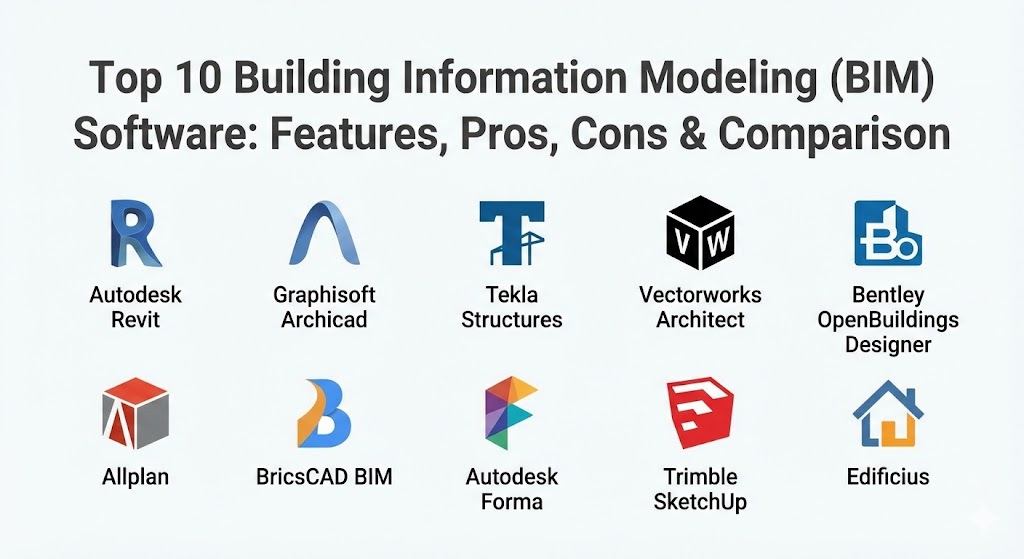
Top 10 Building Information Modeling (BIM) Software Tools
1 — Autodesk Revit
The undisputed heavyweight champion of the BIM world, widely used by architects, structural engineers, and MEP professionals globally for end-to-end project delivery.
Key Features
- Parametric Modeling: Change a wall’s height in one view, and it automatically updates in all floor plans, elevations, and schedules.
- Multi-Discipline Support: Single environment for architectural, structural, and systems design.
- Worksharing: Allows multiple team members to work on the same central model file simultaneously.
- Generative Design: Built-in tools to automate design iterations based on defined goals.
- Massive Library: Access to thousands of manufacturer-specific families (objects like windows, doors, chillers).
- Dynamo Integration: Visual programming interface to automate repetitive tasks and create custom geometries.
Pros
- Industry standard; knowing Revit makes hiring and collaboration much easier.
- Extremely powerful ecosystem with hundreds of third-party plugins.
- Strong documentation capabilities that link directly to the 3D model.
Cons
- Steep learning curve; it takes time to master.
- Can be resource-heavy, requiring powerful hardware to run smoothly.
- Pricing is on the higher end and subscription-only.
Platforms / Deployment
- Windows
- Self-hosted / Cloud (via BIM Collaborate Pro)
Security & Compliance
- SSO, MFA (via Autodesk Account)
- SOC 2, ISO 27001
Integrations & Ecosystem
Revit has the largest ecosystem in the industry. It connects seamlessly with other Autodesk tools like AutoCAD, Navisworks, and Civil 3D.
- Autodesk Construction Cloud
- Twinmotion / Enscape (for rendering)
- Matterport
- Procore
Support & Community
Massive global community. If you have a problem, someone has likely already solved it on a forum. Official support includes knowledge bases, ticket systems, and partner resellers.
2 — Archicad (Graphisoft)
A favorite among architects for its design-centric approach and intuitive interface. It is often seen as the primary rival to Revit, particularly in Europe.
Key Features
- Teamwork (BIMcloud): Extremely stable real-time collaboration that often performs better over slow internet connections than competitors.
- GDL Objects: Intelligent parametric objects that are highly customizable.
- Cineware Rendering: High-quality built-in rendering engine (based on Maxon Cinema 4D).
- Energy Evaluation: Built-in tools to assess the energy performance of the building design.
- Parametric Profiles: Easy creation of complex walls, beams, and columns.
- AI Visualizer: Recent updates include AI tools to generate design inspirations.
Pros
- Generally considered more intuitive and “architect-friendly” than Revit.
- Runs natively on macOS, which is a huge plus for design agencies using Apple hardware.
- Lighter on hardware resources compared to some competitors.
Cons
- Smaller market share in the US compared to Revit, which can complicate hiring.
- MEP (Mechanical, Electrical, Plumbing) features are improved but historically less robust than Revit’s.
Platforms / Deployment
- Windows / macOS
- Self-hosted / Cloud
Security & Compliance
- Not publicly stated (Standard enterprise security practices applied to BIMcloud)
Integrations & Ecosystem
Strong advocate for OpenBIM.
- Solibri
- Bluebeam
- Twinmotion (often bundled)
- Rhino/Grasshopper (live connection)
Support & Community
Very loyal and passionate user base. Graphisoft offers solid documentation and a dedicated community forum.
3 — Vectorworks Architect
A flexible, design-oriented BIM tool that bridges the gap between creative sketching and technical BIM documentation. Popular in landscape and entertainment design as well.
Key Features
- Hybrid 2D/3D: Excellent 2D drafting capabilities that feel like illustration software, combined with 3D modeling.
- Subdivision Modeling: Allows for organic, free-form shape creation unlike rigid BIM tools.
- Data Visualization: Ability to color-code the model based on data (e.g., color rooms by occupancy type).
- Marionette: Visual scripting tool similar to Grasshopper for automating design.
- Landscape Specifics: Has a dedicated “Landmark” version which is the industry leader for landscape BIM.
Pros
- Great visual quality for drawings and presentations right out of the box.
- More affordable purchasing options, including perpetual licenses in some regions (though shifting to subscription).
- Cross-platform (Mac and Windows).
Cons
- Can struggle with extremely large, complex multi-building projects compared to Revit.
- Collaboration workflows are effective but slightly different from the industry standard “central file” logic.
Platforms / Deployment
- Windows / macOS
- Self-hosted
Security & Compliance
- Not publicly stated
Integrations & Ecosystem
- Solibri
- Enscape / Lumion
- Revit (Import/Export)
Support & Community
Good training resources (“Vectorworks University”) and a helpful user forum.
4 — Bentley MicroStation (OpenBuildings)
The powerhouse for infrastructure, civil engineering, and massive scale projects. If you are designing an airport, a dam, or a rail network, this is often the tool of choice.
Key Features
- Hyper-Modeling: Contextualizes drawings within the 3D model for clear navigation.
- Federated Models: Can handle massive datasets and reference files without crashing.
- Generative Components: Advanced computational design tools.
- Reality Mesh Support: excellent handling of point clouds and reality capture data.
- Interoperability: Native DGN support and robust DWG handling.
Pros
- Unmatched performance for infrastructure and mega-projects.
- extremely precise coordinate systems for large-scale civil work.
Cons
- User interface can feel dated and complex (“CAD-heavy” feel).
- Overkill for small to medium residential or commercial building projects.
- Steep learning curve.
Platforms / Deployment
- Windows
- Self-hosted / Cloud (ProjectWise)
Security & Compliance
- ISO 27001
- SOC 2
Integrations & Ecosystem
Deep integration with Bentley’s “ProjectWise” for document management.
- Siemens Teamcenter
- LumenRT
- Synchro 4D
Support & Community
Professional support is geared towards enterprise accounts. Community is smaller but highly technical.
5 — Trimble SketchUp (with Studio plugins)
While originally a simple modeler, SketchUp has evolved into a capable BIM tool when paired with plugins and the “Studio” tier, ideal for concept design and smaller firms.
Key Features
- Push/Pull Modeling: The most intuitive 3D modeling interface ever created.
- Scan Essentials: Import and model directly over point cloud data.
- PreDesign: Climate analysis tools to inform design before modeling starts.
- LayOut: 2D documentation tool linked to the 3D model.
- Live Components: Configurable objects that adjust parametrically.
Pros
- Incredibly easy to learn; you can be modeling in minutes.
- Very affordable compared to “Big BIM” software.
- Huge library of free 3D models (3D Warehouse).
Cons
- Native BIM intelligence is limited without plugins; “dumb” geometry requires manual tagging.
- Struggles with high-detail documentation for large, complex buildings.
- Not suitable for complex MEP or structural engineering analysis.
Platforms / Deployment
- Windows / macOS / Web (iPad version available)
- Cloud / Self-hosted
Security & Compliance
- SSO (Trimble ID)
- Not publicly stated (General cloud security applies)
Integrations & Ecosystem
Massive plugin extension warehouse is its biggest strength.
- V-Ray
- Enscape
- PlusSpec (for BIM features)
Support & Community
One of the largest user bases in the world. Endless YouTube tutorials and free resources.
6 — Allplan (Nemetschek)
A comprehensive BIM solution popular in Europe, particularly strong in structural engineering, concrete detailing, and prefabrication.
Key Features
- Reinforcement Detailing: Best-in-class tools for 3D rebar modeling and concrete reinforcement.
- Python Parts: Scriptable objects for custom automation.
- Multi-User Workflow: Robust team collaboration tools.
- Precision Modeling: Combines the freedom of 3D modeling with the precision of 2D CAD.
- Buildability Focus: Designed with construction and fabrication in mind, not just design.
Pros
- Unbeatable for structural engineers and concrete contractors.
- Handles complex geometry and engineering data efficiently.
Cons
- User interface can be complex and intimidating for new users.
- Less common in the US market (stronger in DACH region).
Platforms / Deployment
- Windows
- Self-hosted / Cloud (Bimplus)
Security & Compliance
- ISO 27001 (Nemetschek Group)
Integrations & Ecosystem
Part of the Nemetschek group (like Archicad and Vectorworks), so it plays well with OpenBIM.
- Solibri
- Bluebeam
- Structural Analysis tools
Support & Community
Strong technical support, though resources are more plentiful in German/European markets.
7 — Tekla Structures
The gold standard for structural steel and concrete detailing. It is used to create constructible models that are ready for fabrication.
Key Features
- LOD 500 Capable: Can model down to the bolts, welds, and rivets.
- Automated Drawings: Generates fabrication drawings automatically from the model.
- Material Management: excellent for tracking quantities and logistics.
- Pour Management: Specific tools for managing concrete pours on site.
- Clash Checking: Built-in tools to check steel connections.
Pros
- Extremely robust; handles massive models with high detail without slowing down.
- Direct link to CNC machines for steel fabrication.
Cons
- Very specialized; not for general architectural design.
- Expensive licensing, justified by its role in high-value fabrication workflows.
Platforms / Deployment
- Windows
- Self-hosted / Cloud (Tekla Model Sharing)
Security & Compliance
- ISO 27001
- SOC 2
Integrations & Ecosystem
- Trimble Connect
- Various Structural Analysis Software
- Machinery software (CNC)
Support & Community
Highly professional support network. “Tekla Warehouse” provides plugins and content.
8 — BricsCAD BIM
A unique tool that uses .dwg as its native file format but adds intelligent AI-driven BIM capabilities. It’s a great bridge for teams moving from AutoCAD to BIM.
Key Features
- AI Classification: You model freely with solids, and the AI guesses what is a wall, a slab, or a column.
- Quad Cursor: Intuitive context-sensitive cursor for fast modeling.
- DWG Native: No file conversion needed if coming from standard CAD workflows.
- Propagate: AI tool that finds details (like a connection) and applies it everywhere else in the model automatically.
- Perpetual License Option: One of the few remaining pro tools offering a permanent license.
Pros
- Familiar interface for AutoCAD users reduces training time.
- Unique approach (Model first, classify later) allows for faster concept design.
- Cost-effective.
Cons
- Market share is smaller, meaning fewer third-party plugins compared to Revit.
- Documentation tools are powerful but operate differently than traditional BIM tools.
Platforms / Deployment
- Windows / macOS / Linux
- Self-hosted
Security & Compliance
- Not publicly stated
Integrations & Ecosystem
- Rhino / Grasshopper
- Enscape
- Twinmotion
Support & Community
Growing community. Bricsys offers good online documentation and tutorials.
9 — Edificius (ACCA Software)
An affordable, user-friendly BIM solution that aims to democratize BIM. It packs a lot of features (rendering, cost estimating, landscaping) into one package.
Key Features
- Real-Time Rendering: Integrated RTBIM engine for instant visualization.
- Garden & Landscape: Dedicated tools for outdoor design.
- 5D Cost Estimating: Live integration with cost estimation from the model.
- IFC Certified: Strong commitment to open standards.
- Video Editing: Built-in tools to create presentation videos.
Pros
- Very high value for money.
- All-in-one philosophy means you don’t need five different subscriptions.
Cons
- Less “enterprise-ready” than Autodesk or Bentley solutions.
- User interface is unique and may take getting used to.
Platforms / Deployment
- Windows
- Self-hosted
Security & Compliance
- Not publicly stated
Integrations & Ecosystem
- SketchUp
- Google Maps
- Blender
Support & Community
Good online video tutorials and training services.
10 — Plannerly
Not a modeling tool, but a BIM Management platform. It is essential for defining, scoping, and verifying BIM requirements (BIM Execution Plans) before modeling begins.
Key Features
- BIM Execution Plans (BEP): Templates and tools to create digital contracts.
- LOD Scoping: Visual drag-and-drop matrix to define who models what and in how much detail.
- Model Verification: Check if the uploaded models meet the agreed requirements.
- ISO 19650: Built-in workflows to ensure compliance with international BIM standards.
- Smart Fields: Auto-update project details across all documents.
Pros
- Solves the “communication” problem of BIM.
- Cloud-based and easy for non-technical stakeholders to use.
Cons
- It does not create 3D geometry (you still need Revit/Archicad).
- Another subscription to manage on top of authoring tools.
Platforms / Deployment
- Web-based (Browser)
- Cloud
Security & Compliance
- SOC 2
- ISO 27001 (SmartResilience)
Integrations & Ecosystem
- Autodesk Construction Cloud
- BIM 360
- IFC upload
Support & Community
Excellent educational content on BIM standards and management.
Comparison Table (Top 10)
| Tool Name | Best For | Platform(s) | Deployment | Standout Feature | Public Rating |
| Autodesk Revit | Enterprise / General | Windows | Hybrid | Massive Ecosystem | N/A |
| Archicad | Architects | Win / Mac | Hybrid | Teamwork Stability | N/A |
| Vectorworks | Creative Design | Win / Mac | Self-hosted | Hybrid 2D/3D | N/A |
| MicroStation | Infrastructure | Windows | Hybrid | Large Scale Handling | N/A |
| SketchUp | Concept / SMB | Win / Mac / Web | Hybrid | Ease of Use | N/A |
| Allplan | Structural / Concrete | Windows | Hybrid | Rebar Detailing | N/A |
| Tekla Structures | Steel Fabrication | Windows | Hybrid | Constructible Detail | N/A |
| BricsCAD BIM | DWG Users | Win / Mac / Lin | Self-hosted | AI Modeling Assist | N/A |
| Edificius | Value / SMB | Windows | Self-hosted | All-in-One Features | N/A |
| Plannerly | BIM Managers | Web | Cloud | Scope Management | N/A |
Evaluation & Scoring of Building Information Modeling (BIM) Software
| Tool Name | Core (25%) | Ease (15%) | Integrations (15%) | Security (10%) | Performance (10%) | Support (10%) | Value (15%) | Weighted Total |
| Revit | 10 | 6 | 10 | 9 | 7 | 8 | 7 | 8.3 |
| Archicad | 9 | 8 | 8 | 7 | 8 | 8 | 8 | 8.2 |
| Vectorworks | 8 | 7 | 7 | 6 | 7 | 7 | 8 | 7.3 |
| MicroStation | 9 | 4 | 7 | 9 | 9 | 7 | 6 | 7.4 |
| SketchUp | 5 | 10 | 9 | 6 | 7 | 9 | 9 | 7.7 |
| Allplan | 9 | 5 | 7 | 8 | 9 | 7 | 7 | 7.5 |
| Tekla | 10 | 4 | 7 | 9 | 10 | 8 | 6 | 7.8 |
| BricsCAD | 7 | 8 | 6 | 5 | 8 | 7 | 9 | 7.2 |
| Edificius | 6 | 7 | 5 | 5 | 6 | 6 | 10 | 6.4 |
| Plannerly | 8 | 9 | 7 | 9 | 10 | 9 | 8 | 8.5* |
*Note on Plannerly: Score reflects its specialized role in management, not geometry creation.
Which Building Information Modeling (BIM) Software Tool Is Right for You?
Solo / Freelancer
If you are a solo architect or designer working on custom homes, Archicad or Vectorworks are excellent choices. They are more artist-friendly and run well on Mac. For extremely tight budgets, SketchUp (with plugins) or BricsCAD are viable starting points.
SMB (Small to Medium Business)
Small firms need efficiency. Archicad is fantastic for small teams due to its easy collaboration. However, if you plan to work as a sub-consultant for larger firms, adopting Revit LT or full Revit might be necessary to ensure file compatibility.
Mid-Market
For mid-sized firms, standardization becomes key. Autodesk Revit is the safest bet here. It ensures you can hire staff who already know the software, and it integrates with the project management tools (like Procore) that your clients are likely using.
Enterprise
Global engineering firms and massive contractors need heavy lifters. Autodesk Revit (for buildings) and Bentley MicroStation (for infrastructure) are the dominant players. Tekla Structures is non-negotiable if you are self-performing steel or concrete fabrication.
Budget vs Premium
Edificius and BricsCAD offer powerful features for a fraction of the cost of the big names. On the premium side, the Autodesk AEC Collection bundle provides high value but requires a significant annual investment per seat.
Feature Depth vs Ease of Use
If you want to design intuitively, SketchUp is the king of ease, but lacks depth. Revit offers infinite depth but feels like piloting a spaceship. Archicad strikes the best balance between the two.
Integrations & Scalability
Revit wins on integrations—everyone builds plugins for Revit first. For scalability in infrastructure (roads, bridges), MicroStation handles file sizes that would crush other software.
Security & Compliance Needs
If you are working on government or military projects, stick to Autodesk, Bentley, or Trimble (Tekla). They have the documented SOC 2 and ISO certifications that IT departments mandate.
Frequently Asked Questions (FAQs)
1.What is the difference between CAD and BIM?
CAD (Computer-Aided Design) is essentially digital drafting—drawing lines and shapes. BIM (Building Information Modeling) is creating intelligent 3D objects that contain data about materials, costs, and physics.
2.Is BIM software hard to learn?
Generally, yes. Unlike simple drawing apps, BIM requires understanding construction logic. Expect a learning curve of 3–6 months to become proficient in tools like Revit or Archicad.
3.Can I use BIM on a Mac?
Yes. Archicad and Vectorworks are famous for being Mac-native. Revit, however, only runs on Windows (or via Parallels/Bootcamp, though native Windows is recommended).
4.Do I need a powerful computer for BIM?
Yes. BIM models are data-heavy. You generally need a dedicated graphics card (NVIDIA RTX series recommended), at least 32GB of RAM, and a fast SSD processor.
5.Is SketchUp considered BIM?
Out of the box, SketchUp is a modeler, not full BIM. However, with the right plugins and proper data tagging workflows, it can function as a BIM tool for smaller projects.
6.Why is Revit so popular?
Autodesk captured the market early by integrating Revit with AutoCAD. Today, it is the industry standard because most consultants (engineers, mechanical, etc.) use it, making collaboration easier.
7.What is “OpenBIM”?
OpenBIM is a universal approach to design that uses open file standards (like IFC). It allows an architect using Archicad to work with an engineer using Revit without losing data.
8.How much does BIM software cost?
It varies widely. Some tools cost a few hundred dollars a year, while enterprise-grade suites like the Autodesk AEC Collection or Tekla can cost thousands of dollars per user per year.
9.Can BIM help with sustainability?
Absolutely. BIM tools can simulate sun position, wind flow, and energy usage. This helps architects design buildings that require less electricity and heating, reducing the carbon footprint.
10.What is “Clash Detection”?
Clash detection is a feature that finds conflicts in the model—like a duct running through a beam. Finding this in the software is free; finding it on the construction site costs thousands to fix.
Conclusion
The shift to Building Information Modeling (BIM) is not just about 3D visualization; it is about building smarter, cheaper, and faster. Whether you are an individual architect looking for creative freedom in Archicad, or a large engineering firm needing the sheer horsepower of Revit or MicroStation, there is a tool that fits your workflow.

Best Cardiac Hospitals Near You
Discover top heart hospitals, cardiology centers & cardiac care services by city.
Advanced Heart Care • Trusted Hospitals • Expert Teams
View Best Hospitals