Introduction
AdTech platforms help businesses plan, buy, manage, and measure digital advertising across channels like search, display, video, social, and programmatic. In simple words: they help you run ads, control budgets, target the right audiences, and track what outcomes you get—so ad spend becomes measurable and repeatable.
These platforms matter because digital advertising is more complex now. Privacy changes, cookie limits, rising acquisition costs, and fragmented media channels have made targeting and measurement harder. At the same time, brands still need predictable growth, so the best platforms focus on strong automation, flexible targeting, creative performance workflows, and measurement that works even when tracking is limited. Modern buyers also expect reliable integrations with analytics, data warehouses, and CRM systems.
Common real-world use cases:
- Running performance ads to drive leads or online purchases
- Scaling programmatic display and video across premium inventory
- Retargeting shoppers who viewed products but didn’t buy
- Managing multi-channel campaigns with unified budgets and reporting
- Using first-party data to build audiences and improve conversion quality
What buyers should evaluate before choosing:
- Channel coverage (search, social, display, video, programmatic, retail media)
- Targeting options (interest, intent, lookalikes, contextual, first-party segments)
- Creative workflow support (formats, testing, dynamic creative options)
- Automation and optimization (bidding strategies, rules, AI optimization features vary)
- Measurement and attribution (conversion tracking, lift testing, modeled reporting varies)
- Brand safety and fraud controls (verification compatibility varies)
- Data integrations (CRM, CDP, analytics tools, data warehouses, offline conversions)
- Reporting quality (custom dashboards, exports, cohort and LTV support varies)
- Governance (roles, approvals, audit trails, multi-account structure)
- Total cost clarity (platform fees, media costs, minimums, service costs vary)
Best for: performance marketers, growth teams, ecommerce brands, agencies, and enterprises running paid media across multiple channels.
Not ideal for: teams doing very small ad spends without clear tracking goals, or brands that only need a single-channel tool and don’t require cross-channel operations.
Key Trends in AdTech Platforms
- More reliance on first-party data: brands build their own audiences and reduce dependence on third-party cookies.
- More modeled measurement: conversions are increasingly reported with modeling and privacy-safe signals.
- Retail media growth: marketplaces and commerce media become major budget destinations.
- AI-driven bidding and creative iteration: platforms automate more of optimization and creative testing (capability varies).
- Contextual targeting comeback: stronger interest in context-based buying as tracking becomes limited.
- Stronger brand safety expectations: advertisers demand better control over placements and fraud prevention.
- More consolidation: teams want fewer tools with broader cross-channel coverage and unified reporting.
- Incrementality focus: marketers try to measure what ads truly add beyond organic demand.
- More integration with data stacks: ad data flowing into BI and warehouses becomes standard.
How These Tools Were Selected
- Chosen for broad industry recognition and frequent real-world adoption
- Balanced mix of major self-serve platforms and programmatic buying capabilities
- Considered scale, reach, targeting options, and measurement tooling
- Looked at practical operations: account structures, reporting, and integration patterns
- Included platforms that cover search, social, retail media, and programmatic buying
- Avoided guessing certifications, ratings, and pricing details; used “Not publicly stated” or “Varies / N/A” where needed
Top 10 Tools
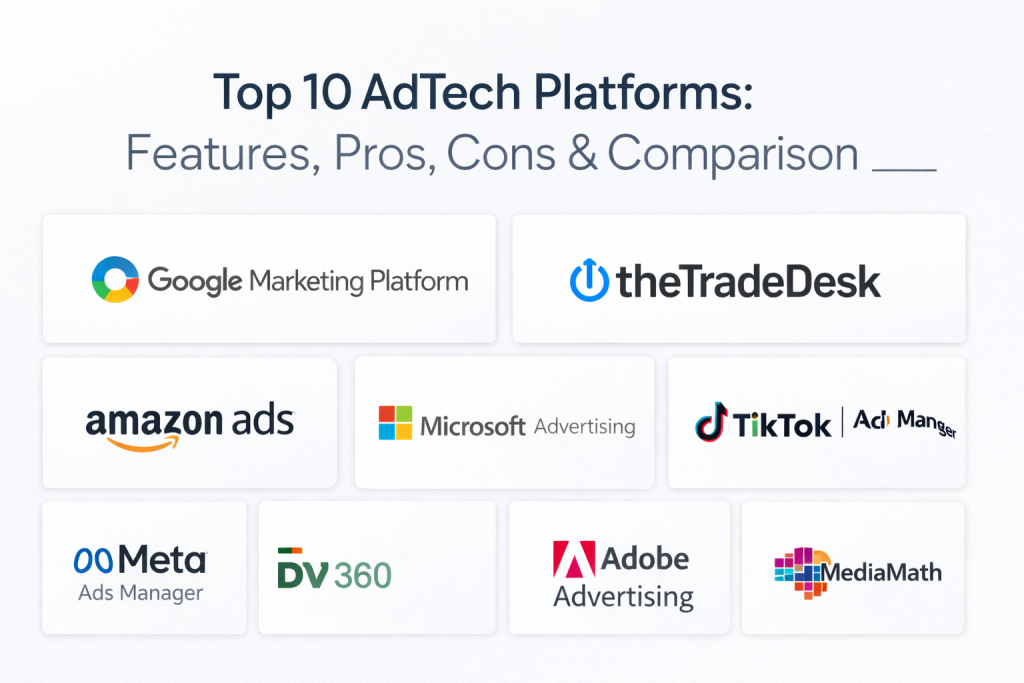
1 — Google Marketing Platform
A suite of advertising and measurement tools used by many organizations for campaign management and analytics workflows. Best for teams running multi-channel campaigns tied to Google’s ecosystem.
Key Features
- Campaign management and measurement workflows (varies by module)
- Audience activation with first-party data patterns (varies)
- Reporting and analytics capabilities (varies)
- Tagging and conversion tracking workflows (varies)
- Integration with broader advertising ecosystem (varies)
- Governance and multi-account operations (varies)
Pros
- Strong ecosystem reach and integration benefits
- Helpful for structured reporting and measurement workflows
- Works well for teams already invested in Google tools
Cons
- Complexity depends on chosen modules
- Some features may require advanced setup
- Commercial terms vary by contract
Platforms / Deployment
- Web
- Cloud
Security & Compliance
Not publicly stated.
Integrations & Ecosystem
Often used with analytics and data pipelines.
- Analytics and reporting integrations (varies)
- Data activation patterns (varies)
- API availability varies / not publicly stated
Support & Community
Large ecosystem and documentation; support levels vary.
2 — The Trade Desk
A well-known demand-side platform used for programmatic buying across display, video, audio, and connected TV inventory. Best for teams needing independent programmatic scale and control.
Key Features
- Programmatic media buying across channels (varies)
- Audience targeting and data activation workflows (varies)
- Frequency management and optimization tools (varies)
- Reporting dashboards and performance analytics (varies)
- Brand safety and supply controls (varies)
- Cross-device measurement patterns (varies)
Pros
- Strong programmatic scale and buying control
- Useful for performance and brand campaigns
- Good for advanced targeting and optimization workflows
Cons
- Learning curve for advanced setups
- Often used with agency or specialist operations
- Costs and pricing models vary
Platforms / Deployment
- Web
- Cloud
Security & Compliance
Not publicly stated.
Integrations & Ecosystem
Often integrated with measurement and data providers.
- Verification and measurement integrations (varies)
- Data partner ecosystem patterns (varies)
- API details vary / not publicly stated
Support & Community
Strong industry adoption; support varies by contract.
3 — Amazon Ads
A major advertising platform for brands selling on Amazon or targeting shoppers in Amazon’s ecosystem. Best for ecommerce and retail-focused advertisers.
Key Features
- Sponsored ads and commerce-focused formats (varies)
- Audience targeting based on shopping signals (varies)
- Retail measurement and reporting workflows (varies)
- Campaign automation features (varies)
- Brand store and creative options (varies)
- Performance reporting for product-level outcomes (varies)
Pros
- Strong intent-based audiences for ecommerce
- Direct connection to commerce outcomes (varies)
- Works well for product-led growth and catalog advertising
Cons
- Best fit when Amazon is an important sales channel
- Competitive auctions can raise costs
- Reporting and attribution depend on program type
Platforms / Deployment
- Web
- Cloud
Security & Compliance
Not publicly stated.
Integrations & Ecosystem
Often integrated into ecommerce and analytics workflows.
- Commerce reporting exports (varies)
- Integration patterns vary by stack
- API details vary / not publicly stated
Support & Community
Large ecosystem; support varies by advertiser size.
4 — Microsoft Advertising
An advertising platform used for search and audience ads, often valued for incremental reach beyond Google search and access to Microsoft-owned inventory.
Key Features
- Search advertising and keyword targeting workflows
- Audience targeting options (varies)
- Campaign automation and bidding strategies (varies)
- Reporting dashboards and conversion tracking (varies)
- Import and migration workflows from other platforms (varies)
- Multi-account and agency operations support (varies)
Pros
- Useful incremental reach and diversification
- Familiar workflow for search marketers
- Good for certain demographics and B2B segments (varies)
Cons
- Smaller volume than the largest search platform
- Some features depend on market and account type
- Performance depends on category and targeting
Platforms / Deployment
- Web
- Cloud
Security & Compliance
Not publicly stated.
Integrations & Ecosystem
Often used alongside analytics and CRM tracking setups.
- Conversion tracking integrations (varies)
- Reporting exports (varies)
- API availability varies / not publicly stated
Support & Community
Good documentation; support tiers vary.
5 — Meta Ads Manager
The core advertising platform for running ads across Meta-owned properties, often used for performance marketing, remarketing, and audience targeting.
Key Features
- Audience targeting and lookalike workflows (varies)
- Creative formats and testing support (varies)
- Conversion tracking and reporting dashboards (varies)
- Automation and budget optimization features (varies)
- Catalog and dynamic ads workflows (varies)
- Campaign structuring for multi-objective setups (varies)
Pros
- Strong reach and targeting options for many audiences
- Flexible creative testing and performance iteration
- Powerful remarketing workflows (varies)
Cons
- Measurement complexity increases with privacy changes
- Creative fatigue can happen quickly in some categories
- Performance depends on creative and landing page quality
Platforms / Deployment
- Web
- Cloud
Security & Compliance
Not publicly stated.
Integrations & Ecosystem
Often connected to ecommerce and analytics stacks.
- Conversion tracking and offline event patterns (varies)
- Ecommerce integrations (varies)
- API details vary / not publicly stated
Support & Community
Large community and documentation; support levels vary.
6 — TikTok Ads Manager
An advertising platform designed for short-form video ad campaigns, often used by consumer brands for discovery-driven acquisition and creative-led performance.
Key Features
- Short-form video ad formats and placements (varies)
- Creative testing and optimization workflows (varies)
- Audience targeting and interest-based discovery (varies)
- Conversion tracking and reporting tools (varies)
- Spark-style content amplification patterns (varies)
- Catalog and performance formats (varies)
Pros
- Strong for discovery and awareness-to-performance funnels
- Creative-driven performance potential in many categories
- Good for consumer brands and mobile-first products
Cons
- Requires frequent creative iteration for best outcomes
- Targeting and measurement vary by region and policy changes
- Performance can be volatile without strong creatives
Platforms / Deployment
- Web
- Cloud
Security & Compliance
Not publicly stated.
Integrations & Ecosystem
Often integrated into ecommerce and analytics workflows.
- Conversion tracking integrations (varies)
- Ecommerce measurement patterns (varies)
- API details vary / not publicly stated
Support & Community
Documentation is available; support tiers vary.
7 — DV360
A demand-side platform used for programmatic buying across display and video inventory with strong integration into Google’s advertising ecosystem. Best for teams managing large programmatic budgets.
Key Features
- Programmatic buying across display and video (varies)
- Audience activation workflows (varies)
- Frequency and reach management tools (varies)
- Brand safety and inventory controls (varies)
- Reporting dashboards and performance analytics (varies)
- Workflow integration with measurement tools (varies)
Pros
- Strong for programmatic operations tied to Google ecosystem
- Useful controls for inventory and brand safety (varies)
- Scales well for larger programmatic programs
Cons
- Can be complex and requires skilled operators
- Access and terms vary by market and contract
- Best value often comes at higher spend levels
Platforms / Deployment
- Web
- Cloud
Security & Compliance
Not publicly stated.
Integrations & Ecosystem
Often used with analytics and measurement workflows.
- Measurement integrations (varies)
- Reporting exports and pipelines (varies)
- API details vary / not publicly stated
Support & Community
Support depends on contract; ecosystem knowledge is broad.
8 — Adobe Advertising
An advertising solution often used by brands already invested in an Adobe marketing stack, supporting campaign execution and measurement workflows for certain programmatic and cross-channel needs.
Key Features
- Campaign management workflows (varies)
- Cross-channel reporting and measurement patterns (varies)
- Audience activation and segmentation workflows (varies)
- Creative and asset workflow alignment (varies)
- Optimization features (varies)
- Integrations with marketing stack components (varies)
Pros
- Strong fit for teams already using related marketing stack tools
- Helpful for unified marketing workflows
- Practical for brands with structured marketing operations
Cons
- Not always the simplest option for SMBs
- Features and modules vary significantly
- Commercial terms vary by contract
Platforms / Deployment
- Web
- Cloud
Security & Compliance
Not publicly stated.
Integrations & Ecosystem
Often integrated with analytics and content workflows.
- Marketing stack integrations (varies)
- Reporting exports (varies)
- API details vary / not publicly stated
Support & Community
Support is typically structured for enterprise contracts; documentation varies.
9 — MediaMath
A programmatic advertising platform historically known for DSP capabilities. Availability, product direction, and current positioning can vary, so buyers should validate current capabilities during evaluation.
Key Features
- Programmatic buying and campaign management workflows (varies)
- Audience targeting and optimization tools (varies)
- Reporting and analytics dashboards (varies)
- Brand safety and inventory controls (varies)
- Integration patterns for data activation (varies)
- Workflow automation options (varies)
Pros
- Programmatic approach that can fit certain buying strategies
- Useful reporting and optimization patterns (varies)
- Can support teams needing DSP-style workflows
Cons
- Current feature scope and availability vary
- Buyers should validate roadmap and support model
- Integration depth depends on setup
Platforms / Deployment
- Web
- Cloud
Security & Compliance
Not publicly stated.
Integrations & Ecosystem
Integrations vary by product configuration and partnerships.
- Data partner integrations (varies)
- Reporting exports (varies)
- API details vary / not publicly stated
Support & Community
Varies / Not publicly stated.
10 — Criteo
A platform often known for commerce-focused advertising and retargeting-style performance workflows. Best for ecommerce brands that want conversion-driven advertising with product-level optimization.
Key Features
- Commerce advertising and retargeting workflows (varies)
- Product catalog and dynamic creative patterns (varies)
- Audience targeting and optimization features (varies)
- Reporting for performance and commerce outcomes (varies)
- Measurement and attribution workflows (varies)
- Retail and commerce ecosystem options (varies)
Pros
- Strong fit for ecommerce and product retargeting needs
- Useful dynamic creative and catalog optimization
- Often performance-focused for commerce outcomes
Cons
- Best fit depends on business model and data readiness
- Measurement depends on tracking and privacy constraints
- Pricing and packaging vary by contract
Platforms / Deployment
- Web
- Cloud
Security & Compliance
Not publicly stated.
Integrations & Ecosystem
Often integrated into ecommerce tracking and catalog workflows.
- Catalog and feed integrations (varies)
- Reporting exports (varies)
- API details vary / not publicly stated
Support & Community
Support varies by contract and region.
Comparison Table
| Tool Name | Best For | Platform(s) Supported | Deployment | Standout Feature | Public Rating |
|---|---|---|---|---|---|
| Google Marketing Platform | Suite-based ad ops and measurement | Web | Cloud | Ecosystem integration across modules (varies) | N/A |
| The Trade Desk | Independent programmatic buying | Web | Cloud | Programmatic scale and buying controls (varies) | N/A |
| Amazon Ads | Retail media and commerce outcomes | Web | Cloud | Shopping-intent audiences (varies) | N/A |
| Microsoft Advertising | Incremental search reach | Web | Cloud | Search diversification and imports (varies) | N/A |
| Meta Ads Manager | Audience-driven social performance | Web | Cloud | Targeting and dynamic formats (varies) | N/A |
| TikTok Ads Manager | Short-form video acquisition | Web | Cloud | Creative-led discovery ads (varies) | N/A |
| DV360 | Google-aligned programmatic buying | Web | Cloud | Integration with measurement workflows (varies) | N/A |
| Adobe Advertising | Stack-aligned marketing execution | Web | Cloud | Marketing stack workflow alignment (varies) | N/A |
| MediaMath | DSP-style programmatic workflows | Web | Cloud | DSP approach (availability varies) | N/A |
| Criteo | Commerce retargeting and performance | Web | Cloud | Catalog-driven dynamic advertising (varies) | N/A |
Evaluation and Scoring
Scoring model:
- Each criterion is scored from 1 to 10 (higher is better).
- The weighted total is calculated on a 0 to 10 scale using the weights below.
- These scores are comparative estimates to support shortlisting; validate using a pilot.
Weights:
- Core features – 25%
- Ease of use – 15%
- Integrations and ecosystem – 15%
- Security and compliance – 10%
- Performance and reliability – 10%
- Support and community – 10%
- Price and value – 15%
| Tool Name | Core (25%) | Ease (15%) | Integrations (15%) | Security (10%) | Performance (10%) | Support (10%) | Value (15%) | Weighted Total (0–10) |
|---|---|---|---|---|---|---|---|---|
| Google Marketing Platform | 9 | 7 | 9 | 7 | 8 | 7 | 6 | 7.70 |
| The Trade Desk | 9 | 6 | 8 | 7 | 8 | 7 | 6 | 7.35 |
| Amazon Ads | 8 | 8 | 7 | 6 | 8 | 7 | 6 | 7.20 |
| Microsoft Advertising | 7 | 8 | 7 | 6 | 7 | 7 | 8 | 7.25 |
| Meta Ads Manager | 8 | 8 | 7 | 6 | 8 | 7 | 7 | 7.45 |
| TikTok Ads Manager | 7 | 8 | 6 | 6 | 7 | 7 | 7 | 6.95 |
| DV360 | 9 | 6 | 8 | 7 | 8 | 7 | 5 | 7.20 |
| Adobe Advertising | 8 | 6 | 8 | 7 | 7 | 7 | 5 | 6.95 |
| MediaMath | 7 | 6 | 7 | 6 | 7 | 6 | 6 | 6.45 |
| Criteo | 7 | 7 | 7 | 6 | 7 | 6 | 6 | 6.70 |
How to interpret the scores:
- Use the weighted total to shortlist, not to pick a universal winner.
- If you rely on programmatic buying, prioritize core features and integrations.
- If you are a smaller team, prioritize ease and value so execution stays fast.
- Validate reporting accuracy, attribution, and brand safety controls in real campaigns.
Which Tool Is Right for You?
Solo or Freelancer
- Choose Meta Ads Manager for flexible performance campaigns with broad reach.
- Add Microsoft Advertising for incremental search reach if search matters.
- If you focus on ecommerce catalog performance, consider Amazon Ads where it fits your channel.
SMB
- Choose Meta Ads Manager and TikTok Ads Manager for creative-driven growth.
- Add Microsoft Advertising for search diversification.
- Use Amazon Ads if you sell heavily on Amazon or want retail intent.
Mid-Market
- Add programmatic buying with The Trade Desk or DV360 if you need broader reach.
- Use Google Marketing Platform for structured measurement workflows tied to analytics.
- Combine with Criteo for commerce retargeting if catalog-based conversion is key.
Enterprise
- Use The Trade Desk or DV360 for scaled programmatic operations with governance.
- Use Google Marketing Platform for measurement and workflow structure across teams.
- Consider Adobe Advertising when the broader marketing stack integration is a priority.
Budget versus Premium
- Budget-leaning: channel-native managers like Meta Ads Manager, TikTok Ads Manager, Microsoft Advertising
- Premium: enterprise programmatic and suite ecosystems like The Trade Desk, DV360, Google Marketing Platform
Feature Depth versus Ease of Use
- Ease-first: Meta Ads Manager, Microsoft Advertising, Amazon Ads
- Depth-first: The Trade Desk, DV360, Google Marketing Platform
Integrations and Scalability
- Strong for data stack integration: Google Marketing Platform, DV360, The Trade Desk
- Strong for ecommerce intent: Amazon Ads, Criteo
- Strong for fast creative-led performance: Meta Ads Manager, TikTok Ads Manager
Security and Compliance Needs
- For large teams, validate role controls, audit trails, and identity options.
- For brand safety, confirm inventory controls, verification compatibility, and placement transparency.
Frequently Asked Questions
- What is the difference between AdTech and MarTech?
AdTech focuses on buying and delivering ads. MarTech focuses on owned channels like email, CRM, automation, and website personalization. Many teams use both. - Do I need a DSP if I already use social and search platforms?
Not always. DSPs help when you need programmatic reach across many sites, video inventory, and more advanced buying controls. - How do privacy changes affect ad performance?
They reduce tracking certainty and can impact targeting. Many platforms rely more on modeled reporting, aggregated signals, and first-party data. - What should I do first before scaling spend?
Make sure conversion tracking is correct, your creative testing process is steady, and your landing pages convert well. Bad measurement causes bad optimization. - How do I measure incrementality?
Use controlled experiments where possible, compare holdouts, and track lift. Not all platforms offer the same testing capabilities. - What is brand safety in programmatic advertising?
It’s control over where your ads appear and avoiding unsafe or irrelevant content. Buyers should validate inventory controls and verification workflows. - How do retail media platforms differ from DSPs?
Retail media uses shopper intent and marketplace signals. DSPs buy broader inventory across the web. Many advertisers use both. - Why do creatives matter more now?
As targeting becomes harder, creatives become a major lever. Strong messaging, short-form video, and fast iteration often drive results. - Can small teams run enterprise platforms effectively?
Sometimes, but complexity can slow execution. Smaller teams often do better with simpler channel-native tools until spend justifies advanced systems. - How do I run a safe pilot?
Start with a small budget, define one clear goal, test multiple creatives, validate reporting accuracy, and compare outcomes across two or three platforms.
Conclusion
AdTech platforms help you reach audiences, manage budgets, and measure results across a complex media landscape. The best platform depends on your goals: retail intent, social acquisition, search capture, or scaled programmatic buying with governance. A practical next step is to shortlist two or three platforms aligned with your channel strategy, run a controlled pilot with reliable conversion tracking, validate reporting and brand safety controls, and then scale the platform that gives you consistent outcomes with manageable operational effort. AdTech platforms help streamline ad campaigns, optimize spend, and provide measurable results across various channels. The best choice depends on your focus, whether it’s programmatic buying, social reach, or retail intent. Start with a small pilot, validate tracking, and scale the platform that delivers consistent performance.

Best Cardiac Hospitals Near You
Discover top heart hospitals, cardiology centers & cardiac care services by city.
Advanced Heart Care • Trusted Hospitals • Expert Teams
View Best Hospitals