Introduction
Affiliate marketing tools help businesses create and manage partner programs where affiliates promote your product and earn commission for sales or qualified leads. In simple words: these tools track referrals, calculate commissions, manage payouts, and give you reporting to understand which partners actually drive revenue.
These tools matter because affiliate marketing has evolved into a performance channel that can scale efficiently—when it’s managed well. Without the right tooling, teams struggle with tracking accuracy, fraud, payout disputes, partner onboarding delays, and unclear ROI. The best affiliate platforms combine reliable attribution, flexible commission rules, partner portals, payment workflows, and clean reporting so you can grow a partner ecosystem without chaos.
Common real-world use cases:
- Launching an affiliate program for an ecommerce brand with coupon and link tracking
- Running B2B referral partnerships that pay per qualified lead or closed deal
- Building an always-on partner ecosystem with tiered commissions and bonuses
- Managing influencer affiliates using promo codes and conversion reporting
- Preventing fraud and ensuring accurate payouts across thousands of partners
What buyers should evaluate before choosing:
- Tracking accuracy and attribution model flexibility (first click, last click, multi-touch rules vary)
- Partner onboarding experience (approval flows, portals, contracts, tax forms vary)
- Commission rules (tiers, bonuses, recurring revenue commissions, caps, exclusions)
- Fraud prevention and compliance controls (self-referrals, coupon abuse, duplicate orders)
- Payout workflows (batch payments, payment method options, minimum thresholds)
- Reporting depth (partner performance, cohort retention, LTV, refunds, chargebacks)
- Integrations (ecommerce, subscriptions, CRM, analytics, billing systems)
- Partner discovery marketplace access (where applicable)
- Team workflows (roles, approvals, audit trails, account structures)
- Pricing clarity (platform fees, usage limits, add-ons, payout fees)
Best for: ecommerce brands, SaaS companies, subscription businesses, marketplaces, and agencies that want a measurable performance channel through partners.
Not ideal for: businesses with low margins or weak tracking infrastructure, teams that cannot handle partner support, or brands that only want one or two informal referrals.
Key Trends in Affiliate Marketing Tools
- More focus on partner ecosystems: affiliates, influencers, agencies, and tech partners managed in one place.
- Stronger fraud controls: coupon abuse and self-referral prevention become a must-have, not a bonus.
- Better LTV and subscription tracking: more programs pay based on recurring revenue and retention.
- More flexible attribution: teams want rule-based attribution across devices and channels (capability varies).
- Integration-led decision-making: tools that connect cleanly to billing, ecommerce, and analytics win.
- More automation: partner onboarding, approvals, and payout workflows are increasingly automated.
- Better partner experience: portals, assets, training, and communication workflows improve activation.
- Shift to measurable incrementality: brands want to know if affiliates create new demand or just claim existing conversions.
- Global payouts and compliance: cross-border payments and tax compliance workflows become more important.
How These Tools Were Selected
- Chosen for strong recognition and widespread adoption in affiliate and partnership programs
- Balanced mix of enterprise platforms and SMB-friendly affiliate tools
- Considered tracking reliability, commission flexibility, payout workflows, and reporting depth
- Looked for practical partner onboarding features and partner portal usability
- Considered integration patterns for ecommerce and SaaS subscription stacks
- Avoided guessing certifications, ratings, and pricing details; used “Not publicly stated” or “Varies / N/A” where needed
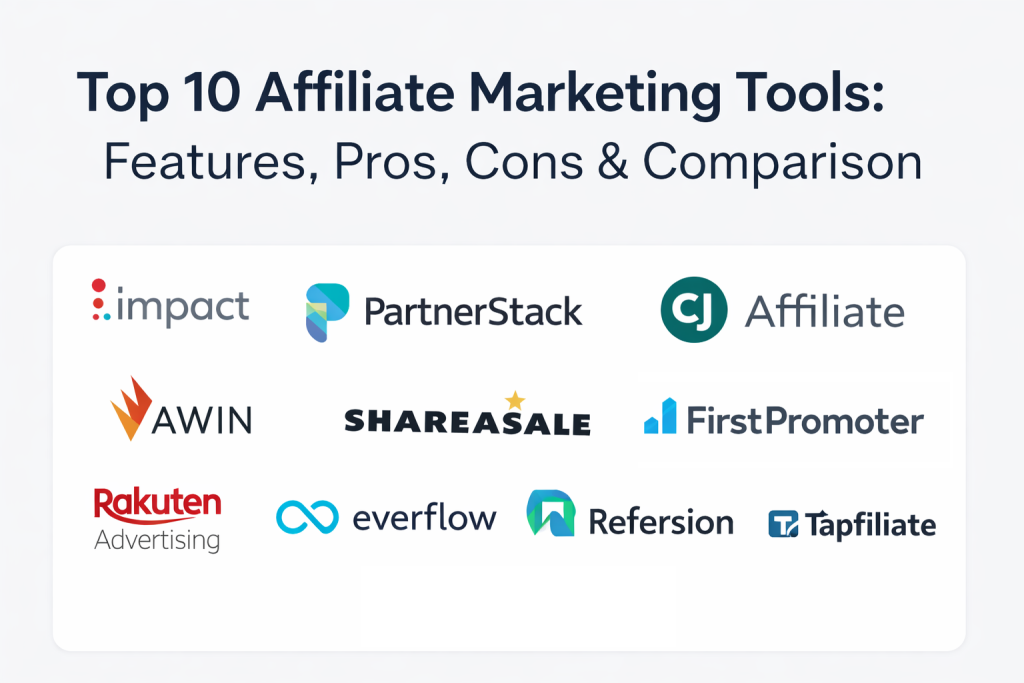
Top 10 Tools
1 — Impact
A partnership platform used by many teams for affiliate, influencer, and partner program management with strong tracking and operational workflows. Best for performance-driven programs that need structure.
Key Features
- Partner onboarding workflows with portals (varies)
- Tracking and attribution options (varies)
- Flexible commission structures, bonuses, and rules (varies)
- Payout operations and partner payments workflows (varies)
- Reporting for partner performance and ROI (varies)
- Workflow automation for partner management (varies)
Pros
- Strong operational control for performance partnerships
- Useful for scaling complex commission programs
- Works well for structured partner ecosystems
Cons
- Can be complex for small teams
- Setup requires careful attribution and rules design
- Commercial terms vary by contract
Platforms / Deployment
- Web
- Cloud
Security & Compliance
Not publicly stated. Confirm role controls and auditability during evaluation.
Integrations & Ecosystem
Often connects with ecommerce, analytics, and billing systems.
- Ecommerce and subscription integrations (varies)
- Reporting exports and analytics workflows (varies)
- API details vary / not publicly stated
Support & Community
Structured onboarding is common; support tiers vary by contract.
2 — PartnerStack
A platform often used for SaaS partnerships and referral programs, supporting partner onboarding, tracking, and payouts. Best for B2B and SaaS ecosystems.
Key Features
- Partner onboarding and program management workflows (varies)
- Referral and affiliate tracking for SaaS (varies)
- Commission and payout management workflows (varies)
- Partner portals with assets and links (varies)
- Reporting for pipeline and partner performance (varies)
- Automation for partner recruitment and activation (varies)
Pros
- Strong for SaaS and B2B partner ecosystems
- Useful partner experience and onboarding flows
- Practical for scaling referral-style programs
Cons
- Not focused on ecommerce coupon-heavy programs
- Pricing and packaging vary by contract
- Tracking setup depends on your billing and CRM stack
Platforms / Deployment
- Web
- Cloud
Security & Compliance
Not publicly stated.
Integrations & Ecosystem
Commonly integrated with CRM and subscription billing workflows.
- CRM and subscription integrations (varies)
- Analytics and reporting exports (varies)
- API details vary / not publicly stated
Support & Community
Support varies by plan; community strength depends on market.
3 — CJ Affiliate
A large affiliate network and platform often used by brands to access affiliate partners and manage programs with network-style operations.
Key Features
- Access to an affiliate network marketplace (varies)
- Program management workflows and tracking (varies)
- Commission structures and payout operations (varies)
- Reporting dashboards for network partner performance (varies)
- Fraud and compliance controls (varies)
- Partner discovery and recruitment workflows (varies)
Pros
- Strong network access for partner discovery
- Useful for brands needing scale and recruitment support
- Structured reporting and network operations
Cons
- Network fees and terms vary by contract
- Less customizable than pure software-only platforms
- Best fit depends on your category and market
Platforms / Deployment
- Web
- Cloud
Security & Compliance
Not publicly stated.
Integrations & Ecosystem
Often integrates into ecommerce tracking and reporting stacks.
- Tracking integrations (varies)
- Reporting exports (varies)
- API availability varies / not publicly stated
Support & Community
Network-style support is common; experience varies by contract.
4 — Awin
An affiliate network and platform that supports partner discovery and program operations across many markets. Best for brands that want access to a broad affiliate ecosystem.
Key Features
- Affiliate marketplace and partner discovery (varies)
- Tracking and attribution workflows (varies)
- Commission and payout operations (varies)
- Reporting dashboards for program performance (varies)
- Compliance workflows and partner approval controls (varies)
- Multi-market operations support (varies)
Pros
- Strong network reach across regions
- Useful for recruiting affiliates at scale
- Mature program management workflows
Cons
- Network structure can be less flexible than standalone tools
- Fees and terms vary by market and contract
- Reporting depth depends on program setup
Platforms / Deployment
- Web
- Cloud
Security & Compliance
Not publicly stated.
Integrations & Ecosystem
Common integration patterns focus on ecommerce tracking and reporting.
- Ecommerce platform tracking (varies)
- Reporting exports and partner insights (varies)
- API details vary / not publicly stated
Support & Community
Strong ecosystem presence; support varies by region.
5 — ShareASale
A well-known affiliate network often used by ecommerce brands for affiliate recruitment and tracking. Best for SMB to mid-market ecommerce programs looking for network access.
Key Features
- Affiliate network access and partner recruitment (varies)
- Tracking links and attribution workflows (varies)
- Commission settings and payout operations (varies)
- Reporting dashboards for affiliate performance (varies)
- Creative assets distribution for affiliates (varies)
- Program compliance and approvals (varies)
Pros
- Strong for ecommerce affiliate recruitment
- Familiar platform for many affiliates
- Practical reporting and program operations
Cons
- Network fees and terms vary
- Less flexible for complex SaaS attribution needs
- Custom workflows may be limited compared to software-first tools
Platforms / Deployment
- Web
- Cloud
Security & Compliance
Not publicly stated.
Integrations & Ecosystem
Often used with ecommerce stores and tracking workflows.
- Ecommerce integrations (varies)
- Reporting exports (varies)
- API details vary / not publicly stated
Support & Community
Network-style support; community presence is strong among affiliates.
6 — Rakuten Advertising
A network and affiliate platform used by established brands for partner programs, often with strong emphasis on commerce partnerships and network operations.
Key Features
- Partner network access and discovery workflows (varies)
- Tracking and attribution operations (varies)
- Commission management and payouts (varies)
- Reporting dashboards for performance and insights (varies)
- Brand-safe partner approvals and compliance controls (varies)
- Multi-market program operations (varies)
Pros
- Strong for larger brands needing network access and structure
- Useful for multi-market affiliate operations
- Mature program management approach
Cons
- Fees and contracts vary significantly
- Less suitable for very small budgets
- Flexibility depends on program structure
Platforms / Deployment
- Web
- Cloud
Security & Compliance
Not publicly stated.
Integrations & Ecosystem
Often integrated into ecommerce and reporting stacks.
- Tracking integrations (varies)
- Reporting exports (varies)
- API availability varies / not publicly stated
Support & Community
Enterprise-style support; varies by contract.
7 — Everflow
A performance marketing tracking platform often used for affiliate and partner tracking with strong attribution controls and reporting flexibility. Best for teams who want tracking power and customization.
Key Features
- Flexible tracking and attribution rules (varies)
- Fraud prevention and traffic quality controls (varies)
- Partner management and offer setup workflows (varies)
- Reporting dashboards and conversion analytics (varies)
- Multi-offer, multi-partner program structure support
- Integrations for tracking data flow (varies)
Pros
- Strong tracking controls and reporting flexibility
- Good for performance marketers managing many partners
- Useful fraud and quality monitoring patterns
Cons
- Requires careful setup for clean data
- Partner experience depends on configuration
- Pricing varies by usage and plan
Platforms / Deployment
- Web
- Cloud
Security & Compliance
Not publicly stated.
Integrations & Ecosystem
Often connects into analytics and ad performance workflows.
- Tracking and analytics integrations (varies)
- Export workflows to BI (varies)
- API details vary / not publicly stated
Support & Community
Support reputation varies; documentation typically available.
8 — Refersion
An affiliate and ambassador platform often used by ecommerce brands to manage affiliates, track referrals, and handle commissions with a simpler setup than enterprise tools.
Key Features
- Affiliate and ambassador program management workflows (varies)
- Referral tracking links and discount code support (varies)
- Commission rules and payout operations (varies)
- Partner portal for links and performance (varies)
- Reporting for sales and partner contribution (varies)
- Ecommerce integration patterns (varies)
Pros
- Good for ecommerce brands starting affiliate programs
- Practical partner portal for affiliates
- Faster onboarding than enterprise platforms
Cons
- Advanced attribution models may be limited
- Enterprise governance features may be limited
- Depth of integrations varies by plan
Platforms / Deployment
- Web
- Cloud
Security & Compliance
Not publicly stated.
Integrations & Ecosystem
Commonly used with ecommerce systems and marketing workflows.
- Ecommerce integrations (varies)
- Reporting exports (varies)
- API availability varies / not publicly stated
Support & Community
SMB-friendly; support tiers vary by plan.
9 — Tapfiliate
An affiliate tracking and management tool often chosen by SMBs and SaaS businesses for flexible commissions, partner portals, and manageable setup.
Key Features
- Partner portals and affiliate onboarding workflows (varies)
- Referral tracking links and promo code options (varies)
- Commission rules including tiers and bonuses (varies)
- Reporting dashboards for affiliate performance (varies)
- Integration options with ecommerce and SaaS stacks (varies)
- Automation workflows for payouts and approvals (varies)
Pros
- Good balance of features and usability for SMBs
- Flexible commission configuration for many use cases
- Useful for SaaS and ecommerce programs
Cons
- Enterprise governance may be limited
- Advanced fraud prevention varies by plan
- Complex attribution needs may require additional tooling
Platforms / Deployment
- Web
- Cloud
Security & Compliance
Not publicly stated.
Integrations & Ecosystem
Often integrated into ecommerce and billing workflows.
- Ecommerce integrations (varies)
- Subscription tracking patterns (varies)
- API details vary / not publicly stated
Support & Community
Good onboarding resources; support tiers vary.
10 — FirstPromoter
A referral and affiliate tool commonly used by SaaS companies for referral programs, partner links, and recurring commission tracking workflows (capability varies).
Key Features
- Referral and affiliate program management workflows (varies)
- Tracking links and affiliate portals (varies)
- Commission rules for recurring revenue (varies)
- Payout workflows and approvals (varies)
- Reporting dashboards for partner performance (varies)
- Integrations with subscription and billing stacks (varies)
Pros
- Strong for SaaS referral programs and recurring commissions
- Simple setup for many subscription businesses
- Good partner portal experience for promoters
Cons
- Ecommerce coupon-heavy needs may be limited
- Advanced attribution and fraud controls may be limited
- Integration depth varies by plan
Platforms / Deployment
- Web
- Cloud
Security & Compliance
Not publicly stated.
Integrations & Ecosystem
Often connects with billing and subscription stacks for recurring commissions.
- Subscription billing integrations (varies)
- Reporting exports (varies)
- API availability varies / not publicly stated
Support & Community
SaaS-focused onboarding; support tiers vary.
Comparison Table
| Tool Name | Best For | Platform(s) Supported | Deployment | Standout Feature | Public Rating |
|---|---|---|---|---|---|
| Impact | Enterprise partner programs and payouts | Web | Cloud | Partnership ops with tracking and payouts (varies) | N/A |
| PartnerStack | SaaS partner ecosystems and referrals | Web | Cloud | SaaS-focused onboarding and partner ops (varies) | N/A |
| CJ Affiliate | Affiliate network access at scale | Web | Cloud | Large affiliate marketplace (varies) | N/A |
| Awin | Multi-market affiliate recruitment | Web | Cloud | Regional network reach (varies) | N/A |
| ShareASale | Ecommerce affiliate recruitment | Web | Cloud | SMB-friendly affiliate network access (varies) | N/A |
| Rakuten Advertising | Established brand affiliate operations | Web | Cloud | Commerce partnership network (varies) | N/A |
| Everflow | Tracking-focused performance marketing | Web | Cloud | Flexible tracking and fraud controls (varies) | N/A |
| Refersion | Ecommerce affiliate and ambassador programs | Web | Cloud | Simple onboarding and partner portal (varies) | N/A |
| Tapfiliate | SMB affiliate tracking with flexible rules | Web | Cloud | Configurable commissions and portals (varies) | N/A |
| FirstPromoter | SaaS referrals and recurring commissions | Web | Cloud | Subscription-friendly referral workflows (varies) | N/A |
Evaluation and Scoring
Scoring model:
- Each criterion is scored from 1 to 10 (higher is better).
- The weighted total is calculated on a 0 to 10 scale using the weights below.
- These scores are comparative estimates to support shortlisting; validate with a pilot.
Weights:
- Core features – 25%
- Ease of use – 15%
- Integrations and ecosystem – 15%
- Security and compliance – 10%
- Performance and reliability – 10%
- Support and community – 10%
- Price and value – 15%
| Tool Name | Core (25%) | Ease (15%) | Integrations (15%) | Security (10%) | Performance (10%) | Support (10%) | Value (15%) | Weighted Total (0–10) |
|---|---|---|---|---|---|---|---|---|
| Impact | 9 | 7 | 8 | 8 | 8 | 8 | 5 | 7.70 |
| PartnerStack | 8 | 7 | 8 | 7 | 7 | 7 | 6 | 7.20 |
| CJ Affiliate | 8 | 7 | 7 | 7 | 8 | 7 | 5 | 6.95 |
| Awin | 8 | 7 | 7 | 7 | 8 | 7 | 5 | 6.95 |
| ShareASale | 7 | 8 | 6 | 6 | 7 | 7 | 6 | 6.75 |
| Rakuten Advertising | 8 | 7 | 7 | 7 | 8 | 7 | 5 | 6.95 |
| Everflow | 8 | 7 | 7 | 7 | 8 | 7 | 6 | 7.10 |
| Refersion | 7 | 8 | 6 | 6 | 7 | 7 | 7 | 6.90 |
| Tapfiliate | 7 | 8 | 6 | 6 | 7 | 7 | 7 | 6.90 |
| FirstPromoter | 6 | 8 | 6 | 6 | 7 | 6 | 8 | 6.70 |
How to interpret the scores:
- Use the weighted total to shortlist, not to pick a universal winner.
- If accurate attribution is critical, prioritize core features and integrations.
- If you’re early-stage, prioritize ease and value so you can launch fast.
- Validate fraud controls, refund handling, and payout accuracy in your pilot.
Which Tool Is Right for You?
Solo or Freelancer
- Choose Tapfiliate if you want an accessible tool to manage a small affiliate program with flexible commissions.
- Choose FirstPromoter if you run a SaaS referral program and need recurring commissions.
- If you mostly want performance partner tracking, Everflow can be a good fit.
SMB
- Choose Refersion for ecommerce affiliate and ambassador programs with a simpler setup.
- Choose ShareASale if you want network access for affiliate recruitment (network terms vary).
- Choose Tapfiliate for flexible commissions with manageable complexity.
Mid-Market
- Choose Everflow if tracking control and performance reporting are priorities.
- Choose PartnerStack for B2B and SaaS partner ecosystems.
- Choose Impact if you need more structured partner operations and payout workflows.
Enterprise
- Choose Impact for large-scale partner ecosystems and operational control.
- Choose CJ Affiliate or Awin if network recruitment and scale are key (contract terms vary).
- Choose Rakuten Advertising for established commerce partnership programs in broader markets.
Budget versus Premium
- Budget-leaning: Tapfiliate, FirstPromoter, Refersion
- Premium and enterprise: Impact (and many network-led programs depending on contract)
Feature Depth versus Ease of Use
- Ease-first: Refersion, Tapfiliate, FirstPromoter
- Depth-first: Impact, Everflow
- Network-first: CJ Affiliate, Awin, ShareASale, Rakuten Advertising
Integrations and Scalability
- Strong for SaaS ecosystems: PartnerStack, FirstPromoter
- Strong for tracking and performance operations: Everflow
- Strong for large multi-partner governance: Impact
Security and Compliance Needs
- If you require strict governance, validate RBAC depth, auditability, and identity features in writing.
- If you handle cross-border payments, confirm payout workflows and compliance handling.
Frequently Asked Questions
- What is the difference between affiliate marketing and partnerships?
Affiliate programs typically pay for tracked actions like sales or leads. Partnerships can include co-marketing, reselling, integrations, and strategic deals with broader terms. - How do affiliate tools track referrals?
Most use tracked links, cookies, and conversion events. Some also support promo codes and server-side tracking patterns, depending on the tool and setup. - What is the most common affiliate fraud?
Self-referrals, coupon abuse, and fake leads are common. Good tools help detect suspicious patterns and enforce validation rules. - Should I pay commission on discounted or refunded orders?
Usually you should define rules for refunds and exclusions. Many programs only pay on net revenue after returns, but rules vary by business. - Can SaaS companies pay recurring commissions?
Yes. Many tools support recurring commissions, but setup depends on your billing system and integration method. - Do I need an affiliate network or just software?
Networks help with partner discovery but add fees and constraints. Software-only tools give more control but require you to recruit partners yourself. - How long does it take to launch an affiliate program?
It varies. A simple program can launch quickly, but clean tracking, commission rules, and partner onboarding workflows should be tested before scaling. - What should I measure besides conversions?
Track partner activation rate, conversion rate by partner type, refund rates, and long-term value of affiliate-acquired customers. - How do I keep affiliates motivated?
Provide clear assets, fast approval, reliable payouts, performance bonuses, and consistent communication. Partner experience matters as much as commission. - How do I run a safe pilot?
Shortlist two or three tools, onboard a small group of partners, test tracking accuracy, validate payout rules, and scale only after results are stable.
Conclusion
Affiliate marketing tools help you scale partner-driven growth with accurate tracking, clear commissions, and reliable payouts. The best platform depends on your business model: ecommerce network recruitment, SaaS referrals with recurring commissions, or performance marketing with deep attribution controls. A practical next step is to shortlist two or three tools, run a pilot with a small partner group, validate tracking accuracy and refund handling, confirm payout workflows, and then expand once your program is stable and easy to operate week after week. Affiliate marketing tools help you scale partner-driven growth with accurate tracking, clear commissions, and reliable payouts. The best platform depends on your business model: ecommerce network recruitment, SaaS referrals with recurring commissions, or performance marketing with deep attribution controls.

Best Cardiac Hospitals Near You
Discover top heart hospitals, cardiology centers & cardiac care services by city.
Advanced Heart Care • Trusted Hospitals • Expert Teams
View Best Hospitals