Introduction
AI agent platforms help teams build, run, and manage AI systems that can plan tasks, use tools, reason through steps, and complete multi-step workflows with limited human input. In simple terms, these platforms go beyond simple chat responses and provide the building blocks for tool use, orchestration, memory, monitoring, and workflow execution.
These platforms are now important across customer support, internal automation, software delivery, operations, analytics, and enterprise workflow modernization. Choosing the right platform is not only about model quality. Teams also need to evaluate orchestration depth, tool integration, observability, governance, developer experience, and production reliability. Some platforms are best for developers building custom agent systems, while others are stronger for enterprise business teams and low-code automation.
Common use cases include:
- Customer support and service automation
- Internal workflow automation and approvals
- Multi-step research and analysis agents
- IT and developer productivity assistants
- Knowledge retrieval and enterprise search agents
- Agent orchestration for business processes and copilots
What buyers should evaluate before selecting a platform:
- Agent orchestration and workflow control
- Tool integration and external system connectivity
- Memory and context management
- Observability, tracing, and debugging support
- Human-in-the-loop control options
- Security and governance controls
- SDK and developer experience
- Low-code or business-user accessibility
- Deployment flexibility and scalability
- Cost predictability and operational fit
Best for: developers, AI engineers, platform teams, enterprise automation teams, and organizations building repeatable AI-driven workflows.
Not ideal for: teams that only need simple chatbot responses without tool orchestration, or teams with very small one-off automation needs that can be handled by basic scripting.
Key Trends in AI Agent Platforms
- Platforms are moving from simple prompt chaining to stateful workflow orchestration and long-running task execution.
- Multi-agent patterns are becoming more common, especially for planning, tool use, and specialist-role collaboration.
- Observability and tracing are now major buying criteria because teams need to debug agent behavior in production.
- Human approval checkpoints are increasingly built into agent workflows for risk-sensitive tasks.
- Enterprise buyers want stronger governance, permissions, and policy controls before broad rollout.
- Developer-first frameworks and enterprise low-code platforms are both growing, but they serve very different teams.
- Tool and system integration depth is becoming more important than headline demo quality.
- Teams are standardizing on internal platform layers for agents instead of building one-off agent projects.
- Memory, session state, and workflow durability are becoming central for complex business automation.
- Cost and latency management are receiving more attention as agent usage scales across departments.
How We Selected These Tools (Methodology)
- Chose widely recognized AI agent platforms and frameworks with strong developer or enterprise adoption visibility.
- Included a mix of developer-first frameworks, enterprise agent builders, and business workflow platforms.
- Prioritized tools that support real production needs such as orchestration, tool use, and observability.
- Considered fit across solo developers, startups, mid-market teams, and enterprise organizations.
- Evaluated workflow control, multi-agent support, and integration potential.
- Considered developer experience, extensibility, and operational maintainability.
- Included both code-centric and low-code business-friendly options.
- Avoided guessing on public ratings, certifications, and compliance claims.
- Focused on practical buyer concerns such as reliability, governance, and workflow fit.
- Used comparative scoring to support shortlisting by scenario and team maturity.
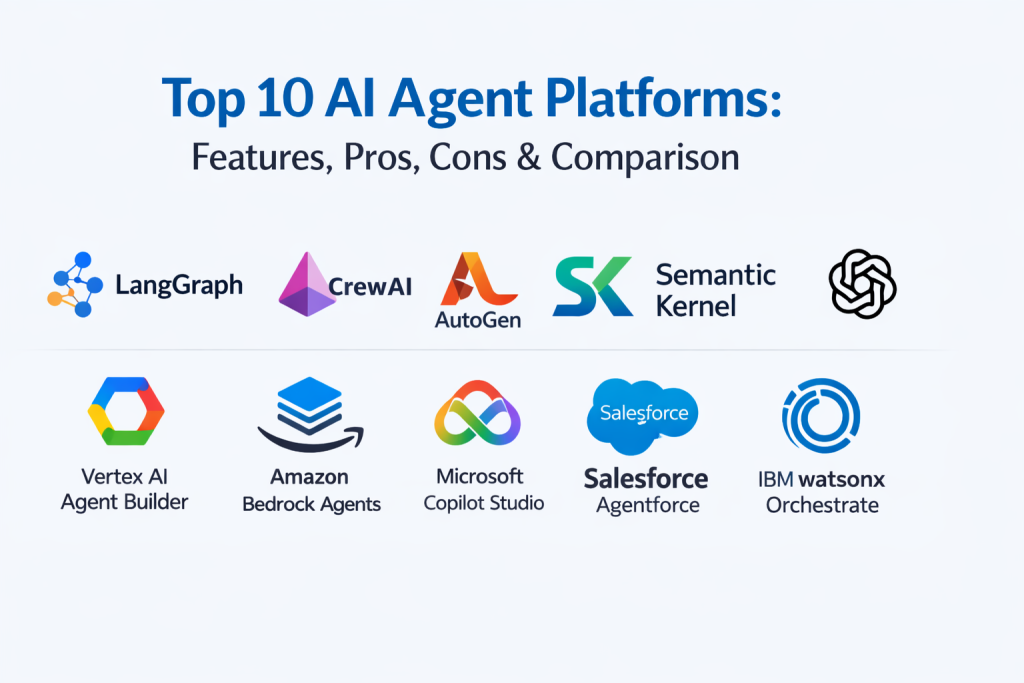
Top 10 AI Agent Platforms
1. LangGraph
LangGraph is a developer-first platform for building stateful, graph-based agent workflows. It is often chosen by teams that need explicit control over orchestration, branching logic, and multi-step agent execution in production applications.
Key Features
- Graph-based orchestration for agent workflows
- Stateful execution and workflow control
- Multi-step and multi-agent workflow design support
- Tool-calling and integration-friendly architecture
- Strong fit for complex agent pipelines
- Developer-centric control over execution paths
- Useful for production-oriented custom agent systems
Pros
- Excellent control for complex and stateful agent workflows
- Strong fit for engineering teams building custom agent systems
- Good for production scenarios requiring explicit orchestration logic
Cons
- Learning curve can be higher than simpler agent tools
- Requires engineering effort and architecture planning
- Not ideal for non-technical teams needing low-code setup
Platforms / Deployment
- Python / Developer Framework
- Self-hosted / Cloud (implementation dependent)
Security and Compliance
- Varies / N/A
Integrations and Ecosystem
LangGraph is often used as a core orchestration layer in custom AI applications where teams need control over agent state, tools, and workflow branching.
- Tool integration workflows
- Custom app backend compatibility
- Agent orchestration with explicit control paths
- Strong fit for engineering-managed deployments
Support and Community
Strong developer interest and growing ecosystem visibility. Community patterns and examples are widely discussed in agent engineering circles.
2. CrewAI
CrewAI is an agent platform focused on multi-agent collaboration patterns and role-based task execution. It is often selected by teams experimenting with coordinated agent workflows where different agents handle specialized tasks.
Key Features
- Multi-agent collaboration workflows
- Role-based agent design patterns
- Task delegation and sequential execution support
- Developer-friendly agent composition workflows
- Useful for process-style automation use cases
- Extensible tool-use patterns for agents
- Rapid experimentation with agent teams
Pros
- Strong for multi-agent teamwork and role-based automation
- Good for teams exploring collaborative agent workflows
- Easy to understand conceptually for process-driven use cases
Cons
- Production hardening needs careful engineering validation
- Complex enterprise governance needs may require companion systems
- Workflow reliability should be tested on real tasks
Platforms / Deployment
- Python / Developer Framework
- Self-hosted / Cloud (implementation dependent)
Security and Compliance
- Varies / N/A
Integrations and Ecosystem
CrewAI is often used for collaborative agent experimentation and task orchestration, especially in workflows where agent specialization is useful.
- Multi-agent task orchestration
- Tool integration support
- Custom automation workflow compatibility
- Developer-managed deployment patterns
Support and Community
Strong visibility among developers exploring agentic systems. Community examples are common for multi-agent task workflows.
3. AutoGen
AutoGen is a developer platform for building conversational and multi-agent systems with structured interaction patterns. It is commonly evaluated by engineering teams building advanced agent workflows and autonomous collaboration scenarios.
Key Features
- Multi-agent conversation and coordination workflows
- Conversational orchestration for task-solving systems
- Tool use and agent collaboration support
- Flexible agent role design and message routing patterns
- Useful for research and advanced automation prototypes
- Strong support for agent interaction experimentation
- Developer-centric framework design
Pros
- Strong for advanced multi-agent and conversational workflows
- Good flexibility for research and engineering teams
- Useful for building complex agent interaction systems
Cons
- Can require more engineering effort than simpler tools
- Production deployment patterns should be carefully designed
- Not a low-code platform for business users
Platforms / Deployment
- Python / Developer Framework
- Self-hosted / Cloud (implementation dependent)
Security and Compliance
- Varies / N/A
Integrations and Ecosystem
AutoGen is commonly used by developers building sophisticated agent collaboration patterns, often as part of larger custom automation systems.
- Multi-agent interaction workflows
- Tool-use and orchestration support
- Research and production prototype compatibility
- Developer-managed system integration
Support and Community
Strong recognition in agent engineering discussions and research-oriented development communities. Community examples are widely shared.
4. Semantic Kernel
Semantic Kernel is a developer framework for building AI applications and agent-style workflows with orchestration, plugins, and enterprise-friendly integration patterns. It is often chosen by teams that want structured AI workflow development with strong engineering controls.
Key Features
- AI workflow orchestration and plugin architecture
- Tool and function integration patterns
- Agent-style development support
- Strong fit for enterprise application integration
- Multi-step workflow composition for automation
- Developer-friendly abstractions for AI services
- Useful for structured business automation scenarios
Pros
- Strong enterprise integration and engineering structure
- Good for organizations building governed AI workflows
- Useful plugin approach for connecting tools and services
Cons
- Requires engineering effort and architecture planning
- Team fit depends on existing development stack and skills
- Some teams may prefer more agent-native workflow abstractions
Platforms / Deployment
- Developer Framework / SDK
- Self-hosted / Cloud (implementation dependent)
Security and Compliance
- Varies / N/A
Integrations and Ecosystem
Semantic Kernel is often used as an enterprise-friendly foundation for AI automation and agent workflows connected to internal systems and services.
- Plugin and tool integration support
- Enterprise backend compatibility
- Structured workflow orchestration patterns
- Developer-managed deployment flexibility
Support and Community
Strong visibility in enterprise AI engineering circles and growing ecosystem usage. Documentation and developer resources are actively used by platform teams.
5. OpenAI Agents SDK
OpenAI Agents SDK is a developer toolkit for building agent-style workflows with tools, structured execution, and application integration patterns. It is often selected by teams wanting a modern developer experience for building agentic applications.
Key Features
- Agent workflow development with developer-friendly SDK patterns
- Tool integration and task execution support
- Structured agent interactions for application workflows
- Useful for custom agent applications and automation
- Support for iterative agent behavior design
- Flexible integration into backend systems
- Strong fit for modern agent engineering workflows
Pros
- Good developer experience for agent application building
- Strong fit for teams building custom product and internal agents
- Useful for structured tool-use workflows
Cons
- Production governance and monitoring setup still require architecture work
- Teams should validate workflow reliability on complex tasks
- Business users may need a separate interface layer
Platforms / Deployment
- Developer SDK / API workflows
- Cloud (with custom app deployment options)
Security and Compliance
- Not publicly stated
Integrations and Ecosystem
OpenAI Agents SDK is often used as a developer foundation for custom agent applications, internal assistants, and orchestrated workflow systems.
- SDK-based agent development workflows
- Tool and backend integration support
- Custom app and service compatibility
- Useful for engineering-led agent platforms
Support and Community
Strong developer attention and rapidly growing usage patterns in agent engineering workflows. Community experimentation is active.
6. Vertex AI Agent Builder
Vertex AI Agent Builder is an enterprise platform for building and managing AI agents with integration into cloud services and enterprise operations. It is often evaluated by teams that want production-oriented agent development with cloud-native deployment workflows.
Key Features
- Agent building and deployment workflows
- Enterprise integration with cloud services and data systems
- Tool and connector support for business automation
- Observability and operational management support
- Developer and platform-team workflow compatibility
- Scalable deployment options for enterprise use
- Useful for production agent rollout and governance programs
Pros
- Strong enterprise and cloud-platform fit
- Useful for production deployment and operational management
- Good option for teams standardizing agents on a cloud platform
Cons
- Best value depends on broader cloud ecosystem alignment
- Teams should validate cost and operations fit at scale
- Developer experience should be tested against internal standards
Platforms / Deployment
- Web / Developer Tools / Cloud Platform
- Cloud
Security and Compliance
- Not publicly stated
Integrations and Ecosystem
Vertex AI Agent Builder is often adopted as part of a broader enterprise cloud strategy for agent development, testing, and deployment.
- Cloud-native integration support
- Business system and data workflow compatibility
- Operational management and observability patterns
- Enterprise platform-team deployment workflows
Support and Community
Strong enterprise visibility and growing interest among platform engineering teams. Vendor support and cloud operations alignment are important evaluation factors.
7. Amazon Bedrock Agents
Amazon Bedrock Agents is an enterprise agent platform for building agent-driven workflows connected to enterprise systems and cloud services. It is commonly evaluated by teams building business automation and customer-facing agents in cloud environments.
Key Features
- Agent workflow orchestration for business tasks
- Integration with cloud services and enterprise systems
- Tool and action execution support
- Useful for customer and internal automation scenarios
- Developer and enterprise platform workflow support
- Scalable deployment for cloud-based operations
- Structured agent behavior for repeatable processes
Pros
- Strong fit for cloud-native enterprise automation
- Useful for integrating agents into business workflows
- Good option for organizations standardizing on cloud services
Cons
- Best value depends on ecosystem alignment and cloud strategy
- Teams should test operational complexity and cost patterns
- Workflow depth should be validated for advanced multi-agent use cases
Platforms / Deployment
- Cloud Platform / Developer Tools
- Cloud
Security and Compliance
- Not publicly stated
Integrations and Ecosystem
Amazon Bedrock Agents is often used as part of a broader cloud automation strategy where agent workflows need access to services, data, and enterprise actions.
- Cloud service integration support
- Enterprise workflow automation patterns
- Developer and platform-team deployment workflows
- Useful for customer and internal agent systems
Support and Community
Strong enterprise visibility and practical interest in cloud-based agent automation. Support quality depends on the cloud support model and rollout maturity.
8. Microsoft Copilot Studio
Microsoft Copilot Studio is a low-code and enterprise workflow platform for building copilots and agent-like business automations. It is often chosen by organizations that want faster rollout of business agents across productivity and workflow environments.
Key Features
- Low-code agent and copilot creation workflows
- Business process automation and workflow integration
- Useful for internal support, HR, service, and operations use cases
- Integration with productivity and enterprise tools
- Human-in-the-loop and approval-oriented workflow support
- Team and admin controls for organizational rollout
- Strong fit for business-led automation programs
Pros
- Strong low-code option for enterprise business teams
- Useful for fast rollout of internal productivity agents
- Good fit for organizations with process automation focus
Cons
- Deep custom engineering workflows may need developer frameworks
- Advanced agent orchestration control may be more limited than code-first tools
- Best value depends on platform ecosystem usage
Platforms / Deployment
- Web / Low-code Platform
- Cloud
Security and Compliance
- Not publicly stated
Integrations and Ecosystem
Microsoft Copilot Studio is strongest in organizations that want agent-like automation inside business operations and productivity workflows without heavy custom coding.
- Low-code workflow automation support
- Business process integration patterns
- Team admin and organizational rollout workflows
- Strong fit for enterprise productivity environments
Support and Community
Strong enterprise visibility and adoption interest among operations and platform teams. Vendor guidance and internal enablement are important for rollout success.
9. Salesforce Agentforce
Salesforce Agentforce is an enterprise AI agent platform focused on customer-facing and business workflow automation inside a CRM-centered environment. It is often evaluated by organizations that want agent-driven support, sales, and service workflows connected to business data.
Key Features
- Agent workflows for customer service and business operations
- CRM-connected automation and execution support
- Low-code and business workflow configuration patterns
- Useful for service, sales, and support process automation
- Team governance and admin-oriented controls
- Enterprise deployment support for customer-facing use cases
- Strong fit for business process and customer interaction workflows
Pros
- Strong fit for CRM-centered enterprise automation
- Useful for service and customer workflow agent deployments
- Good option for organizations standardizing on CRM workflows
Cons
- Best value depends on CRM ecosystem alignment
- Deep custom engineering agents may need companion developer tools
- Teams should validate workflow complexity fit and operational cost
Platforms / Deployment
- Web / Enterprise Platform
- Cloud
Security and Compliance
- Not publicly stated
Integrations and Ecosystem
Salesforce Agentforce is typically evaluated as part of a broader CRM and customer operations strategy where agents act on business workflows and records.
- CRM and business process integration support
- Service and sales workflow automation patterns
- Enterprise admin and rollout controls
- Customer interaction workflow compatibility
Support and Community
Strong enterprise visibility and business-platform adoption potential. Vendor-led implementation and governance planning are important for successful rollout.
10. IBM watsonx Orchestrate
IBM watsonx Orchestrate is an enterprise automation platform for AI-assisted task orchestration and business workflow execution. It is often chosen by organizations seeking structured automation across internal operations and service processes.
Key Features
- AI-assisted task orchestration for business workflows
- Enterprise automation and process execution support
- Tool and system integration for internal operations
- Useful for service, operations, and administrative workflows
- Governance-oriented rollout for enterprise teams
- Human oversight and process control support
- Strong fit for business process automation programs
Pros
- Strong enterprise process automation orientation
- Useful for structured internal operations workflows
- Good option for organizations prioritizing governance and control
Cons
- Best fit is often enterprise rather than small-team experimentation
- Deep developer-agent customization may require additional tooling
- Teams should validate workflow flexibility and integration depth
Platforms / Deployment
- Web / Enterprise Platform
- Cloud / Varies by deployment arrangement
Security and Compliance
- Not publicly stated
Integrations and Ecosystem
IBM watsonx Orchestrate is often evaluated for enterprise process automation where AI-assisted task execution must fit governance and business operations standards.
- Enterprise system integration support
- Business process orchestration workflows
- Operational automation compatibility
- Governance-oriented deployment patterns
Support and Community
Strong enterprise focus with vendor-led support expectations. Adoption is typically driven by business automation and platform teams.
Comparison Table (Top 10)
| Tool Name | Best For | Platform(s) Supported | Deployment | Standout Feature | Public Rating |
|---|---|---|---|---|---|
| LangGraph | Stateful custom agent orchestration by engineering teams | Python / Developer Framework | Self-hosted / Cloud | Graph-based control for complex agent workflows | N/A |
| CrewAI | Multi-agent collaboration and role-based task workflows | Python / Developer Framework | Self-hosted / Cloud | Role-based multi-agent coordination patterns | N/A |
| AutoGen | Conversational multi-agent systems and advanced agent interactions | Python / Developer Framework | Self-hosted / Cloud | Flexible multi-agent conversational orchestration | N/A |
| Semantic Kernel | Enterprise-friendly AI workflow and agent development | Developer Framework / SDK | Self-hosted / Cloud | Plugin-based structured AI workflow integration | N/A |
| OpenAI Agents SDK | Modern developer workflows for custom agent applications | Developer SDK / API workflows | Cloud | Developer-friendly SDK for agent tool workflows | N/A |
| Vertex AI Agent Builder | Enterprise cloud-native agent development and deployment | Web / Developer Tools / Cloud Platform | Cloud | Production-oriented agent building and operations support | N/A |
| Amazon Bedrock Agents | Cloud-based enterprise agent workflow automation | Cloud Platform / Developer Tools | Cloud | Agent workflows connected to enterprise cloud actions | N/A |
| Microsoft Copilot Studio | Low-code enterprise business agent and copilot creation | Web / Low-code Platform | Cloud | Fast business workflow agent rollout with low-code tools | N/A |
| Salesforce Agentforce | CRM-centered customer and business workflow agents | Web / Enterprise Platform | Cloud | Agent automation tightly aligned with CRM workflows | N/A |
| IBM watsonx Orchestrate | Enterprise task orchestration and business automation | Web / Enterprise Platform | Cloud / Varies | Governance-oriented AI-assisted process orchestration | N/A |
Evaluation and Scoring of AI Agent Platforms
| Tool Name | Core (25%) | Ease (15%) | Integrations (15%) | Security (10%) | Performance (10%) | Support (10%) | Value (15%) | Weighted Total (0–10) |
|---|---|---|---|---|---|---|---|---|
| LangGraph | 9.2 | 7.2 | 8.8 | 7.4 | 8.7 | 8.2 | 8.5 | 8.31 |
| CrewAI | 8.4 | 8.0 | 7.8 | 7.1 | 8.0 | 7.8 | 8.6 | 8.02 |
| AutoGen | 8.8 | 7.3 | 8.2 | 7.2 | 8.2 | 8.0 | 8.3 | 8.07 |
| Semantic Kernel | 8.7 | 7.5 | 8.7 | 7.6 | 8.2 | 8.2 | 8.1 | 8.16 |
| OpenAI Agents SDK | 8.9 | 8.0 | 8.4 | 7.5 | 8.4 | 8.2 | 8.2 | 8.33 |
| Vertex AI Agent Builder | 8.8 | 7.8 | 9.0 | 7.9 | 8.4 | 8.4 | 7.8 | 8.36 |
| Amazon Bedrock Agents | 8.6 | 7.6 | 8.9 | 7.9 | 8.3 | 8.3 | 7.9 | 8.25 |
| Microsoft Copilot Studio | 8.4 | 8.8 | 8.6 | 8.0 | 8.1 | 8.5 | 8.0 | 8.37 |
| Salesforce Agentforce | 8.5 | 8.4 | 8.8 | 8.0 | 8.1 | 8.4 | 7.7 | 8.28 |
| IBM watsonx Orchestrate | 8.3 | 7.8 | 8.5 | 8.1 | 8.0 | 8.3 | 7.8 | 8.10 |
How to interpret these scores:
- These scores are comparative and designed to support shortlisting, not benchmark test results.
- A higher total does not mean one platform is best for every organization.
- Developer frameworks often score higher on control and flexibility, while enterprise platforms score higher on ease of rollout and business integration.
- Security and governance fit depends heavily on deployment model and internal policy requirements.
- Always test shortlisted platforms on a real workflow with real tools, approvals, and monitoring needs.
Which AI Agent Platform Is Right for You
1. Solo / Freelancer
If you are a solo developer or consultant, prioritize speed, flexibility, and learning value. CrewAI and AutoGen are useful for multi-agent experimentation and prototypes. OpenAI Agents SDK is a strong choice if you want a modern SDK-based workflow for custom agent apps. LangGraph is excellent if you need tighter orchestration control and are comfortable with more engineering work.
Recommended shortlist: OpenAI Agents SDK, CrewAI, AutoGen
2. SMB
SMB teams usually need practical automation wins without heavy platform overhead. Microsoft Copilot Studio can be strong for business workflow automation when low-code adoption matters. OpenAI Agents SDK and LangGraph are good for engineering-led custom applications. Amazon Bedrock Agents or Vertex AI Agent Builder may fit cloud-first SMBs already standardized on a cloud platform.
Recommended shortlist: Microsoft Copilot Studio, OpenAI Agents SDK, LangGraph, Vertex AI Agent Builder
3. Mid-Market
Mid-market organizations often need better governance, integrations, and observability while still moving quickly. Vertex AI Agent Builder and Amazon Bedrock Agents are strong choices for cloud-platform alignment. Semantic Kernel is a strong fit for engineering teams building structured enterprise workflows. Salesforce Agentforce becomes especially relevant when customer operations and CRM processes are central.
Recommended shortlist: Vertex AI Agent Builder, Amazon Bedrock Agents, Semantic Kernel, Salesforce Agentforce
4. Enterprise
Enterprise buyers should prioritize governance, integration depth, rollout controls, observability, and long-term maintainability. Microsoft Copilot Studio, Salesforce Agentforce, Vertex AI Agent Builder, Amazon Bedrock Agents, and IBM watsonx Orchestrate are all strong candidates depending on business system alignment. For engineering platform teams building custom internal agent systems, LangGraph and Semantic Kernel are also important to evaluate.
Recommended shortlist: Microsoft Copilot Studio, Salesforce Agentforce, Vertex AI Agent Builder, Amazon Bedrock Agents, IBM watsonx Orchestrate
5. Budget vs Premium
- High-value developer-first experimentation: CrewAI, AutoGen
- High-control engineering value: LangGraph, Semantic Kernel
- Cloud enterprise platform value: Vertex AI Agent Builder, Amazon Bedrock Agents
- Business workflow premium value: Microsoft Copilot Studio, Salesforce Agentforce, IBM watsonx Orchestrate
If budget is limited, start with a single high-value workflow pilot before platform-wide rollout.
6. Feature Depth vs Ease of Use
- Best orchestration depth for engineers: LangGraph
- Best multi-agent experimentation: CrewAI, AutoGen
- Best low-code business rollout: Microsoft Copilot Studio
- Best CRM-centered business workflow fit: Salesforce Agentforce
- Best cloud-platform deployment alignment: Vertex AI Agent Builder, Amazon Bedrock Agents
Choose based on who will build and maintain the agent workflows day to day.
7. Integrations and Scalability
If you need strong enterprise system integration and scalable rollout, prioritize Vertex AI Agent Builder, Amazon Bedrock Agents, Microsoft Copilot Studio, Salesforce Agentforce, and IBM watsonx Orchestrate. If you need custom tool orchestration and engineering control, LangGraph and Semantic Kernel are stronger foundations.
8. Security and Compliance Needs
For production agent programs, confirm these during evaluation:
- User roles and admin controls
- Tool access permissions and action boundaries
- Logging, tracing, and audit visibility
- Data retention and deletion controls
- Human approval checkpoints for sensitive actions
- Environment isolation and deployment governance
If agents will act on sensitive systems or customer data, involve security, legal, and platform teams at the pilot stage.
Frequently Asked Questions
1. What is an AI agent platform?
An AI agent platform helps build and run AI systems that can plan steps, use tools, access data, and complete multi-step tasks. It usually includes orchestration, integrations, and operational controls.
2. How is an AI agent platform different from a chatbot platform?
A chatbot platform mainly handles conversations and responses. An AI agent platform typically adds task execution, tool use, memory, workflow orchestration, and action-taking capabilities.
3. Do I need a developer-first framework or a low-code platform?
If your team needs custom logic and deeper control, a developer-first framework is usually better. If business teams need fast rollout and process automation, low-code platforms can be a stronger fit.
4. Which platforms are best for multi-agent systems?
LangGraph, CrewAI, and AutoGen are commonly evaluated for multi-agent and advanced orchestration workflows. Final choice depends on your engineering skill level and production needs.
5. Which platforms are better for enterprise business automation?
Microsoft Copilot Studio, Salesforce Agentforce, Vertex AI Agent Builder, Amazon Bedrock Agents, and IBM watsonx Orchestrate are common enterprise choices for business workflow automation.
6. Do AI agent platforms replace existing automation tools?
Not always. Many organizations use AI agent platforms alongside workflow automation, integration, and business process tools. Agents often add reasoning and flexibility to existing automation stacks.
7. What is the biggest mistake when choosing an AI agent platform?
A common mistake is choosing based on demos without testing real workflows. Teams should evaluate integrations, observability, governance, and failure handling before scaling usage.
8. Can one AI agent platform work for every department?
Sometimes, but often organizations use more than one. A developer platform may power internal apps while a low-code platform handles business workflow agents for operations teams.
9. How should I test an AI agent platform before rollout?
Run a pilot on one real workflow with clear success criteria such as task completion rate, review effort, failure recovery, latency, and operational visibility. Then compare a shortlist.
10. Are AI agent platforms safe to use on sensitive business systems?
They can be, but only with proper controls. Review permissions, approval workflows, logging, and governance settings before allowing agents to act on sensitive systems or data.
Conclusion
AI agent platforms can unlock major gains in automation, productivity, and business workflow execution, but the right platform depends on who is building the agents, what systems they must connect to, and how much control your organization needs. Some teams need developer-first orchestration and custom agent logic, while others need low-code business rollout with strong governance. There is no single universal winner across all use cases. A practical strategy is to choose one high-value workflow, shortlist a few platforms that match your team and system landscape, and run a controlled pilot that measures reliability, visibility, and real operational value before scaling.

Best Cardiac Hospitals Near You
Discover top heart hospitals, cardiology centers & cardiac care services by city.
Advanced Heart Care • Trusted Hospitals • Expert Teams
View Best Hospitals