Introduction
AI content generation tools help teams create written content faster by turning prompts, outlines, notes, and source material into drafts, rewrites, summaries, and polished copy. In simple terms, these tools act like writing assistants that can help with blogs, emails, social posts, product descriptions, ad copy, scripts, and internal documentation. Instead of starting from a blank page every time, teams use these tools to speed up ideation, drafting, and editing.
These tools are now important across marketing, sales, support, education, media, e-commerce, and product teams. However, selecting the right one is not only about writing quality. Teams also need workflow fit, brand voice control, collaboration, integrations, governance, and cost predictability. Some tools are strong for general-purpose writing and brainstorming, while others are built for marketing workflows, SEO content, or enterprise collaboration.
Common use cases include:
- Blog drafting and article expansion
- Marketing copy for ads, emails, and landing pages
- Social media captions and campaign variations
- Product descriptions and e-commerce content
- Internal documentation and knowledge-base drafting
- Rewrite, tone adjustment, and grammar refinement
What buyers should evaluate before selecting a tool:
- Output quality and instruction following
- Brand voice consistency and tone control
- Long-form writing support
- Collaboration and team workflows
- Templates and use-case coverage
- API and integration options
- Security and access controls
- Multilingual content support
- Editing and fact-check workflow compatibility
- Cost model and scaling fit
Best for: content marketers, founders, agencies, product teams, sales teams, support teams, and writers who need faster draft creation and editing support.
Not ideal for: teams needing fully verified expert content without human review, or organizations that only need occasional light proofreading.
Key Trends in AI Content Generation Tools
- General-purpose AI assistants and specialized writing tools are increasingly overlapping in features.
- Brand voice controls and style consistency are becoming a major buying factor for teams.
- Many tools now combine drafting, rewriting, summarization, and content repurposing in one workflow.
- Collaboration features are becoming more important as content production moves from solo writing to team pipelines.
- AI writing tools are increasingly bundled with marketing automation, CRM, or workspace ecosystems.
- Buyers are paying closer attention to governance, permissions, and content review processes.
- Multilingual content generation and localization support are becoming standard expectations.
- Teams are separating ideation tools from final publishing workflows and using both together.
- SEO-oriented writing support remains important, but teams are prioritizing usefulness and quality over keyword stuffing.
- Cost control matters more as organizations scale usage across departments and high-volume content workflows.
How We Selected These Tools (Methodology)
- Chose widely recognized AI content generation tools used by individuals, teams, and enterprises.
- Included a mix of general AI assistants, dedicated AI writing platforms, and content workflow tools.
- Prioritized tools with strong adoption visibility, documentation, or established market presence.
- Considered use-case breadth across blogs, marketing copy, social content, and business writing.
- Evaluated practical workflow fit, including collaboration, templates, and editing features.
- Considered API access and ecosystem integration potential where relevant.
- Included both beginner-friendly and advanced team-oriented options.
- Avoided guessing on public ratings, certifications, and compliance claims when not clearly known.
- Focused on real buyer decisions such as usability, output consistency, and operational fit.
- Used comparative scoring to support shortlisting by business size and content goals.
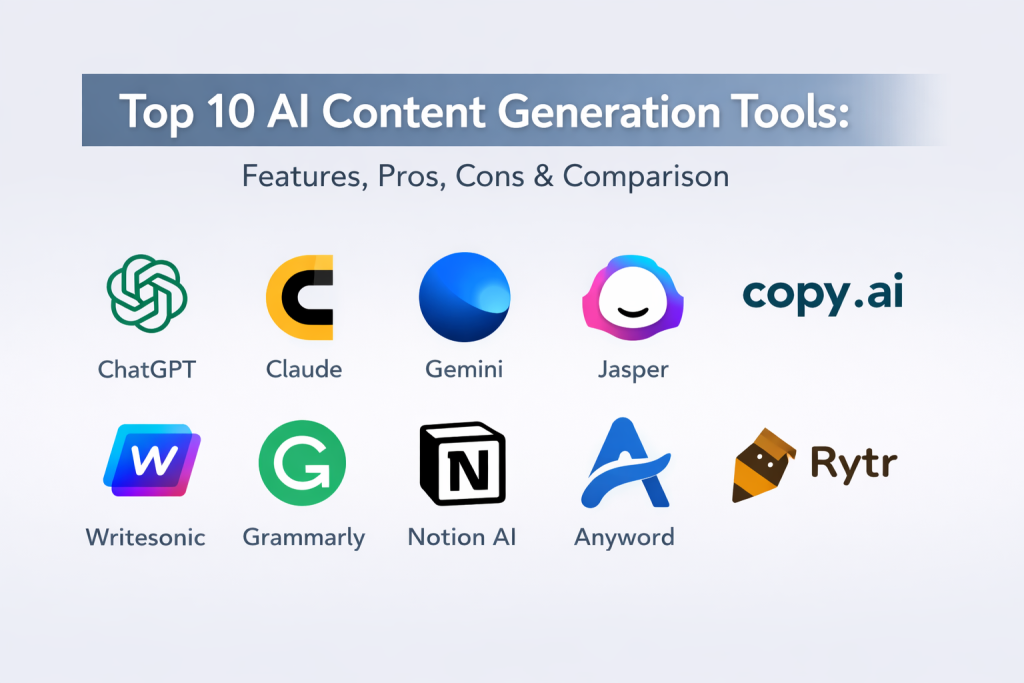
Top 10 AI Content Generation Tools
1. ChatGPT
ChatGPT is a widely used general-purpose AI assistant for writing, brainstorming, summarization, rewriting, and content drafting. It is popular with individuals and teams because it supports many content formats and allows iterative prompting for refinement.
Key Features
- Conversational drafting and rewriting workflows
- Long-form content generation support
- Brainstorming, outlining, and ideation assistance
- Tone and style adaptation based on prompts
- Summarization and transformation of existing text
- Broad use-case coverage across marketing and business writing
- Strong interactive editing workflow through follow-up prompts
Pros
- Very versatile across many content types and tasks
- Strong iterative workflow for refining drafts quickly
- Useful for both solo creators and team content preparation
Cons
- Output quality depends heavily on prompting and review
- Fact-checking and brand consistency still need human oversight
- Teams may need structured workflows for repeatable content quality
Platforms / Deployment
- Web / API / App
- Cloud
Security and Compliance
- Not publicly stated
Integrations and Ecosystem
ChatGPT is often used as a central drafting and ideation layer, then paired with editing, SEO, publishing, or workspace tools for final production.
- API integration for custom workflows
- Broad productivity and app ecosystem usage patterns
- Flexible content transformation workflows
- Strong compatibility with team editing pipelines
Support and Community
Very strong community awareness, extensive examples, and broad usage across industries. Team support experience depends on plan and deployment choice.
2. Claude
Claude is an AI assistant widely used for writing, summarization, research support, editing, and long-context content workflows. It is often chosen by users who want strong drafting quality, thoughtful rewriting, and document-based collaboration.
Key Features
- High-quality drafting and rewriting support
- Strong long-context document handling
- Summarization and structured writing workflows
- Tone shaping and style adaptation
- Brainstorming and content expansion support
- Useful for business writing and content planning
- Conversational editing with iterative refinement
Pros
- Strong writing quality for many professional use cases
- Helpful for long documents and content refinement
- Good balance of creativity and structured output
Cons
- Teams still need review processes for facts and brand consistency
- Workflow depth may vary depending on team tooling needs
- Pricing and packaging should be validated for scale use
Platforms / Deployment
- Web / API / App
- Cloud
Security and Compliance
- Not publicly stated
Integrations and Ecosystem
Claude is commonly used in writing and knowledge workflows that require long document context and iterative editing rather than template-only generation.
- API integration support
- Document-centric drafting and revision workflows
- Strong fit for content review and refinement loops
- Compatibility with broader editorial processes
Support and Community
Strong user adoption and growing ecosystem awareness. Community examples are common, and enterprise support should be reviewed by plan.
3. Gemini
Gemini is a general AI assistant used for content generation, rewriting, brainstorming, and business writing workflows. It is often selected by teams that want AI-assisted writing connected to broader workspace and productivity environments.
Key Features
- General-purpose writing and content drafting
- Idea generation and outline support
- Rewriting, summarization, and tone adaptation
- Productivity-oriented content workflows
- Multilingual support for broad writing use cases
- Useful for email, docs, and business content creation
- Conversational refinement for draft improvement
Pros
- Strong fit for teams already working in productivity ecosystems
- Good general-purpose writing coverage
- Useful for everyday business content generation tasks
Cons
- Content teams may still need specialized tools for brand workflows
- Output style consistency may require prompt templates
- Buyer should test quality for long-form marketing content needs
Platforms / Deployment
- Web / API / App
- Cloud
Security and Compliance
- Not publicly stated
Integrations and Ecosystem
Gemini is often most valuable when used inside productivity and workspace workflows where teams generate and revise content as part of daily operations.
- API and workspace integration potential
- Content drafting within productivity workflows
- Multiformat writing support
- Team-friendly day-to-day usage patterns
Support and Community
Broad awareness and strong visibility among business and productivity users. Support and admin capabilities vary by plan and environment.
4. Jasper
Jasper is a dedicated AI writing platform built for marketing teams, agencies, and content operations. It is commonly used for campaign copy, blogs, social content, and brand-aligned writing workflows.
Key Features
- Marketing-focused content generation workflows
- Blog, email, ad, and social copy support
- Brand voice and style guidance features
- Team collaboration and content workflow support
- Template-based content creation for common use cases
- Campaign-oriented writing workflows
- Enterprise-oriented content operations features
Pros
- Strong fit for marketing teams and agencies
- Useful templates and workflow structure for repeatable output
- Better alignment for brand-driven content production than generic chat-only tools
Cons
- May be more expensive than general-purpose tools for small teams
- Teams with simple needs may not use full workflow depth
- Output still requires human editorial review
Platforms / Deployment
- Web
- Cloud
Security and Compliance
- Not publicly stated
Integrations and Ecosystem
Jasper is designed for repeatable marketing production workflows and is often used as a core system for teams creating multi-channel content at scale.
- Marketing workflow integration support
- Team collaboration and approval-oriented usage
- Brand-oriented content production features
- Campaign content pipeline compatibility
Support and Community
Strong market visibility in AI writing and marketing operations. Vendor support and onboarding are key strengths for teams scaling content production.
5. Copy.ai
Copy.ai is an AI content generation platform focused on marketing copy, business writing, and workflow automation. It is widely used for fast content creation across ads, emails, landing-page messaging, and sales-related text.
Key Features
- Marketing and sales copy generation
- Template-driven writing for common business needs
- Workflow support for repeated content tasks
- Rewriting and message variation generation
- Campaign content drafting across channels
- Team-oriented content production support
- Automation-friendly content creation workflows
Pros
- Strong fit for fast marketing and sales copy creation
- Practical templates for common business writing tasks
- Useful for teams that need many content variations quickly
Cons
- Long-form editorial content may require extra refinement
- Brand consistency still depends on setup and review
- Teams needing deep editorial collaboration may compare alternatives
Platforms / Deployment
- Web
- Cloud
Security and Compliance
- Not publicly stated
Integrations and Ecosystem
Copy.ai is often used for high-volume message generation and campaign workflow support rather than deep editorial content planning alone.
- Workflow-oriented content creation support
- Team usage for campaign and sales messaging
- Reusable prompts and templates
- Automation-focused content generation patterns
Support and Community
Good adoption visibility in marketing and growth teams. Support and onboarding quality vary by plan and organization size.
6. Writesonic
Writesonic is an AI writing and content generation tool used for blog drafts, marketing copy, product descriptions, and business content workflows. It is often chosen by users who want an all-in-one writing assistant with broad template coverage.
Key Features
- AI writing for blogs and marketing copy
- Templates for ads, emails, and product content
- Rewriting and paraphrasing support
- Long-form content drafting workflows
- Business writing and productivity use cases
- Team usage support for content operations
- Multi-format content generation from prompts
Pros
- Good all-round option for mixed content needs
- Broad template coverage helps speed up drafting
- Useful for creators and smaller teams needing one main writing tool
Cons
- Output quality may vary by task and prompt quality
- Teams should validate long-form consistency for editorial workflows
- Advanced governance and brand controls may need evaluation
Platforms / Deployment
- Web / API
- Cloud
Security and Compliance
- Not publicly stated
Integrations and Ecosystem
Writesonic is often used as a multi-purpose writing layer for marketing and business teams creating content across several formats and channels.
- API and workflow integration potential
- Template-based production across content types
- Rewriting and drafting workflow support
- Broad business writing use-case coverage
Support and Community
Widely discussed among AI writing tool users. Practical onboarding is usually straightforward for small and mid-sized teams.
7. Grammarly
Grammarly is best known for writing improvement, grammar correction, and tone guidance, but it also supports AI-assisted drafting and rewriting workflows for business and everyday content. It is often chosen by teams that prioritize editing quality and consistency.
Key Features
- Grammar, spelling, and clarity improvement
- Tone adjustment and writing style assistance
- AI rewriting and drafting support
- Productivity-oriented writing workflows
- Team usage for writing consistency
- Cross-application writing assistance patterns
- Useful for editing and refinement in content pipelines
Pros
- Excellent for polishing and improving drafts
- Strong everyday writing workflow support
- Good complement to generation-first tools in editorial pipelines
Cons
- May be less specialized than dedicated marketing content platforms
- Teams needing campaign template depth may use companion tools
- Final content strategy and fact validation still require human review
Platforms / Deployment
- Web / App / Browser-based workflows
- Cloud
Security and Compliance
- Not publicly stated
Integrations and Ecosystem
Grammarly is often used as a refinement and quality-control layer after initial drafting in other tools, though it also supports direct AI-assisted writing.
- Cross-workflow writing assistance usage
- Editing and refinement pipeline support
- Team consistency and review support
- Productivity-oriented writing integration patterns
Support and Community
Very strong brand recognition and broad user familiarity. It is widely used across teams, including non-technical users.
8. Notion AI
Notion AI is an AI writing and productivity assistant integrated into a workspace platform used for notes, docs, wikis, and team collaboration. It is often selected by teams that want content generation directly inside their documentation and planning workflows.
Key Features
- Drafting and rewriting inside collaborative documents
- Summarization and action-oriented writing support
- Brainstorming and outline generation
- Team documentation and internal content assistance
- Integrated workflow with notes, docs, and project pages
- Useful for knowledge-base and internal writing tasks
- Collaborative editing-friendly AI support
Pros
- Strong fit for teams already using collaborative workspace tools
- Reduces copy-paste between writing and project documentation
- Useful for internal content, docs, and planning workflows
Cons
- May not match specialized marketing tools for campaign workflows
- Advanced brand content operations may require additional tools
- Output quality still depends on prompts and review
Platforms / Deployment
- Web / App
- Cloud
Security and Compliance
- Not publicly stated
Integrations and Ecosystem
Notion AI is most valuable when content generation is part of an ongoing team workflow that includes planning, documentation, and project collaboration.
- In-workspace writing and summarization workflows
- Team collaboration and knowledge management support
- Internal documentation content generation
- Project and content planning alignment
Support and Community
Strong adoption among startup and team collaboration users. Ease of adoption is usually high when teams already use the workspace platform.
9. Anyword
Anyword is an AI content generation platform focused on marketing performance, campaign copy, and conversion-oriented writing workflows. It is often considered by teams that want AI-assisted copy generation tied to marketing outcomes and message testing.
Key Features
- Marketing copy generation for ads and campaigns
- Performance-oriented message creation workflows
- Brand and audience-focused content variation support
- Template-driven content generation for common channels
- Team collaboration for campaign workflows
- Copy refinement and rewriting support
- Useful for conversion-focused content production
Pros
- Strong fit for performance marketing and ad copy teams
- Useful for rapid message variation and testing workflows
- Good option for teams optimizing conversion-oriented content
Cons
- Less broad than general-purpose assistants for all writing tasks
- Long-form editorial content may need companion tools
- Teams should validate fit for non-marketing use cases
Platforms / Deployment
- Web
- Cloud
Security and Compliance
- Not publicly stated
Integrations and Ecosystem
Anyword is best evaluated by marketing teams that need structured campaign copy generation and fast testing-oriented content workflows.
- Campaign content workflow support
- Audience and message variation generation
- Team collaboration in marketing operations
- Conversion-focused copy production patterns
Support and Community
Good visibility in performance marketing circles. Vendor onboarding and workflow setup are important for getting full value from the platform.
10. Rytr
Rytr is an AI writing tool focused on fast content generation for short-form and medium-length use cases such as emails, social posts, product descriptions, and basic blog drafting. It is often chosen by freelancers and small teams seeking affordability and simplicity.
Key Features
- AI writing for marketing and business content
- Templates for common copy formats
- Rewriting and tone adjustment support
- Blog idea and draft assistance
- Lightweight workflow for quick content production
- Multi-use writing support across channels
- Easy-start interface for non-technical users
Pros
- Easy to use and quick to adopt
- Good value for freelancers and smaller teams
- Practical for short-form and repetitive content tasks
Cons
- May not provide the same workflow depth as enterprise platforms
- Long-form content often needs more manual refinement
- Teams with advanced brand governance needs may need stronger tools
Platforms / Deployment
- Web
- Cloud
Security and Compliance
- Not publicly stated
Integrations and Ecosystem
Rytr fits best in lightweight content workflows where speed, simplicity, and affordability are more important than complex team operations or advanced campaign systems.
- Template-based writing workflows
- Fast draft and rewrite support
- Useful for solo creators and small teams
- Simple adoption for everyday content tasks
Support and Community
Popular among freelancers and smaller businesses. Documentation and onboarding are generally straightforward for first-time AI writing users.
Comparison Table (Top 10)
| Tool Name | Best For | Platform(s) Supported | Deployment | Standout Feature | Public Rating |
|---|---|---|---|---|---|
| ChatGPT | General-purpose content drafting, rewriting, and ideation | Web / API / App | Cloud | Highly flexible conversational writing workflow | N/A |
| Claude | Long-context writing, editing, and document refinement | Web / API / App | Cloud | Strong long-document drafting and revision support | N/A |
| Gemini | Productivity-oriented AI writing across business workflows | Web / API / App | Cloud | Broad general writing support with productivity workflow fit | N/A |
| Jasper | Marketing teams and brand-driven content operations | Web | Cloud | Marketing-focused templates and brand workflow support | N/A |
| Copy.ai | High-volume marketing and sales copy generation | Web | Cloud | Fast business copy and campaign workflow generation | N/A |
| Writesonic | All-round AI writing across blogs and marketing content | Web / API | Cloud | Broad template coverage for multi-format writing | N/A |
| Grammarly | Draft improvement, rewriting, and writing quality refinement | Web / App / Browser-based workflows | Cloud | Strong editing and writing quality assistance | N/A |
| Notion AI | Collaborative document-based content generation and summaries | Web / App | Cloud | AI writing directly inside team documentation workflows | N/A |
| Anyword | Performance marketing and conversion-focused copy generation | Web | Cloud | Campaign-oriented copy variation and optimization workflows | N/A |
| Rytr | Affordable and simple AI writing for freelancers and small teams | Web | Cloud | Quick-start template-driven writing for everyday content | N/A |
Evaluation and Scoring of AI Content Generation Tools
| Tool Name | Core (25%) | Ease (15%) | Integrations (15%) | Security (10%) | Performance (10%) | Support (10%) | Value (15%) | Weighted Total (0–10) |
|---|---|---|---|---|---|---|---|---|
| ChatGPT | 9.4 | 8.8 | 9.0 | 7.8 | 8.9 | 8.8 | 8.6 | 8.83 |
| Claude | 9.2 | 8.6 | 8.3 | 7.8 | 8.7 | 8.4 | 8.4 | 8.57 |
| Gemini | 8.9 | 8.5 | 8.8 | 7.9 | 8.6 | 8.4 | 8.5 | 8.55 |
| Jasper | 8.8 | 8.4 | 8.1 | 7.7 | 8.3 | 8.4 | 7.6 | 8.16 |
| Copy.ai | 8.5 | 8.6 | 7.8 | 7.4 | 8.2 | 8.0 | 8.0 | 8.11 |
| Writesonic | 8.4 | 8.5 | 7.9 | 7.3 | 8.1 | 7.9 | 8.2 | 8.07 |
| Grammarly | 8.2 | 9.2 | 8.2 | 7.8 | 8.5 | 8.7 | 8.1 | 8.42 |
| Notion AI | 8.0 | 8.9 | 8.4 | 7.7 | 8.2 | 8.3 | 8.2 | 8.24 |
| Anyword | 8.3 | 8.2 | 7.6 | 7.4 | 8.1 | 7.8 | 7.8 | 7.97 |
| Rytr | 7.8 | 8.8 | 7.0 | 7.1 | 7.8 | 7.6 | 8.8 | 7.98 |
How to interpret these scores:
- These scores are comparative and meant to support shortlisting, not to represent absolute benchmark results.
- A higher total does not mean one tool is the best for every content team.
- General-purpose assistants often score high on flexibility, while specialized tools score higher for marketing workflows or editing support.
- Value scores vary by team size and usage volume, so a tool that is excellent for freelancers may not be ideal for enterprise content operations.
- Always test your shortlisted tools with your real content types, tone requirements, and review process.
Which AI Content Generation Tool Is Right for You
1. Solo / Freelancer
If you are a solo creator, freelancer, or consultant, prioritize ease of use, affordability, and flexibility. ChatGPT is a strong all-round option for drafting and ideation. Rytr is useful for quick, budget-friendly content tasks. Grammarly is an excellent companion for polishing final drafts before delivery.
Recommended shortlist: ChatGPT, Rytr, Grammarly
2. SMB
SMB teams usually need speed, consistency, and broad template coverage without heavy setup. Writesonic and Copy.ai are strong options for mixed marketing content. ChatGPT is useful as a flexible drafting engine, while Notion AI can help if the team manages content inside collaborative documentation workflows.
Recommended shortlist: Writesonic, Copy.ai, ChatGPT, Notion AI
3. Mid-Market
Mid-market teams often need repeatable brand workflows, collaboration, and multi-channel output. Jasper is a strong fit for structured marketing operations. ChatGPT and Claude are valuable for high-quality draft creation and refinement. Anyword is especially useful when performance marketing copy and conversion-oriented testing are priorities.
Recommended shortlist: Jasper, ChatGPT, Claude, Anyword
4. Enterprise
Enterprise buyers should prioritize governance, team controls, integration fit, workflow standardization, and support quality. Jasper is often a strong candidate for marketing teams. ChatGPT, Claude, and Gemini are powerful general assistants for cross-functional content generation. Grammarly can play an important role as a quality and consistency layer across teams.
Recommended shortlist: Jasper, ChatGPT, Claude, Gemini, Grammarly
5. Budget vs Premium
- Budget-friendly and simple: Rytr
- Balanced and flexible: ChatGPT, Writesonic, Copy.ai
- Premium team and workflow focus: Jasper, Anyword
- Editing and quality layer value: Grammarly
- Workspace-integrated productivity value: Notion AI
If budget is limited, start with one flexible generation tool plus one editing-focused tool before adding specialized platforms.
6. Feature Depth vs Ease of Use
- Best flexibility: ChatGPT, Claude, Gemini
- Best marketing workflow depth: Jasper, Anyword, Copy.ai
- Best editing and refinement support: Grammarly
- Best embedded team documentation workflow: Notion AI
- Best quick-start simplicity: Rytr
Choose based on how your team actually creates content each day, not only on feature lists.
7. Integrations and Scalability
If your team needs high-volume workflows, repeatable prompts, approvals, and multi-user collaboration, prioritize Jasper, Copy.ai, Anyword, and ChatGPT API-based workflows. If your content work happens inside documentation systems, Notion AI can reduce friction and improve adoption.
8. Security and Compliance Needs
For sensitive content or enterprise workflows, confirm these during evaluation:
- User roles and permissions
- Identity and sign-in controls
- Data retention and deletion options
- Admin controls and team governance features
- Audit and review workflow support
- Integration controls for internal systems
If content includes regulated, confidential, or customer-sensitive information, involve security and legal stakeholders early.
Frequently Asked Questions
1. What is an AI content generation tool?
An AI content generation tool helps create drafts, rewrites, summaries, and variations of text from prompts or source material. It can support blogs, emails, ads, social posts, and business writing workflows.
2. Are AI content generation tools only for marketers?
No. They are used by marketers, founders, sales teams, support teams, product teams, educators, and internal operations teams for many writing tasks.
3. Can AI content tools write full blog posts by themselves?
They can generate strong drafts, but most teams still need human review for facts, tone, examples, and final editing. Best results usually come from collaboration between human writers and AI tools.
4. Which tool is best for general-purpose writing?
ChatGPT, Claude, and Gemini are strong general-purpose choices because they support many writing styles and iterative prompt-based refinement.
5. Which tool is best for marketing teams and campaigns?
Jasper, Copy.ai, and Anyword are often strong candidates for marketing workflows, especially when teams need templates, repeatable output, and campaign-focused content variations.
6. Do I still need an editor if I use AI writing tools?
Yes, in most cases. AI can accelerate drafting and rewriting, but human editing is still important for accuracy, brand voice, compliance, and final polish.
7. What is the biggest mistake when choosing an AI content tool?
A common mistake is choosing based only on generated sample quality. Teams should also evaluate workflow fit, collaboration, review process, integrations, and cost at scale.
8. Can I use more than one AI content generation tool?
Yes. Many teams use one tool for drafting, another for editing, and another for team collaboration or campaign workflows. A mixed setup can improve quality and efficiency.
9. How should I test these tools before buying?
Create a short pilot using your real content types, tone guidelines, and review process. Compare output quality, editing effort, speed, and usability across a few shortlisted tools.
10. Are AI content tools safe to use for confidential information?
That depends on the tool, plan, and your internal policies. Always review admin controls, data handling settings, and governance requirements before using confidential or sensitive information.
Conclusion
AI content generation tools can dramatically speed up drafting, rewriting, and content operations, but the best tool depends on your workflow, team structure, and quality standards. Some teams need flexible general assistants for many writing tasks, while others need marketing-focused platforms with templates, brand controls, and repeatable campaign workflows. Editing-focused tools can also add major value by improving clarity and consistency across drafts. The most reliable path is to shortlist a few tools that match your real use cases, run a structured pilot, and choose the combination that improves both speed and content quality in day-to-day work.

Best Cardiac Hospitals Near You
Discover top heart hospitals, cardiology centers & cardiac care services by city.
Advanced Heart Care • Trusted Hospitals • Expert Teams
View Best Hospitals