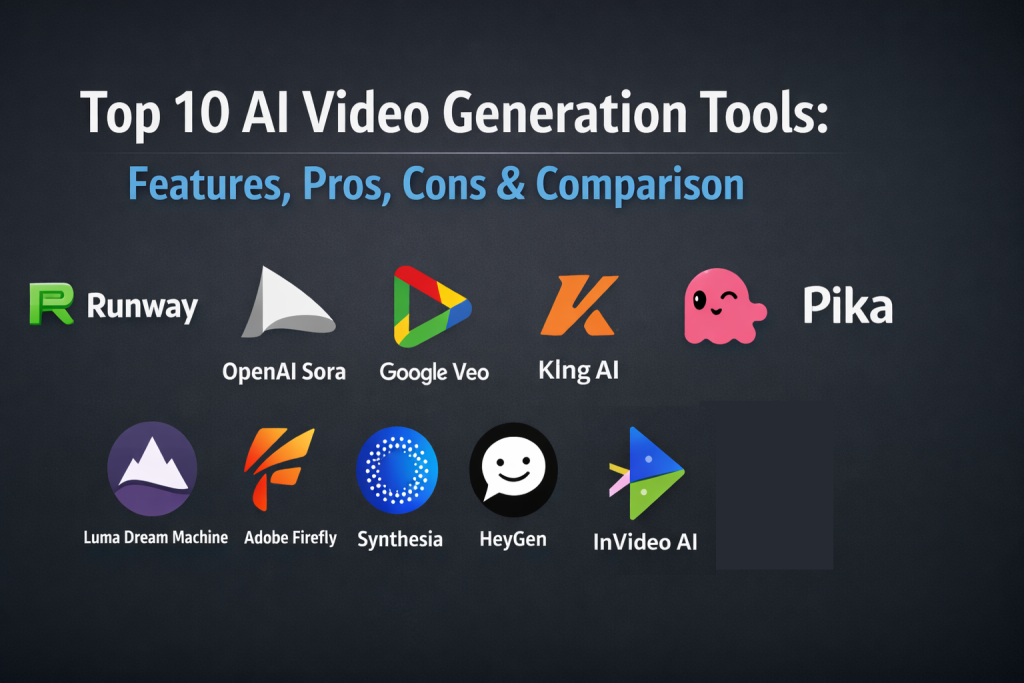
Introduction
AI video generation tools help users create videos from text prompts, images, scripts, avatars, and editing instructions. In simple terms, these tools reduce the time and effort needed to produce visual content by automating parts of scripting, scene creation, motion generation, voiceover, avatars, and editing. Instead of building every video manually from scratch, teams can generate first drafts quickly and then refine them for production use.
These tools are now used across marketing, social media, training, e-learning, product demos, creative storytelling, internal communications, and customer support. Choosing the right tool is not only about visual quality. Teams also need to evaluate control, speed, editing flexibility, avatar quality, workflow integration, collaboration, and cost.
Common use cases include:
- Social media video creation and repurposing
- Product demos and promotional videos
- Training and e-learning videos
- Talking-avatar explainers and internal communications
- Creative concept videos and storyboards
- Marketing campaigns and ad variations
What buyers should evaluate before selecting a tool:
- Output quality and motion realism
- Prompt control and editability
- Avatar quality and voice options
- Text-to-video and image-to-video support
- Speed and rendering time
- Templates and workflow features
- Collaboration and approval workflows
- API and automation options
- Commercial usage fit and governance controls
- Pricing model and scaling cost
Best for: marketers, creators, agencies, product teams, educators, training teams, and businesses that need faster video production at scale.
Not ideal for: teams that need fully finished cinema-grade output without human review, or users with very occasional video needs who can rely on traditional editing tools only.
Key Trends in AI Video Generation Tools
- Generative video tools and AI video editors are increasingly merging into all-in-one workflows.
- Text-to-video is now commonly paired with image-to-video, scene extension, and editing features.
- Avatar-based business video platforms continue to grow for training, onboarding, and multilingual communication.
- Teams are using multiple tools together for scripting, generation, editing, and publishing instead of one tool only.
- Motion quality, character consistency, and style control are becoming major selection factors.
- Video generation tools are adding workflow templates and team collaboration to support marketing operations.
- API-based generation is expanding for automation, internal content pipelines, and product features.
- Commercial usage confidence and review workflows are becoming more important for businesses.
- Cost control matters more as teams scale from experimentation to regular production.
- Buyers are separating creative ideation tools from repeatable business video production tools.
How We Selected These Tools (Methodology)
- Chose widely recognized AI video generation tools with strong creator, business, or developer adoption.
- Included a mix of creative video generators, avatar-led video tools, and business content video platforms.
- Prioritized tools with strong visibility, practical usability, and broad workflow relevance.
- Considered use cases across marketing, storytelling, social content, and training videos.
- Evaluated workflow fit, including ease of use, templates, editing support, and collaboration potential.
- Considered API and automation possibilities where relevant.
- Included both beginner-friendly and advanced creative options.
- Avoided guessing on public ratings, certifications, or compliance claims when not clearly known.
- Focused on practical buying criteria such as output quality, speed, and operational fit.
- Used comparative scoring to help shortlist tools by scenario and team size.
Top 10 AI Video Generation Tools
1. Runway
Runway is a widely used AI video generation platform for creative teams, filmmakers, and marketers who want text-to-video, image-to-video, and editing-focused workflows in one environment. It is often chosen for high creative control and production experimentation.
Key Features
- Text-to-video and image-to-video generation
- Video editing and generative transformation workflows
- Creative controls for style, motion, and scene variation
- Useful for storyboarding, concept videos, and marketing assets
- Fast iteration for visual ideas and drafts
- Workflow support for teams and creative production
- Broad use-case coverage for creators and studios
Pros
- Strong creative control for generative video workflows
- Good fit for filmmakers, agencies, and visual experimentation
- Useful balance of generation and editing features
Cons
- Can require practice to get consistent business-style outputs
- Costs and credits should be monitored for high-volume usage
- Final production videos still benefit from manual editing
Platforms / Deployment
- Web
- Cloud
Security and Compliance
- Not publicly stated
Integrations and Ecosystem
Runway is often used as a creative generation layer and then combined with editing, sound, and publishing tools for final production workflows.
- Creative production workflow support
- Team-oriented video iteration patterns
- Prompt and asset-driven generation workflows
- Useful companion to post-production tools
Support and Community
Strong creator adoption and broad community visibility. Learning resources and examples are widely shared by users and production teams.
2. OpenAI Sora
OpenAI Sora is an AI video generation tool focused on creating videos from prompts and visual instructions. It is commonly considered by teams and creators looking for strong generative storytelling potential and iterative video ideation.
Key Features
- Prompt-based video generation workflows
- Visual scene generation from natural language instructions
- Creative iteration through prompt refinement
- Useful for concept storytelling and campaign ideation
- Broad style and scene coverage for draft production
- Image and prompt-driven experimentation support
- Strong general-purpose generative video use cases
Pros
- Strong potential for narrative and concept-driven video generation
- Useful for fast visual ideation and creative exploration
- Good fit for teams already using conversational AI workflows
Cons
- Teams should validate output consistency for production campaigns
- Advanced editing and pipeline needs may require companion tools
- Final outputs typically need review and refinement
Platforms / Deployment
- Web / App-integrated workflows
- Cloud
Security and Compliance
- Not publicly stated
Integrations and Ecosystem
OpenAI Sora is often used for ideation and visual draft generation, especially where teams want prompt-based workflows connected to broader AI-assisted content processes.
- Conversational prompt refinement workflows
- Broad creative ideation use cases
- Useful for content and concept teams
- Often paired with editing and publishing tools
Support and Community
Strong awareness and high interest across creators and AI users. Community discussion and experimentation patterns are widespread.
3. Google Veo
Google Veo is an AI video generation model and workflow option used for prompt-based video creation and advanced visual generation scenarios. It is often evaluated by teams prioritizing high-quality output and strong generative video capabilities.
Key Features
- Text-to-video generation for creative and business use cases
- Strong visual quality focus for generated scenes
- Prompt-based motion and scene control workflows
- Useful for concept videos and marketing ideation
- Multi-scene generation possibilities depending on workflow access
- Broad use across creative experimentation and prototype production
- Integration potential within broader AI workflows
Pros
- Strong visual generation capabilities for prompt-based workflows
- Good option for teams testing advanced generative video quality
- Useful for concept creation and campaign ideation
Cons
- Access and workflow availability may vary
- Teams should validate production fit and editing workflow compatibility
- Final outputs often require post-production refinement
Platforms / Deployment
- Web / API-integrated workflows (varies)
- Cloud
Security and Compliance
- Not publicly stated
Integrations and Ecosystem
Google Veo is often evaluated as a high-end generative video component rather than a complete publishing workflow, so teams may combine it with editing and collaboration tools.
- Prompt-based video generation workflows
- Integration potential within broader AI stacks
- Useful for prototype and concept video generation
- Often paired with production editing tools
Support and Community
Strong interest and visibility in AI video discussions. Practical adoption experience depends on access path and workflow availability.
4. Kling AI
Kling AI is a generative video tool known for prompt-based video creation and strong visual output in many creator workflows. It is often chosen by users looking for high-impact visuals and competitive quality for text-to-video and image-to-video tasks.
Key Features
- Text-to-video and image-to-video generation
- Prompt-based scene and motion creation
- Strong visual quality for creative clips
- Fast iteration for social and campaign ideation
- Useful for stylized and cinematic concept drafts
- Creator-friendly generation workflows
- Broad interest for short-form video production experiments
Pros
- Strong visual results in many creative use cases
- Useful for fast concept generation and short-form assets
- Good option for creators comparing quality-focused generators
Cons
- Workflow consistency should be validated for team production use
- Advanced editing and collaboration may require companion tools
- Output control can depend on prompt quality and iteration time
Platforms / Deployment
- Web / App
- Cloud
Security and Compliance
- Not publicly stated
Integrations and Ecosystem
Kling AI is often used for visual draft generation and creative experimentation, then paired with editing and publishing tools for final production.
- Prompt-driven creative workflows
- Short-form video ideation support
- Useful for marketing and creator experimentation
- Complements external editing pipelines
Support and Community
Growing visibility and strong interest among AI video creators. Community examples are common for prompt and quality comparisons.
5. Pika
Pika is an AI video generation tool popular for fast creative video creation, effects-style transformations, and social-friendly visual experimentation. It is often used by creators and marketers who want quick, engaging video outputs with simple workflows.
Key Features
- Text-to-video and image-to-video workflows
- Fast creative effects and transformations
- Social-friendly short-form video generation
- Prompt-based visual experimentation
- Easy iteration for content ideas and concepts
- Useful for marketing and creator workflows
- Accessible interface for rapid generation
Pros
- Fast and approachable for creative video experiments
- Good fit for short-form and social content ideation
- Useful for marketers and creators needing quick iterations
Cons
- Teams needing advanced production control may need other tools
- Long-form consistency and detailed scene control can vary
- Final campaign assets may require additional editing
Platforms / Deployment
- Web / App
- Cloud
Security and Compliance
- Not publicly stated
Integrations and Ecosystem
Pika is often used early in the content creation process for ideation and visual experimentation before final assembly in editing software.
- Fast prompt-based concept generation
- Social and creator workflow compatibility
- Short-form video experimentation support
- Useful companion to editing tools
Support and Community
Strong creator visibility and wide experimentation usage. Easy onboarding is a common reason users test it.
6. Luma Dream Machine
Luma Dream Machine is an AI video generation tool used for creating visually rich, prompt-based video clips and creative concept sequences. It is often selected for brainstorming, mood-driven visuals, and cinematic-style experimentation.
Key Features
- Text-to-video and image-to-video generation
- Strong visual style and motion experimentation workflows
- Useful for concept videos and creative ideation
- Fast generation for storyboard and mood exploration
- Prompt-based scene creation and refinement
- Creator-friendly interface for visual drafts
- Broad appeal for artistic and branded concept work
Pros
- Strong for visual ideation and mood-driven concepts
- Useful for creators and teams exploring cinematic styles
- Good option for early-stage campaign visual development
Cons
- Teams needing strict production consistency should test carefully
- Advanced editing and team workflow features may require companions
- Final videos usually need review and post-production polishing
Platforms / Deployment
- Web
- Cloud
Security and Compliance
- Not publicly stated
Integrations and Ecosystem
Luma Dream Machine is often used as a creative draft generator for concept sequences, then combined with editing, sound, and design tools for final output.
- Prompt-driven concept video generation
- Strong creative ideation workflow support
- Useful for agencies and visual teams
- Complements post-production and editing tools
Support and Community
Strong visibility among AI video creators and visual artists. Community examples are helpful for prompt exploration and style discovery.
7. Adobe Firefly
Adobe Firefly includes AI video generation capabilities within a broader creative production ecosystem and is often chosen by design and marketing teams that want generation inside professional editing and design workflows.
Key Features
- Text-to-video and image-to-video generation workflows
- Integration with broader creative production tools
- Video generation plus editing-oriented workflow fit
- Useful for marketing and design team collaboration
- Prompt-based visual creation with follow-up refinement
- Business-focused creative production support
- Practical for content operations and campaign workflows
Pros
- Strong fit for teams already using creative production tools
- Good workflow alignment for marketing and design operations
- Useful when generation and editing happen in connected systems
Cons
- Teams outside design ecosystems may not use full value
- Feature depth and workflow fit should be tested by use case
- Final production quality still depends on review and editing process
Platforms / Deployment
- Web / App-integrated workflows
- Cloud
Security and Compliance
- Not publicly stated
Integrations and Ecosystem
Adobe Firefly is strongest in production-oriented workflows where video generation is part of a larger creative pipeline with editing and asset management.
- Creative production workflow integration
- Marketing and design team compatibility
- Prompt-to-edit video workflow support
- Useful for repeatable content operations
Support and Community
Strong brand visibility and enterprise creative adoption. Team support experience depends on product plan and workflow setup.
8. Synthesia
Synthesia is an AI video generation platform focused on avatar-led business videos for training, onboarding, internal communication, and explainers. It is widely used by organizations that need scalable presenter-style video production.
Key Features
- AI avatar video generation for business communications
- Script-to-video workflows for explainers and training
- Multilingual voice and localization-oriented workflows
- Template-based video creation for repeatable formats
- Team collaboration and business use-case support
- Useful for e-learning and internal communications
- Efficient production of presenter-led content at scale
Pros
- Excellent for business training and explainer video workflows
- Strong repeatability for teams producing many videos
- Good option for multilingual and presenter-style content
Cons
- Less suited for cinematic creative storytelling workflows
- Visual style is more structured than open creative generators
- Teams needing deep custom motion control may use companion tools
Platforms / Deployment
- Web
- Cloud
Security and Compliance
- Not publicly stated
Integrations and Ecosystem
Synthesia is best for organizations that need repeatable business video workflows rather than pure creative experimentation.
- Script-to-video workflow support
- Team collaboration for training and communications
- Template-based production patterns
- Useful for enterprise content operations
Support and Community
Strong business adoption and good visibility in training and communication workflows. Vendor onboarding and support are often important for larger teams.
9. HeyGen
HeyGen is an AI video generation platform known for avatar-led videos, presenter workflows, and business content creation. It is often used by marketing, sales, and training teams that want fast talking-head style video production.
Key Features
- Avatar-based video generation workflows
- Script-driven presenter video creation
- Marketing and training video use-case support
- Voice and localization-friendly workflows
- Template-based production for repeatable formats
- Team collaboration and business workflow support
- Fast generation for product, sales, and internal videos
Pros
- Strong fit for presenter-style business content
- Useful for marketing, sales, and training teams
- Fast production of repeatable talking-avatar videos
Cons
- Less suitable for cinematic scene generation than creative video tools
- Teams needing advanced visual storytelling may need companion tools
- Final output style depends on template and avatar workflow choices
Platforms / Deployment
- Web / App
- Cloud
Security and Compliance
- Not publicly stated
Integrations and Ecosystem
HeyGen is often used for scalable business video workflows where speed, repeatability, and multilingual communication are more important than cinematic control.
- Script-to-avatar production workflows
- Marketing and sales video support
- Team-friendly repeatable video creation
- Useful for business communication pipelines
Support and Community
Strong adoption visibility in business video creation. Onboarding is typically straightforward for non-technical teams and marketers.
10. InVideo AI
InVideo AI is an AI video generation tool focused on turning prompts into marketing, social, and explainer videos with templates and automated content assembly workflows. It is often chosen by creators and businesses that want speed and ready-to-publish formats.
Key Features
- Prompt-to-video generation for social and marketing content
- Template-driven video creation workflows
- Automated scene assembly and script support
- Useful for promo videos, explainers, and short-form content
- Editing-friendly workflow for fast revisions
- Broad content format support for business teams
- Easy-start interface for creators and marketers
Pros
- Strong fit for fast marketing and social video production
- Useful templates reduce manual editing effort
- Good option for small teams needing rapid output
Cons
- Creative control may be less flexible than advanced generative tools
- Highly branded production workflows may need extra manual refinement
- Teams requiring cinematic realism may compare other generators
Platforms / Deployment
- Web / App
- Cloud
Security and Compliance
- Not publicly stated
Integrations and Ecosystem
InVideo AI is often used for high-volume business and social content workflows where template support and speed matter more than deep generative control.
- Prompt-to-template video workflows
- Social and marketing content production support
- Fast revision and output iteration
- Useful for small teams and creators
Support and Community
Broad business and creator visibility with practical onboarding. It is commonly evaluated by teams focused on fast publishing workflows.
Comparison Table (Top 10)
| Tool Name | Best For | Platform(s) Supported | Deployment | Standout Feature | Public Rating |
|---|---|---|---|---|---|
| Runway | Creative generative video and editing-oriented workflows | Web | Cloud | Strong creative control for text-to-video and image-to-video | N/A |
| OpenAI Sora | Prompt-based concept storytelling and video ideation | Web / App-integrated workflows | Cloud | Strong narrative-style generative video potential | N/A |
| Google Veo | High-quality prompt-based video generation experiments | Web / API-integrated workflows (varies) | Cloud | Strong visual quality focus for generative video | N/A |
| Kling AI | Quality-focused creative video clips and short-form ideation | Web / App | Cloud | Strong visual results for prompt-based video generation | N/A |
| Pika | Fast short-form creative video generation and effects workflows | Web / App | Cloud | Quick social-friendly video experimentation | N/A |
| Luma Dream Machine | Cinematic-style concept videos and mood-driven ideation | Web | Cloud | Strong visual ideation for creative concept sequences | N/A |
| Adobe Firefly | Design and marketing video generation inside creative workflows | Web / App-integrated workflows | Cloud | Video generation integrated with creative production workflows | N/A |
| Synthesia | Avatar-led business training and explainer videos | Web | Cloud | Scalable presenter-style business video production | N/A |
| HeyGen | Avatar-based marketing, sales, and training videos | Web / App | Cloud | Fast talking-avatar business video workflows | N/A |
| InVideo AI | Template-driven marketing and social video production | Web / App | Cloud | Prompt-to-video workflow with ready-to-publish templates | N/A |
Evaluation and Scoring of AI Video Generation Tools
| Tool Name | Core (25%) | Ease (15%) | Integrations (15%) | Security (10%) | Performance (10%) | Support (10%) | Value (15%) | Weighted Total (0–10) |
|---|---|---|---|---|---|---|---|---|
| Runway | 9.3 | 8.2 | 8.3 | 7.5 | 8.8 | 8.5 | 8.0 | 8.47 |
| OpenAI Sora | 9.1 | 8.4 | 8.0 | 7.5 | 8.7 | 8.3 | 8.0 | 8.37 |
| Google Veo | 9.2 | 7.8 | 8.1 | 7.6 | 8.9 | 8.1 | 7.7 | 8.32 |
| Kling AI | 8.9 | 8.2 | 7.4 | 7.2 | 8.6 | 7.9 | 8.3 | 8.13 |
| Pika | 8.4 | 8.8 | 7.2 | 7.1 | 8.2 | 8.0 | 8.4 | 8.04 |
| Luma Dream Machine | 8.7 | 8.3 | 7.4 | 7.2 | 8.4 | 8.0 | 8.1 | 8.08 |
| Adobe Firefly | 8.6 | 8.4 | 8.8 | 7.8 | 8.3 | 8.4 | 7.8 | 8.35 |
| Synthesia | 8.8 | 8.9 | 8.1 | 7.8 | 8.4 | 8.5 | 7.9 | 8.38 |
| HeyGen | 8.7 | 8.8 | 7.9 | 7.6 | 8.3 | 8.3 | 8.1 | 8.25 |
| InVideo AI | 8.3 | 8.9 | 7.7 | 7.3 | 8.1 | 8.1 | 8.5 | 8.11 |
How to interpret these scores:
- These scores are comparative and meant to support shortlisting, not benchmark test results.
- A higher score does not mean one tool is best for every team or video type.
- Creative video tools often score higher on visual flexibility, while avatar and template tools score higher on repeatability and ease of use.
- Value depends heavily on your video volume, review process, and whether you need cinematic control or business workflow speed.
- Always test shortlisted tools using your real scripts, prompts, and production workflow needs.
Which AI Video Generation Tool Is Right for You
1. Solo / Freelancer
If you are a freelancer, creator, or consultant, prioritize ease of use, visual quality, and flexible output. Runway is strong for creative experimentation and concept work. Pika is useful for fast social-friendly clips. InVideo AI can help when speed and templates matter more than deep manual editing.
Recommended shortlist: Runway, Pika, InVideo AI
2. SMB
SMB teams usually need fast production, repeatable workflows, and affordable scaling. InVideo AI is a strong fit for marketing and social video output. HeyGen is useful for presenter-style promos and internal communications. Adobe Firefly can be attractive when the team already works in a creative production ecosystem.
Recommended shortlist: InVideo AI, HeyGen, Adobe Firefly
3. Mid-Market
Mid-market teams often need a mix of creative quality and operational repeatability. Runway and Adobe Firefly are strong options for creative and marketing teams. Synthesia and HeyGen are excellent when training or presenter-style videos are a major use case. Luma Dream Machine can add value for concept and campaign ideation.
Recommended shortlist: Runway, Adobe Firefly, Synthesia, HeyGen, Luma Dream Machine
4. Enterprise
Enterprise buyers should prioritize governance, workflow controls, team collaboration, integration fit, and repeatability. Synthesia and HeyGen are strong for training, onboarding, and internal communications at scale. Adobe Firefly is often a strong candidate for design-led organizations. Runway may fit enterprise creative teams that need generative control and experimentation.
Recommended shortlist: Synthesia, HeyGen, Adobe Firefly, Runway
5. Budget vs Premium
- Budget-friendly and fast workflow value: InVideo AI, Pika
- Balanced creative and business value: Runway, HeyGen
- Premium creative production fit: Adobe Firefly, Runway
- Business training and localization value: Synthesia
- Advanced generative experimentation value: Google Veo, OpenAI Sora, Kling AI
If budget is limited, start with one generator for ideation and one business workflow tool for repeatable publishing.
6. Feature Depth vs Ease of Use
- Best creative depth: Runway
- Best prompt-based narrative experimentation: OpenAI Sora, Google Veo
- Best short-form speed and ease: Pika, InVideo AI
- Best avatar-led business workflows: Synthesia, HeyGen
- Best design workflow integration: Adobe Firefly
Choose based on your daily production style, not only on sample clip quality.
7. Integrations and Scalability
If your team needs repeatable operations, templates, and collaboration, prioritize Synthesia, HeyGen, InVideo AI, and Adobe Firefly. If your focus is creative ideation and advanced generative experimentation, Runway, OpenAI Sora, Google Veo, and Kling AI are stronger to evaluate first.
8. Security and Compliance Needs
For business and sensitive content workflows, confirm these during evaluation:
- User roles and permissions
- Admin controls and workspace governance
- Data retention and deletion options
- Identity and sign-in controls
- Review and approval workflow support
- Usage tracking and project access controls
If your videos include regulated or confidential information, involve security and legal stakeholders early.
Frequently Asked Questions
1. What is an AI video generation tool?
An AI video generation tool creates videos from prompts, scripts, images, or templates and can automate parts of scripting, scene generation, motion, avatars, and editing workflows.
2. Are AI video generation tools only for creative creators and filmmakers?
No. They are used by marketers, trainers, sales teams, support teams, educators, and internal communications teams in addition to creators and agencies.
3. Which tool is best for business training and avatar videos?
Synthesia and HeyGen are strong choices for avatar-led business videos, training content, and internal communications where repeatability matters.
4. Which tool is best for creative generative video and storytelling concepts?
Runway, OpenAI Sora, Google Veo, Kling AI, and Luma Dream Machine are often evaluated for creative prompt-based video generation and visual concept work.
5. Which tool is best for fast social media and marketing video creation?
InVideo AI and Pika are strong options for quick social-friendly videos and marketing drafts, especially for smaller teams and fast turnaround workflows.
6. Do I still need a video editor if I use AI video tools?
In most cases, yes. AI tools can speed up drafts and production, but human editing is still important for pacing, brand quality, audio polish, and final approval.
7. Can one AI video tool handle every use case?
Sometimes, but many teams use more than one. A common setup is one tool for creative generation and another for repeatable business or template-based production.
8. What is the biggest mistake when choosing an AI video generation tool?
A common mistake is choosing based only on sample video quality. Teams should also evaluate workflow fit, speed, editing effort, consistency, and operational cost.
9. How should I test AI video tools before buying?
Run a small pilot using your real scripts, prompts, and publishing formats. Compare output quality, revision effort, generation time, and team usability across a shortlist.
10. Are AI video generation tools safe for confidential business content?
That depends on the tool, plan, and your internal policy requirements. Review admin controls, data handling settings, and governance features before using sensitive content.
Conclusion
AI video generation tools can greatly improve the speed of video ideation, production, and repurposing, but the best choice depends on your workflow and business goals. Some teams need creative prompt-based video generation, while others need repeatable avatar-led training videos or fast template-driven social content. No single tool is ideal for every scenario. A practical strategy is to shortlist tools based on your primary use cases, test them with real scripts and prompts, and then choose the setup that gives your team the best balance of quality, speed, and operational simplicity.

Best Cardiac Hospitals Near You
Discover top heart hospitals, cardiology centers & cardiac care services by city.
Advanced Heart Care • Trusted Hospitals • Expert Teams
View Best Hospitals