Introduction
In the modern software ecosystem, the proliferation of specialized SaaS applications has created a fragmented landscape. Developers often find themselves writing and maintaining dozens of unique integrations for CRM, accounting, HRIS, and e-commerce platforms. API aggregators have emerged as a critical infrastructure layer to solve this “integration spaghetti” problem. By providing a single, unified API that maps to multiple underlying providers, these platforms allow engineering teams to build a single connection that instantly grants access to an entire category of software.
The strategic value of an API aggregator lies in its ability to normalize data structures and handle the heavy lifting of authentication, rate limiting, and webhooks across different vendors. Instead of spending months building individual connectors for every tool a customer might use, developers can leverage a unified schema. This acceleration of the product roadmap is essential for companies looking to scale their interoperability without exploding their maintenance costs or technical debt.
Best for: Product-led growth companies, B2B SaaS developers, and fintech startups that need to offer a wide array of native integrations to their end-users with minimal engineering overhead.
Not ideal for: Simple applications that only require a single, stable integration, or projects where the specific, non-standard features of a single vendor’s API are the primary requirement.
Key Trends in API Aggregators
- Unified Schema Expansion: Platforms are moving beyond simple data mapping to provide deep, bi-directional synchronization that maintains data integrity across hundreds of different third-party apps.
- Real-Time Webhook Orchestration: A shift toward centralized webhook management that transforms varying provider formats into a single, reliable stream for the developer.
- Security and Compliance at the Edge: Modern aggregators are incorporating advanced encryption and PII (Personally Identifiable Information) masking to ensure data remains secure as it passes through the proxy.
- AI-Driven Mapping: The use of machine learning to automatically map new provider fields to the unified schema, drastically reducing the time it takes to add support for new integrations.
- On-Premise and Private Cloud Deployment: For high-security sectors, aggregators are beginning to offer self-hosted versions to keep all integration traffic within the corporate firewall.
- Low-Code Integration Components: The rise of “embeddable” UI components that allow end-users to authenticate and manage their own integrations without the developer building a custom settings page.
- Advanced Error Handling and Retries: Sophisticated logic that automatically manages “flaky” third-party APIs, performing exponential backoffs and alerting developers only when a permanent failure occurs.
- Usage Analytics and Monitoring: Comprehensive dashboards that provide visibility into the health and performance of all active third-party connections in real-time.
How We Selected These Tools
- Breadth of Category Support: We prioritized platforms that cover essential business categories like CRM, HRIS, Accounting, Ticketing, and E-commerce.
- Developer Experience (DX): Each tool was evaluated based on the quality of its SDKs, the clarity of its unified documentation, and the ease of its authentication flow.
- Data Normalization Quality: We looked for aggregators that go beyond “pass-through” and actually provide a consistent, well-structured data model.
- Reliability and Uptime: Priority was given to platforms with a proven track record of high availability and transparent status reporting.
- Security Posture: Evaluation of enterprise-ready features such as SOC 2 compliance, data residency options, and secure credential handling.
- Scalability: The selection includes tools capable of handling high-volume synchronization and thousands of concurrent customer connections.
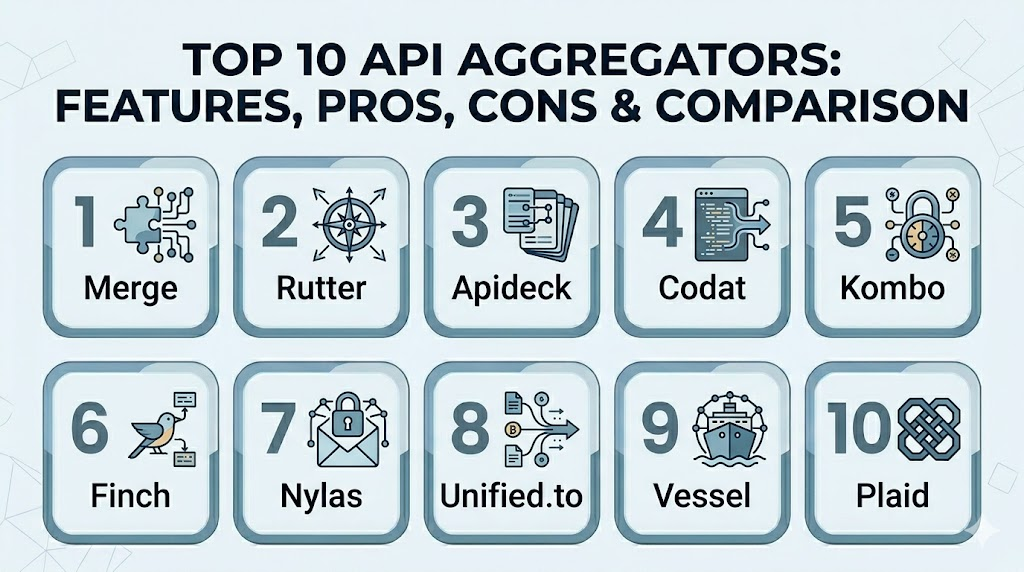
Top 10 API Aggregators
1. Merge
Merge is a leading unified API platform that specializes in B2B integrations. It offers a single API for categories like HRIS, ATS, CRM, Accounting, and Ticketing, allowing companies to launch hundreds of integrations in weeks.
Key Features
- Unified data models across 150+ different software integrations.
- Comprehensive “Integration Management” dashboard for monitoring sync health.
- Automated webhook normalization and delivery.
- Embeddable “Link” component for seamless user authentication.
- Advanced field mapping for handling non-standard data.
Pros
- Extremely high-quality documentation and developer support.
- Rapidly adds new integrations based on customer demand.
Cons
- Pricing can scale quickly as the number of linked accounts grows.
- The unified model may occasionally abstract away very niche provider features.
Platforms / Deployment
Web / Cloud
Cloud
Security & Compliance
SOC 2 Type II, HIPAA, and GDPR compliant.
SSO/SAML and data encryption at rest.
Integrations & Ecosystem
Connects to virtually all major business software including Salesforce, HubSpot, Workday, and QuickBooks.
Support & Community
Highly rated professional support and a strong community of B2B SaaS developers.
2. Rutter
Rutter provides a universal API for e-commerce, accounting, and payment platforms. It is widely used by fintech companies to access financial data from storefronts and back-office tools.
Key Features
- Unified schema for e-commerce platforms like Shopify, Amazon, and Walmart.
- Robust accounting integrations for Xero, QuickBooks, and NetSuite.
- Real-time data synchronization with customizable sync frequencies.
- Credential management and automated token refreshing.
- Detailed error logs for debugging integration failures.
Pros
- Strongest focus on the e-commerce and fintech sectors.
- Very reliable data normalization for complex financial records.
Cons
- Niche focus means it lacks HRIS or ATS support found in other tools.
- Initial setup can require careful mapping of financial categories.
Platforms / Deployment
Web / Cloud
Cloud
Security & Compliance
SOC 2 compliant and high-standard financial data encryption.
Not publicly stated.
Integrations & Ecosystem
Directly connects to major e-commerce engines and financial institutions.
Support & Community
Direct access to engineering support for enterprise clients.
3. Apideck
Apideck offers a “plug-and-play” integration experience. It provides a unified API and a suite of UI components that allow companies to build an “Integration Marketplace” inside their own app.
Key Features
- Unified APIs for CRM, HRIS, Lead Mapping, and Vault (Secret management).
- “Ecosystem Manager” for building white-labeled integration portals.
- Real-time webhooks with a single unified format.
- Built-in logging and observability tools for every API call.
- Support for “Proxy” mode to call the raw underlying API when needed.
Pros
- Excellent white-labeling capabilities for user-facing integration pages.
- Transparent and competitive pricing for mid-market companies.
Cons
- The library of supported apps is slightly smaller than some competitors.
- Some advanced workflow automations require additional configuration.
Platforms / Deployment
Web / Cloud
Cloud
Security & Compliance
GDPR compliant and ISO 27001 (Not publicly stated, but follows standards).
Secure vault for credential storage.
Integrations & Ecosystem
Strong coverage across sales and marketing tools.
Support & Community
Very responsive support and a growing developer documentation library.
4. Codat
Codat is the industry standard for small business data. It provides a single API to connect to the diverse accounting, banking, and commerce systems used by small and medium enterprises.
Key Features
- Deep synchronization with accounting software for pulling ledgers and invoices.
- Bank account connectivity for real-time transaction monitoring.
- Standardized data models for financial statements.
- Automatic handling of different tax codes and currencies.
- White-labeled authorization flow for business owners.
Pros
- Unrivaled depth in financial and accounting data accuracy.
- Used by major banks and lending institutions globally.
Cons
- Very specialized; not suitable for non-financial use cases.
- The API can be complex due to the nature of financial accounting.
Platforms / Deployment
Web / Cloud
Cloud
Security & Compliance
SOC 2 Type II and specialized financial data protection.
Not publicly stated.
Integrations & Ecosystem
Integrates with almost every major global accounting and banking platform.
Support & Community
Professional financial-grade support and extensive implementation consulting.
5. Kombo
Kombo is a European-focused API aggregator that excels in HRIS, ATS, and Payroll integrations. It is built specifically to handle the complexities of the European software landscape.
Key Features
- Unified API for 50+ European and global HR providers.
- Emphasis on GDPR compliance and data residency.
- Real-time webhooks and automated data cleaning.
- Embeddable UI for user authentication and setup.
- Custom field support for regional payroll requirements.
Pros
- Best-in-class support for local European HR and Payroll tools.
- Clean, developer-friendly API structure.
Cons
- Smaller footprint in the North American market.
- Focused primarily on HR-related categories.
Platforms / Deployment
Web / Cloud
Cloud
Security & Compliance
Strict GDPR compliance and EU-based data hosting.
Not publicly stated.
Integrations & Ecosystem
Strongest connections to tools like Personio, Datev, and HiBob.
Support & Community
Personalized support with deep knowledge of European software nuances.
6. Finch
Finch focuses exclusively on the “employment ecosystem,” providing a unified API for HRIS and Payroll. It allows applications to securely access employee data and manage payroll across various providers.
Key Features
- Read and write access to payroll and benefits systems.
- Automated deduction management and payroll execution.
- Unified employee directory and organizational chart data.
- Standardized pay stub and tax document retrieval.
- No-code onboarding for employers to link their accounts.
Pros
- One of the few aggregators that effectively handles “Write” actions for payroll.
- Essential for fintech and benefits administration companies.
Cons
- Limited strictly to HR and Payroll categories.
- Some legacy payroll systems have inherent sync delays.
Platforms / Deployment
Web / Cloud
Cloud
Security & Compliance
SOC 2 Type II and HIPAA compliant.
High-level data encryption and secure token handling.
Integrations & Ecosystem
Directly integrates with top payroll providers like ADP, Gusto, and Zenefits.
Support & Community
Professional support focused on the complexities of employment law and data.
7. Nylas
Nylas is the premier aggregator for communications data. It provides a single API for email, calendar, and contacts, normalizing data from providers like Google, Microsoft, and IMAP.
Key Features
- Unified API for sending/receiving emails and managing calendars.
- Real-time synchronization with high-volume communication streams.
- Neural API for extracting intent and data from email bodies.
- White-labeled authentication and hosted OAuth flows.
- Powerful scheduling components for embeddable calendars.
Pros
- The most robust solution for communication-heavy applications (CRMs, ATS).
- Handles the immense complexity of different calendar protocols seamlessly.
Cons
- Limited to communication data; does not cover HR or CRM categories.
- Can be expensive for high-volume email sync.
Platforms / Deployment
Web / Cloud
Cloud
Security & Compliance
SOC 2 Type II, HIPAA, and GDPR compliant.
Enterprise-grade security and data privacy.
Integrations & Ecosystem
Connects to all major email and calendar providers globally.
Support & Community
Excellent developer resources, SDKs in multiple languages, and a large user base.
8. Unified.to
Unified.to offers a massive range of categories, including CRM, HRIS, ATS, Authentication, and even E-commerce. It is designed for developers who want a single tool to handle every possible integration.
Key Features
- Support for over 20 different software categories.
- Unified webhooks and automated data transformation.
- Real-time monitoring and advanced API request logging.
- Custom object and field support for flexible data mapping.
- Simple, usage-based pricing model.
Pros
- The widest variety of supported software categories on this list.
- Very fast setup for developers who need to move quickly.
Cons
- The depth of data normalization in niche categories can vary.
- Newer entrant compared to established giants like Merge or Codat.
Platforms / Deployment
Web / Cloud
Cloud
Security & Compliance
Standard security protocols and data encryption.
Not publicly stated.
Integrations & Ecosystem
Massive library of connectors covering almost every B2B SaaS tool.
Support & Community
Active developer Discord and responsive technical support.
9. Vessel
Vessel is a unified CRM API designed specifically for the needs of sales and marketing software companies. It simplifies the process of syncing leads, contacts, and deals.
Key Features
- Unified data model for all major CRM platforms.
- High-performance “bulk” sync for large data migrations.
- Native support for custom CRM objects and fields.
- Built-in observability for tracking integration health.
- White-labeled auth component for a seamless user experience.
Pros
- Highly specialized for CRM data, ensuring high fidelity.
- Simple and predictable pricing structure.
Cons
- Does not support non-CRM categories.
- Smallest category footprint among the top aggregators.
Platforms / Deployment
Web / Cloud
Cloud
Security & Compliance
SOC 2 compliant and secure data handling.
Not publicly stated.
Integrations & Ecosystem
Focused on Salesforce, HubSpot, Pipedrive, and Zoho CRM.
Support & Community
Direct engineering support and straightforward documentation.
10. Linking (by Plaid)
While Plaid is known for banking, its “Linking” and data aggregation features serve as a primary API aggregator for the financial world, connecting apps to bank accounts and investment data.
Key Features
- Universal connection to thousands of financial institutions.
- Real-time balance and transaction verification.
- Standardized identity and asset verification data.
- Support for recurring payment authorization and ACH.
- High-security authentication flow used by millions.
Pros
- The global standard for financial data aggregation.
- Unbeatable institutional coverage.
Cons
- Limited to banking and investment data.
- Strict compliance and vetting process for new developers.
Platforms / Deployment
Web / Mobile / Cloud
Cloud
Security & Compliance
Bank-level security and various financial certifications.
SOC 2 Type II compliant.
Integrations & Ecosystem
The foundation of the modern fintech ecosystem, connecting to almost all banks.
Support & Community
Extensive documentation and a massive professional developer community.
Comparison Table
| Tool Name | Best For | Platform(s) Supported | Deployment | Standout Feature | Public Rating |
| 1. Merge | B2B SaaS / HRIS | Web, Cloud | Cloud | Massive Category Depth | N/A |
| 2. Rutter | E-commerce / Fintech | Web, Cloud | Cloud | Universal Storefront API | N/A |
| 3. Apideck | Ecosystem Builder | Web, Cloud | Cloud | Marketplace Components | N/A |
| 4. Codat | SMB Financial Data | Web, Cloud | Cloud | Accounting Accuracy | N/A |
| 5. Kombo | European HRIS | Web, Cloud | Cloud | GDPR/EU Expertise | N/A |
| 6. Finch | Payroll / Benefits | Web, Cloud | Cloud | Payroll Write Access | N/A |
| 7. Nylas | Email / Calendar | Web, Cloud | Cloud | Communication Sync | N/A |
| 8. Unified.to | Rapid Multi-Category | Web, Cloud | Cloud | Category Breadth | N/A |
| 9. Vessel | CRM Sales Tools | Web, Cloud | Cloud | CRM Specialization | N/A |
| 10. Plaid | Banking / Finance | Web, Mobile, Cloud | Cloud | Institutional Coverage | N/A |
Evaluation & Scoring
| Tool Name | Core (25%) | Ease (15%) | Integrations (15%) | Security (10%) | Perf (10%) | Support (10%) | Value (15%) | Total |
| 1. Merge | 10 | 9 | 10 | 9 | 9 | 9 | 7 | 8.95 |
| 2. Rutter | 9 | 8 | 8 | 9 | 9 | 8 | 8 | 8.45 |
| 3. Apideck | 8 | 9 | 8 | 8 | 8 | 8 | 9 | 8.20 |
| 4. Codat | 10 | 7 | 9 | 9 | 8 | 9 | 7 | 8.35 |
| 5. Kombo | 8 | 8 | 8 | 10 | 9 | 9 | 8 | 8.55 |
| 6. Finch | 9 | 7 | 8 | 9 | 8 | 8 | 7 | 7.85 |
| 7. Nylas | 10 | 8 | 9 | 9 | 9 | 9 | 7 | 8.65 |
| 8. Unified.to | 7 | 10 | 10 | 7 | 8 | 7 | 9 | 8.20 |
| 9. Vessel | 8 | 8 | 7 | 8 | 9 | 7 | 8 | 7.75 |
| 10. Plaid | 10 | 7 | 9 | 10 | 9 | 8 | 7 | 8.45 |
The scoring emphasizes the platform’s ability to maintain high data fidelity while managing a large number of diverse integrations. Merge and Nylas lead because they have mastered the most complex data categories (HR and Email) while providing top-tier developer experiences. For those prioritizing regional compliance, Kombo is a clear leader. Unified.to offers the highest “Ease” and “Value” scores for those needing many categories quickly, while Plaid remains the security and performance gold standard for financial data.
Which API Aggregator Tool Is Right for You?
Solo / Freelancer
If you are building a single integration or a small project, Unified.to or Apideck offer the lowest barrier to entry with simple setup and flexible pricing. These tools allow you to experiment with multiple integrations without a massive upfront commitment.
SMB
Small to medium businesses building a specific product, like a specialized CRM or an HR tool, should look at Merge or Vessel. These tools provide the reliability and documentation needed to support a growing customer base without needing a dedicated integration team.
Mid-Market
Companies that need to manage complex financial data for their customers should prioritize Codat or Rutter. These platforms offer the depth of data normalization required for professional accounting and e-commerce workflows.
Enterprise
Large enterprises with strict security requirements and global operations should look at Merge or Plaid. Their established security certifications and ability to handle massive volumes of data make them the most stable choice for high-stakes environments.
Budget vs Premium
Unified.to provides the most integrations for the lowest cost, making it the budget leader. Merge and Codat are premium solutions that command a higher price but offer deeper data modeling and more extensive professional support.
Feature Depth vs Ease of Use
Merge and Codat offer the most feature depth but require more time to fully map your data. Apideck and Unified.to are focused on ease of use, allowing you to get an integration marketplace live in a fraction of the time.
Integrations & Scalability
For high-volume communication sync (millions of emails), Nylas is the only scalable choice. For HR and CRM at scale, Merge provides the most robust infrastructure for handling thousands of linked accounts.
Security & Compliance Needs
If your primary concern is European data residency and GDPR, Kombo is the standout choice. For banking-level security in the US, Plaid and Merge provide the most comprehensive compliance frameworks.
Frequently Asked Questions (FAQs)
1. What is an API Aggregator?
It is a platform that connects to multiple third-party APIs in a specific category and provides a single, unified API for a developer to use, simplifying the integration process.
2. How do API Aggregators handle authentication?
Most platforms provide a white-labeled UI component that the end-user uses to log in. The aggregator then manages the OAuth tokens and refreshes them automatically.
3. Does using an aggregator slow down my application?
While there is a slight proxy overhead, most professional aggregators are highly optimized and have a negligible impact on overall performance compared to the benefits of normalized data.
4. What happens if a third-party API goes down?
Aggregators have built-in retry logic and will alert you through webhooks or dashboards. They often provide cached data so your app can stay functional during minor outages.
5. Are API Aggregators secure?
Yes, top-tier aggregators use enterprise-grade encryption and are SOC 2 compliant. They act as a secure vault for your users’ credentials so you don’t have to store them.
6. Can I still access the “raw” data from the provider?
Most aggregators offer a “proxy” or “passthrough” mode that allows you to call the original API directly through their secure connection for niche features.
7. How much do these platforms typically cost?
Pricing is usually based on the number of “linked accounts” (your customers’ connections). It can range from a free tier for developers to several thousand dollars a month for enterprise.
8. Do I need an aggregator if I only integrate with Salesforce?
Probably not. If you only need one integration, it is usually better to build it directly. Aggregators are most valuable when you need to support five or more tools in the same category.
9. What is “Data Normalization”?
It is the process of taking different data formats from multiple sources (like Salesforce and HubSpot) and turning them into one consistent format for your application to read.
10. Can aggregators handle “write” actions or just “read”?
Most modern aggregators support bi-directional sync, meaning you can both pull data from and push data to the third-party platforms.
Conclusion
API aggregators have shifted from a “nice-to-have” to a fundamental requirement for modern SaaS development. By abstracting the complexity of the ever-growing integration landscape, these tools allow engineering teams to focus on their core product rather than the maintenance of third-party connections. Choosing the right aggregator depends on the specific categories of software you need to support and the depth of data fidelity your application requires. As the market continues to consolidate and mature, these platforms will only become more essential for any company that wants to compete in an interconnected digital world.

Best Cardiac Hospitals Near You
Discover top heart hospitals, cardiology centers & cardiac care services by city.
Advanced Heart Care • Trusted Hospitals • Expert Teams
View Best Hospitals